>

Martyred for the Gospel

Martyred for the Gospel
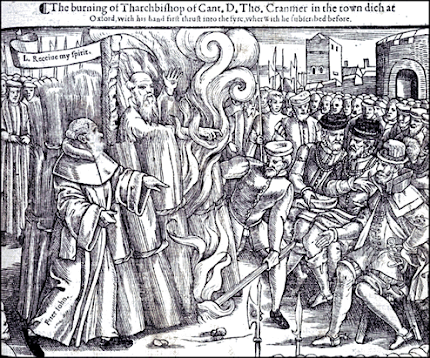
The burning of Tharchbishop of Cant. D. Tho. Cranmer in the town dich at Oxford, with his hand first thrust into the fyre, wherwith he subscribed before. [Click on the picture to see Cranmer's last words.]

Daily Bible Verse

Saturday, December 31, 2011

There is no hiding with LSD | Sue Blackmore | Comment is free | guardian.co.uk

Magical thinking and superstitution seems to dominate the postmodern world. With the collapse of modernism and confidence in knowledge as something definite and definable following the Renaissance, postmodernists advocate taking LSD trips to escape reality in order to deal with reality. Such nonsense is similar to getting drunk only to sober up and realize that not only did getting drunk not solve anything but in fact made matters worse.

Having done psychedelic drugs myself in the late 1970's and early 1980's I can tell you that the only insight I gained was that drugs can make you high, make you feel good when you're on a good trip, and that your problems are not solved when you come down. And to top all that off the normal emotions and fears you experience in everyday life are magnified by a thousand or more. Bad trips and overdoses are also a possibility. How do you know how much LSD you're getting? There is no constant dosage nor is there a way to measure what dosage of LSD you're going to receive.

Psychedelic mushrooms can be controlled better since they are handpicked and you can know how many mushrooms you put into the brew. But even here the dosage is unpredictable and overdosing is a real possibility.

The short of it is that those advocating the experimental or even spiritual use of psychedelic drugs are not only advocating breaking the law but they are advocating a dangerous activity that could have devastating and catastrophic results. While mysticism and pagan religion might seem to be the answer, logical and reasonable examination of ineffable experiences are impossible. Therefore to say that ineffable experience somehow contributes to one's mental or spiritual health is irrational at best and superstitious at worst.

The Christian worldview is not one of mysticism or ecstatic visions, although the Bible does record such experiences in the inerrant record of God's revelation to man. The problem is that direct revelation from God to individuals would negate the one revelation that is the infallible and inerrant word of God to man in written form. Mysticism essentially makes revelation from God a moot point since revelation would then be nothing more than some indescribable LSD trip without rational or propositional content. God's objective revelation in the written Scriptures would be unnecessary if direct revelation to individuals were the norm. Individual revelations would be essentially relative to each individual person and there could then be no objective standard for Christian doctrine or for individual belief.

The Word of God makes it clear that Scripture is rational and that God the Son is Himself the very being and essence of logic and reason since He is called the Logos. (See John 1:1 KJV and John 1:1 NA27). Irrationalism and existentialism is the way of paganism and superstition and atheism. It is not part of the Christian worldview at all. The influence of the charismatic movement and pentecostalism coupled with neo-orthodoxy and an attack on the propositional logic of divine revelation in written form has undermined not only the Christian worldview but the very foundations of western civilization. If there is no objective revelation from God to man, then all other forms of knowledge collapses. That would include philosophy, science, the arts, and natural law. Without divine revelation, according to Gordon H. Clark's apologetics, there can be no genuine knowledge at all.

Click here to read the article in question: There is no hiding with LSD | Sue Blackmore | Comment is free | guardian.co.uk


Friday, December 30, 2011

Catholics Come Home? | Christianity Today | A Magazine of Evangelical Conviction

A self professing "Calvinist" Evangelical pastor over at Christianity Today, Chris Castaldo, gives a word of warning to the Inquisitors of the come home to the synagogue of satan campaign:
From this historical example, my encouragement to Catholics pursuing the New Evangelization is to remain positive. While there will necessarily be moments of defining yourself over and against Protestants, don't let this become your modus operandi. Unfortunately, this negative trend seems to have already started in some of the above-mentioned apostolates. Even the Catholics Come Home site, in the "Answering Your Questions" section, has some content that is, shall we say, less than winsome. It's one thing to express disagreement with Protestants; it's quite another to portray them as morons.


Odd, but in this article Castaldo never once mentions the Council of Trent, justification by faith alone or the other four solas of the Protestant Reformation. Of course being a good "ecumenical" Evangelical means not damning your Roman Catholic "brethren" to hell or evangelizing them. But it's quite alright for Roman Catholics to evangelize Protestants. This sort of "tolerant" Evangelicalism is really liberalism and theological relativism in disguise. The Scriptures make it clear that there are more issues than simply Roman Catholic tradition being placed on the same level as biblical revelation. A consistent Calvinism cannot be "Evangelical" in the sense advocated by Chris Castaldo. Like most Evangelicals Castaldo is naive. He thinks that Roman Catholicism is not militant and Castaldo is under the mistaken impression that Roman Catholicism is content with leaving Protestants be. Nothing could be further from the truth.

As anyone who has been following the apologetics ministry of Gerry Matatics. I am not a huge fan of James White of Alpha and Omega Ministries. However, as a calvinistic or particular Baptist White has done a fine job of debating Roman Catholics like Matatics. (See James White Versus Gerry Matatics, Sola Scriptura). Many confused Evangelicals convert to Roman Catholicism because they have not fully understood the authority of Scripture or the real issues. (See Romeward Bound). If the Bible is insufficient in and of itself to reveal enough propositional truths for saving faith, then having another "divine revelation" alongside the Bible as an infallible interpreter of Scripture, namely Roman Catholic tradition, would not solve the problem of insufficiency.  It would follow then that Roman Catholic "revelation" in the form of tradition would require an infallible interpretation and thus requiring an infinite regress of infallible interpretations of the interpretations.

I have to agree with Rome. Protestants who think Roman Catholicism is benign and benevolent toward Protestants and Evangelicals are simply "morons". The fact is Roman Catholicism and Calvinism are diametrically contradictory to one another. A true believer is required to choose sides. Either the believer will side with Scripture or with Rome. There really is no middle ground. In fact, those who consistently follow the teaching of Rome are lost and in need of conversion to the Gospel of Jesus Christ. The Council of Trent officially condemned and anathematized the Gospel as "heresy". Until that changes the theological and philosophical battle between Rome and Geneva/Canterbury/Wittenberg continues.

When the plow boy knows the Scriptures better than the pope it is a sign that Rome is truly apostate. (John 5:39 KJV; John 12:47-48 KJV). The sine qua non of the Gospel is justification by faith alone and salvation by grace alone. In fact, I would say that all five of the solas of the Protestant Reformation are absolutely essential doctrines. Sola Scriptura! Sola Gratia! Sola Fide! Solus Christus! Soli gloria Deo!

Catholics Come Home? | Christianity Today | A Magazine of Evangelical Conviction


Wednesday, December 28, 2011

Martin Luther: Quote of the Day: Against the Anbaptists, Pentecostals and Charismatics

Similarly, some misguided people brag of the spirit of revelation, or of visions and other such monstrous matters, dealing in wonders above their reach. Such people have invented a new cross and new works and dream that by doing them they please God. To be brief, whoever does not know the truth of justification takes away Christ, the mercy-seat, and will have to comprehend God in his majesty by the judgment of reason and pacify him with their own works.

Luther, M. (1998). Galatians. The Crossway classic commentaries (34). Wheaton, Ill.: Crossway Books.

Saturday, December 24, 2011

David Engelsma Says Gordon H. Clark Crossed the Line into Nestorianism


As he is about to state his conclusion, that Jesus is a human person, Clark not only wards off the charge of Nestorianism (the heresy that Christ is two persons, condemned by the church at the Council of Ephesus in A.D. 431 and rejected in the orthodox statement of the incarnation by the Council of Chalcedon in A.D. 451), but also ascribes any such criticism of his, Clark's, doctrine to "unfriendly critics": "Some unfriendly critics will instantly brand the following defense of Christ's humanity as the heresy of Nestorianism" (p. 75). I am a friendly critic. But Clark's doctrine is the boldest, most advanced Nestorianism, suffering, fatally, from the weaknesses because of which the church rejected Nestorianism—its failure to unite the two natures of the Savior and its inability to unify the work of redemption.


Book Reviews

THE INCARNATION, by Gordon H. Clark; The Trinity Foundation, 1988; 91 pp. plus appendixes; $8.95 (Reviewed by the Editor) 


This is a disturbing, and even distressing, book. Gordon H. Clark, renowned champion of Presbyterian orthodoxy, challenges the church's traditional and creedal doctrine of the incarnation, that Jesus is one person and that this person is the divine person of the eternal Son of God. Clark argues that Jesus cannot be a real man like us unless He is a human person. Jesus, therefore, is both a divine person and a human person. John W. Robbins accurately expresses Clark's teaching in the concluding paragraph (written by Robbins because Clark died before completing the book), when he states: 

Jesus Christ was and is both God and man, a divine person and a human person. To deny either is to fall into error. (p. 78) 

Clark is quite willing to criticize both the ecumenical and the Presbyterian creeds, which teach that Jesus has two natures in the unity of the one divine person. The manner of his criticism is cavalier. Having charged a "fatal flaw in the Chalcedonian Symbol," Clark tells us that "its bishop-authors did not explain, and probably did not themselves know the meanings of 'rational soul,''consubstantial,' 'nature,' 'subsistence,' and above all 'person'" (p. 15). He treats the Westminster divines in similar fashion. Writing about the Westminster Confession's doctrine of God's infinity (Clark denies that God is infinite: "the Bible definitely says he is not," p. 60), Clark remarks that these "theologians . . . were not mathematicians and did not know what they were talking about" (p. 58). I am not so sure that the fathers at Chalcedon were such dummies regarding the person and natures of Christ, or that the divines of Westminster, mathematicians or not, were such ignoramuses concerning the infinity of the being of God. I am even less sure that the Spirit of Christ failed to lead the church into all the truth of the person and natures of Christ at Chalcedon, or into the truth of the infinity of the being of God at Dordt and Westminster.

A formidable logician, Clark nevertheless permits himself the logical fallacy of "poisoning the well" at the crucial point in his argument. As he is about to state his conclusion, that Jesus is a human person, Clark not only wards off the charge of Nestorianism (the heresy that Christ is two persons, condemned by the church at the Council of Ephesus in A.D. 431 and rejected in the orthodox statement of the incarnation by the Council of Chalcedon in A.D. 451), but also ascribes any such criticism of his, Clark's, doctrine to "unfriendly critics": "Some unfriendly critics will instantly brand the following defense of Christ's humanity as the heresy of Nestorianism" (p. 75). I am a friendly critic. But Clark's doctrine is the boldest, most advanced Nestorianism, suffering, fatally, from the weaknesses because of which the church rejected Nestorianism—its failure to unite the two natures of the Savior and its inability to unify the work of redemption.

As though it clinches his argument that Christ is also a human person, Clark repeatedly raises the question, "Who suffered and died in the suffering and death of Jesus?" "On the cross Jesus said, 'I thirst.' No trinitarian Person could have said this because the Three Persons are pure incorporeal spirits . . . Who then, or what, thirsted on the cross?" (p. 73). "Let us then take it for granted that God cannot die. Now, if Christ be one divine person, no person was crucified and died. What then died on the cross?" (p. 69) Clark supposes that Chalcedonian orthodoxy has no answer to this question. Clark is mistaken. The answer is, "The person of the eternal Son of God suffered and died in the human nature." This is the wonder of the passion of Jesus Christ. This is also the reason why that suffering is of infinite worth and value, as the Canons of Dordt teach in II/3, 4. On the answer of Clark and Nestorius, that it was the human person of Jesus that suffered, the divine person was not involved, in which case the humanity of Jesus could never have endured the suffering of the infinite wrath of God. Also, even if the human person of Jesus did manage the suffering, that suffering does not have the worth that is necessary to satisfy the justice of God.

Clark also proposes his own, novel, and very peculiar definition of the term that is fundamental to trinitarian and incarnational doctrine, the term "person": 
  
we shall define person as a composite of truths. A bit more exactly. . . the definition must be a composite of propositions (p. 54). 

As three persons, God then is three composites of propositions. On this definition, it is not obvious to me that a compound English sentence is not a person. Besides, since the word "composite" has as its basic meaning 'made up of parts,' Clark's definition seems to carry with it a challenge to the doctrine of the simplicity of God (the teaching that God's Being is not made up of parts).

Preachers and teachers in Reformed circles may well be reminded that the doctrine of the incarnation, like the related doctrine of the trinity, is being reexamined today, not only by the liberal left, but also by the conservative right. The point at which the traditional doctrine is being challenged is that of the full, real humanity of Jesus. This challenge calls for vigorous defense of the creedal doctrine of the church, as well as renewed study of the Scripture's teaching concerning the wonder of the Word's becoming flesh. 

Reformed Anglicanism: Charles Hodge's Bracing and Confessional Letter to Pope Pius IX on Behalf of Presbyterians Declining Attendance at Vatican 1

Phil Veitch has posted a helpful letter from Charles Hodge, professor of Bible and theology at the Old Princeton Seminary, to the pope in 1869. A portion of that letter indicates the issues which still remain between Protestants and Roman Catholics. Many Evangelicals today are moving closer to Rome and further from the Bible and the Scriptures. Hodge's remarks in this quote from the letter should be taken to heart by all who consider themselves Reformed and Anglican:

But although we do not decline your invitation because we are either heretics or schismatics, we are nevertheless debarred from accepting it, because we still hold with ever increasing confidence those principles for which our fathers were excommunicated and pronounced accursed by the Council of Trent, which represented, and still represents, the Church over which you preside.

The most important of those principles are: First, that the Word of God, contained in the Scriptures of the Old and New Testaments, is the only infallible rule of faith and practice. The Council of Trent, however, pronounces Anathema on all who do not receive the teachings of tradition pari pietatis affectu (with equal pious affection) as the Scriptures themselves. This we cannot do without incurring the condemnation which our Lord pronounced on the Pharisees, who made void the Word of God by their traditions (Matt. 15:6).


Click here to read the letter posted over at Reformation Anglicanism: Reformed Anglicanism: Charles Hodge's Bracing and Confessional Letter to Pope Pius IX on Behalf of Presbyterians Declining Attendance at Vatican 1


Vincent Murphy

I would like to recommend the blog of Vincent Murphy, a Reformed and Evangelical Anglican on the other side of the world. He resides in Malaysia and has connections to Sydney Anglicanism. Be sure to visit his blog and read a few of his articles.

Click here to see his blog: Vincent Murphy


Friday, December 23, 2011

The Clark/Van Til Controversy: The Answer to the Complaint of Cornelius Van Til et al Against the Ordination of Gordon H. Clark

The Clark/Van Til Controversy: The Answer to the Complaint of Cornelius Van Til et al Against the Ordination of Gordon H. Clark

Clark's Scripturalism Utilized to Proselytize for Van Tilian Theonomy

It has recently come to my attention that the theonomists are now claiming John Robbins and Gordon H. Clark are in their camp.  Of all the possible irrationalist positions out there I believe this one takes the cake.  That's especially true since The Trinity Foundation has been posting for years against the irrational contradictions inherent in the theonomic position.  See:  Theonomic Schizophrenia.

"But my elder said..." is not an appeal to Scripture but to the authority of apostolic succession.  Scripture alone IS the Word of God.   (2 Timothy 3:15-17 KJV; 2 Peter 1:19-21 KJV; 2 Timothy 2:15 KJV; 2 Peter 3:15-16 NKJV)
--

Reasonable Christian Blog Glory be to the Father, and to the Son : and to the Holy Ghost; Answer. As it was in the beginning, is now, and ever shall be : world without end. Amen. 1662 Book of Common Prayer

Thursday, December 22, 2011

Parker Society - Post-Reformation Digital Library - LibGuides at Calvin College

Parker Society - Post-Reformation Digital Library - LibGuides at Calvin College

Oxford divinity compared with that of the Romish and Anglican churches, with a special view to the illustration of the doctrine of justification by faith ... - Google Books

Oxford divinity compared with that of the Romish and Anglican churches, with a special view to the illustration of the doctrine of justification by faith ... - Google Books

PCA Historical Center: Letter of Cornelius Van Til to Gordon H. Clark

The following is a transcribed letter from the PCA Historical Center. It is a letter by Van Til in response to a manuscript that Clark had asked him to review. I have corrected a couple of obvious misspellings. Click on the title above to see the original post or click on the link following the letter. I wonder why Van Til does not address Dr. Clark by his first name or by his title? Is this an indicator of something wrong with the relationship?

Charlie.

Letter of Dr. Cornelius Van Til to Dr. Gordon H. Clark
[In reproducing the following letter, we have followed the convention of using italics where in the original Dr. Van Til underlined words or phrases. Dr. Clark's marginal notes in response are here added in black copy set in square brackets. The letter is located in Box 309, File 58 of the Gordon H. Clark Papers.]

Westminster Seminary
December 5, 1938

Dr. Gordon H. Clark
Wheaton College
Wheaton, Illinois.

Dear Clark:

Your letter containing the article on the place of the intellect in respect to the Scriptures came today. I shall be glad to make a few remarks about it.

Before doing so I should like to ask your advice about a matter. Your father wrote me last week. He wants me to read and criticize his book on philosophy. I told him I shall be glad to read it and have a talk about it. But now my fears are somewhat aroused. He is pretty well along in years and not in robust health. Suppose I should differ with him on his conception of philosophy. Would it be too much of a strain on him if I should go into the matter with him, in case we differed? As far as a detailed knowledge of the history of philosophy is concerned I cannot do anything for him that you cannot do much better. I am, however, glad to read his manuscript and discuss it with him. Only I thought I should ask you about the advisability of it.

As to the notes on Apologetics of which you speak I expect there will be some available by February. Rudolph is planning to make a number of copies of them. I have no time to revise them fully but hope to do something toward improving sections of them.

I shall be brief in my remarks on your paper. I have just finished reading it. Perhaps I should wait and reread it later but I feel I must do this at once for fear other matters intervene and prevent me from doing it.

With the larger part of your paper I find myself in hearty agreement. You have stated the criticism on the theology of feeling and Voluntarism admirably. I can also, I think, agree to a large extent when you say that Christianity has more sympathy with "intellectualism" than with either of the other views. The Hegelian argument against anti-intellectualism of every sort is certainly refreshing.

But can our agreement with such intellectualism as that of Hegel be more than a formal one? Will not the intellectualism you speak of be finally subject to the same criticism which you launch at voluntarism and emotionalism? It seems to me that it will. [Dr. Clark here underlines this sentence and writes in the margin "How so?"]. If we say that the real is the rational and the rational is the real we must apply this first to God as He exists by Himself apart from the created world. To that we must add the doctrine of creation into nothing. Thus we make a basic distinction between the reach of God's intellect and the reach of man's intellect.

[Page 2]
Reality, uncreated reality, divine reality may and must, it seems to me, be forthwith identified with rationality. God's consciousness and His being are coextensive; His being and His attributes are one. Created reality too is rational in the sense that whatsoever comes to pass happens in accord with the counsel of God. On the other hand God might have created the universe otherwise than He did. There might be various rational ways of existing for the created universe. Hence with respect to the created universe we cannot say that the rational is the real. [Clark here write in the margin "In which case the world cannot be known."]

The fatal flaw of Hegelianism may be said to be that in effect it fails to make the distinction between the Creator's mind and the creature's mind. The Logic of Hegel would lead to the position of Parmenides. I quote from Burnet on Greek Philosophy, Part I, Thales to Plato, page 67:

"To the mathematician of all men it is the same thing that can be thought (esti noein) and that can be (esti einai), and this is the principle from which Parmenides starts. It is impossible to think what is not, and it is impossible for what cannot be thought to be. The great question, Is it or is it not? is therefore equivalent to the question, Can it be thought or not?

"Parmenides goes on to consider in the light of this principle the consequences of anything that is. In the first place, it cannot have come into being. If it had it must have arisen form nothing or from something. It cannot have arisen from nothing; for there is no nothing. It cannot have arisen from something, for there is nothing else than what is. Nor can anything besides itself come into being; for there can be no empty space in which it could do so." Is it or is it not? If it is, then it is now, all at once. In this way Parmenides refutes all accounts of the origin of the world. Ex nihilo nihil fit."

Any non-theistic and non-Christian form of intellectualism will, it would seem always have to reduce temporal reality to a "bloodless ballet of categories." [Clark: "Amen!"] It was and is in opposition to such non-Christian intellectualisms that modern voluntarism, emotionalism and existentialism have arisen. The argument between the two, intellectualism on the one hand and all forms of anti-intellectualism on the other hand, can never get beyond the proportions of a family quarrel. Both agree with Singer that the question What do we know? may be ignored when we ask the question How do we know? (Experience and Reflection, Chpt I, p. 4) By thus assuming that we can intelligently ask the epistemological question without asking the metaphysical question they have taken the position that reality is all on one level. If this is done the irrationalist have, to say the least, as much right as the intellectualists. Nay, rather, in that case the irrationalists would seem to have the better of the argument. To discover what virtue is we shall be driven to go to the "soothsayers" inasmuch as the human mind cannot comprehend the "science of the future". Human intellect is not comprehensive in its grasp. And for it to hold complete comprehension before itself as a limiting concept is only to admit that the irrationalists are essentially right. [Clark to last sentence: "non sequitur"]

If then we are to avoid falling into scepticism we shall need to do more than set intellectualism as such over against voluntarism, etc. We shall have to distinguish clearly between a Christian and a non-Christian intellectualism. The creation doctrine, that is, real temporal creation ex or into nihilo is the touchstone between them.

Taking the Christian conception of man's creation by God we need not elevate one aspect of man's personality above another aspect of his personality. [Clark: "...we do not have to say that man must (...unclear...) all types of action"] As you say, personality is a unit, which thinks and wills and loves. Psychologically we may and must speak of the priority of the intellect but not logically. [Clark: "impossible"] We cannot speak and think of our willing and loving, we cannot direct our willing and loving without the guidance of the intellect. But this [page 3] psychological priority betokens no logical or metaphysical priority. The "vision of deity" is no more ultimate as an end for man than the love of deity or the work for deity. [Clark: "I requested a distinction between knowledge and knowledge plus love in the interest of epistemology? Van Til admitted no distinction."] and [Clark: "the work of love is to understand"] We are prophets, priests and kings; why should the prophet rule over the priest or the king? Life is not deeper than logic, but it is certainly wider than human logic. [Clark: "what is the literal meaning of this?"]

I have perhaps said enough to indicate my general reaction. Perhaps I have somewhere misunderstood you. If so my criticism must to that extent be discounted. Perhaps I have not made myself clear. If so I shall be happy to try again if you think it worth while. I greatly appreciate the opportunity of corresponding with you on matters of this sort.

With kind regards,

C. Van Til

P.S.: Do you wish me to return the manuscript?


©PCA Historical Center, 12330 Conway Road, St. Louis, MO, 2007. All Rights Reserved.


©PCA Historical Center, 12330 Conway Road, St. Louis, MO, 2007. All Rights Reserved.


PCA Historical Center: Letter of Cornelius Van Til to Gordon H. Clark


Declaration of Principles

Just for clarification I'm posting this doctrinal statement that was originally part of the Reformed Episcopal Church's official doctrine. The reason the REC separated from the Protestant Episcopal Church in 1873 was Tractarianism and the Anglo-Catholic pelagianism and idolatry rampant in the 19th century Episcopal church. Unfortunately the REC decided to reverse itself and join up with the idolaters and the semi-pelagian revisionists in the Anglo-Catholic tradition. The REC for all practical purposes is an apostate church. How the mighty are fallen. (2 Samuel 1:17-27 KJV). You can read the Declaration of Principles here:


Declaration of Principles

of the Reformed Episcopal Church

Adopted, December 2d, 1873

i

The Reformed Episcopal Church, holding "the faith once delivered unto the saints," declares its belief in the Holy Scriptures of the Old and New Testaments as the Word of God, and the sole Rule of Faith and Practice; in the Creed "commonly called the Apostles' Creed;" in the Divine institution of the Sacraments of Baptism and the Lord's Supper; and in the doctrines of grace substantially as they are set forth in the Thirty–nine Articles of Religion.

ii

This Church recognizes and adheres to Episcopacy, not as of Divine right, but as a very ancient and desirable form of Church polity.

iii

This Church, retaining a Liturgy which shall not be imperative or repressive of freedom in prayer, accepts The Book of Common Prayer, as it was revised, proposed, and recommended for use by the General Convention of the Protestant Episcopal Church, A. D. 1785, reserving full liberty to alter, abridge, enlarge, and amend the same, as may seem most conductive to the edification of the people, "provided that the substance of the faith be kept entire."

iv

This Church condemns and rejects the following erroneous and strange doctrines as contrary to God's Word;

First, That the Church of Christ exists only in one order or form of ecclesiastical polity:

Second, That Christian Ministers are "priests" in another sense than that in which all believers are "a royal priesthood:"

Third, That the Lord's Table is an altar on which the oblation of the Body and Blood of Christ is offered anew to the Father:

Fourth, That the Presence of Christ in the Lord's Supper is a presence in the elements of the Bread and Wine:

Fifth, That Regeneration is inseparably connected with Baptism.


The following link is to a now defunct traditional Reformed Episcopal congregation that was faithful to the Evangelical and Reformed side of the faith. I might point out that Gordon H. Clark once taught as an interim professor at the Reformed Episcopal Seminary in Philadelphia, Pennsylvania. The year escapes me at the moment.

Click here to see the original page: Declaration of Principles


Wednesday, December 21, 2011

Quote of the Day: Thomas Cranmer: The World's Ruined

The following is a quote on the sidebar in Jack Miller's blog, The World is Ruined:

"Nor the faith also does not shut out the justice of our good works, necessarily to be done afterwards of duty towards GOD (for we are most bounden to serve GOD, in doing good deeds, commanded by him in his holy Scripture, all the days of our life): But it excludes them, so that we may not do them to this intent, to be made good by doing of them. For all the good works that we can do, be imperfect, and therefore not able to deserve our justification: but our justification doth come freely by the mere mercy of God..." (Thomas Cranmer - Homily of Justification)


To visit Jack Miller's blog click here: The World's Ruined


Mike Horton Responds to Lane Tipton: Christ the Center


The following was posted on the Westminster Seminary California blog. I eagerly look forward to hearing Dr. Horton's response to Lane Tipton's accusation that Horton's view of justification is essentially Lutheran, non-reformed, and semi-pelagian. For further information see my earlier blog post at Reformed Forum: Union with Christ.

Horton Interview on Christ the Center
VFT

Recently, Dr. Horton was interviewed on the audio program Christ the Center, hosted by Reformed Forum, on the topic of Union with Christ. This interview was given in response to a recent episode with WTS Professor Lane Tipton which discussed various dimensions of the doctrine of Union with Christ, including reference to Dr. Horton’s work, Covenant and Salvation: Union with Christ.

The audio of the discussion with Horton is embedded below, and the audio for the interview with Professor Tipton to which he is responding can be found here.


Westminster Seminary California


Reasonable Christian: R. Scott Clark's Critique of Triperspectivalism, Tim Keller, and John Frame

This is a clip from the now deleted Heidelblog of R. Scott Clark, professor of theology at Westminster Theological Seminary, California. Scott Clark is no longer willing to publicly blog about theological issues. The reason for that is not clear, however there were a few hints going on at the time. Apparently Scott was under investigation by his denomination at the time for making uncharitable comments about certain theological developments taking place in the United Reformed Churches in North America. Shortly after news of that investigation made its way around the blogosphere R. Scott Clark deleted the late disputatious and pugnacious Heidelblog. While Scott Clark does still blog at the Westminster Seminary, California blog, he has effectively been defanged, declawed, and castrated.

Unfortunately, R. Scott Clark still cannot bring himself to admit that the root cause of liberalism in the Christian Reformed Church and other mainline denominations is a capitulation to the neo-Kuyperian theology of common grace and the well meant offer. There are also links to the Clark/Van Til controversy.


Click here to read the excerpt from RSC's comments on triperspectivalism: Reasonable Christian: R. Scott Clark's Critique of Triperspectivalism, Tim Keller, and John Frame

Radon Thoughts: A thought on R. Scott Clark's definiton of "Reformed"

R. Scott Clark correctly took the stand that credo baptists are not Reformed. Of course, it's the total package that makes that true and credo baptism is just one symptom of a much larger problem. Even the 1689 London Baptist Confession of Faith is simply the Westminster Confession of Faith with deletions where Baptists disagree with the Reformed position. Anyone examining modern calvinistic Baptists can see that they have more in common with their "Baptist" brothers than with the genuinely Reformed theology of traditional Calvinism. Take a long look at Paul Washer, John MacArthur, John Piper, Albert Mohler and others and you'll note numerous points of departure from the Reformed confessional theology as it is outlined in the Westminster Standards and the Three Forms of Unity. I could add the Anglican Formularies to that as well since the English Reformation was Calvinist, not Lutheran.

You'll also be interested to note that Scott Clark makes several comments beneath the article defending his position. It's too bad that Scott Clark's denomination effectively put the muzzle on his outspoken internet presence. When the Gospel is at stake one wonders why professional theologians and ministers of the Gospel prefer to protect their job security rather than preach the truth of the Gospel.

To read the blog entry, click here: Radon Thoughts: A thought on R. Scott Clark's definiton of "Reformed"


Sunday, December 18, 2011

John W. Robbins Sermons: On the Church & Justification Series - SermonAudio.com

On the Church & Justification Series - SermonAudio.com

Gordon H. Clark: Quote of the Day - God and Logic

Gordon H. Clark sounding the trumpet.


Is it not strange that these days Charismatics and Pentecostals and various other miscreants in the Evangelical movement disparage logic and that they disparage the Scriptures as a "paper pope"? Could it be that the source of such thinking is liberal or neo-orthodox theology?

In this may be anticipated the relation of logic to the Scripture. First of all, Scripture, the written words of the Bible, is the mind of God. What is said in Scripture is God’s thought. In contemporary religious polemics, the Biblical view of the Bible, the historic position of the Reformation, or-what is the same thing-the doctrine of plenary and verbal inspiration is castigated as Bibliolatry. The liberals accuse the Lutherans and Calvinists of worshipping a book instead of worshipping God. Apparently they think that we genuflect to the Bible on the pulpit, and they deride us for kissing the ring of a paper pope.

This caricature stems from their materialistic turn of mind-a materialism that may not be apparent in other discussions-but which comes to the surface when they direct their fire against fundamentalism. They think of the Bible as a material book with paper contents and a leather binding. That the contents are the thoughts of God, expressed in God’s own words, is a position to which they are so invincibly antagonistic that they cannot even admit it to be the position of a fundamentalist.    Gordon H. Clark


The Trinity Foundation - God and Logic


Saturday, December 17, 2011

The BibleWorks Blog » Modules

The following link will provide a list of extra addons for Bibleworks. These addons are free and they work in the Windows Helpfile format but are linked to Bibleworks. Give them a try if you have Bibleworks 9 or lower.The BibleWorks Blog » Modules


Friday, December 16, 2011

An Independent Fundamentalist Baptist Critiques Albert Mohler's Signing of the Manhattan Declaration

"Just where does Mohler’s first loyalty lie; to God and His Word or to a well-intended social agenda?"

Click here to see the blog article at: In the Defense of the Gospel.

Is the pope the vicar of Christ on earth?  Or is he another antichrist?  1 John 2:18


Although I am not an Independent Fundamentalist Baptist, I have to say that this article is an accurate critique of Mohler.  Al has been blinded by his commitment to Christian reconstruction rather than the Gospel.  The theonomists and reconstructionists and postmillennialists actually have more in common with liberal ecumenicalists than with conservative theology and the Gospel. 

My difference with fundamentalism is that I am not opposed to Christian education or an intellectual defense of the Christian faith.  However, I think there needs to be a return to the neo-fundamentalism espoused by the late J. Gresham Machen, who would have been appalled by the results of Cornelius Van Til's theology of Scripture as an analogy of God's words and thoughts rather than univocally the very words and thoughts of God.  Such theology is not that far removed from neo-orthodoxy, which said that the Bible is not the Word of God but merely a framework wherein the Word of God is contained.  For neo-orthodoxy revelation can only take place subjectively through an existential encounter, not through the objective revelation of God in written form and fully inspired by God.  When social transformation becomes the focus of the "gospel" what you have is no longer the Gospel but simply relativism and liberalism and ecumenicalism posing as Christianity.

Albert Mohler, J.I. Packer, David Virtue, and other Evangelicals are unwittingly falling into the very trap that they claim to be opposing, namely liberalism.  When ecumenicalism and co-belligerence with  Roman Catholics and Anglo-Catholics trumps the Gospel and the doctrines of grace and the Holy Scriptures, what we have is no longer gospel but a false religion of faith plus works and relativism.

Joining in league with false prophets, false teachers, and false religions is directly opposed to the very Gospel itself.  There are those who think tolerance is a higher virtue than scriptural truth.  But is it?  Is compromise with false teaching a sign of superior spirituality?  Or maybe it is a sign of apostasy instead?

O foolish Galatians! Who has bewitched you that you should not obey the truth, before whose eyes Jesus Christ was clearly portrayed among you as crucified? 2 This only I want to learn from you: Did you receive the Spirit by the works of the law, or by the hearing of faith? 3 Are you so foolish? Having begun in the Spirit, are you now being made perfect by the flesh? 4 Have you suffered so many things in vain-- if indeed it was in vain? 5 Therefore He who supplies the Spirit to you and works miracles among you, does He do it by the works of the law, or by the hearing of faith?-- 6 just as Abraham "believed God, and it was accounted to him for righteousness." 7 Therefore know that only those who are of faith are sons of Abraham. (Galatians 3:1-7 NKJ)

Signatories to The Manhattan Declaration include evangelical leaders, as well as leaders from the Roman Catholic Church and the Orthodox churches. In addition to Mohler other notable evangelical signatories include:


Dr. Mark L. Bailey- President, Dallas Theological Seminary; Dr. J. Ligon Duncan- Senior Minister, First Presbyterian Church; Rev. Jonathan Falwell- Senior Pastor, Thomas Road Baptist Church; Dr. Wayne Grudem- Research Professor of Theological and Biblical Studies, Phoenix Seminary; Dr. J. I. Packer- Board of Governors, Professor of Theology, Regent College; Dr. Joseph Stowell- President, Cornerstone University; Dr. John Woodbridge- Research professor of Church History & the History of Christian Thought, Trinity Evangelical Divinity School; Dr. Michael Easley- President Emeritus, Moody Bible Institute; and many more. These added their names alongside a host of Roman Catholic signatories.

Thursday, December 15, 2011

Textual Commentary on the Greek Gospels, by Wieland Willker

Wieland Willker has make available his personal work in investigating and compiling a textual criticism apparatus for the Greek Gospels of the New Testament.  His work is invaluable in comparing the textual apparatus of the Nestle-Aland 26th/27th editions, the United Bible Societies 3/4th editions, and The Center for New Testament Textual Studies NT Critical Apparatus available in Bibleworks 9.0.  You can access Mr. Willker's site at TCG 2011:  An Online Textual Commentary on the Greek Gospels.

The Monty Collier Report (Common Grace 3) - YouTube

Although I do not endorse everything Monty Collier posts on YouTube, the following reasons why Scripturalists disagree with the so-called "Reformed doctrine of common grace" are accurate.


The Monty Collier Report (Common Grace 3) - YouTube

Fort Worth parish ordinariate bound: The Church of England Newspaper, Dec 9, 2011 p 6. « Conger


It appears that all is not well in Oz. With the defection of the Anglican Mission in the Americas from the full membership status in the Anglican Church in North America the first cracks in the new coalition of "orthodox" Anglo-Catholics in North America have appeared. Episcopalian and Anglican continuing denominations and the ACNA remain predominately advocates of Tractarianism and Anglo-Catholicism, which is really nothing more than "Roman Catholic-lite"--great taste! Less filling! Now congregations, which should be satisfied with the new "orthodoxy" in the ACNA, are taking up the Roman Catholic offer of an ordinariate. Why settle for near beer when the "real" thing is now an option? "Evangelical" Anglicans leaving for Rome? Mike Horton should be horrified!

"Why cain't we all jus' git along"? --Rodney King after the LA riots in 1992.

A Fort Worth mission congregation will ask its members to ratify the request of its vicar and parish council to accept Pope Benedict XVI’s invitation to enter into full communion with Rome through the Anglican Ordinariate.


Reported at the Conger blog. To read the rest of the story, click here: Fort Worth parish ordinariate bound: The Church of England Newspaper, Dec 9, 2011 p 6. « Conger


Prison Fellowship Writes a Prisoner: The Neo-Orthodox Presbyterian Church in Asia Minor

Committee on Pastoral Relations

Subcommittee on Apostolic Affairs

The Neo-Orthodox Presbyterian Church in Asia Minor

243351 Broadway

Telephone: 1.900. PARADOX † Fax: 1.900.FEELING

Paul of Tarsus

Imperial Prison System

Dear Paul:

We hope you are well, despite being in prison. (Perhaps you will head our prison fellowship project when you are released.) We missed you at the last meeting of the General Assembly in Philadelphia. It was, as usual, a wonderful experience; we finished our business in record time and had a few days to do some fly-fishing. Too bad you were detained.

We have received a complaint from the Church at Corinth about your letter in which you criticize some of the brothers there for teaching that there is no resurrection. Their complaint is the most recent to be referred to the General Assembly by the Presbytery of Philadelphia. As you recall, the churches at Rome, Galatia, and Colosse have also complained about your letters.

The Complainants from Corinth feel that your attempts to draw out logical implications from their sincerely held views about the resurrection evince a spirit of rationalism and an uncharitable attitude that is improper for a Christian, especially an Apostle. They are concerned that you seem to think that your logic and God’s logic are the same. The tone of your letter, they say, is one of arrogant rationalism that delights in embarrassing those who disagree with you over a relatively minor matter.

We also received from the Church in Corinth a copy of your letter (please consult with our Committee on Communications in Rome before you send any more letters to churches), and after having discussed it in Subcommittee and Committee, we are inclined to agree with the Complainants. Your language about the resurrection is insensitive, but perhaps with the assistance of a good editor, the letter might have been made acceptable to all.

God’s revelation contains great mysteries, Paul, and your letter, particularly the paragraphs about the resurrection, does not adequately appreciate the incredible spiritual richness of the Gospel, a richness that is not comprehensible to our mere human faculties. Faith, Paul, must curb our merely human logic, for our logic is not God’s logic. Remember what the prophet Isaiah wrote: God’s ways are not our ways, and God’s thoughts are not our thoughts. The gentlemen in Corinth were particularly hurt by your arguments that if there is no resurrection, then it follows that Christ is not risen, that your own preaching is false, and that their dear departed friends and families are lost. This last statement is most insensitive and un-Christlike.

The Corinthians believe none of these things, of course; they believe only that there is no resurrection. By their humble acceptance of paradoxes, they show that they understand that mere human logic is of no use in theology, that we are not to use our fallen reason to understand or defend our faith, and that we are to humbly bow before those paradoxes that cannot be reconciled before the bar of human reason. Christianity is an experiential religion, Paul, not a verbal, logical, or intellectual religion. Gnosticism is our worst enemy. Christianity is not based on knowledge, but on faith. Knowledge puffs up, but experience humbles. You simply cannot say things like, “If there is no resurrection, then Christ is not raised.” That is human, not divine, logic. As an Apostle, you especially should know that God’s knowledge and the knowledge possible to man do not coincide at any single point. To think that they do is to suppose that you have a word from God-an arrogant and rationalist attitude on your part.

Since this is not the first complaint against you, Paul, this Committee, after careful deliberation, has decided to ask you to:

1.†Cease writing harsh letters to the churches. If you feel you must write, keep your letters positive and upbeat, encouraging and edifying. Avoid criticism and negativism. You can catch more flies with honey than with vinegar.

2.†Apologize to the churches you have offended by your rationalism and offer to work with them in advancing our common message, God’s wish that all men be saved. We have taken the liberty of drafting several letters for your signature.

3.†When you are released from prison, meet with this Committee so that we may discuss some of the ideas that you have been teaching that seem contrary to the mysteries of our faith and your future role as an Apostle.

In addition, we have heard that you are not a graduate of an approved seminary, having studied at some place called The Wilderness. We must refer this matter to the Committee on Pastoral Credentials, and you should be hearing from them soon.

We hope you can come to General Assembly next year, Paul, Caesar willing. We are holding it in Corinth as part of our church-wide program to increase our awareness of and appreciation for other religions. Your absences in the past seem to indicate a lack of interest in or concern for the work of the church, but we are confident that this is not the case.

Koinoniacally yours,

Charles G. Phinney Amy Simple McFearsome

For the Committee

[The above was borrowed without permission from:  Trinity Review].


--

Reasonable Christian Blog Glory be to the Father, and to the Son : and to the Holy Ghost; Answer. As it was in the beginning, is now, and ever shall be : world without end. Amen. 1662 Book of Common Prayer

Wednesday, December 14, 2011

Normalizing nihilism – Euthanasia in Holland: Get Religion, December 9, 2011. « Conger

George Conger said:

This is extraordinary. A patient at home whose doctor will not kill him, will be sent another doctor by the government to put them down — and if the patient has dementia and therefore is incapable of meeting the second Dutch death criteria, the request to die must be voluntary and well-considered — an expert will decide. Added to this the Dutch doctors demand that they be allowed to kill those who are unhappy, poor or lonely — I’m very tempted to play the Nazi card.

One of the unofficial rules I have picked up over the years is that whoever plays the Nazi or Hitler card looses the argument. They are no longer making a reasonable argument but making an appeal to sentiment and horror. And when the topic is euthanasia, the murders by Nazi doctors of 75,000 people including 5000 children deemed racially, mentally or physically unfit, is apt to arise. However, I think playing the Nazi card is wrong in this case too, as it detracts from the moral issue at hand — the problem of euthanasia is not that it might be abused, but that it will be used.

By allowing the killing of people who are not considered fit to live, we are adopting a view of humanity that reduces existence to the balancing of pain and pleasure. Life is worth living when pleasure is greater than pain. This view of life makes irrelevant many of the traits and characteristics of our humanity. Virtue, duty, courage, honor and even love play no part in this animalistic calculus. It is moral nihilism.


Click here to read more: Normalizing nihilism – Euthanasia in Holland: Get Religion, December 9, 2011. « Conger


Bishop Murphy under threat of discipline: The Church of England Newspaper, December 9, 2011 p 7. « Conger

Bishop Chuck Murphy, bishop of the Anglican Mission in America, has been charged with disobeying his the House of Bishops in Rwanda:

The head of the Anglican Mission in America has been threatened with ecclesiastical discipline for contumacy.

In letter to Bishop Chuck Murphy dated 30 November 2011 under the signature of all of the members of the Rwandan House of Bishops, the AMiA leader was chastised for disobedience.


To read the rest of the article, click here: Bishop Murphy under threat of discipline: The Church of England Newspaper, December 9, 2011 p 7. « Conger


Why There Is No Perfect Translation of the Bible

Chester Beatty XII, leaf 3.  Public Domain Photo.


Why There Is No Perfect Translation of the Bible

Charlie J. Ray, M. Div.

I have become increasingly frustrated with Bible translations in general. Why would that upset me? The main issue is finding a good translation for public worship and a standard translation for Bible study, teaching, preaching, and general exhortation. Unfortunately no such translation exists. Every translation has flaws. So if a congregation or a denomination makes a commitment to one particular translation for public preaching and teaching, the flaws of that particular translation then become influential upon individuals. In other words, when the pastor or others with more theological training do not instruct the members of their flock or Sunday school class or small group about issues in translation and textual criticism, the result can be bad theology.

Even more to the point, pastors and theologians often have an agenda other than being as objective as possible when exegeting a text for their sermons or formal writings. Dumbing down the issues for a Sunday sermon may seem like the right thing to do—after all it is application that really matters—but that is not necessarily so. Keeping folks in the dark for the sake of brevity and keeping within the time frame of a Sunday sermon does not justify preaching wrong doctrine or bad theology.

The best translations are literal translations. However, literal translations are often hard to understand since the word order and the thought patterns in Greek or Hebrew do not always translate easily into English as the idioms often differ. Translations today are often too interpretative; that is they offer a translation that is actually commentary rather than strict translation, word for word.

Interpretative Translations of Problem Verses

Although I do use and prefer the English Standard Version, I am increasingly dissatisfied with it. Why? Although the ESV is usually a close approximation of what the Greek New Testament text actually says, there are many places where the ESV is as interpretative as other translations that use the dynamic equivalency theory of translation. The dynamic equivalency theory is basically the idea that where a wooden, word for word translation does not make much sense in English the translators are justified in imposing on the text their commentary or interpretation of what they think the text means. The ESV is as guilty of this method as the NIV or the New Living Translation. A good example of that is Revelation 13:8,

and all who dwell on earth will worship it, everyone whose name has not been written before the foundation of the world in the book of life of the Lamb who was slain. (Revelation 13:8 ESV)

The more literal translation of the Authorized Version and the New King James Version have:

And all that dwell upon the earth shall worship him, whose names are not written in the book of life of the Lamb slain from the foundation of the world. (Revelation 13:8 KJV)

All who dwell on the earth will worship him, whose names have not been written in the Book of Life of the Lamb slain from the foundation of the world. (Revelation 13:8 NKJ)

By now you are asking why I am being so picky about nothing. The answer is that this issue is not as simple as it appears. In Greek the word order is not necessarily the meaning of the sentence as it is in English, although in general the word order does matter in Greek as well. The deciding factor for me on this particular verse, however, is that the entire thought of the object of the verse is in the same case and gender, indicating that the word order agrees with the English thought as a whole. In other words, the KJV and NKJ get it right while virtually every other translation, including the NASB, gets it wrong. Here is what the Greek looks like:

καὶ προσκυνήσουσιν αὐτὸν πάντες οἱ κατοικοῦντες ἐπὶ τῆς γῆς, οὗ οὐ γέγραπται τὸ ὄνομα αὐτοῦ ἐν τῷ βιβλίῳ τῆς ζωῆς τοῦ ἀρνίου τοῦ ἐσφαγμένου ἀπὸ καταβολῆς κόσμου. (Revelation 13:8 NA27)

To see an interlinear view of this verse click here: Revelation 13:8 Biblos Interlinear Bible. The Biblos website is particularly helpful for the person who has not been trained in reading Greek or Hebrew. The interlinears at least allow a physical viewing of the text with appropriate parsings of verbs and formations of nouns and adjectives. There is also a transliteration of the Greek into English letters so that at least the word can be understood. Anyone looking at this interlinear can then see that what I have put into bold in the Greek verse above is the flow of thought of the literal translation. The literal verse in translation says: “of the lamb of slain before foundation of world.” A better literal translation supplies the missing English articles: “of the lamb [which was] slain before [the] foundation of [the] world.”

The context of the pericope or passage is the beast who deceives. The antecedent of the “it” of the ESV and the “him” of the Authorized Version and the NKJV is the “beast” of verse 4. The obvious point of the verse is that those living on earth who are not written in the book of life will worship the beast. It is highly interpretative to read into the verse that this writing of names took place before the foundation of the world, although that is a possible meaning which would fit with the Calvinist view of God's decrees to election and reprobation made before the foundation of the world, i.e., before the creation of the world. But that is not what the literal wording in Greek says. The emphasis of the Greek is that the lamb was slain before the foundation of world, or before creation. Given the difficulty of such a “rough reading” the translators have taken it upon themselves to fix this obviously irrational break in thought and to read a subsequent verse into this verse to make a more smooth reading:

The beast that you saw was, and is not, and is about to rise from the bottomless pit and go to destruction. And the dwellers on earth whose names have not been written in the book of life from the foundation of the world will marvel to see the beast, because it was and is not and is to come. (Revelation 17:8 ESV)

The verse in Greek says:

Τὸ θηρίον ὃ εἶδες ἦν καὶ οὐκ ἔστιν καὶ μέλλει ἀναβαίνειν ἐκ τῆς ἀβύσσου καὶ εἰς ἀπώλειαν ὑπάγει, καὶ θαυμασθήσονται οἱ κατοικοῦντες ἐπὶ τῆς γῆς, ὧν οὐ γέγραπται τὸ ὄνομα ἐπὶ τὸ βιβλίον τῆς ζωῆς ἀπὸ καταβολῆς κόσμου, βλεπόντων τὸ θηρίον ὅτι ἦν καὶ οὐκ ἔστιν καὶ παρέσται (Revelation 17:8 NA27)


As you can see from the Greek text in bold, the construction of “whose names have not been written in the book of life from the foundation of the world, is a completely different sentence in Greek. For one thing, “the book” in Revelation 13:8 is in the dative case while Revelation 17:8 has the neuter accusative case. Secondly, the phrase “of the lamb slain” is completely missing in Revelation 17:8. It is therefore irrational to read Revelation 13:8 as if it actually says what Revelation 17:8 says. The two verses do not say the same thing since Revelation 13:8 is particularized with the additional “of the lamb slain” intervening between “of the names written” and “before the foundation of the world.” One can justly conclude that the majority of translations are here reading their own commentary into Revelation 13:8. As evidence of that I can point to a commentary note in the New English Translation:

27 tn The prepositional phrase "since the foundation of the world" is traditionally translated as a modifier of the immediately preceding phrase in the Greek text, "the Lamb who was killed" (so also G. B. Caird, Revelation [HNTC], 168), but it is more likely that the phrase "since the foundation of the world" modifies the verb "written" (as translated above). Confirmation of this can be found in Rev 17:8 where the phrase "written in the book of life since the foundation of the world" occurs with no ambiguity. (See NET, Revelation 13:8 Click on note 27 in verse 8 to see the context).

The comment in the New English Translation footnotes explains why the majority of modern translations interpret this verse the way they do. However, such interpretative translations are unjustified. Amazingly, even the more literal NASB mistranslates Revelation 13:8,

8 And all who dwell on the earth will worship him, everyone whose name has not been written from the foundation of the world in the book of life of the Lamb who has been slain. Revelation 13:8 (NASB)

The only way to justify this as a translation is to reorder the wording or syntax to fit a preconceived commentary on the text. A better approach is to let the text alone and let commentators and exegetes reach their own conclusions. It is also better to let the common reader to struggle with the meaning of the text than to unjustly hide the problems of understanding the text from the average reader. The Greek grammar and the word order itself favors the view that “the lamb is slain before the foundation of the world.” The reason translators do not like this literal reading is their own bias against the possibility that election and reprobation take place before the foundation of the world. When the book of life is taken along with God's decree that the lamb is determined before the foundation of the world to die only for the elect—that is, particular election and particular atonement—the thought contradicts the theology of the Amyraldians and the Arminians that Christ died universally for every single indivdual. The literal meaning of the text implies particular reprobation, particular election, and particular atonement! In other words, God reprobates and elects individuals before the foundation of the world (Romans 9:11-13; Ephesians 1:4-5, 11). The plan for Christ to die for the elect individuals chosen before creation also precedes creation (Genesis 3:15 KJV; Revelation 13:8 KJV). In short, it is this coupling of predetermined election and reprobation with a particular atonement rather than universal atonement that causes modern translators to read their own biases into the text.

There are likely to be other areas where this sort of interpretative translation occurs. Therefore, it would do the modern reader well to read the AV, NKJ, NASB and other more literal translations in addition to the dynamic equivalency translations to head off these kinds of commentaries at the pass so to speak.

Establishing the Text from Greek Manuscript Evidence: Textual Critical Issues in Translation

Another issue arises when the critical editions of the Greek New Testament include a portion of a verse in brackets but still include that part of the verse. Several modern translations then take it upon themselves to disagree with the critical editions and leave that portion of the verse out. An example of this is Colossians 3:6,

On account of these the wrath of God is coming. (Colossians 3:6 ESV)

Because of these things the wrath of God is coming upon the sons of disobedience, (Colossians 3:6 NKJ)

δι᾽ ἃ ἔρχεται ἡ ὀργὴ τοῦ θεοῦ [ἐπὶ τοὺς υἱοὺς τῆς ἀπειθείας]. (Colossians 3:6 NA27)


Here again, the notes in the New English Translation are helpful:

4 tc The words ἐπὶ τοὺς υἱοὺς τῆς ἀπειθείας (epi tous huious tes apeitheias, "on the sons of disobedience") are lacking in P46 B b sa, but are found in ‌א‎‏‎ A C D F G H I Ψ 075 0278 33 1739 1881 M lat sy bo. The words are omitted by several English translations (NASB, NIV, ESV, TNIV). This textual problem is quite difficult to resolve. On the one hand, the parallel account in Eph 5:6 has these words, thus providing scribes a motive for adding them here. On the other hand, the reading without the words may be too hard: The ἐν οἷς (en hois) of v. Col 3:7 seems to have no antecedent without υἱούς already in the text, although it could possibly be construed as neuter referring to the vice list in v. Col 3:5. Further, although the witness of B is especially important, there are other places in which B and P46 share errant readings of omission. Nevertheless, the strength of the internal evidence against the longer reading is at least sufficient to cause doubt here. The decision to retain the words in the text is less than certain.

sn The expression sons of disobedience is a Semitic idiom that means "people characterized by disobedience." In this context it refers to "all those who are disobedient." Cf. Eph 5:6. (See NET Colossians 3:6).


You will note well that the NET properly includes the section that is placed in brackets in Colossians 4:6 NA27, despite the textual note that decries that decision! So the NASB leaves out “upon the sons of disobedience” in the 1977 edition but puts the phrase back in the 1995 edition of the NASB! The NIV 2011, ESV 2011, and TNIV all continue to side against the critical editions of the Greek New Testament. The Holman Christian Standard Bible and the Lexham English Bible both get this one right while the New Living Translation leaves the bracketed part of the verse out.

Bruce Metzger's. A Textual Commentary on the New Testament, says the following:

θεοῦ [ἐπὶ τοὺς υἱοὺς τῆς ἀπειθείας] {D}

It is exceedingly difficult to decide whether the words ἐπὶ . . . ἀπειθείας were added in most witnesses by copyists who recollected Eph 5:6 (where no manuscript omits the words), or whether they are absent . . . because of an accident in transmission. . . . A majority of the committee decided to retain the words in the text but to enclose them within square brackets in order to indicate a measure of doubt as to their genuineness in Colossians. Metzger, A Textual Commentary on the New Testament. Corrected edition. (Stuttgart: United Bible Societies, 1975), pp. 624-625.


I have not gone into great detail about the principles of textual criticism or extant Greek manuscripts of the New Testament, which literally number in the tens of thousands.  Be that as it may, I hope the reader will see that cross checking numerous translations is an absolute necessity when studying passages of the Bible. Only by doing so can the layperson see how translators have sometimes put their own spin on the Greek text. (For more information about textual criticism look on the left sidebar of this blog under “Textual Criticism”.  Also see: Textual Criticism of the New Testament).


-->
--
Reasonable Christian Blog Glory be to the Father, and to the Son : and to the Holy Ghost; Answer. As it was in the beginning, is now, and ever shall be : world without end. Amen. 1662 Book of Common Prayer

Support Reasonable Christian Ministries with your generous donation.