>

Martyred for the Gospel

Martyred for the Gospel
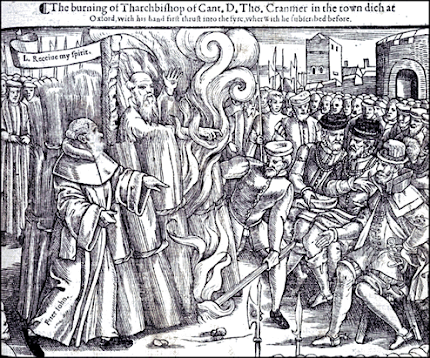
The burning of Tharchbishop of Cant. D. Tho. Cranmer in the town dich at Oxford, with his hand first thrust into the fyre, wherwith he subscribed before. [Click on the picture to see Cranmer's last words.]

Daily Bible Verse

Monday, January 31, 2011

Robert L. Reymond Responds to Frank Turk: Calvin on the "Pernicious Hypocrisy" of Justification by Faith and Works


[Click on the title to see the original article at Trinity Foundation.]

Calvin on the "Pernicious Hypocrisy" of Justification by Faith and Works


By Robert L. Reymond


That some serious slippage has occurred away from the classical Protestant doctrine of justification sola fide has been well documented in many religious publications. Certain teachers - Douglas Wilson, Steve Schlissel, and Steve Wilkins,1 to name only three - have risen within confessing Reformed communions who, in concert with the errant teaching of Norman Shepherd,2 do not endorse the doctrine of justification as enunciated by their historic church confessions and, instead of doing the honorable thing and leaving their communions,3 are corrupting the one true law-free Gospel4 and causing division within their communions with their teaching that the Christian’s justification is not by faith alone in the all-sufficient work of Jesus Christ but is rather the eschatological end result of the believer’s faithfulness to Christ, which faithfulness includes his imperfect works of obedience.

These teachers have rejected the clear Pauline teaching that justification is an act of God’s free grace alone by which the moment a penitent sinner places his faith in Christ God forgives him of all of his sins forever and imputes to him and hence also to his weak and imperfect "good works"5 the perfection of the obedience of his Son Jesus Christ (see Acts 13:38-39; Galatians 2:16; Romans 1:16-17; 3:21-22, 28; 4:4-15; 2 Corinthians 5:21; Ephesians 2:8-10), thereby constituting and declaring him righteous in his sight. These teachers, either minimizing or denying altogether the imputation of Christ’s active obedience to the believer, teach that justification is not a purely forensic declaration but a transforming activity in which the believer’s obedience also plays a significant role in his justification. This corrupted doctrine of justification includes within it the lie of Satan that Christ’s righteousness is not enough in itself to justify and that obedience on the part of the believer is also necessary for his full and final justification before God. It ignores Westminster Larger Catechism, Question 73, which states:

Faith justifies a sinner in the sight of God, not because of those other graces which do always accompany it, or of good works that are the fruits of it, nor as if the grace of faith, or any act thereof, were imputed to him for justification, but only as it is an instrument by which he receives and applies Christ and his righteousness.

More tragically, it ignores the Apostle Paul’s inspired warning that those who to any degree intermingle with their faith in Christ and his obedience their own obedience as the ground of their final justification before God

* stand under apostolic condemnation (Galatians 1:8-9);

* have made Christ’s cross-work of no value to them (Galatians 5:2);

* have alienated themselves from Christ (Galatians 5:4a);

* have set aside (Galatians 2:21) and have fallen away from grace (in the sense that they have placed themselves once again under the Law as the way of salvation [Galatians 3:10; 5:4b]); and

* have abolished the offense of the cross (Galatians 5:11) because they are trusting in a "different gospel" [from Paul’s] that is no gospel at all. (Galatians 1:6-7); indeed, their false "gospel" requires them to "continue to do everything written in the Book of the Law" (Galatians 3:10) perfectly as the ground of their justification before God.

While multitudes of voices and myriads of letters and essays have attempted to call these erring teachers back to the "old way," so far no one has been able to convince them that their position is flawed and dangerous to their own spiritual health and well-being and the spiritual health and well-being of those who follow them. But I have thought for some time now that perhaps a "pen from the past" - the pen of the one who knew better than any man of his time the errors of the Roman Catholic view of justification, which view these contemporary teachers are now in essence inculcating and propagating - might induce them to rethink their position and repent of it.

In the sixteenth century John Calvin termed the doctrine of justification by faith alone in Jesus Christ "the main hinge on which religion turns" (Institutes, 3.11.1),""the sum of all piety" (Institutes, 3.15.7), and "the first and keenest subject of controversy" between Rome and the Reformation ("Reply to Sadoleto"). He treats justification by faith in his Institutes, Book 3, Chapters 11-19. Here Calvin first defines what he means by justification:

...he is justified who is reckoned in the condition not of a sinner, but of a righteous man; and for that reason, he stands firm before God’s judgment seat while all sinners fall. If an innocent accused person be summoned before the judgment seat of a fair judge, where he will be judged according to his innocence, he is said to be "justified" before the judge. Thus, justified before God is the man who, freed from the company of sinners, has God to witness and affirm his righteousness [Institutes, 3.11.2];

...justified by faith is he who, excluded from the righteousness of works, grasps the righteousness of Christ through faith, and clothed in it, appears in God’s sight not as a sinner but as a righteous man [Institutes, 3.11.2].

He then declares that the ground of our justification is Christ’s righteousness alone:

Therefore, we explain justification simply as the acceptance with which God receives us into his favor as righteous men. And we say that it consists in the remission of sins and the imputation of Christ’s righteousness [Institutes, 3.11.2];

...since God justifies us by the intercession of Christ, he absolves us not by the confirmation of our own innocence but by the imputation of righteousness, so that we who are not righteous in ourselves may be reckoned as such in Christ [Institutes, 3.11.3].

...the best passage of all on this matter [2 Corinthians 5:18-21] is the one in which [Paul] teaches that the sum of the Gospel embassy is to reconcile us to God, since God is willing to receive us into grace through Christ, not counting our sins against us. Let my readers carefully ponder the whole passage. For a little later Paul adds by way of explanation: "Christ, who was without sin, was made sin for us," to designate the means of reconciliation. Doubtless he means by the word "reconciled" nothing but "justified." And surely, what he teaches elsewhere - that "we are made righteous by Christ’s obedience" - could not stand unless we are reckoned righteous before God in Christ and apart from ourselves [Institutes, 3.11.4, emphasis supplied].

Calvin then addresses the error of virtually all of professing Christendom, namely, the "pernicious hypocrisy" that we obtain righteousness before God by faith in Christ plus our own works of righteousness:

...a great part of mankind imagine that righteousness is composed of faith and works [but according to Philippians 3:8-9] a man who wishes to obtain Christ’s righteousness must abandon his own righteousness.... From this it follows that so long as any particle of works-righteousness remains some occasion for boasting remains with us [Institutes, 3.11.13].

...according to [the Sophists, that is, the medieval Schoolmen of the Sorbonne, the theological faculty of the University of Paris], man is justified by both faith and works provided they are not his own works but the gifts of Christ and the fruit of regeneration. [But] all works are excluded, whatever title may grace them... [Institutes, 3.11.14].

...Scripture, when it speaks of faith-righteousness, leads us...to turn aside from the contemplation of our own works and look solely upon God’s mercy and Christ’s perfection [Institutes, 3.11.16].

[The Sophists] cavil against our doctrine when we say that man is justified by faith alone. They dare not deny that man is justified by faith because it recurs so often in Scripture. But since the word "alone" is nowhere expressed, they do not allow this addition to be made. Is it so? But what will they reply to these words of Paul where he contends that righteousness cannot be of faith unless it be free? How will a free gift agree with works? With what chicaneries will they elude what he says in another passage, that God’s righteousness is revealed in the Gospel? If righteousness is revealed in the Gospel, surely no mutilated or half-righteousness but a full and perfect righteousness is contained there. The law therefore has no place in it. Not only by a false but an obviously ridiculous shift they insist upon excluding this adjective. Does not he who takes everything from works firmly enough ascribe everything to faith alone? What, I pray, do these expressions mean: "His righteousness has been manifested apart from the law"; and, "Man is freely justified"; and, "Apart from the works of the law?" [Institutes, 3.11.19]

As we were made sinners by one man’s disobedience, so we have been justified by one man’s obedience. To declare that by him alone we are accounted righteous, what else is this but to lodge our righteousness in Christ’s obedience, because the obedience of Christ is reckoned to us as if it were our own [Institutes, 3.11.23].

These contemporary teachers seem to have forgotten the nature of the Judge and the nature of the Final Judgment to which Calvin then quite properly calls our attention in Institutes 3.12 - one of the most powerful and awesome chapters in the entire Institutes. We must never forget, Calvin writes, that the doctrine of justification is

...concerned with the justice not of a human court but of a heavenly tribunal, lest we measure by our own small measure the integrity of works needed to satisfy the divine judgment.... [T]here are none who more confidently, and as people say, boisterously chatter over the righteousness of works than they who are monstrously plagued with manifest diseases, or creak with defects beneath the skin.... [God’s justice is] so perfect that nothing can be admitted except what is in every part whole and complete and undefiled by any corruption. Such was never found in any man and never will be. In the shady cloisters of the schools anyone can easily and readily prattle about the value of works in justifying men. But when we come before the presence of God we must put away such amusements! For there we deal with a serious matter, and do not engage in frivolous word battles. To this question, I insist, we must apply our minds if we would profitably inquire concerning true righteousness: How shall we reply to the Heavenly Judge when he calls us to account? Let us envisage for ourselves that Judge, not as our minds naturally imagine him, but as he is depicted for us in Scripture: by whose brightness the stars are darkened; by whose strength the mountains are melted; by whose wrath the Earth is shaken; whose wisdom catches the wise in their craftiness; beside whose purity all things are defiled; whose righteousness not even the [holy] angels can bear; who makes not the guilty man innocent; whose vengeance when once kindled penetrates to the depths of Hell. Let us behold him, I say, sitting in judgment to examine the deeds of men: Who will stand confident before his throne? "Who...can dwell with the devouring fire?"..."Who...can dwell with everlasting burnings? He who walks righteously and speaks the truth." But let such a one, whoever he is, come forward. Nay, that response causes no one to come forward. For, on the contrary, a terrible voice resounds: "If thou, O Lord, shouldst mark iniquities, Lord, who shall stand?" [Institutes, 3.12.1].

And our own consciences, Calvin observes, will someday bear witness to the truth of the exceeding sinfulness of our works and our inability to contribute to our justification before God by anything we do:

...if the stars, which seem so very bright at night, lose their brilliance in the light of the Sun, what do we think will happen even to the rarest innocence of man when it is compared with God’s purity? For it will be a very severe test, which will penetrate to the most hidden thoughts of the heart.... This will compel the lurking and lagging conscience to utter all things that have now even been forgotten.... Outward parade of good works...will be of no benefit there; purity of will alone will be demanded of us. And therefore hypocrisy shall fall down confounded, even as it now vaunts itself with drunken boldness.... They who do not direct their attention to such a spectacle can, indeed, for the moment pleasantly and peacefully construct a righteousness for themselves, but one that will soon in God’s judgment be shaken from them, just as great riches heaped up in a dream vanish upon awakening. But they who seriously, and as in God’s sight, will seek after the true rule of righteousness, will certainly find that all human works, if judged according to their own worth, are nothing but filth and defilement. And what is commonly reckoned righteousness is before God sheer iniquity; what is adjudged uprightness, pollution; what is accounted glory, ignominy [Institutes, 3.12.4, emphasis supplied].

Let us not be ashamed to descend from this contemplation of divine perfection to look upon ourselves, without flattery and without being affected by blind self-love. For...while man flatters himself on account of the outward mask of righteousness that he wears, the Lord meanwhile weighs in his scales the secret impurity of the heart. Since, therefore, a man is far from being benefited by such flatteries, let us not, to our ruin, willingly delude ourselves. In order that we may rightly examine ourselves, our consciences must necessarily be called before God’s judgment seat. For there is need to strip entirely bare in its light the secret places of our depravity, which otherwise are too deeply hidden. Then only will we clearly see the value of these words: "Man is far from being justified before God, man who is rottenness and a worm," "abominable and empty, who drinks iniquity like water."...[T]he rigor of this examination ought to proceed to the extent of casting us down into complete consternation, and in this way preparing us to receive Christ’s grace [Institutes, 3.12.5].

What we need to exhibit before God’s judgment seat, Calvin avers, is true humility, not the insistence of false teachers that in addition to Christ’s perfect obedience our imperfect works are necessary for our final justification before God:

...what way do we have to humble ourselves except that, wholly poor and destitute, we yield to God’s mercy. For if we think that we have anything left to ourselves, I do not call it humility. And those who have hitherto joined these two things together - namely, that we must think humbly concerning ourselves before God and must reckon our righteousness to be of some value - have taught a pernicious hypocrisy.... If you would, according to God’s judgment, be exalted with the humble, your heart ought to be wounded with...contrition. If that does not happen, you will be humbled by God’s powerful hand to your shame and disgrace [Institutes, 3.12.6, emphasis supplied].

The burning question in the sixteenth century for the Reformers was "How can I find a gracious God?," or as Job asks: "...how can a mortal be righteous before God" (Job 9:2; see also Job 25:4). The Church of the Medieval Age had taught for centuries that right standing before God was achieved through the Spirit’s inward work of grace in the human heart. More specifically, it taught that men achieve Heaven through the sacrament of baptism that removes original sin and regenerates, then through inner renewal by works of penance that address post-baptismal sins, and then by the grace of sanctification that is never complete in this life, which necessitates that Christians go to purgatory after death to make expiation for their sins. That Church, including the deliverances of Vatican I and II, is still with us today, with no change in its false soteriology6 from that time to our own, declaring again as recently as its 1994 Catechism of the Catholic Church that "justification is...the sanctification and renewal of the interior man." And now an essentially similar soteriology has begun to make its appearance within conservative Protestantism.

The proponents of this "neonomism" within Protestantism should take seriously what Calvin (as did all the sixteenth-century magisterial Reformers) came to understand from his careful study of Scripture, namely, that

* the only man with whom the infinitely holy God can have direct fellowship is the perfect God-man, the only mediator "between God and man, the man Christ Jesus" (1 Timothy 2:5), and that it is only as sinful people place their trust in Christ’s saving work and are thereby regarded by God as "in Christ" that the triune God can have any fellowship with them;

* the only way to protect the solus Christus ("Christ alone") of salvation is to insist upon the sola fide ("faith alone") of justification, and the only way to protect the sola fide of justification is to insist upon the solus Christus of salvation;

* saving faith is to be directed to the doing and dying of Christ alone and never and in no sense to the so-called good works or inner experience of the believer;

* the Christian’s righteousness before God today is in Heaven at the right hand of God in Jesus Christ, and not on Earth within the believer;

* the ground of our justification is the vicarious work of Christ for us, not the gracious work of the Spirit in us;

* the faith-righteousness of justification is not personal but vicarious, not infused but imputed, not experiential but forensic, not psychological but legal, not our own but a righteousness alien to us, and not earned but graciously given through faith in Christ, which faith is itself a gift of grace;

* all which means that justification by faith is to be set off over against justification by any and all of our works, for justification is grounded in Christ’s alien preceptive and penal obedience in our stead, and we receive by faith alone his perfect obedience.

My intention in this essay has been to let Calvin speak to the contemporary Reformed community as if he were still alive. I trust that I have done that. I trust also that most, if not all, of my readers already believe that "justification is an act of God’s free grace, wherein he pardons all our sins and accepts us as righteous in his sight, only for the righteousness of Christ, imputed to us, and received by faith alone" (Westminster Shorter Catechism, Question 33), but I would urge all my readers - including Norman Shepherd, Steve Schlissel, Steve Wilkins, Douglas Wilson, N. T. Wright, et al. - to re-examine themselves with respect to whether they are trusting solely in the preceptive and penal obedience of the only righteous One, even Jesus Christ, for their forgiveness and needed righteousness before God. For make no mistake about it: The Day will come, as Calvin reminded us, when all of us will stand naked before God, and in that Great Day of his Assize in whom or in what we trusted for our salvation will be all-important. Unable to "answer him once in a thousand times" all of us in that Day will be stripped of all the things in which we may have placed our confidence in this world. We will stand before the Throne of God in that Day in utter poverty in ourselves - without title, without money, without property, without reputation, without personal prestige, without meritorious works of our own. And unless we have been forgiven of our sins by faith alone in Christ and have been enrobed solely in his imputed righteousness, God will consign us to eternal perdition for our sins. In other words, unless we have completely repudiated all of our own efforts at salvation and have totally trusted the Savior’s righteous life and sacrificial death alone for our salvation, we will be condemned. For by no works of righteousness that we will ever do will we be justified before God (see Titus 3:5). Our so-called works of righteousness simply will not cut it! Christ’s perfect obedience alone is our only hope for Heaven. It alone is enough. We must trust him if we would be justified, for it is by faith alone in Christ’s obedient doing and dying that sinners are justified freely before the high tribunal of Heaven. Every other way of salvation, however well-intended, will fail, and those who trust in any other way will be cast into Hell forever.

April 2006


1 Steve Wilkins is the pastor of the Auburn Avenue Presbyterian Church (PCA) in Monroe, Louisiana. The 2002 General Assembly of the Reformed Presbyterian Church (RPCUS) denounced as heresy the teachings of the Auburn Avenue Theology as well as the theology of Norm Shepherd and the "New Perspective" on Paul.

2 The Reformed Church in the United States (RCUS) at its 258th Synod found without dissent on May 13, 2004, the teachings of Norman Shepherd on justification to be "another gospel" and called upon him "to repent of his grievous errors."


3 Douglas Wilson is the exception here, having started his own denomination, the Confederation of Reformed and Evangelical Churches (CREC).


4 By the term "law-free Gospel" I intend that "a man is justified by faith apart from observing the law" (Romans 3:28) and that a "man is not justified by observing the law, but by faith in Jesus Christ...because by observing the law no one will be justified" (Galatians 2:16). I do not intend by the term "law-free Gospel" that the Gospel delivers the Christian from the obligation to obey God’s moral law as that law comes to expression in the Ten Commandments, in their summary in the two love commandments of Holy Scripture, and in Christ’s pattern of life.


The Westminster Confession of Faith, XI.2 states: "Faith, thus receiving and resting on Christ and his righteousness, is the alone instrument of justification: yet is it not alone in the person justified, but is ever accompanied with all other saving graces, and is no dead faith, but works by love." Clearly the Christian lives under the law of God as the covenant way of life. But just as clearly his obedience to God’s law is no part of the ground of his justification; Christ’s obedience alone is the ground of his justification.

5 Westminster Confession of Faith, XVI. 5, 6 (emphasis supplied) states: "...as [our best works] are wrought by us, they are defiled, and mixed with so much weakness and imperfection, that they cannot endure the severity of God’s judgment. Notwithstanding, the persons of believers being accepted through Christ, their good works also are accepted in him; not as though they were wholly unblamable and unreprovable in God’s sight; but that he, looking upon them in his Son, is pleased to accept and reward that which is sincere, although accompanied with many weaknesses and imperfections.

6 Roman Catholicism declares, because it holds to the early ecumenical creeds, that it is an orthodox church and should be viewed as such by all. The problem here is that these early creeds (Apostles’ Creed, Nicene Creed, Niceno-Constantinopolitan Creed, Definition of Chalcedon, and Athanasian Creed) are not evangelical creeds, that is, creeds that explicate soteric matters. They were all framed in the context of the Trinitarian debates in the fourth and fifth centuries and are underdeveloped respecting and virtually silent on matters of soteriology. Herman Bavinck in The Doctrine of God, (Baker, 1951), 285, notes: "...the Reformation has brought to light that not the mere historical belief in the doctrine of the Trinity, no matter how pure, is sufficient unto salvation, but only the true heart-born confidence that rests in God himself, who in Christ has revealed himself as the triune God." That is to say, there is no saving value in holding to an orthodox view of God as Trinity if one is at the same time also holding to an unorthodox view of the saving work of the Trinity.

Consequently, when the counter-Reformation Council of Trent by its Decrees and Canons rejected the doctrine of justification by faith alone and anathematized those who believe this doctrine, Rome in effect formally declared its own apostasy from the apostolic Gospel. Rome has never to this day repudiated Trent; to the contrary, it has time and again reaffirmed Trent. So by no stretch of the imagination are the core beliefs of Roman Catholicism and Reformation theology on the Gospel, that is, on the doctrine of justification by faith alone, the same today. They differ radically on the Gospel itself with Roman Catholicism teaching the heresy of justification by faith plus works and Reformation theology teaching the Biblical truth of justification by faith alone in Christ’s perfect obedience, which justifying faith will be accompanied, as James 2:14-26 teach, by good works that form no part of the ground of justification but are "the fruits and evidence of a true and lively faith" (Westminster Confession of Faith, XVI.2).

--

Reasonable Christian Blog Glory be to the Father, and to the Son : and to the Holy Ghost; Answer. As it was in the beginning, is now, and ever shall be : world without end. Amen. 1662 Book of Common Prayer


The Trinity Foundation - What must I do to be saved?

The Trinity Foundation - What must I do to be saved?

The Trinity Foundation - The Current Justification Controversy

The Trinity Foundation - The Current Justification Controversy

“Should We Exclusively Use the King James Version?” « The Misadventures of Captain Headknowledge

“Should We Exclusively Use the King James Version?” « The Misadventures of Captain Headknowledge

Modern Reformation - The Gospel Driven Church

Mike Horton said:

The Gospel-Driven Church

We must never take Christ's work for granted. The gospel is not merely something we take to unbelievers; it is the Word that created and continues to sustain the whole church in its earthly pilgrimage. In addition, we must never confuse Christ's work with our own. There is a lot of loose talk these days about our "living the gospel" or even "being the gospel," as if our lives were the good news. We even hear it said that the church is an extension of Christ's incarnation and redeeming work, as if Jesus came to provide the moral example or template, and we are called to complete his work.

There is one Savior and one head of the church. To him alone all authority is given in heaven and on earth. There is only one incarnation of God in history, and he finished the work of fulfilling all righteousness, bearing the curse, and triumphing over sin and death.

We use the verb "redeem" too casually today, as if we (individually or collectively) could be the subject of this sort of action. God has already redeemed the world in his Son, purchasing for himself "people from every tribe and tongue and nation" (Rev. 5:9). On this basis, the Spirit is at work applying this redemption, drawing sinners to Christ, justifying and renewing them, in the hope that their bodies will be raised together with an entirely renovated creation (Rom. 8:16-23). The church comes into being not as an extension or further completion of Christ's redeeming work, but as a result of his completed work.


To read the full article click here: Modern Reformation - Articles: The Gospel Driven Church


EV News :: Church must make women bishops, say MPs

EV News :: Church must make women bishops, say MPs

EV News :: Internet lies are destroying us, say Christian hoteliers

EV News :: Internet lies are destroying us, say Christian hoteliers

Sunday, January 30, 2011

Ties to the Federal Vision: Open Letter to Michael Horton Pyromaniacs

Someone over at the Puritan Board pointed me to this comment by R. Scott Clark:

MacArthur's view, as articulated in the Lordship Controversy and reflected in The Gospel According to Jesus and the like isn't much different from Norman Shepherd's. This is the problem with the whole controversy. Confessional Reformed people should say: a pox on both your houses. The Zane Hodges ("easy believism"; walk the aisle, pray the prayer, ex opere operato view) is antinomian because it denies the moral necessity of the third use of the law, the moral necessity of fruit as evidence, the moral necessity of sanctity in the justified. MacArthur, however, because he isn't a confessional Protestant (and he will tell you so) but a biblicist, didn't have the categories by which evaluate the Zane Hodges view properly. He reacted by doing as many have been wont to do, by trying to make sanctity essential to justification. Since that time, I'm told, he has said more orthodox things but he has never, to my knowledge substantially revised what he published in the Gospel According to Jesus.

The confessional Reformed view, taught in the Three Forms and in the Westminster Standards is that justification is by trusting in the finished work of Christ alone AND that those who believe and are united by the Spirit to Christ, will produce fruit as evidence of their justification. Those who are united to Christ must seek to conform their lives to the moral law of God, not as a condition of acceptance with God but as a consequence of having been freely accepted by God for Christ's sake.

Everyone should read the two essays by Paul Schaefer in Christ the Lord. They are the single best treatments of the controversy.

Tragically, there has been something of a confluence between the Shepherdites (justification through faithfulness) and MacArthurites, such as Frank Turk, via Doug Wilson. The latter is quite the Wilsonite and I've heard more than a few Shepherdites pledge allegiance to MacArthur, as if we had a side in the Lordship Controversy.


R. Scott Clark is a professor of historical theology at Westminster Theological Seminary, California. I happen to agree with his assessment and am actually shocked to see that Dr. Clark has publicly stated his opinion on this. Good for him! You'll have to click on this link and then scroll down to see Dr. Clark's remarks: Open Letter to Michael Horton Pyromaniacs

Sincerely in Christ,

Charlie


Friday, January 28, 2011

We Are Not Wesleyans « Heidelblog

R. Scott Clark hit the nail on the head here. We are not Wesleyans. But the Wesleyans only have a "bent" toward sinning and they get entirely sanctified later. Unfortunately they do so by lowering God's moral law so they can "appear" to meet it. To them sin isn't missing the mark or sinning in ignorance or leaving undone what they ought to have done. No, sin is merely willfully or deliberately violating a known moral law. It reminds me of the Pharisees who think they've done above and beyond the call of duty but really had not. (Matthew 5:17-21, 48; Luke Luke 17:10). I graduated from a Wesleyan holiness seminary so I know Wesleyan theology from the inside. Wesley himself never professed to have attained his theoretical state of entire sanctification. For him it was a goal to be pursued. When Phoebe Palmer advocated claiming the state of entire sanctification as an experience by faith, the door was opened to the modern Wesleyan and Keswick holiness movements. Unfortunately, it opened the door for the pelagianism of Charles Finney as well.

To read R. Scott Clark's confession of sin click on the link below:


We Are Not Wesleyans « Heidelblog

Daniel's Place - (Reformata et semper reformanda): A Response to Frank Turk's Open Letter

The following is a response by the Daniel's Place blog:
The core problem with Turk is his view of the Gospel. Classical Reformed orthodoxy teaches that the Gospel is good news period. The Gospel is proclaimed to sinners of what Christ has done for them. Over and over, the Scriptures starts with proclaiming the Gospel, and then proclaim the law (in its third use) as how we ought to live in light of the Gospel. In epistles like Romans, the model is Law (first use), then Gospel, then Law (third use).

According to Turk, the Gospel must be seen as something that God has done for us which results in "the advantages of declared righteousness". Therefore, the Gospel itself is transformative. Whereas the Reformed position is that the Gospel is declarative, Turk and I suspect many Evangelicals think of the Gospel as transformative. Therefore, it is the Gospel that must transform lives, which brings us to the next point.


You can read the entire article at this link:

Daniel's Place - (Reformata et semper reformanda): A Response to Frank Turk's Open Letter

Should Reformed Anglicans "Fellowship" with Anglo-Catholics?

I will not go into a long and serious article on this at the moment.  However, in brief just let me say that I believe Reformed Anglicans should come out from among them, that is Anglo-Catholics and various other heretics, and start another "province" or "denomination" since geographical boundaries no longer apply.  There is no place for Calvinist Anglicans in any of the existing "provinces", including the Anglican Church in North America.  Even if the ACNA did accept Protestant and Reformed Anglicans, it still would not work because the Calvinist would be expected to stop trying to convert the lost souls of the Anglo-Papists who insist on muddying the waters and corrupting the Gospel of free grace with semi-pelagianism, prayers to the saints, real presence, baptismal regeneration and other heresies and idolatries.

I have equal objections to the Charismatic Anglicans since they are perfectly willing to whore after the Anglo-Papists and promote their false gospel of fake miracles, Christian Science, gnosticism, mysticism, ecstatic religion, and semi-pelagianism.

By the way, I have removed the Anglicans Ablaze link due to the fact that Robin Jordan insists on promoting the Anglo-Catholics on his blog by advertising for them without criticism.  Such confused thinking does not deserve a mention on my part.  It's time for Reformed Anglicans to stop sleeping with the enemy and to repent of spiritual adultery.  Choose whether you are going to be Protestant, "catholic" and Reformed or you're going to be a Papist or a Charismatic.  The choice is clear for me.  I will choose to follow Jesus Christ and the Gospel, not heresy and heretics and idolatry.  I am done "striving" with unrepentant heretics.

So be it according to thy will, O Lord!

Charlie

 And the servant of the Lord must not strive; but be gentle unto all men, apt to teach, patient, 25 In meekness instructing those that oppose themselves; if God peradventure will give them repentance to the acknowledging of the truth; 26 And that they may recover themselves out of the snare of the devil, who are taken captive by him at his will. (2 Timothy 2:24-26 KJV)


Tullian Tchividjian: Two Ways To Realize Radical Obedience: My Indirect Response To Jason Hood – Tullian Tchividjian

Every now and again someone says something that makes perfect sense. Tullian Tchividjian's remark below is the perfect example. I agree wholeheartedly. It's gratitude and adoption as a son of God that motivates holiness, not fear and trembling as though we would be cut off at any moment. Although the warning passages are clear, it's not the warnings that motivate us to obey but knowing that we are accepted by God on the basis of Jesus' active obedience, sinless life, and his atoning death on the cross:

As a pastor, one of my responsibilities is to disciple people into a deeper understanding of obedience—teaching them to say “no” to the things God hates and “yes” to the things God loves. But all too often I have wrongly concluded that the only way to keep licentious people in line is to give them more rules–lay down the law. The fact is, however, that the only way licentious people start to obey is when they get a taste of God’s radical, unconditional acceptance of sinners. The irony of gospel-based sanctification is that those who end up obeying more are those who increasingly realize that their standing with God is not based on their obedience, but Christ’s. --Tullian Tchividjian--

To read the full article click on the link below:

Two Ways To Realize Radical Obedience: My Indirect Response To Jason Hood – Tullian Tchividjian

Update: The quote is actually from Dane Ortlund and is quoted by Tullian in his article. Sorry about that. (See The Radical Gospel: Defiant and Free).


Frank Turk Supports Doug Wilson: Father Hunger

If you will click on the link and then look at the comments section you'll see Frank Turk supports Doug Wilson as far back as 2006. I'm not sure how far that support goes but this is at least some indication. Just for the record, Doug Wilson started out as a theonomist and then went into the Federal Vision error. I hope everyone can see why I blame theonomy for many of the defections to Federal Vision and Auburn Avenue in Presbyterian and Reformed circles and why the Reformed Episcopal Church has gone in the Tractarian/Anglo-Catholic direction. Where there is smoke there is fire. Click on this link, Father Hunger, to see Doug Wilson's blog and the comment made by Frank Turk. You can also see Doug Wilson singing praises to Frank Turk here: Frank the Baptist Nails It.


Thursday, January 27, 2011

Out of the Horse's Mouth: The Fear of Antinomianism

Mike Horton responds to the charge of antinomianism at the White Horse Inn blog. Click here to see the post: The Fear of Antinomianism


On Churchless Evangelicals (pt 1) « Heidelblog

I guess Scott Clark thinks that we should join the local Arminian or the local liberal church?

On Churchless Evangelicals (pt 1) « Heidelblog

R. Scott Clark Responds: Jason Hood, Frank Turk, Dane Ortlund, Mike Horton, and Antinomianism (UPDATED) « Heidelblog


I couldn't have said it better myself. The thing Dr. Clark overlooked is that Jason Hood is a United Methodist and an Arminian. Arminians are very good at lowering the standard of God's absolute moral demands to make it appear as though they have perfectly kept the law. The Wesleyan definition of sin is somewhat different from the Reformed definition. Wesley's definition is that sin is a deliberate and willful violation of a known moral law. So much for sins of omission, ignorance, and falling short of the mark. You can read Dr. Clark's response to Frank Turk at this link: Jason Hood, Frank Turk, Dane Ortlund, Mike Horton, and Antinomianism (UPDATED) « Heidelblog


Pyromaniacs: Open Letter to Michael Horton

Unfortunately, some particular Baptists don't think the Law/Gospel distinction is important or that doctrine matters. What really matters is that you have some sort of behavioral change. (See Frank Turk's article at Pyromaniacs: Pyromaniacs: Open Letter to Michael Horton). I guess the morality gospel trumps the Gospel of Jesus every time in the mind of the self-justifying Pharisees. Unfortunately, Frank Turk does not understand the systematic nature of the Reformed confessions and standards as a whole. He would rather proof text out of context and create straw man arguments that prove the Reformed faith is "antinomian". It really goes to show how deeply ingrained the Anabaptist worldview is in the United States. As R. Scott Clark pointed out recently, it is a reflection of a rejection of authority of any kind and an overemphasis on individualism over and above any confessional commitments within a congregational or denominational setting.  (See:  Sister Aimee and the Anabaptist Nation).

What is especially amazing is that Turk thinks the hortatory subjunctive somehow escapes the classification of "Law" as in the Law/Gospel distinction. He says:

The first is a general complaint: I think you fellows have taken the right-minded theological distinction "Law and Gospel" too far; you have made all of human life and God's interactions with man into either an imperative or an indicative — missing the point that some things in life (especially in the Christian life, and in Christian theological anthropology) fall under the subjunctive mood.

For example, Hebrews 12:1 says, "Therefore, since we are surrounded by so great a cloud of witnesses, let us also lay aside every weight, and sin which clings so closely, and let us run with endurance the race that is set before us, looking to Jesus, the founder and perfecter of our faith, who for the joy that was set before him endured the cross, despising the shame, and is seated at the right hand of the throne of God." Now, I realize that the hortatory subjective is a way to "command one's self" as they say, but let's recognize something here: that kind of command is not external or decreed but in fact internal and voluntary, speaking to a willingness and not merely to submission to some exterior force or authority. Here the writer of Hebrews — someone we must agree is not a pelagian or syncretist or closet Roman Catholic or any sort of denier of the Gospel — really says, "somehow we can relate to the life of faith, and relate to Christ himself, and want to do what the faithful have always done."

There is much to be gained from the Law/Gospel, imperative/indicative distinction in Scripture, but not everything is resolved by it. And one of the things which is not resolved by it is what manner of people the Gospel makes us - which is actually part and parcel of the Good News.


There are several problems with Turk's position here. The one that immediately jumps out, however, is his understanding of the subjunctive mood. He seems to not be aware that the hortatory subjunctive is indeed a command as almost every Greek grammar I consulted indicates. It is not a reflexive command back to one's self, as Turk thinks.  Rather it is a command to others.  It's not expressed in the singular but the plural. In other words, the hortatory subjunctive is still an expression of the Moral Law and does not therefore escape the Law and Gospel distinction:


160. The Hortatory Subjunctive. The Subjunctive is used in the first person plural in exhortations, the speaker thus exhorting others to join him in the doing of an action. HA. 866, 1; G. 1344; B. p. 209; WM. p. 355; G.MT. 255, 256.
Heb. 12:1; diV u`pomonh/j tre,cwmen to.n prokei,menon h`mi/n avgw/na, "let us run with patience the race that is set before us."
1 John 4:7; avgaphtoi,( avgapw/men avllh,louj, "beloved, let us love one another."

(See: Syntax of the Moods and Tenses in New Testament Greek, by Ernest De Witt Burton).


What part of "doing an action" does Turk not understand? Anything in Scripture associated with "doing" is "Law". That is not to say that the Reformed position or the Lutheran position is antinomian. It is simply an insistence that justification is always and forever based and founded upon faith alone and not upon any action that we take or "do". Another example of a Greek grammar that says the hortatory subjunctive carries an imperatival force is:

a. Hortatory Subjunctive (a.k.a. Volitive) [let us]

1) Definition

The subjunctive is commonly used to to exhort or command oneself and one’s associates. This use of the subjunctive is used “to urge some one to unite with the speaker in a course of action upon which he has already decided.” Since there is no first person imperative, the hortatory subjunc­tive is used to do roughly the same task. Thus this use of the subjunctive is an exhortation in the "first person plural". The typical translation, rather than "we should" . . . is "let us . . . ."

On five occasions, the first person singular is also used in a hortatory way. The force is akin to asking permission for the verbal action. "Let me" or "per­mit me" brings out its meaning. The key to the singular hortatory usage is the presence of a;fej (“permit” [aorist imperative of avfi,hmi]) or the adverb deu/ro (“come”) preceding the subjunctive.

(See: Greek Grammar Beyond the Basics, by Daniel B. Wallace, p. 464).


You will note that both of the above grammars indicate that the hortatory subjunctive is a command and Wallace further particularizes by telling us that when the verb is used in the first person plural it is a command. This is true because Greek has no other way to express the imperative in the first person since "there is no first person imperative". In short, this is precisely where Frank Turk misses the boat. He proposes a third option to avoid the category of Law, hoping to sidestep the Law/Gospel distinction. Instead he falls into the trap of confusing Law with Gospel. While it is good to avoid antinomianism, the Reformed position is clearly not antinomian simply because it insists on the Law/Gospel distinction.

A further problem with Turk's view is this comment:

. . . but let's recognize something here: that kind of command is not external or decreed but in fact internal and voluntary, speaking to a willingness and not merely to submission to some exterior force or authority.
I guess by that comment that Turk also rejects the doctrine of Sola Scriptura since the Bible is an exterior force or authority that is outside of our inward experience?  This is a perfect example of Anabaptist thinking.  Basically the individual justifies himself through his own experience.  It is subjectivism carried to the extreme.  This sort of thinking is precisely what Michael Horton was refuting in his book, Christless Christianity.  The description below the video at that link says,

Christless Christianity guides the reader to a greater understanding of a big problem within the American religious setting, namely the creeping fog of countless sermons in churches across the country that focus on moralistic concerns and personal transformation rather than the theology of the cross.

I could not agree with Horton's assessment more.  R. Scott Clark talks about this as well in the discussion about Sister Aimee at the Reformed Forum.

Not only is Turk's article a straw man argument against the Reformed position but Turk's understanding of Greek grammar leaves much to be desired. For a better understanding of the Law/Gospel issue you might want to listen to this edition of The White Horse Inn: Law and Gospel. If you doubt that Michael Horton is not an antinomian, you might want to read the Heidelberg Catechism: Lord's Day 32-45. Ironically, Turk claims to be a "reformed" Baptist. I found it amusing that at the bottom of the page there is this disclaimer:


Disclaimer

The opinions expressed in this blog do not necessarily represent the views of all contributors. Each individual is responsible for the facts and opinions contained in his posts. Generally, we agree. But not always.


Unfortunately, having "strong opinions" does not necessarily coincide with having true, right or accurate opinions on the matter. Baptists cannot bind each other's consciences because they do not accept creeds or confessions. It's no wonder that they cannot reach any consensus among themselves. But then, the Reformed denominations cannot enforce their own confessions of faith as the current situation with the Federal Visionists illustrates. And who could forget the divisions within Anglicanism?

[To view the above Greek terms you will need to download and install the Bibleworks Greek fonts.]


When Was Zwingli an Anabaptist? Updated « Heidelblog

When Was Zwingli an Anabaptist? Updated « Heidelblog

A Review of Dr. John Fesko’s Lecture on Word, Water and Spirit, part 1 « The Misadventures of Captain Headknowledge

A Review of Dr. John Fesko’s Lecture on Word, Water and Spirit, part 1 « The Misadventures of Captain Headknowledge

Religious Rights Watch: EV News :: Second B&B owner sued for turning gay couple away

Looks like the right to be immoral trumps the right to the freedom of religion. No Christian should be forced to conduct business in their own home in a way that contradicts their religious convictions and beliefs. It's call the freedom of religion. Please pray for Peter and Hazelmary Bull. Click on this link to see the story: EV News :: Second B&B owner sued for turning gay couple away


Wednesday, January 26, 2011

Joshua Judges Ruth: Always Reformed & Courageous Calvinism, II

One need only visit a few PCA churches to find great diversity amongst them. In any given presbytery you will find upbeat churches whose worship barely differs from many charismatic churches and just a few miles up the road you will find a traditional church that sings from a hymnal. Why the great divergence? Just consider where our ministers have studied -- RTS Jackson, RTS Orlando, RTS Charlotte, Greenville, Westminster Philadelphia, Westminster California, Covenant Theological Seminary, Biblical Theological Seminary, Trinity Evangelical Divinity School, Dallas Theological Seminary, Gordon-Conwell and a score of lesser known institutions. Each school has its strengths and weaknesses: each school has its own loyalties and distinctives. Some are "old-school" Presbyterian while others are broadly evangelical. Some study the giants in reformed theology; others prefer modern interpretations of reformed theology. Added to this mix is the fact that the PCA is a member of the The National Association of Evangelicals. Prominent PCA leaders advocate involvement with The Gospel Coalition, The World Reformed Fellowship, and other broad organizations.

It seems by design that our denomination is more eclectic than is healthy. To try to implement an eclectic Strategic Plan is a curious proposition at best.


To read the rest of the article by Dave Sarafolean, click on the link below.


Joshua Judges Ruth: Always Reformed & Courageous Calvinism, II

Young, Restless, and Resistant to Horton’s New Systematic Theology? « Heidelblog

Young, Restless, and Resistant to Horton’s New Systematic Theology? « Heidelblog

WHI-946 | Rightly Dividing the Word: Law & Gospel - White Horse Inn Blog

WHI-946 | Rightly Dividing the Word: Law & Gospel - White Horse Inn Blog

Featured Document: The Magna Carta

The Magna Carta is a Christian document and was initiated by the "prompting of God". In other words, one of the foundational documents inspiring modern democracy is in fact rooted solidly in Christianity. Odd that secular histories neglect to mention this fact which is mentioned in the preamble to the Magna Carta itself:

Magna Carta Translation

[Preamble] Edward by the grace of God King of England, lord of Ireland and duke of Aquitaine sends greetings to all to whom the present letters come. We have inspected the great charter of the lord Henry, late King of England, our father, concerning the liberties of England in these words:

Henry by the grace of God King of England, lord of Ireland, duke of Normandy and Aquitaine and count of Anjou sends greetings to his archbishops, bishops, abbots, priors, earls, barons, sheriffs, reeves, ministers and all his bailiffs and faithful men inspecting the present charter. Know that we, at the prompting of God and for the health of our soul and the souls of our ancestors and successors, for the glory of holy Church and the improvement of our realm, freely and out of our good will have given and granted to the archbishops, bishops, abbots, priors, earls, barons and all of our realm these liberties written below to hold in our realm of England in perpetuity.


Featured Document: The Magna Carta


The theonomists like to misrepresent this fact as if it favors their postmillennial optimism or their confusion of civil law with the moral law of God, etc. The principle of general equity and natural law does apply to civil law today; however, we do not live in a time when Christianity is the established religion of a nation. While it might be a desirable thing to have Christianity as the established religion, the separation of church and state was meant to protect the freedom of various Christian denominations which had arisen out of the initial Puritan settlements. The Pilgrims came to the United States for religious freedom from persecution by the high church Arminians and Charles I. (See Great Migration).

Neither modern secularism and atheism nor modern theonomic views are true. The fact is the United States has Christian roots and foundations but without the extremes of modern secular atheism or the rightwing Christian theonomic/reconstructionist movement. Religious freedom is a God given right. While it is true that the Puritans did not extend absolute religious freedom, it is equally true that they wanted Christians to have the freedom to dissent from an overbearing episcopal system.


Calvin on Augustine's View of the Lord's Supper: Spiritual Feeding on Christ by Faith

6. When Augustine, whom they claim as their patron, wrote, that we eat by believing, all he meant was to indicate that that eating is of faith, and not of the mouth. This I deny not; but I at the same time add, that by faith we embrace Christ, not as appearing at a distance, but as uniting himself to us, he being our head, and we his members. I do not absolutely disapprove of that mode of speaking; I only deny that it is a full interpretation, if they mean to define what it is to eat the flesh of Christ. I see that Augustine repeatedly used this form of expression, as when he said (De Doct. Christ. Lib. 3), “ Unless ye eat the flesh of the Son of Man” is a figurative expression enjoining us to have communion with our Lord’s passion, and sweetly and usefully to treasure in our memory that his flesh was crucified and wounded for us. Also when he says, “These three thousand men who were converted at the preaching of Peter ( [Acts 2:41] ), by believing, drank the blood which they had cruelly shed.”60 [06 606 See August. Hom. in Joann. 31 et 40, &c., Chrysost. Hom. ad Popul. Antioch., 60, 61; et Hom. in Marc. 89.] But in very many other passages he admirably commends faith for this, that by means of it our souls are not less refreshed by the communion of the blood of Christ, than our bodies with the bread which they eat. The very same thing is said by Chrysostom, “Christ makes us his body, not by faith only, but in reality.” He does not mean that we obtain this blessing from any other quarter than from faith: he only intends to prevent any one from thinking of mere imagination when he hears the name of faith. I say nothing of those who hold that the Supper is merely a mark of external profession, because I think I sufficiently refuted their error when I treated of the sacraments in general (Chap. 14 sec. 13). Only let my readers observe, that when the cup is called the covenant in blood ( [Luke 22:20] ), the promise which tends to confirm faith is expressed. Hence it follows, that unless we have respect to God, and embrace what he offers, we do not make a right use of the sacred Supper.


--

Reasonable Christian Blog Glory be to the Father, and to the Son : and to the Holy Ghost; Answer. As it was in the beginning, is now, and ever shall be : world without end. Amen. 1662 Book of Common Prayer

Tuesday, January 25, 2011

Leithart: Apostasy Happens « Heidelblog

Leithart: Apostasy Happens « Heidelblog

Leithart: “Apostasy Happens” « Johannes Weslianus

Leithart: “Apostasy Happens” « Johannes Weslianus

Getting the Gospel Right: Jonathan Akin


The following is an except from an article by Jonathan Akin, a Baptist.  I'm not sure if Akin claims to be a particular Baptist or a Calvinistic Baptist.  However, this section of his article, "The Gospel in Synchronic and Diachronic Perspective:On the Nature and Implications of the Gospel," jumped out at me:


The gospel is the central message of the Christian faith. Getting the gospel wrong is disastrous. I believe that each of the positions stated above can be wrongly emphasized and cause us to lose sight of what the gospel is! I will take the positions in reverse order. The most disastrous position is the one that sees the gospel as the door or hoop that gets you into the Christian life but does not see the gospel as central to all of the Christian life, something you both continually believe and live. In theological terms, this view sees the importance of the gospel for justification but not for sanctification. This leads some preachers to ignore proclaiming the gospel weekly because they believe the gospel is only for unbelievers and not for believers (or they just tack on an evangelistic appeal at the end of a message for the unbelievers in the crowd). This view separates the gospel from the Christian life by strongly associating it with the praying of a prayer to get in (“accepting the gospel”) and then viewing discipleship as following a list of rules or principles laid down in the Bible after that. This leads to a new form of legalism that is not gospel-centered and can block our lost friends, neighbors, and the nations from hearing the clear message of the gospel. It tends to put the emphasis of the Christian life primarily on what individual believers “do,” and this lends itself to works-based self-righteousness (or sin-based guilt) rather than gospel-driven, continual repentance. This approach leads to divorcing the imperatives of the Bible from the indicatives of the gospel. By following this approach to the gospel, we train our children to be Pharisees who pray like Daniel, love their in-laws like Ruth, are brave like David, etc. They thus come to view the Christian life as a set of rules or principles to follow which are entirely separated from the One who has already acted to rescue a people.1 The Christian life, in this view, is still mainly seen as obeying in order to be accepted rather than acceptance that leads to obedience. This muddying of the gospel has caused many young people to walk away from the church.
1For further examination of this issue, see the following baptist21 blog entry entitled “Preaching the Gospel Every Week.”

To read the entire article, go to the Beginning with Moses blog.  Akin's article originally appeared at the baptist twentyone site.

Footnote:  Apparently, Baptist12.com is indeed a particular Baptist or calvinistic Baptist site: Who We Are


Doctrinal Affirmations

We provide the following doctrinal affirmations as a summary of our convictions. However, in keeping with the introduction to the BF&M 2000 we affirm that “the sole authority for faith and practice among Baptists is the Scriptures of the Old and New Testaments. Confessions are only guides in interpretation, having no authority over the conscience.”


If confessions of faith are not a secondary authority, following the sole authority of Scripture, why bother?  It's contradictory to say that what we believe as a church is not an authority over the conscience, especially when we claim that what we believe is derived from the Holy Scriptures.  Only Scripture is infallible and absolutely binding but that does not mean that the church has no authority at all. (Cf. 39 Articles of Religion, Article 20).
--
Reasonable Christian Blog Glory be to the Father, and to the Son : and to the Holy Ghost; Answer. As it was in the beginning, is now, and ever shall be : world without end. Amen. 1662 Book of Common Prayer

The Prayer Book Society: Promoting the Continued Use of the 1662 BCP

The Prayer Book Society

D. Broughton Knox: Do the Sacraments Save?


. . . The soul feeds on Christ, the living bread. --David Broughton Knox


Do the Sacraments “Justify” or “Save”? Good Question!

Most of us with knee jerk reaction would immediately say that the sacraments do not save. We think that any idea of a sacrament saving anyone must be a Roman Catholic doctrine. At one time I would have denied that baptism and the Lord's supper were anything more than mere ceremonies reminding us of what Christ did in His ministry on earth and in His atoning death for the sins of the whole world. Since then I have become a Calvinist and later a Reformed Anglican.

Recently, I've been reading D. Broughton Knox: Selected Works, Volume III: The Christian Life, Tony Payne and Karen Beilharz, eds., (Kingsford: Matthias Media: 2006). I have major problems with several of D. Broughton Knox's theological positions including his tendency to emphasize following the example of Jesus more than justification by faith alone and his view that faith is more than assent. How can we assent to something we do not believe? I also have a problem with some statements Knox made about the sacraments being unnecessary in which he implied that we ought to throw out the sacraments. I got that feeling from the emphasis of Broughton Knox's son, David Paul Knox. I also strongly disagree with Broughton Knox on the issue of the extent of the atonement. Unfortunately, Knox was an Amyraldian and believed in a general atonement. However, in reading volume three I'm finding that perhaps David Knox has misunderstood or misinterpreted his father's views on the sacraments.

I was pleasantly surprised when I began reading the section on justification by faith only. The trouble with Broughton's theology is that it is often eclectic and disorganized. He never wrote a systematic theology himself and the Selected Works are basically an ad hoc collection of his lectures, radio addresses and papers. One gets the impression that the editors have influenced how Knox is understood and read by the order in which the material is presented and put together as well as what got put into the publication and what did not. What is worthy of note here is that Knox did emphasize the doctrine of justification by faith alone, although at times one has to wonder if Knox confuses Law with Gospel, particularly in the chapter where he says that the Gospel is “news” but not necessarly “good news”. While his exegetical point is well taken that the original language word for Gospel is often only “news” not necessarily “good” news. That's true of the Hebrew word in the Old Testament as well. The trouble is Knox thinks preaching judgment is part of the Gospel. That is in effect to confuse Law with Gospel.

But in reading the section on justification by faith Knox makes it clear that he does have a firm grasp of justification by faith alone. Sometimes I wonder if part of the problem is the way Australian theologians phrase things. At any rate, right in the midst of the chapter on justification by faith alone, Knox makes the astounding claim that the sacraments save! Before you holler, “Heresy!” take a long breath and consider the Reformed view of what a sacrament actually is. It seems that despite Knox's view that the sacraments are not necessary—his remark was in the context of world missions and cross cultural communication of the Gospel—he actually held to a Calvinist and Zwinglian view of the sacraments. In other words, the sacraments do save in one sense and they do not save in another. If we mean that the sacraments have some magical quality inherent within the elements of bread and wine, then that is the Roman Catholic view and is in fact heresy and unbiblical doctrine. However, if we understand that the sacraments are a metaphor for our spiritual union with Christ, then the sacraments do save. Without true faith baptism and the Lord's supper are meaningless and empty signs. For the Christian, however, the spiritual participation in Christ as the way to the Father, the water of life, the bread of heaven, etc., to eat and drink the blood of Christ is to focus on who Jesus Christ is and to feed on Him by faith. It is not the eating of bread and the drinking of wine that nourishes the soul but the spiritual union with Christ by faith that takes places in the sacrament. Bread and wine nourish the body but the sacrament nourishes and builds our faith in Christ because we spiritually eat and drink. It is our union with Christ that makes the sacrament salvific and effectual, not the physical eating and drinking of bread and wine.

Only a direct relation of the sacraments to the doctrine of justification by faith makes the sacraments justify, according to Broughton Knox:

A question suggests itself that, if works have no part in justification, why does the New Testament speak of the sacraments as bringing forgiveness and participation in Christ? For example, St Peter stated that baptism saves. [1 Peter 3:21] By it St Paul washed away his sins. [Acts 22:16] The Corinthians are told that, by partaking of the Lord's Supper, they participate in Christ himself. [1 Corinthians 10:16].

In baptism and the Lord's Supper, God's provision of forgiveness and spiritual sustenance in Christ is plainly depicted in the actions of the service and enunciated in the accompanying words. In these sacraments God holds out for acceptance his promises. They are, in fact, sacraments of the gospel. By them the gospel is preached and by them its benefits are appropriated. As faith takes hold of the promises, so God grants to the believer the promised blessing, as he has covenanted to do. . .

. . . The soul feeds on Christ, the living bread.

Thus the sacraments bring blessing because they are the exercise of faith toward God's promises which are exhibited in them. They only bring blessing so long as they are the expression of faith. As the expression of faith, they may properly be said to save, and are so spoken of in the New Testament. But if performed as merely works which God has enjoined, no promise is attached to them. For the performance of good works is not the way of a sinner's justification.
Selected Works, Volume Three, “Justification”, pp. 82-83.

In light of the this, it would do the reader well to read the entire Selected Works before jumping to any conclusions about the theology of D. B. Knox as a whole. Although I have strong disagreements with Broughton Knox at certain points—as I do as well with W. H. Griffith Thomas—the Selected Works is a necessary part of any Reformed Anglican's theological library. I highly recommend it to all.

May the peace of God be with you!

Charlie

The Selected Works is available at this link:  Selected Works.
--
Reasonable Christian Blog Glory be to the Father, and to the Son : and to the Holy Ghost; Answer. As it was in the beginning, is now, and ever shall be : world without end. Amen. 1662 Book of Common Prayer

Support Reasonable Christian Ministries with your generous donation.