>

Martyred for the Gospel

Martyred for the Gospel
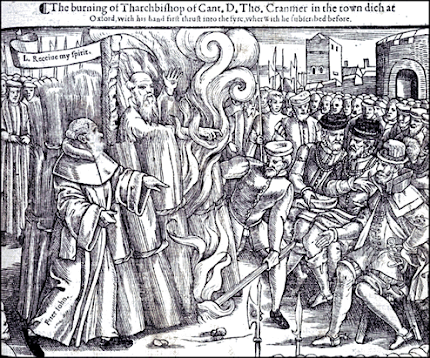
The burning of Tharchbishop of Cant. D. Tho. Cranmer in the town dich at Oxford, with his hand first thrust into the fyre, wherwith he subscribed before. [Click on the picture to see Cranmer's last words.]

Daily Bible Verse

Saturday, July 31, 2010

What Is the Difference Between Law and Gospel?

What is the difference between the law and the gospel?

Romans 4:16.

The universal depravity of our race is nowhere more evident than it is in the fact that we are all proud, self-righteous, legalists by nature. All men naturally cherish the foolish notion that we can, in some measure, atone for our sin and win God’s favor by our obedience to his law, or by some other works of righteousness we perform but it is all a vain delusion. It is this natural tendency toward self-righteousness and legalism that Paul constantly exposed and denounced. It was as common to the Gentiles as it was to the Jews. He declared as plainly to the Romans as he did to the Galatians, "that a man is justified by faith without the deeds of the law" (Galatians 3:28). Paul keeps insisting, in all his writings, that salvation is by faith alone, in Christ alone, that it might be by grace alone, without the works of human flesh. Paul opposed nothing so fully and constantly as he did legalism, and he opposed that in any form. He gave no place for the law in the house of faith (Read Galatians 4:21-31).

Why is the law/grace issue so important? The answer is obvious; Any mixture of law and grace is a total denial of grace (Romans 11:6). Almost all doctrinal error and religious heresy arise from man’s inability to distinguish between the law and the gospel. Blessed is the man who knows the difference between grace and works, gospel and law, very few do. The law says, "Do". The gospel says, "Done!" That is the difference. Legalism always attempts to wear the mask of grace but it always smells like works. The smell of the carcass is easily detected. Legalism will always enforce its claims, somewhere, with the promise of reward or the threat of punishment. It may talk about "love" and "faith", but legalism must have its "stick and carrot". At some point the legalist will either promise or threaten something, conditioned upon man’s obedience or disobedience. The gospel conditions everything on the Person and work of Christ alone!

From:  Free Grace

Monday, July 26, 2010

Sunday, July 25, 2010

Saturday, July 24, 2010

Gordon Fee Endorses N. T. Wright


I guess it's official. A leading Pentecostal scholar thinks N. T. Wright is great. It seems that any scholar who even remotely attacks the Protestant Reformation is on the side of the Pentecostals since the doctrines of grace, particularly Sola Scriptura, undermines the Pentecostal and  gnostic theology of super-spirituality.

Has Pietism Infiltrated Reformed Churches? What Is Pietism?

Bob DeWaay rightly points out in this enlightening article that any teaching that promises something extra to make someone an "elite" Christian is rightly called "pietism." In other words, most of this stuff originates in the higher life movement or the Wesleyan holiness movement. What is particularly alarming is that many Reformed churches and individuals are buying into pietism without realizing its connection with Pentecostal/Charismatic doctrine. As DeWaay points out:

The essence of pietism is this: It is a practice designed to lead to an experience that purports to give one an elite or special status compared to ordinary Christians. The Bible addresses this error in the book of Colossians.4 The false teachers in Colossae claimed to have the secret to a superior Christian experience that would cause people to rise above the bad “fate” they feared. Paul went on to explain that they already had everything they needed through Christ and His work on the cross. Another way of stating this is: If after having fully trusted Christ’s finished work on the cross, you are told that you are still lacking something, you are being taught pietism.

Church history is littered with misguided pietistic movements. Many of them are linked with mysticism. I will give examples later in this article. Pietism can be practiced many ways including enforced solitude, asceticism of various forms, man made religious practices, legalism, submission to human authorities who claim special status, and many other practices and teachings. The fact that pietism has many forms can be seen by the litany Paul gives in Colossians:
Many thanks to Paula Coyle for posting the link to this article on her wall at Facebook.  You can read the full article here:  How Pietism Deceives Christians:  The Errors of Elitist Teachings in the Church.

Tuesday, July 20, 2010

Re: Church authority and Scripture

Spencer said:  "And if you say, 'Because I have determined that their interpretation is in line with the Bible,' then you have set yourself up as the ultimate arbiter of doctrinal orthodoxy, and cannot consistently object to someone in your congregation doing the same and denying the doctrine of the Trinity."

Yes, just as you have set yourself up as the ultimate arbiter of doctrinal orthodoxy by choosing Rome.  The point you're ignoring is YOU are fallible.  So no matter what YOU choose, you are the ultimate arbiter of doctrinal orthodoxy and your choices are subjective.  There is no way around this.

The choice is not between your choice and Rome's choice.   Rather the choice is between two competing truth claims:  1)  Sola Scriptura and 2)  Sola Ecclesia.

If 2 then throw out your Bible and your brain and kiss some Roman Catholic's ass....

If 1 then find a church where the Scriptures are faithfully exegeted and in line with the Protestant Confessions of Faith, whether that be Lutheran or Reformed.

Simply because you "think" Rome is infallible because Rome "claims" to be infallible does not remove the fact that you are fallible and YOU could be wrong.  There is plenty of evidence in fact that Rome is not infallible but is mostly boasting  a false authority based on a mythological apostolic succession that cannot be substantiated in any meaningful way.

When confronted with opposing truth claims I go with the most obvious and the most easily substantiated one.  Since the Bible is readily available to even a common plow boy, I believe God would have us to follow Scripture rather than the traditions of men wearing costumes and who claim to have an authority that I cannot verify for myself.  It is no different from the Pentecostal who claims to have raised the dead.  It is basically an unfalsifiable claim and therefore illogical and irrational.

I suspect that the real reason you e-mailed me is that you are in fact a Roman Catholic who is simply baiting me.  You should be aware that a violation of the 9th commandment is a mortal sin:)

Besides, you totally ignored all the quotes I sent you from the Apostolic Fathers upholding the authority of Scripture:)

Sincerely yours,

Charlie

Reasonable Christian Blog Glory be to the Father, and to the Son : and to the Holy Ghost; Answer. As it was in the beginning, is now, and ever shall be : world without end. Amen. 1662 Book of Common Prayer

On 7/20/2010 4:52 PM, Spencer Hall wrote:
Charlie,

Thank you for the quick and in-depth reply. I appreciate your evident concern for my soul, and assure you that my object in this search is truth; and truth that is sought not merely in research but in prayer. You and I agree, no doubt, that the Lord hears those who call to Him and is "the rewarder of them that diligently seek Him," so I believe that whatever conclusion I come to, provided I continue in seeking Him, will be the truth. Whatever that conclusion is, I am happy to accept it.

I still have not quite found an answer to my question, however, in your explanation of how the Reformed Confessions function. I am aware that they function as THE authoritative doctrinal statements of the church in Reformed circles. Such was not my point; my point was this: "Whence do the Reformed Confessions derive their authority? And if you say, 'From Scripture,' then whose interpretation? And if you say, 'The interpretation of the Reformed churches,' then why choose that interpretation instead of the evangelical Arminian interpretation, or the Anglo-Catholic interpretation? And if you say, 'Because I have determined that their interpretation is in line with the Bible,' then you have set yourself up as the ultimate arbiter of doctrinal orthodoxy, and cannot consistently object to someone in your congregation doing the same and denying the doctrine of the Trinity."
You said that the doctrines of the church are subject to correction by the entire church, not by individuals. But what was the Reformation if not a break-off from the established visible church led by individuals? Martin Luther, John Calvin, and Thomas Cranmer were all popular individual figures who advocated their own personal interpretation of Scripture. The fact that we now have large ecclesiastical bodies backing each of their interpretations--the Lutheran, Presbyterian, and Reformed Anglican churches, respectively--does not change the fact that their theology originated as individual interpretations set against the teaching of the Church. In what principled way does an individual setting his interpretation against that of the Church now differ from an individual setting his interpretation against that of the Church then?

What I have just written above is addressing the point of the first email I sent you, and I believe most of what else you wrote, though helpful in its own way, was irrelevant to my point. However, I appreciate your bringing some of these issues up, because they are some other matters which I have also studied and am glad to hear your opinion on. You asked me a question, so I'll answer as best I can:

But let me ask you a question.  IF Rome "claims" to be an infallible interpreter of the Bible, how does that help YOU as an individual?  You are still fallible and so if someone "claims" to be infallible you have no way of interpreting what they say any more than you can interpret the Bible for yourself.  So what does it solve if you have an infinite line of infallible interpreters upon infallible interpreters to the nth degree?  That does not solve your dilemma as an individual because you have no way to infallibly determine whether they are in fact infallible or not.  All you have is their bare assertion of that.  You might be deceived!

This is a good question, but I would answer thus: Yes, I'm still fallible, and there is still a degree of "interpretation" of whatever information I receive--whether it's the Bible or the canons of the Council of Trent--but the Roman Church gives interpretations of the Bible, and, if necessary, interpretations of its interpretations for clearness. There has been a great deal of debate in Christendom over the meaning of Paul's teaching on justification, right? But where is the great amount of debate in Rome's fold over what Trent meant in stating how a man is justified, or defining the doctrine of transubstantiation? Sure there's debate in Rome over some things, but on the whole, her definitions (whether right or wrong) are quite clear--clearer than Scripture sometimes is.

Thanks for this, as well as your other emails. I would appreciate it though if we could keep the discussion in this exchange reasonably relevant to the two points we're currently discussing.

Pax Christi,

Spencer


On Tue, Jul 20, 2010 at 1:27 PM, Charlie J. Ray <cranmer1959@hotmail.com> wrote:
Spencer,

The Reformed Confessions function as THE authoritative doctrinal statements of the church in Reformed circles.  Anyone who denies the confession is excommunicated.  The difference is that we are HONEST about our church and confession by saying that they "may" have errors in them and are therefore subject to correction by the entire church, NOT by individuals.  Anyone who denies the trinity is excommunicated.  So how is that different from Rome?  They have no power to make people believe.  They can only excommunicate those who do not believe.  How does Rome guarantee orthodoxy?  It cannot since individuals believe what they will regardless.  There is only one who can convert the soul and regenerate a lost sinner--God Almighty!  (Titus 3:5-7; John 3:3-8; John 6:39-40, 44, 65).

But let me ask you a question.  IF Rome "claims" to be an infallible interpreter of the Bible, how does that help YOU as an individual?  You are still fallible and so if someone "claims" to be infallible you have no way of interpreting what they say any more than you can interpret the Bible for yourself.  So what does it solve if you have an infinite line of infallible interpreters upon infallible interpreters to the nth degree?  That does not solve your dilemma as an individual because you have no way to infallibly determine whether they are in fact infallible or not.  All you have is their bare assertion of that.  You might be deceived!  (2 Corinthians 11:13-15).

The LORD saw that the wickedness of man was great in the earth, and that every intention of the thoughts of his heart was only evil continually. 6 And the LORD was sorry that he had made man on the earth, and it grieved him to his heart. 7 So the LORD said, "I will blot out man whom I have created from the face of the land, man and animals and creeping things and birds of the heavens, for I am sorry that I have made them." 8 But Noah found favor in the eyes of the LORD. (Genesis 6:5-8 ESV)

Notice it does not say Noah was righteous in and of himself.  It says, "But Noah found favor in the eyes of the Lord."  Noah and his sons were sinners and as soon as the flood was over sin again takes over the world and Noah and his family sinned just as before--despite the fact that God calls Noah "righteous."  (See Genesis 6:9-22; Genesis 9:20-29).  So how did Noah find favor and why is Noah "righteous"?  It is by faith alone!  (Romans 1:16).

Getting back to your original test of orthodoxy, the real issue is what we can know for sure about the teaching of Jesus and the original apostles.  Oral traditions can be corrupted over time, particularly when sinful men revise and re-interpret them over time.  But what is written down is inspired of God and recorded so that all man hear or read and be without excuse.  The Catholic Church for all practical purposes negates Scripture and invents religion as they go along.  God's Word NEVER changes.  It is forever settled in the heavens.  

 Forever, O LORD, your word is firmly fixed in the heavens. (Psalm 119:89 ESV)

You search the Scriptures because you think that in them you have eternal life; and it is they that bear witness about me, 40 yet you refuse to come to me that you may have life. (John 5:39-40 ESV)
 Subjectivism is still a problem even if you become a Roman Catholic only now you have more to keep up with instead of just the Bible and the church's confession of faith.  Now you have to read the Roman Catholic Catechism, the various Papal Bulls, the exhaustive teaching of the RCC wherever you find it.  On the other hand, to be saved all you need to do is to believe the Bible and find a Gospel preaching church where there is a solid confesson of faith.  Either way, you're on your own.  The bottom line is this, however:  which church is faithful to Scripture?  By its own admission Rome is NOT faithful to Scripture but rather to their own leaders who falsely claim to be in apostolic succession and inspired of God.   There is no way to verify any allleged succession except to believe it by faith on their word.  I would rather trust God than to trust men.

Now, the bottom line here is I cannot elect, regenerate or call you or justify you.  Only God can do that.  However, when you stand before God and you are condemned because you went over to a false church with an antichrist leading it, do not complain to God that you did not know.   You have been warned.

They went out from us, but they were not of us; for if they had been of us, they would have continued with us. But they went out, that it might become plain that they all are not of us. (1 John 2:19 ESV)

 To the teaching and to the testimony! If they will not speak according to this word, it is because they have no dawn. (Isaiah 8:20 ESV)

 Yes, to this day whenever Moses is read a veil lies over their hearts. (2 Corinthians 3:15 ESV)
The only way to spot a counterfeit is to study the real thing.  (Acts 17:11).  In fact, the reason you're asking this question in the first place is that you have forsaken God's word and "opened" yourself up to be deceived.  The only way to know the truth is to know God's word, which is sufficient to save and the only way you can know God's will.  Everything else, including Rome, is subject to correction.

This charge I entrust to you, Timothy, my child, in accordance with the prophecies previously made about you, that by them you may wage the good warfare, 19 holding faith and a good conscience. By rejecting this, some have made shipwreck of their faith, 20 among whom are Hymenaeus and Alexander, whom I have handed over to Satan that they may learn not to blaspheme. (1 Timothy 1:18-20 ESV)

 
Sincerely in Christ,

Charlie


Reasonable Christian Blog Glory be to the Father, and to the Son : and to the Holy Ghost; Answer. As it was in the beginning, is now, and ever shall be : world without end. Amen. 1662 Book of Common Prayer

On 7/20/2010 12:39 PM, Spencer Hall wrote:
Hello Charlie,

I am a Protestant currently considering converting to either the Catholic or Orthodox Church. I have been a reader and commenter at Called to Communion for some time now, and found your blog after you started commenting there a few days ago. I am trying to communicate with both Catholics and Protestants before making a decision, to ensure that I have heard both sides fairly and can judge well between them, and had a question for you pertaining to Church authority and Scripture.

I have looked around on your blog a little bit and am aware that you are a Reformed Anglican, and thus have a confessionalist view of Scripture and the Church. Confessionalism seems to me to be the best form of Protestantism, but it seems to present a difficult dilemma for those who, like yourself, insist on sola scriptura: How would you respond to someone who was a member of your church and began teaching that the Trinity was an unbiblical doctrine, and was just as much a borrowing from Greek philosophy as you believe transubstantiation to be? If you tell him that he is reading Scripture contrary to the Reformed Anglican church's confessional understanding of it, and that he should revise his interpretation so that it fits with that, then how is that different from Rome's demand for doctrinal conformity regardless of one's own reading of Scripture? And since you cannot consider your confessions to be invested with any intrinsic authority, but only to have authority insofar as they conform with Scripture, and since this man is saying that they do not conform with Scripture on this point, then you cannot really appeal to the confessions as having some sort of authority that should regulate his reading of Scripture. But if you tell him that he has a right to private judgment and should come to his own interpretation of Scripture, then you have essentially legitimatized any opinion someone forms based on their reading of Scripture, and that destroys all foundation for orthodoxy. So what would you tell him? How can you insist on confessionalism and yet insist on sola scriptura as well?

Thanks for your time. Pax Christi,

Spencer

What Do We Mean by Sola Scriptura?

What Do We Mean by
Sola Scriptura?

by Dr. W. Robert Godfrey


There are two main issues that divide Protestant Catholics from Roman Catholics. Both groups claim to be catholic, that is, part of the apostolic, universal church of Jesus Christ. Roman Catholics believe we Protestants departed from that church in the sixteenth century. Protestant Catholics believe they departed earlier.

The theme of this opening chapter is one of the issues that still divides us: the source of religious truth for the people of God. (The other main issue, that of how a man is made right with God, has been dealt with in the book Justification by Faith ALONE!, published by Soli Deo Gloria in 1995.) As Protestants we maintain that the Scripture alone is our authority. Our Roman opponents maintain that the Scripture by itself is insufficient as the authority of the people of God, and that tradition and the teaching authority of the church must be added to the Scripture.

This is a solemn topic. This is no time for games. We must be searching for the truth. God has declared that whoever adds to or takes away from His Word is subject to His curse. The Roman church has declared that we Protestants are accursed (“anathematized”) for taking away the Word of God as found in tradition. We Protestants have declared that the Roman church is a false church for adding human traditions to the Word of God. Despite sincere debates by fine apologists over the course of nearly 500 years, the differences remain basically as they were in the sixteenth century. I will not say much new here, but we must continue to pursue the truth.

In spite of the difficulty of this undertaking, I am eager to join that historic train of Protestant apologists to defend the doctrine that the Scripture alone is our ultimate religious authority. I believe that it can be shown that this position is the clear position of Scripture itself. And I hope that, by the grace of God, those committed to the Roman doctrine of tradition will come to see the tragic error of denigrating the sufficiency and perspicuity of God’s own inspired Word.

Let me begin with certain clarifications so as not to be misunderstood. I am not arguing that all truth is to be found in the Bible, or that the Bible is the only form in which the truth of God has come to His people. I am not arguing that every verse in the Bible is equally clear to every reader. Nor am I arguing that the church — both the people of God and the ministerial office — is not of great value and help in understanding the Scripture. As William Whitaker stated in his noble work: “For we also say that the church is the interpreter of Scripture, and that the gift of interpretation resides only in the church: but we deny that it pertains to particular persons, or is tied to any particular see or succession of men.”1

The Protestant position, and my position, is that all things necessary for salvation and concerning faith and life are taught in the Bible clearly enough for the ordinary believer to find it there and understand.

The position I am defending certainly is what is taught in the Bible itself. For example, Deuteronomy 31:9 states: “Moses wrote down this law. . . .” Moses instructed the people by writing down the law and then ordering that it be read to them “so they can listen and learn to fear the Lord your God and follow carefully all the words of this law,” Deuteronomy 31:9, 12.

Moses declared to all Israel: “Take to heart all the words I have solemnly declared to you this day, so that you may command your children to obey carefully all the words of this law. They are not just idle words for you, they are your life,” Deuteronomy 32:46, 47.

Notice the clear elements in these passages:

  1. The Word of which Moses spoke was written.
  2. The people can and must listen to it and learn it.
  3. In this Word they can find life.

The people do not need any additional institution to interpret the Word. The priests, prophets, and scribes of Israel certainly function to help the people ministerially. But the Word alone was sufficient for salvation. The prophets, who were indeed inspired, came very much in the spirit of Micah who said, “He has shown you, O man, what is good,” Micah 6:8. The function of the prophets and priests was not to add to or even clarify the law; rather, they applied it to the people who were sinfully indifferent.

If this principle of the sufficiency and clarity of the Word is true in the Old Testament, we can assume that it is all the more true in the New. The New Testament gloriously fulfills what the Old Testament promises. But we do not have to assume it; rather, the New Testament makes clear that the character of Scripture is to be sufficient and clear. One example of that is found in 2 Timothy 3, 4. Here Paul writes to his younger brother in the faith, Timothy. He writes that Timothy — who was instructed in the faith by his mother and grandmother — has also learned all about Paul’s teaching (3:10). Timothy has been mightily helped by all sorts of oral teaching, some of it apostolic. Yet Paul writes these words to Timothy:

And indeed, all who desire to live godly in Christ Jesus will be persecuted. But evil men and impostors will proceed from bad to worse, deceiving and being deceived. You, however, continue in the things you have learned and become convinced of, knowing from whom you have learned them; and that from childhood you have known the sacred writings which are able to give you the wisdom that leads to salvation through faith which is in Christ Jesus. All Scripture is inspired by God and profitable for teaching, for reproof, for correction, for training in righteousness; that the man of God may be adequate, equipped for every good work. I solemnly charge you in the presence of God and of Christ Jesus, who is to judge the living and the dead, and by His appearing and His kingdom: preach the word; be ready in season and out of season; reprove, rebuke, exhort, with great patience and instruction. For the time will come when they will not endure sound doctrine; but wanting to have their ears tickled, they will accumulate for themselves teachers in accordance to their own desires; and will turn away their ears from the truth, and will turn aside to myths. But you, be sober in all things, endure hardship, do the work of an evangelist, fulfill your ministry. (2 Timothy 3:12; 4:5)

You see, Paul reminds Timothy that the Scriptures are able to make him wise unto salvation in Christ Jesus (2 Timothy 3:15). He teaches that the Scriptures are useful for teaching, reproof (rebuking), correcting, and training in righteousness (2 Timothy 3:16). Because the Scriptures have this character, they thoroughly equip the man of God for every good work (2 Timothy 3:17). So Paul tells Timothy that he must preach this Word, even though the time is coming when people will not want to hear it, but rather will want teachers to suit their fancy, who will instruct them in myths rather than the truth of the Word (2 Timothy 4:1-4).

The force and clarity of the Apostle’s teaching here are striking. In spite of the rich oral teaching Timothy had, he is to preach the Scriptures because those Scriptures give him clearly all that he needs for wisdom and preparation to instruct the people of God in faith and all good works. The Scripture makes him wise for salvation, and equips him with everything he needs for doing every good work required of the preacher of God. The sufficiency and clarity of the Word are taught in this one section of Scripture over and over again. John Chrysostom paraphrased the meaning of Paul’s words to Timothy this way: “You have Scripture for a master instead of me; from there you can learn whatever you would know.”2

I have listened to several taped debates on this topic. Often Protestant apologists have cited 2 Timothy 3 against Roman opponents. The usual response of Catholic apologists is to repeatedly assert that 2 Timothy 3 does not teach sufficiency. Sometimes they will refer to James 1:4, Matthew 19:21, or Colossians 1:28 and 4:12 as parallel texts, claiming that the word “complete” in 2 Timothy 3:17 does not mean sufficient. But such passages are not parallel; a completely different Greek word is used. Where 2 Timothy 3:17 uses exartizo, which has to do with being fitted for a task, these other passages use the Greek word teleios, which has reference to maturity or having reached a desired end.

Repeated assertions do not prove a point; that is only a propaganda technique. Our opponents need to answer in a responsible, thorough way.

The confidence that Paul had in the Scriptures, and which he taught Timothy, was clearly understood by the great church father, Augustine. In his treatise to prepare leaders of the church in an understanding of the Bible (0n Christian Doctrine), Augustine wrote: “Among those things which are said openly in Scripture are to be found all those teachings which involve faith, the mores of living, and that hope and charity which we have discussed.”3

We should not be surprised that the Apostle Paul, the Old Testament, and the greatest teacher of the ancient church held to the sufficiency and perspicuity of Scripture. It is the position that Jesus took in one of the most important moments of his life. At the beginning of his public ministry, Jesus faced the focused temptation of the devil in the wilderness. He faced the temptation as the Son of God, but also as the second Adam and the true Israel. And how did He face that temptation? He did not appeal to the oral tradition of Israel; He did not appeal to the authority of the rabbis or Sanhedrin; He did not even appeal to His own divinity or the inspiration of the Holy Spirit. Our Savior, in the face of temptation, turned again and again and again to the Scriptures. “It is written,” He said.

The Scriptures made Him wise; they equipped Him for every good work. They were clear, as He implied that even the evil one knew. When the devil quoted the Scripture, Jesus did not turn to some other authority. Rather Jesus said, “It is also written.”

When the evil one or his representatives misuse the Bible, or imply that it is unclear, Jesus teaches us that we must look more deeply into the written Word, not away from it.

Roman apologists will attempt to convince us that these texts of Scripture do not mean what they clearly say. Let me anticipate some of their arguments and prepare you for some of the ways they tend to respond.

1. The Word of God. First, they will try to say that the phrase “the Word of God” can mean more than just the Bible. I have already granted that. The question before us is whether today anything other than the Scriptures is necessary to know the truth of God for salvation. The Scripture texts I have cited show that nothing else is needed. Our opponents need to show not that Paul referred to his preaching as well as his writing as the Word of God — I grant that; they need to show that Paul taught that the oral teaching of the apostles would be needed to supplement the Scriptures for the Church through the ages. They cannot show that because Paul did not teach that, and the Scriptures as a whole do not teach that!

2. Tradition. Our Roman opponents, while making much of tradition, will never really define tradition or tell you what its content is. Tradition is a word that can be used in a variety of ways. It can refer to a certain school of understanding the Scriptures, such as the Lutheran tradition. It can refer to traditions — supposedly from the apostles — that are not in the Bible. It can refer to developing traditions in the history of the church that are clearly not ancient in origin. Usually, in the ancient fathers of the church, the word “tradition” refers to the standard interpretation of the Bible among them. And we Protestants value such traditions.

But what do Roman apologists mean when they assert the authority of tradition? Historically, they have not agreed among themselves about the nature and content of tradition. For example, one has said that tradition does not add anything to Scripture. But almost all Roman apologists, for over three hundred years after the Council of Trent, argued that tradition does add to the Scriptures. Some Roman apologists believe that all binding tradition was taught by the apostles, while others believe that tradition evolves and develops through the centuries of the church so that there are traditions necessary for salvation that were never known to the apostles. It is impossible to know what the real Roman position is on this matter.

The Second Vatican Council expressed itself with deliberate ambiguity: “This tradition which comes from the apostles develops in the Church with the help of the Holy Spirit. For there is a growth in the understanding of the realities and the words which have been handed down. . . . For as the centuries succeed one another, the Church constantly moves forward toward the fulness of divine truth until the words of God reach their complete fulfillment in her.”4 What does that mean? It certainly does not give us any clear understanding of the character or content of tradition.

Rome usually tries to clarify its position by saying that its authority is Scripture, tradition, and church together. Vatican II declared: “It is clear, therefore, that sacred tradition, sacred Scriptures and the teaching authority of the Church, in accord with God’s most wise design, are so linked and joined together that one cannot stand without the others, and that all together and each in its own way under the action of the one Holy Spirit contribute effectively to the salvation of souls.”5

In fact, however, if you listen carefully, you will notice that the real authority for Rome is neither Scripture nor tradition, but the church. What is the Scripture, and what does it teach? Only the church can tell you. What is tradition, and what does it teach? Only the church can tell you. As the Roman theologian John Eck said, “The Scriptures are not authentic, except by the authority of the church.”6 As Pope Pius IX said at the time of the First Vatican Council in 1870, “I am tradition.”7 The overwhelming arrogance of such a statement is staggering. But it confirms our claim that, for Rome, the only real authority is the church: sola ecclesia.

Now Protestantism arose in the sixteenth century in reaction to such claims and teachings of the Roman church. In the Middle Ages, most within the church had believed that the Bible and the tradition of the church taught the same, or at least complementary, doctrines. But as Luther and others studied the Bible with a greater care and depth than the church had done in centuries, they began to discover that tradition actually contradicted the Bible. They discovered that, for example:

    (1) The Bible teaches that the office of bishop and presbyter are the same office (Titus 1:5-7), but tradition says they are different offices.

    (2) The Bible teaches that all have sinned except Jesus (Romans 3:10-12, Hebrews 4:15), but tradition says that Mary was sinless.

    (3) The Bible teaches that Christ offered His sacrifice once for all (Hebrews 7:27, 9:28, 10:10), but tradition says that the priest sacrifices Christ on the altar at mass.

    (4) The Bible says that we are not to bow down to statues (Exodus 20:4, 5), but tradition says that we should bow down to statues.

    (5) The Bible says that all Christians are saints and priests (Ephesians 1:1; 1 Peter 2:9), but tradition says that saints and priests are special castes within the Christian community.

    (6) The Bible says that Jesus is the only Mediator between God and man (1 Timothy 2:5), but tradition says Mary is co-mediator with Christ.

    (7) The Bible says that all Christians should know that they have eternal life (1 John 5:13), but tradition says that all Christians cannot and should not know that they have eternal life.

The Reformers saw that the words of Jesus to the Pharisees applied equally to their day: “You nullify the Word of God for the sake of your tradition” (Matthew 15:6).

The Reformers also discovered that tradition contradicted tradition. For example, the tradition of the Roman church teaches that the pope is the head of the church, a bishop over all bishops. But Gregory the Great, pope and saint at the end of the ancient church period, said that such a teaching came from the spirit of Antichrist (“I confidently affirm that whosoever calls himself sacerdos universalis, or desires to be so called by others is in his pride a forerunner of Antichrist”)8

More directly related to our discussion is the evident tension in tradition about the value of reading the Bible. The Index of Forbidden Books of Pope Pius IV in 1559 said:

Since experience teaches that, if the reading of the Holy Bible in the vernacular is permitted generally without discrimination, more damage than advantage will result because of the boldness of men, the judgment of the bishops and inquisitors is to serve as guide in this regard. Bishops and inquisitors may, in accord with the counsel of the local priest and confessor, allow Catholic translations of the Bible to be read by those of whom they realize that such reading will not lead to the detriment but to the increase of faith and piety. The permission is to be given in writing. Whoever reads or has such a translation in his possession without this permission cannot be absolved from his sins until he has turned in these Bibles.9

In marked contrast, Vatican II stated: “Easy access to sacred Scripture should be provided for all the Christian faithful. . . Since the word of God should be available at all times, the Church with maternal concern sees to it that suitable and correct translations are made into different languages, especially from the original texts of the sacred books.”10 Does tradition believe that the Bible is dangerous or helpful? The Bible did prove dangerous in the sixteenth century; most who read it carefully became Protestants!

Such discoveries about tradition led the Reformers back to the Bible. There they learned that the Scriptures must stand as judge of all teaching. The Scripture teaches that it is the revelation of God, and is therefore true in all that it teaches. But nowhere does the Scripture say that the church is true in all it says. Rather, although the church as a whole will be preserved in the faith, wolves will arise in the church (Acts 20:29, 30), and even the man of lawlessness will sit at the heart of the church teaching lies (2 Thessalonians 2:4).

3. This brings us to our third concern, the church and the canon. Our Roman opponents will use the word “ church” repeatedly. Those of us who are Protestants will normally be inclined to interpret their use of the word “church” as referring to the body of the faithful. But that is not the way they characteristically use the word. When they refer to the authority of the church, they mean the infallible teaching authority of councils and popes. That view of the church they take from the Middle Ages and in a romantic way read back into the ancient church period. So notice very carefully how they use the word “church.” And remember that neither the Scriptures, nor the great majority of the fathers of the ancient church period, understand the authority of the church in the way they do.

Let me offer as an illustration two examples from the work of Augustine, often quoted against the Protestant position on the question of the authority of the church. At one point in his debate with the Pelagians, a bishop of Rome sided with Augustine, and Augustine declared, “Rome has spoken, the matter is settled.” Later, however, another pope opposed Augustine on this subject, and Augustine responded by saying, “Christ has spoken, the matter is settled.” Augustine did not bow to the authority of the bishop of Rome, but turned to the word of Christ to evaluate the teaching of Rome.

Another statement of Augustine’s, often cited by Roman apologists, reads: “I would not have believed had not the authority of the catholic church moved me.” That seems very strong and clear. But in another place Augustine wrote: “I would never have understood Plotinus had not the authority of my neo-Platonic teachers moved me.” This parallel shows that Augustine is not talking about some absolute, infallible authority in the church, but rather about the ministerial work of the church and about teachers who help students understand.

Let us look at the church further by raising a related issue: the canon of Scripture. Romanists will try to make much of the issue of the canon. They will tell you that the Bible alone cannot be our authority because the Bible does not tell us what books are in the Bible. They will argue that the church must tell us what books are in the Bible. When they say the church tells us, they mean popes and councils must tell us. This implies that we did not have a Bible until Pope Damasus offered a list of the canon in 382, or, perhaps, until 1546 when the Council of Trent became the first “ecumenical”council to define the canon. But of course the people of God had the Bible before 1546 and before 382.

In the first place, the church always had Scripture. The apostolic preaching and writing of the first century repeatedly verified its teaching by quoting from the Old Testament. The quotations from, and allusions to, the Old Testament abound in the New Testament. The New Testament does not reject the Old, but fulfills it (Romans 1:2; Luke 16:29; Ephesians 2:19, 20). The church always had a canonical foundation in the Old Testament.

In the second place, we can see that the apostles sensed that the new covenant inaugurated by our Lord Jesus would have a new or augmented canon. Canon and covenant are interrelated and interdependent in the Bible (see Meredith G. Kline, The Structure of Biblical Authority). Peter testifies to this emerging canon when he includes the letters of Paul as part of the Scriptures (2 Peter 3:16).

In the third place, we must see that the canon of Scripture is, in a real sense, established by the Scripture itself, because the canonical books are self-authenticating. As God’s revelation, they are recognized by the people of God as God’s own Word. As Jesus said, “I am the good shepherd; I know My sheep and My sheep know Me. They . . . will listen to My voice” (John 10:14-16). In the deepest sense we cannot judge the Word, but the Word judges us. “For the word of God is living and active. Sharper than any double-edged sword, it penetrates even to dividing of soul and spirit, joints and marrow; it judges the thoughts and attitudes of the heart” (Hebrews 4:12). The self-authenticating character of the canon is demonstrated by the remarkable unanimity reached by the people of God on the canon.

In the fourth place, we must see that historically the canon was formed not by popes and councils; these actions simply recognized the emerging consensus of the people of God as they recognized the authentic Scriptures. Indeed, whatever criteria were used by popes and councils to recognize the canon (authorship, style, content, witness of the Spirit, etc.), these same criteria were available to the people of God as a whole.

We can see this basic understanding of the formation of the canon stated in The New Catholic Encyclopedia which states: “The canon, already implicitly present in the apostolic age, gradually became explicit through a number of providential factors forming and fixing it.”11

We can also see this basic approach to the canon reflected in the words of Augustine, writing in his important treatise entitled On Christian Doctrine. This treatise was written between 396 and 427 — after the supposedly authoritative decision of Pope Damasus on the canon, and after a council held in Hippo had discussed the canon. Augustine wrote:

In the matter of canonical Scriptures he should follow the authority of the greater number of catholic Churches, among which are those which have deserved to have apostolic seats and receive epistles. He will observe this rule concerning canonical Scriptures, that he will prefer those accepted by all catholic Churches to those which some do not accept; among those which are not accepted by all, he should prefer those which are accepted by the largest number of important Churches to those held by a few minor Churches of less authority. If he discovers that some are maintained by the larger number of Churches, others by the Churches of weightiest authority, although this condition is not likely, he should hold them to be of equal value.12

This statement shows that Augustine did not look to popes or councils for the solution of the question of the canon. He recognized the variety among churches, and the appropriateness of a plurality of churches. He urged all students of Scripture to examine the question and to look for the emerging consensus among the people of God. Like Augustine, we do not disparage the value of the witness of the people of God to the canon. We value the ministry of the church in this as in all things. But we deny that the church in its offices or councils authoritatively establishes the Scripture on the basis of some knowledge or power not available to Christians generally. The character of the canonical books draws the people of God to them.

4. Unity. Notice how Catholics use the word “unity.” They will suggest that we Protestants disprove our claim of the clarity of the Scripture by our failure to agree about the meaning of the Scripture. We recognize that Protestants are divided into various denominations. But all Protestants who are heirs of the Reformation are united in understanding the gospel and in respecting one another as brothers in Christ. We have all found the same gospel clearly in the Bible.

When we discuss unity and authority, let us be certain that we are making fair and accurate comparisons. Our Roman opponents will want to compare Roman theory with Protestant practices. That is not fair. We must compare theory with theory or practice with practice. In practice, neither group has the agreement we should have. Remember that while Rome is united organizationally, it is just as divided theologically as is Protestantism broadly understood. The institution of an infallible pope has not created theological unity in the Roman church. Rather, Roman theologians are constantly disagreeing with each other as to what the popes have taught, and as to whether those teachings are in fact proclaimed ex cathedra, and are therefore infallible. The modern state of the Roman church really has shown that the institution of the papacy has not made clear the necessary content of Christian truth. I suspect that every honest member of the Roman church will have to acknowledge that.

As early as the seventeenth century the Reformed theologian Francis Turretin noted the serious theological divisions in the Roman church and asked why the pope did not settle these disputes if his office was so effective.13 Such theological problems are certainly much greater today than in Turretin’s day and the question remains unanswered as to why the pope is so ineffective.13

We should not be surprised that there are divisions in the church. Christ and His apostles predicted that there would be. The Apostle Paul told us that such divisions are useful. He wrote: “No doubt there have to be differences among you to show which of you have God’s approval” (1 Corinthians 11:19). Differences should humble us and drive us back to the Scriptures to test all claims to truth. If we do not accept the Scriptures as our standard and judge, there is indeed no hope for unity.

The church must have a standard by which to judge all claims to truth. The church must have a standard of truth by which to reform and purify itself when divisions arise. The church cannot claim that it is that standard and defend that claim by appealing to itself. Such circular reasoning is not only unconvincing; it is self-defeating. Rome’s argument boils down to this: we must believe Rome because Rome says so.

The Bible tells us that the Word of God is the light that enables us to walk in the ways of God. Listen to Psalm 119:99, 100, 105, 130: “I have more insight than all my teachers, for I meditate on Thy statutes. I have more understanding than the elders, for I obey Thy precepts. Thy word is a lamp unto my feet and a light for my path. The unfolding of Thy words gives light; it gives understanding to the simple.”

Roman opponents usually object to an appeal to Psalm 119 on the grounds that it speaks of the Word of God, not of the Bible, and therefore could include in its praise tradition as well as Scripture. But their argument is irrelevant to our use of Psalm 119, because we are using it to prove the clarity, not the sufficiency of Scripture! The Psalmist is saying here that the light of the Word shines so brightly and clearly that if I meditate on it and obey it, I am wiser than any teacher or elder. The simple can understand it. The Word is like a strong flashlight in a dark forest. It enables me to walk on the path without tripping.

We must listen to the Scriptures so that we will act as God’s Word teaches us to act. Consider the story of Paul in Berea, Acts 17:10-12. Paul preached there in the synagogue and many Jews responded to his preaching with eagerness. We are told that after they listened to Paul each day they examined the Scriptures to see if what Paul said was true. How did Paul react? Did he say that the Scriptures were not clear, and that only he as an apostle or the rabbis or the Sanhedrin could tell them what the Scriptures really meant? Or did he say that they should not expect to find the truth in the Scriptures because they were incomplete and needed to be supplemented by tradition? Or did he say that they were insulting his apostolic authority, and that they should simply submit to him as the infallible interpreter of the Bible? Or did Paul say that they should defer to Peter as the only one who could interpret the Bible? No! He did not say any of these things. The practice of the Bereans is praised in the Bible. They are called noble because they evaluated everything on the basis of the written Word of God.

If we would be faithful children of God, if we would be noble, we must proceed as the Bereans did. We must follow the example of Moses and Paul and our Lord Jesus. Do not rest your confidence on the wisdom of men who claim infallibility. Stand rather with the Apostle Paul who wrote in 1 Corinthians 4:6, "Do not go beyond what is written."


NOTES

  1. William Whitaker, A Disputation on Holy Scripture (Cambridge,: University Press, 1849) P. 411.
  2. Cited in Whitaker, p. 637.
  3. Augustine, On Christian Doctrine trans. by D.W. Roberston, Jr. (New York: Liberal Arts Press, 1958) 11:9.
  4. The Documents of Vatican II, ed. waiter M. Abbott (New York: Herden and Herden, 1966) p. 116. Dei Verbum, 8.
  5. Ibid., p. 118.
  6. John Eck, Enchiridion of Commonplaces, trans. by Ford Lewis Battles, (Grand Rapids: Baker, 1979) P. 13.
  7. Jesef Rupert Geiselmann, The Meaning of Tradition (Montreal: Palm Publishers, 1966)p. 16, note on pp. 113,114.
  8. Cited in Cambridge Medieval History, section written by W. H. Hutton, edited by H. M. Gwatkin and J. P. Whitney,(New York: The MacMillan Co., 1967) 11:247.
  9. James Townley, Illustrations of Biblical Literature, Vol. 2 (London: printed for Longman, Hurst, Rees, Orme, and Brown, 1821) p. 481
  10. Documents of Vatican II, PP. 125,126.
  11. Cited in a tape by William Webster entitled “The Canon,” available from Christian Resources, 304 West T Street, Battleground, WA 98604. This tape is part 3 of a 16 tape series entitled Roman Catholic Tradition: Its Roots and Evolution.
  12. On Christian Doctrine, Book 2 section VIII, trans. by D. W. Roberston, Jr. (New York.: Liberal Arts Press, 1958) p. 41.
  13. Francis Turretin, Institutes of Elenctic Theology, Vol. 1, trans. by George Musgrave Giger, ed. by James T. Dennison, Jr. (Phillipsburg: P & R, 1992) p. 156.

Author

Dr. W. Robert Godfrey is President of Westminster Theological Seminary in Escondido, California. He is also Professor of Church History. He received the A.B., M.A., and Ph.D. degrees from Stanford University, and the M.Div. degree from Gordon-Conwell Theological Seminary. He has taught at Westminster Theological Seminary (both in Pennsylvania and California) for over twenty years. He is an ordained minister in the Christian Reformed Church. Dr. Godfrey was a contributor to John Calvin: His Influence on the Western World; Reformed Theology in America; and Scripture and Truth. He edited the Westminster Theological Journal for several years, and is a frequent speaker at Christian conferences. Dr. Godfrey is a native of California. He and his wife Mary Ellen have three children: William, Mari, and Robert.

___________________________

 This article originally appeared as Chapter I in Sola Scriptura! The Protestant Position on the Bible, Don Kistler, General Editor and published by Soli Deo Gloria Publications.


Return to the Home Page Return to the Main Highway 

Return to Calvinism and the Reformed Faith Index Return to Calvinism and the Reformed Faith Index

Return to Roman Catholicism Archive Return to the Roman Catholic Archive

Go to the Resource Page

:-) <——

--
Reasonable Christian Blog Glory be to the Father, and to the Son : and to the Holy Ghost; Answer. As it was in the beginning, is now, and ever shall be : world without end. Amen. 1662 Book of Common Prayer

Former Reformed Believers Commit Apostasy: The "Called to Communion" Deception

I should not be surprised when I hear of those who have departed from the faith that comes from our Lord Jesus Christ and have worshipped idols and prayed to dead saints. But then it is surprising when those who once knew the truth suddenly endorse paganism and superstition posing as biblical Christianity. Actually, I should not say "biblical" because Roman Catholicism places all of its authority in itself as the final authority. Rome claims the power to infallibly rule in doctrinal matters and therefore has the authority to tell its followers what "tradition" teaches--even if what they say cannot be found except in extremely "implicit" form. Rome also claims to have the infallible power to interpret Scripture. In other words, the Bible is irrelevant and you must listen to Rome, the pope and the Roman Catholic Church. What am I talking about? I'm speaking about the Called to Communion: Reformation Meets Rome blog.

What is typical of cults and drug dealers is the same approach used by the former Evangelicals and Calvinists who have converted to Roman Catholicism. Their basic argument is, "You should be open." Now that is interesting. I wonder if these former Evangelicals think that we should be "open" to Buddhism or Mormonism? Should we be "open" to joining the Universalist Church? Of course not. But that is what they want Evangelicals to do regarding Roman Catholicism. Why would a Bible believing Evangelical want to be "open" to a church that teaches another gospel, superstitious prayers to dead saints, and veneration of bread and wine as if the elements were the virtual body and blood of Christ and other heresies?

Heresy is always subtle and deceptive. A case in point is the title of their blog, which implies that the Protestant Reformation has something in common with Rome, which is far from the case. The other implication is that Protestants are "called to communion" with Rome. Again, that is far from true as well. What do I mean? First of all, joining with any church does not and never will save anyone whatsoever. Salvation is completely of the Lord, end of story. (See Psalm 37:39 KJV).

A favorite tactic of cults is to pretend they are a Christian organization. The naive are then led in by deception. The same tactic is used by former Evangelicals in the Roman Catholic Church. They will redefine terms used by Evangelicals and Reformed churches to make it seem as if they believe the same things we do as Bible believers. Once a rapport is established the wolf will lead the naive sheep further and further from the safety of the flock until it is isolated. At this point the wolves proceed to devour the helpless sheep. This is exactly the tactic being employed at the Called to Communion blog.

For example, Roman Catholics will often say that they believe in justification by faith. Anglo-Catholics and Tractarians likewise make this claim. But this is a subtle trick I call "bait and switch." There is just enough truth in the claim that on the surface it appears to be true. But just as rat poison is 95% real food and 5% poison it is the 5% of deception that destroys the genuine Gospel and replaces it with another gospel that is no gospel at all. (Galatians 1:6-8; 2 Corinthians 11:3-4).

Just what is the biblical doctrine of justification by faith alone? Stated simply, it comes down to this. "God commands us to do what we are unable to do." What do I mean? First of all, God requires absolute obedience without any deviation, rebellion, omission, or ignorance. Adam failed to obey God and the consequences of his disobedience affected all of his descendants from that point in time on. Since the fall of Adam everyone is born a sinful rebel who sins from the time we are able to make willful choices. (Psalm 58:3; Psalm 51:4-5; Romans 3:10-23). And even before that we are charged with Adam's original sin because Adam is our federal head who represented all of us. (Romans 5:12-21). In fact, Scripture affirms our own accountability for our sins that we willfully choose to do but Scripture also affirms that sin is passed down through heredity, example, and a corrupt nature (See Genesis 6:5; Exodus 34:7; Leviticus 26:39; Isaiah 14:20; Jeremiah 3:25; Lamentations 5:7). So when God commands us to be absolutely obedient we are unable to do so because we are born in slavery to sin. (John 8:30-34, 44; Romans 6:6).

Since it is therefore impossible for us to meet God's absolute command to perfection (Deuteronomy 27:26; Galatians 3:10-12; Galatians 5:4; Ezekiel 18:4; Matthew 5:17-20, 48), God Himself decreed to make another way of salvation (John 14:6). That way is not working or meriting our own righteousness but fully trusting in Christ and Christ alone to save us. We do not go about establishing our own righteousness (Romans 10:1-4). Rather we are credited with a foreign righteousness that is not our own. God as our Judge declares us righteous based on the active obedience of Christ in our place and on His taking the penalty of the law in our place. This is called the active and passive obedience of Christ (Romans 5:1-2). (See Active and Passive Obedience). Moreover, God justifies His elect by regenerating them (John 3:3-8, by giving them the gift of faith (Ephesians 2:8-9), and by imputing to them the righteousness or justification which is by faith alone (Romans 4:1-8). In fact, God does not justify "godly" people but those who are "ungodly"!

And to the one who does not work but believes in him who justifies the ungodly, his faith is counted as righteousness, (Romans 4:5 ESV) (Compare: Romans 3:10-12; Romans 20-24; Romans 1:16; Luke 5:31-32).

Pelagians have a hard time explaining why everyone sins if everyone has grace to choose not to sin. Why do all humans grow up to become active sinners if they are not born corrupt? (Genesis 6:5-7). Roman Catholicism teaches what we know as the semi-pelagian view. That is, those who sin sin by choice and they are not totally corrupt after all. But the Bible teaches that all of the human race is born corrupt and apart from God's mercy all deserve God's judgment (Romans 3:23; Romans 9:18-25).

So it is clear that good works do not justify us before we come to faith or afterwards because our sanctification, which is inside us and subjective is always imperfect. If our level of sanctification or personal piety and holiness saves and justifies us, then we are essentially saved or justified by our own righteousness and not the righteousness of Christ (Romans 10:1-4). If that is true, then we are in terrible shape because God will not lower His standards whatsoever (James 1:17; James 2:10-11). Therefore, the righteousness which justifies and saves us is not subjective or in our hearts. It is a righteousness that is outside of us and is absolutely objective (2 Corinthians 5:21).  Basically, Christ takes our sin upon Himself and bears the penalty for us on the tree (1 Peter 2:22-24) We change places. Jesus becomes our substitute by living a perfect life for us and by dying for our sins for us. We are then credited with His sinless life and His righteousness is credited to us as if it were ours. The father of the Protestant Reformation gave this illustration. Although we are still sinners and have an inward corruption, we are also saints who are sanctified by the blood of Jesus Christ. We are like a pile of manure covered over by a fresh layer of pure white snow. We are completely justified and sanctified by the blood of Jesus Christ. See Hebrews 9:12-14; Revelation 7:14). The very moment we are regenerated and drawn to believe by the Holy Spirit we are saved, justified and sanctified (Romans 8:28-30; Ephesians 2:8-9; Romans 5:1-2; Romans 8:1-2; Romans 8:33; 1 Corinthians 6:11; Titus 3:5-7). We do not earn our righteous at any point in time but we "inherit" it by faith in Jesus Christ.

Which leads me back again to the deception perpetuated by Roman Catholics. They will assert that Rome does not deny justification by faith. Anglo-Catholics make the same assertions. But what exactly do the papists and Tractarians mean by their term "justification by faith"? Generally, what they mean is to be understood by the word we Evangelicals call "sanctification." In other words, the Roman Catholic doctrine of justification is essentially the same thing we would call "sanctification" as in the process of being made holy on a more subjective and individual basis. They confuse the doctrine of justification with sanctification. In other words, Rome teaches that justification is not an imputed righteousness that is declared to us by a legal decree of God but rather that justification is an infusion of holiness or righteousness into the heart.  But modern Roman Catholics will protest that Rome does not deny "justification by faith" and the proof is in canons I-III in the anathemas on Justification:

CANON I.-If any one saith, that man may be justified before God by his own works, whether done through the teaching of human nature, or that of the law, without the grace of God through Jesus Christ; let him be anathema.

CANON II.-If any one saith, that the grace of God, through Jesus Christ, is given only for this, that man may be able more easily to live justly, and to merit eternal life, as if, by free will without grace, he were able to do both, though hardly indeed and with difficulty; let him be anathema.

CANON III.-If any one saith, that without the prevenient inspiration of the Holy Ghost, and without his help, man can believe, hope, love, or be penitent as he ought, so as that the grace of Justification may be bestowed upon him; let him be anathema.  [From:  Council of Trent:  Sixth Session on Justification].

Now the first three canons pronouncing the anathemas sound good.  But the trouble is alluded to already and becomes even more apparent in Canon IV.   Above we can see that the Catholic Church does teach "justification by faith."  But what it does not teach is justification by faith "alone".  And why is that?  It is because the Roman Catholic Church has a low view of man's depravity and the effects of original sin and the fall upon the human race that is descended from Adam.  What we see above is a synergistic model  of converion where man cooperates with God in his own salvation, a doctrine typical of most Arminians these days as well.  But notice that Canon I specifically denies that man can be saved by his own works, a position that Reformed and Evangelical Christians typically raise again Rome.   And the response by Catholics is, "See?  We do not believe in salvation by works after all!!!"  But this is a blatant lie as we shall see below.

[Page 45] CANON IV.-If any one saith, that man's free will moved and excited by God, by assenting to God exciting and calling, nowise co-operates towards disposing and preparing itself for obtaining the grace of Justification; that it cannot refuse its consent, if it would, but that, as something inanimate, it does nothing whatever and is merely passive; let him be anathema.

CANON V.-If any one saith, that, since Adam's sin, the free will of man is lost and extinguished; or, that it is a thing with only a name, yea a name without a reality, a figment, in fine, introduced into the Church by Satan; let him be anathema. 

CANON VI.-If any one saith, that it is not in man's power to make his ways evil, but that the works that are evil God worketh as well as those that are good, not permissively only, but properly, and of Himself, in such wise that the treason of Judas is no less His own proper work than the vocation of Paul; let him be anathema. 

CANON VII.-If any one saith, that all works done before Justification, in whatsoever way they be done, are truly sins, or merit the hatred of God; or that the more earnestly one strives to dispose himself for grace, the more grievously he sins: let him be anathema. 

CANON VIII.-If any one saith, that the fear of hell,-whereby, by grieving for our sins, we flee unto the mercy of God, or refrain from sinning,-is a sin, or makes sinners worse; let him be anathema.  [Sixth Session].
OK, here goes.  Beginning with Canon IV we can begin to see that Protestant doctrines, along with anyone who publicly preaches those doctrines, are condemned.  So in Canon IV we see Article IX of the Thirty-nine Articles of Religion denied.  So technically the Anglican Communion would be anathema based just on Canon IV:

Article IX

Of Original or Birth Sin

Original sin standeth not in the following of Adam (as the Pelagians do vainly talk), but it is the fault and corruption of the nature of every man that naturally is engendered of the offspring of Adam, whereby man is very far gone from original righteousness, and is of his own nature inclined to evil, so that the flesh lusteth always contrary to the spirit; and therefore in every person born into this world, it deserveth God's wrath and damnation. And this infection of nature doth remain, yea, in them that are regenerated, whereby the lust of the flesh, called in Greek phronema sarkos (which some do expound the wisdom, some sensuality, some the affection, some the desire of the flesh), is not subject to the law of God. And although there is no condemnation for them that believe and are baptized, yet the Apostle doth confess that concupiscence and lust hath itself the nature of sin.

Article X

Of Free Will

The condition of man after the fall of Adam is such, that he cannot turn and prepare himself, by his own natural strength and good works, to faith and calling upon God. Wherefore we have no power to do good works pleasant and acceptable to God, without the grace of God by Christ preventing us that we may have a good will, and working with us when we have that good will.

Now, obviously the Thirty-nine Articles of Religion directly contradict Canons I-VIII! How does this fair with what the canons say on justification by faith alone? Here I will only quote those appropriate canons that condemn the doctrine of justification by faith alone. Be that as it may there are many of the canons that condemn the doctrines of sovereign grace as well. But I will leave those anthemas for another day. The canons anathematizing the Gospel of justification by faith alone are:

CANON IX.-If any one saith, that by faith alone the impious is justified; in such wise as to mean, that nothing else is required to co-operate in order to the obtaining the grace of Justification, and that it is not in any way necessary, that he be prepared and disposed by the movement of his own will; let him be anathema.

CANON XIV.-If any one saith, that man is truly absolved from his sins and justified, because that he assuredly believed himself absolved and justified; or, that no one is truly justified but he who believes himself justified; and that, by this faith alone, absolution and justification are effected; let him be anathema.

CANON XXIX.-If any one saith, that he, who has fallen after baptism, is not able by the grace of God to rise again; or, that he is able indeed to recover the justice which he has lost, but by faith alone without the sacrament of Penance, contrary to what the holy Roman and universal Church-instructed by Christ and his Apostles-has hitherto professed, observed, and taugh[t]; let him be anathema.  [Sixth Session].
So we can see that those who say that Protestants and those who teach Protestant doctrines are not cursed or anathematized by the Roman Catholic Church are clearly lying.  In fact, the consequences for disobeying Rome in those days was death by burning at the stake.  Although that is no longer true today, it is still true that Rome teaches that those who knowingly deny the teachings of Rome are not saved because they are not part of the Roman Catholic Church and are therefore lost.

The Roman Catholic Catechism says:

845 To reunite all his children, scattered and led astray by sin, the Father willed to call the whole of humanity together into his Son's Church. The Church is the place where humanity must rediscover its unity and salvation. The Church is "the world reconciled." She is that bark which "in the full sail of the Lord's cross, by the breath of the Holy Spirit, navigates safely in this world." According to another image dear to the Church Fathers, she is prefigured by Noah's ark, which alone saves from the flood.334


"Outside the Church there is no salvation"

846 How are we to understand this affirmation, often repeated by the Church Fathers?335 Re-formulated positively, it means that all salvation comes from Christ the Head through the Church which is his Body:


Basing itself on Scripture and Tradition, the Council teaches that the Church, a pilgrim now on earth, is necessary for salvation: the one Christ is the mediator and the way of salvation; he is present to us in his body which is the Church. He himself explicitly asserted the necessity of faith and Baptism, and thereby affirmed at the same time the necessity of the Church which men enter through Baptism as through a door. Hence they could not be saved who, knowing that the Catholic Church was founded as necessary by God through Christ, would refuse either to enter it or to remain in it.336
847 This affirmation is not aimed at those who, through no fault of their own, do not know Christ and his Church:


Those who, through no fault of their own, do not know the Gospel of Christ or his Church, but who nevertheless seek God with a sincere heart, and, moved by grace, try in their actions to do his will as they know it through the dictates of their conscience - those too may achieve eternal salvation.337 
[From: The Catechism of the Roman Catholic Church].
Obviously, Rome claims that all religious adherents must come to Rome to be saved.  That much is obvious if you read numbers 811 through 870 in the catechism.  Also, it should be pointed out that Cranmer and the Anglicans responded to the Council of Trent with the Thirty-nine Articles of Religion.  Cranmer deliberately contradicted Rome by upholding justification by faith alone:


XI. Of the Justification of Man.
WE are accounted righteous before God, only for the merit of our Lord and Saviour Jesus Christ by faith, and not for our own works or deservings. Wherefore that we are justified by faith only is a most wholesome doctrine, and very full of comfort; as more largely is expressed in the Homily of Justification.
And in contradiction to Canon XXIX, the Thirty-nine Articles specifically say that sins committed after baptism require only repentance and nowhere say that the false sacrament of penance is necessary for forgiveness:


XVI. Of Sin after Baptism.
NOT every deadly sin willingly committed after Baptism is sin against the Holy Ghost, and unpardonable. Wherefore the grant of repentance is not to be denied to such as fall into sin after Baptism. After we have received the Holy Ghost, we may depart from grace given and fall into sin, and by the grace of God we may arise again and amend our lives. And therefore they are to be condemned, which say they can no more sin as long as they live here, or deny the place of forgiveness to such as truly repent.

This is far from the Roman Catholic doctrine of infused righteousness and the sacrament of penance.  And according to the modern Roman Catholic Catechism, anyone who knowingly and not in ignorance denies the doctrines of Rome, as I am doing in this article, is deprived of salvation and placed under an anathema.  If civil penalties were still in place, I might even be jailed for this.  So much for Roman Catholic "tolerance".   I could go on but I think I have done enough to demonstrate the duplicity of Roman Catholic apologists at the Called to Communion site, which is really designed to deceive Protestants.


Support Reasonable Christian Ministries with your generous donation.