>

Martyred for the Gospel

Martyred for the Gospel
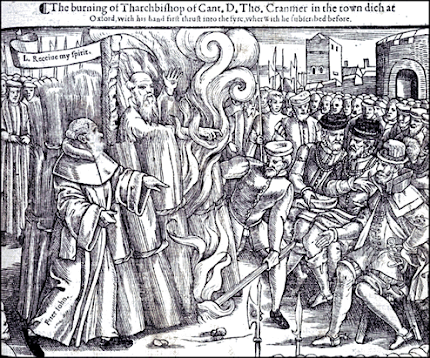
The burning of Tharchbishop of Cant. D. Tho. Cranmer in the town dich at Oxford, with his hand first thrust into the fyre, wherwith he subscribed before. [Click on the picture to see Cranmer's last words.]

Daily Bible Verse

Wednesday, June 30, 2010

Of Interpreting the Holy Scripture; And of Fathers, Councils and Traditions

Second Helvetic Confession


CHAPTER II

Of Interpreting The Holy Scripture;
and of Fathers, Councils, and Traditions


THE TRUE INTERPRETATION OF SCRIPTURE. The apostle peter has said that the Holy Scriptures are not of private interpretation (2 Pet. 1:20), and thus we do not allow all possible interpretations. Nor consequently do we acknowledge as the true or genuine interpretation of the Scriptures what is called the conception of the Roman Church, that is, what the defenders of the Roman Church plainly maintain should be thrust upon all for acceptance. But we hold that the interpretation of the Scripture to be orthodox and genuine which is gleaned from the Scriptures themselves (from the nature of the language in which they were written, likewise according to the circumstances in which they were set down, and expounded in the light of and unlike passages and of many and clearer passages) and which agree with the rule of faith and love, and contributes much to the glory of God and man's salvation.

INTERPRETATIONS OF THE HOLY FATHERS. Wherefore we do not despise the interpretations of the holy Greek and Latin fathers, nor reject their disputations and treatises concerning sacred matters as far as they agree with the Scriptures; but we modestly dissent from them when they are found to set down things differing from, or altogether contrary to, the Scriptures. Neither do we think that we do them any wrong in this matter; seeing that they all, with one consent, will not have their writings equated with the canonical Scriptures, but command us to prove how far they agree or disagree with them, and to accept what is in agreement and to reject what is in disagreement.

COUNCILS. And in the same order also we place the decrees and canons of councils.

Wherefore we do not permit ourselves, in controversies about religion or matters of faith, to urge our case with only the opinions of the fathers or decrees of councils; much less by received customs, or by the large number of those who share the same opinion, or by the prescription of a long time. Who Is The Judge? Therefore, we do not admit any other judge than God himself, who proclaims by the Holy Scriptures what is true, what is false, what is to be followed, or what to be avoided. So we do assent to the judgments of spiritual men which are drawn from the Word of God. Certainly Jeremiah and other prophets vehemently condemned the assemblies of priests which were set up against the law of God; and diligently admonished us that we should not listen to the fathers, or tread in their path who, walking in their own inventions, swerved from the law of God.

TRADITIONS OF MEN. Likewise we reject human traditions, even if they be adorned with high-sounding titles, as though they were divine and apostolical, delivered to the Church by the living voice of the apostles, and, as it were, through the hands of apostolical men to succeeding bishops which, when compared with the Scriptures, disagree with them; and by their disagreement show that they are not Apostolic at all. For as the apostles did not contradict themselves in doctrine, so the apostolic men did not set forth things contrary to the apostles. On the contrary, it would be wicked to assert that the apostles by a living voice delivered anything contrary to their writings. Paul affirms expressly that he taught the same things in all churches (I Cor. 4:17). And, again, "For we write you nothing but what you can read and understand." (II Cor. 1:13). Also, in another place, he testifies that he and his disciples - that is, apostolic men - walked in the same way, and jointly by the same Spirit did all things (II Cor. 12:18). Moreover, the Jews in former times had the traditions of their elders; but these traditions were severely rejected by the Lord, indicating that the keeping of them hinders God's law, and that God is worshipped in vain by such traditions (Matt. 15:1 ff.; Mark 7:1 ff).

--
Reasonable Chrstian Blog Glory be to the Father, and to the Son : and to the Holy Ghost; Answer. As it was in the beginning, is now, and ever shall be : world without end. Amen. 1662 Book of Common Prayer

Tuesday, June 29, 2010

Belgic Confession: Article 29: Of the Marks of the True Church

Article 29: Of the Marks of the True Church

We believe that we ought to discern diligently and very carefully from the Word of God what is the true church, for all sects which are in the world today claim for themselves the name of church.[1] We are not speaking here of the hypocrites, who are mixed in the church along with the good and yet are not part of the church, although they are outwardly in it.[2] We are speaking of the body and the communion of the true church which must be distinguished from all sects that call themselves the church.

The true church is to be recognized by the following marks: It practises the pure preaching of the gospel.[3] It maintains the pure administration of the sacraments as Christ instituted them.[4] It exercises church discipline for correcting and punishing sins.[5] In short, it governs itself according to the pure Word of God,[6] rejecting all things contrary to it[7] and regarding Jesus Christ as the only Head.[8] Hereby the true church can certainly be known and no one has the right to separate from it.

Those who are of the church may be recognized by the marks of Christians. They believe in Jesus Christ the only Saviour,[9] flee from sin and pursue righteousness,[10] love the true God and their neighbour[11] without turning to the right or left, and crucify their flesh and its works.[12] Although great weakness remains in them, they fight against it by the Spirit all the days of their life.[13] They appeal constantly to the blood, suffering, death, and obedience of Jesus Christ, in whom they have forgiveness of their sins through faith in Him.[14]

The false church assigns more authority to itself and its ordinances than to the Word of God. It does not want to submit itself to the yoke of Christ.[15] It does not administer the sacraments as Christ commanded in His Word, but adds to them and subtracts from them as it pleases. It bases itself more on men than on Jesus Christ. It persecutes those who live holy lives according to the Word of God and who rebuke the false church for its sins, greed, and idolatries.[16]

These two churches are easily recognized and distinguished from each other.

[1] Rev 2:9. [2] Rom 9:6. [3] Gal 1:8; 1 Tim 3:15. [4] Acts 19:3-5; 1 Cor 11:20-29. [5] Mt 18:15-17; 1 Cor 5:4, 5, 13; 2 Thess 3:6, 14; Tit 3:10. [6] Jn 8:47; Jn 17:20; Acts 17:11; Eph 2:20; Col 1:23; 1 Tim 6:3. [7] 1 Thess 5:21; 1 Tim 6:20; Rev 2:6. [8] Jn 10:14; Eph 5:23; Col 1:18. [9] Jn 1:12; 1 Jn 4:2. [10] Rom 6:2; Phil 3:12. [11] 1 Jn 4:19-21. [12] Gal 5:24. [13] Rom 7:15; Gal 5:17. [14] Rom 7:24, 25; 1 Jn 1:7-9. [15] Acts 4:17, 18; 2 Tim 4:3, 4; 2 Jn 9. [16] Jn 16:2.

--
Reasonable Christian Blog Glory be to the Father, and to the Son : and to the Holy Ghost; Answer. As it was in the beginning, is now, and ever shall be : world without end. Amen. 1662 Book of Common Prayer

Anglican Mission in America: Chooses to Reduce Status to "Ministry Partner" with ACNA

A Papist or Liberal Liturgy Leads to Romanism or Liberalism

The present crop of Puseyism, Ritualism, Sacerdotalism, and Sacramentarianism, which has startled the Protestant Episcopal Church, is the natural, legitimate, and necessary result of the use of a Liturgy and offices intentionally Romanized; and the crop will flourish as long as the seed is sown, even by professedly Protestant hands.

From: REVISION A DUTY AND NECESSITY. THE DEPARTURE FROM THE DOCTRINE OF THE REFORMERS MADE IN THE REVISIONS OF ELIZABETH AND CHARLES II. BY REV. MASON GALLAGHER, PRESBYTER OF THE REFORMED EPISCOPAL CHURCH.


Monday, June 28, 2010

Sermon Excerpt: The Evangelical Ideal of the Visible Church, by Bishop Charles Cheney, Founding Minister of The Reformed Episcopal Church

It is sometimes urged that the Church of Christ existed before the Gospels, and that therefore the traditions of the Church are to be accepted as authoritative interpreters of the New Testament. So did the tradition to which St. John refers at the close of his Gospel, that Christ had declared that the beloved "disciple should not die," exist before the Gospel which corrected it. But for that very reason was that part of St. John's Evangel written, that it might contradict, upon the authority of inspiration, the errors of ecclesiastical tradition, and brand the previous belief of the Church as a lie that no Christian was to accept.

Equally opposed to the Evangelical ideal of the Church is the acceptance of either Church tradition or the decrees of ecclesiastical Councils as authoritative interpreters of the Word of God. It matters little whether I give my own ship over to a pilot's hands, resign to him the vessel's full control, and make his authority unlimited on board the bark to which my life has been entrusted, or whether I abandon my own ship to go on board the pilot's boat. In either case my fate depends on him. So little does it matter whether I give up the Bible for Tradition, or take Tradition to be the Scriptures' infallible interpreter.

The moment a Church accepts the authority of uninspired men [8/9] as infallible interpreters of God's Word, it becomes like the trees which Agassiz tells us abound on the tropic shores of the Amazon, whose life is smothered by the parasitic vines which cover them.


From the sermon, The Evangelical Ideal of the Visible Church, by Bishop Charles Cheney, The Reformed Episcopal Church.


--
Reasonable Christian Blog Glory be to the Father, and to the Son : and to the Holy Ghost; Answer. As it was in the beginning, is now, and ever shall be : world without end. Amen. 1662 Book of Common Prayer

PCA General Assembly: Johannes Weslianus

The Reformed Forum Express: What Is the Nature of Heresy?

To hear this discussion click on the title of this post.


Saturday, June 26, 2010

Theological Word of the Day: Hyper-Calvinism

Hyper-Calvinism
Date June 25, 2010

Hyper-Calvinism is a pejorative designation for those who are believed to go beyond historic Calvinism in their doctrine. Although there is no one way to designate a Calvinist as “hyper,” there are many extremes that might carry such a designation. Among these extremes: the belief that we do not need to evangelize, the belief that God is the author of evil and sin, the belief that God does not love the non-elect, the belief that God actively elected people to go to hell (the reprobate) before he created them (superlapsarianism), the belief in meticulous sovereignty (that God is the immediate cause of all things), and/or that true Christians will always be Calvinist. All of these are not defining characteristics of historic Calvinism.

Unfortunately the comments are closed on this posting at the Theological Word of the Day for this term. If the comments were open I would have made an extensive comment, particularly since this definition makes classical Calvinism "hyper-Calvinism." Why would I say that? Let me explain.

First of all, the author of the definition cannot decide what the criteria are for defining a "hyper-Calvinist". He says that there is "no one way to designate a Calvinist as 'hyper'." If we are going to pejoratively label someone or some denomination as "hyper-Calvinist" surely there must be some objective standard by which to judge such theology? In fact, there are several such standards. We call them the Reformed symbols or the Reformed confessions. Another term is the Reformed standards, which would include the accompanying catechisms which instruct new believers in the basics of the Reformed understanding of the Christian faith. Another standard by which we could judge such a person or denomination is John Calvin's Institutes, which is considered the first authoritative and universally accepted systematic theology of the Reformed or "Calvinistic" faith. So how does our author's statement line up with the Reformed confessions? Let us investigate.

Our author implies that the "pejorative" term is an acceptable one for anyone who holds to any single one of the markers he identifies as an indication of "hyper-Calvinism." Let us examine point by point the designations which deserve the pejorative label of "hyper-Calvinist as indicated by the writer. First, he says that the extremes of "hyper-Calvinism are:

1. The belief that we do not need to evangelize.

This point seems to be a legitimate one. However, no Reformed denomination that I know of takes this view, with the one exception of the Primitive Baptists. Clearly Scripture commands evangelism and preaching and teaching the Gospel is God's appointed means for saving His elect. (See Matthew 28:18-20; Romans 8:28-32; Romans 10:8-18).

2. The belief that God is the author of evil and sin.

This point is ambiguous. It implies that anyone who believes God is sovereign over evil also believes that God is the author of evil. Here another ambiguity arises. What "kind" of evil is the author speaking about? Theologically speaking there are two major divisions of the concept of evil. The first is moral evil committed or conceived by free moral agents like angels or human beings. The second is classified as catastrophes or "acts of God." Events that would fall into the latter category would be floods, famines, earthquakes, tsunamis, hurricanes, storms of various kinds, meteorites, volcanoes, diseases and other natural disasters. Clearly the Bible does teach that God is in absolute control over all catastrophic events. Isaiah 45:7 says this:

I form light and create darkness, I make well-being and create calamity, I am the LORD, who does all these things. (Isaiah 45:7 ESV)

I could go through the Scriptures and give many cross references and proof texts supporting the general assertion made in Isaiah 45:7. (See Amos 3:6; Luke 13:1-5; Deuteronomy 29:20-28; Joshua 7:7; Isaiah 29:6). The Bible teaches that God is in providential control of "evil" in the form of calamities and disasters. That much is clear. No Calvinist I know of would say that the attack on the World Trade Center in 2001 was merely a chance event which was outside of God's control. If God is omnipotent, omniscient and omnipresent then surely God could have prevented this disaster?

Which leads me to the next point. Is God in control of moral evil? The short answer is yes. But how is this possible if we have free choice and a real human autonomy? I am glad you asked. First of all, we ought to note that God does not make humans "robots" who simply act by God's direct action upon them. Calvinism is often accused of making mankind merely puppets who act and react by the direct action of God upon them. However, this is a straw man argument. The Westminster Confession of Faith clarifies this doctrine for us:

God from all eternity, did, by the most wise and holy counsel of His own will, freely, and unchangeably ordain whatsoever comes to pass: (Eph. 1:11, Rom. 11:33, Heb. 6:17, Rom. 9:15,18) yet so, as thereby neither is God the author of sin, (James 1:13,17, 1 John 1:5) nor is violence offered to the will of the creatures; nor is the liberty or contingency of second causes taken away, but rather established. (Acts 2:23, Matt. 17:12, Acts 4:27–28, John 19:11, Prov. 16:33)

The Westminster confession of faith : An authentic modern version. 1985 (Rev. EPC ed.). Signal Mountain, TN: Summertown Texts.

Clearly, the Westminster Confession says that God does not violate the will of fallen men, including the elect and the non-elect. John Calvin in discussing the fall of Adam quotes Augustine favorably when Augustine said that God willingly permits that which is against God's will. In other words, God's decrees have to do with what actually happens in real time while God's law is His preceptive will or what God commands us to to do. In the Institutes of the Christian Religion, Book I, 18.3, "Instrumentality of the Wicked Employed by God, While He Stays Pure," Calvin says:

The former wishes what God wills not, the latter wishes what God also wills. And yet the filial affection of the former is more consonant to the good will of God, though willing differently, than the unnatural affection of the latter, though willing the same thing; so much does approbation or condemnation depend on what it is befitting in man, and what in God to will, and to what end the will of each has respect. For the things which God rightly wills, he accomplishes by the evil wills of bad men,”—(August. Enchirid. ad Laurent. cap. 101). He had said a little before (cap. 100), that the apostate angels, by their revolt, and all the reprobate, as far as they themselves were concerned, did what God willed not; but, in regard to his omnipotence, it was impossible for them to do so: for, while they act against the will of God, his will is accomplished in them. Hence he exclaims, “Great is the work of God, exquisite in all he wills! so that, in a manner wondrous and ineffable, that is not done without his will which is done contrary to it, because it could not be done if he did not permit; nor does he permit it unwillingly, but willingly; nor would He who is good permit evil to be done, were he not omnipotent to bring good out of evil,” (Augustin. in Ps. 111:2). (See Instrumentality of the Wicked).

Calvin, J., & Beveridge, H. (1996). Institutes of the Christian religion (electronic ed.) (I, xviii, 3). Oak Harbor, WA: Logos Research Systems.

As can be easily seen from the above, both the Westminster Confession and the Institutes of the Christian Religion affirm that God is in absolute control of moral evil without being the direct cause of moral evil. Even more to the point, the Bible clearly teaches this doctrine in many places. The most obvious example of this is the story of Joseph being sold into slavery(Genesis 37:28; Genesis 50:20). Another example is the crucifixion of our Lord and Savior Jesus Christ:

"Men of Israel, hear these words: Jesus of Nazareth, a man attested to you by God with mighty works and wonders and signs that God did through him in your midst, as you yourselves know-- 23 this Jesus, delivered up according to the definite plan and foreknowledge of God, you crucified and killed by the hands of lawless men. (Acts 2:22-23 ESV)

Our writer is correct that God is not the "author" of evil. However, it is not correct to say that God is not in absolute control of the actions of free moral agents, even if they freely choose to sin and rebel. God can and does use even rebellion for His own glory (Romans 9:6; Romans 9:19-23). The accusation that God is the "author of evil" is simply a straw man fallacy leveled at Calvinists by those who refuse to accept the whole counsel of God as it is written in the Holy Scriptures. Taking the statement of the definition above at face value one would think that being a Calvinist is in and of itself "hyper-Calvinism."

3. The belief that God does not love the non-elect.

Again, the author of this theological definition does not seem to recognize that historic or classical Calvinism does in fact teach that God does not love the reprobate or the non-elect. This should not be a controversial doctrine since it is taught in Romans 9:13. That God does not love the "non-elect" is also taught by Calvin:

Meanwhile, we must remember that however feeble and slender the faith of the elect may be, yet as the Spirit of God is to them a sure earnest and seal of their adoption, the impression once engraven can never be effaced from their hearts, whereas the light which glimmers in the reprobate is afterwards quenched. Nor can it be said that the Spirit therefore deceives, because he does not quicken the seed which lies in their hearts so as to make it ever remain incorruptible as in the elect. I go farther: seeing it is evident, from the doctrine of Scripture and from daily experience, that the reprobate are occasionally impressed with a sense of divine grace, some desire of mutual love must necessarily be excited in their hearts. Thus for a time a pious affection prevailed in Saul, disposing him to love God. Knowing that he was treated with paternal kindness, he was in some degree attracted by it. But as the reprobate have no rooted conviction of the paternal love of God, so they do not in return yield the love of sons, but are led by a kind of mercenary affection. The Spirit of love was given to Christ alone, for the express purpose of conferring this Spirit upon his members; and there can be no doubt that the following words of Paul apply to the elect only: “The love of God is shed abroad in our hearts, by the Holy Ghost which is given unto us,” (Rom. 5:5); namely, the love which begets that confidence in prayer to which I have above adverted. On the other hand, we see that God is mysteriously offended with his children, though he ceases not to love them. He certainly hates them not, but he alarms them with a sense of his anger, that he may humble the pride of the flesh, arouse them from lethargy, and urge them to repentance. Hence they, at the same instant, feel that he is angry with them or their sins, and also propitious to their persons. It is not from fictitious dread that they deprecate his anger, and yet they retake themselves to him with tranquil confidence. It hence appears that the faith of some, though not true faith, is not mere pretence. (See III:2.12).

Calvin, J., & Beveridge, H. (1996). Institutes of the Christian religion (electronic ed.) (III, ii, 12). Oak Harbor, WA: Logos Research Systems.

Now clearly Calvin says that God loves only the elect and that God does not "hate" the elect, though they can fall under His anger for a time. It is not illogical therefore to take this at face value and say that God does hate the "non-elect" since God only loves the elect and does not "hate" the elect. It is the flip side of election. Election = God's unconditional love. Reprobation = God's justice against the fallen human race applied by passing over some of them. (See Romans 9:13; Malachi 1:2-3; John 6:70; John 13:18).

4. The belief that God actively elected people to go to hell (the reprobate) before he created them (superlapsarianism).

This statement is so full of contradictions that it is difficult to know exactly what the author means to say here. First of all, how can God not actively elect since that is a sovereign decree of God in the first place? Secondly, "election" is the doctrine that God chooses to have mercy on some and not on others. So in that sense, God does not "elect" the reprobate. In fact, He does not choose to have mercy on them but hardens whom He will harden (Romans 9:16-18). Election or electing therefore applies only to the elect and not to the reprobate. But this would involve a choice to pass over some of fallen mankind and this is predestined as well since God could have chosen to give all men without distinction election to mercy, forgiveness, and reconciliation. We know from Scripture that this is not so. Judas Iscariot was not chosen and was destined to stumbled. (See 1 Peter 2:8; Jude 1:4) Calvin's commentary on 1 Peter 2:8 clearly shows the possibility of the interpretation that God destines the reprobate for rejection:

Whereunto also they were appointed, or, to which they had been ordained. This passage may be explained in two ways. It is, indeed, certain that Peter spoke of the Jews; and the common interpretation is, that they were appointed to believe, for the promise of salvation was destined for them. But the other sense is equally suitable, that they had been appointed to unbelief; as Pharaoh is said to have been set up for this end, that he might resist God, and all the reprobate are destined for the same purpose. And what inclines me to this meaning is the particle καὶ (also) which is put in. (See 1 Peter 2:8).

And finally, the author seems not to know that both infralapsarianism supralapsarianism teach that election and reprobation are decrees made before creation. The order of the decrees is a logical order and not a temporal order that falls out in time. This can easily be seen in the Canons of Dort where the controversy over the order of the decrees was the dispute that ultimately led to the Arminian heresy:

Article 6
God's Eternal Decree

That some receive the gift of faith from God, and others do not receive it proceeds from God's eternal decree, "For known unto God are all his works from the beginning of the world," (Acts 15:18)."Who worketh all things after the counsel of his will," (Ephesians 1:11).According to which decree, he graciously softens the hearts of the elect, however obstinate, and inclines them to believe, while he leaves the non-elect in his just judgment to their own wickedness and obduracy. And herein is especially displayed the profound, and merciful, and at the same time the righteous discrimination between men, equally involved in ruin; or that decree of election and reprobation, revealed in the Word of God, which though men of perverse, impure and unstable minds wrest to their own destruction, yet to holy and pious souls affords unspeakable consolation.


Article 7
Election Defined

Election is the unchangeable purpose of God, whereby, before the foundation of the world, he hath out of mere grace, according to the sovereign good pleasure of his own will, chosen, from the whole human race, which had fallen through their own fault, from their primitive state of rectitude, into sin and destruction, a certain number of persons to redemption in Christ, whom he from eternity appointed the Mediator and Head of the elect, and the foundation of Salvation.

This elect number, though by nature neither better nor more deserving than the others, but with them involved in one common misery, God hath decreed to give to Christ, to be saved by him, and effectually to call and draw them to his communion by his Word and Spirit, to bestow upon them true faith, justification and sanctification; and having powerfully preserved them in the fellowship of his Son, finally, to glorify them for the demonstration of his mercy, and for the praise of his glorious grace; as it is written: "According as he hath chosen us in him, before the foundation of the world, that we should be holy, and without blame before him in love; having predestinated us unto the adoption of children by Jesus Christ to himself, according to the good pleasure of his will, to the praise of the glory of his grace, wherein he hath made us accepted in the beloved," (Ephesians 1:4,5,6).And elsewhere: "Whom he did predestinate, them he also called; and whom he called, them he also justified; and whom he justified, them he also glorified," (Romans 8:30). (See First Head of Doctrine, 6 and 7).

You will have to forgive me for quoting from Phillip Johnson here but this is the most concise and clear explanation of the dispute between the Supralapsarians and the Infralapsarians I could find online. Obviously, I do not agree with Phil Johnson's definition of "hyper-Calvinism" since he is a Reformed Baptist and biased against the Three Forms of Unity and the Westminster Standards. However, he does have a good chart explaining the differences on this page:

The distinction between infralapsarianism and supralapsarianism has to do with the logical order of God's eternal decrees, not the timing of election. Neither side suggests that the elect were chosen after Adam sinned. God made His choice before the foundation of the world (Eph. 1:4)—long before Adam sinned. Both infras and supras (and even many Arminians) agree on this. (See Notes on Supralapsarianism and Infralapsarianism).

Just two more points in the definition to which I will respond. The next being:

5. The belief in meticulous sovereignty (that God is the immediate cause of all things).

Again, this one is ambiguous since no Calvinist I know of denies that God is in charge of absolutely everything that happens. So to say that God is not the "immediate cause" of all things implies that God is not the cause of all things at all, which is not Calvinism but Arminianism or worse. The fact of the matter is that the Reformed confessions unanimously affirm that God brings every single detail of every event to pass. Not only so but Scripture affirms this as well. The difference is that God works through secondary means rather than primary means. (See Westminster Confession 3:1)

And the final point of the definition says:

6. And/or that true Christians will always be Calvinist.

This point is misleading as well. Most Calvinists acknowledge that those who are Protestants and uphold the five solas of the Protestant Reformation are genuinely Christian. However, not every denomination agrees to the same extent on the meaning of those solas. Most Arminians can affirm the five solas to one degree or another so being an Arminian does not in and of itself negate salvation. That being said, however, some Arminians and Amyraldians are for all practical purposes outright pelagian, especially those who adopt the views of Charles Finney. Semi-pelagianism is very close to pelagianism and sometimes the line between the two becomes fuzzy in today's Evangelicalism where pragmatism and libertarian free will are emphasized above the Scriptures and God's sovereignty in salvation. (See Christless Christianity). It has been my experience that usually the pejorative term "hyper-Calvinism" is unjustified in the vast majority of the cases. For example, many have labelled the Protestant Reformed Church in America as "hyper-Calvinist" based on their rejection of the relatively late doctrines of common grace and the free offer of the Gospel expressed in the Three Points of Common Grace. However, this is unjustified since the doctrines of the PRCA are directly based on Scripture and the Three Forms of Unity.

The problem with the above definition is that it really defines nothing and instead poses several straw man fallacies against the actual and real position of most Calvinists. While there are certainly internecine disagreements among Calvinists over issues like the logical order of the divine decrees and the issue of common grace versus unconditional grace, this definition overgeneralizes and does not make the finer distinctions necessary for a proper understanding of the doctrine of God and the double decrees to election and reprobation. In fact, about the only denomination which might remotely fit the above description is the Primitive Baptists and even here there is no consistency from one church or association to another; basically, the Primitive Baptists have no seminary and no formal training for their ministers so opinions will vary from minister to minister and from church to church. My strongest disagreement with Primitive Baptists is their belief that God has not ordained Gospel preaching as the only way of salvation and as the appointed means of saving God's elect. God owes those who have not heard the Gospel nothing. In this case, I might be accused of being more "hyper" than the "hyper-Calvinists"! (Acts 4:11-12; John 14:6).




Thursday, June 24, 2010

Wednesday, June 23, 2010

Archbishop Thomas Cranmer's Final Words

And now I come to the great thing that troubleth my conscience more than any other thing that ever I said or did in my life: and that is, the setting abroad of writings contrary to the truth. Which here now I renounce and refuse, as things written with my hand contrary to the truth which I thought in my heart, and writ for fear of death, and to save my life, if it might be: and that is, all such bills, which I have written or signed with mine own hand, since my degradation; wherein I have written many things untrue. And forasmuch as my hand offended in writing contrary to my heart, therefore my hand shall first be punished. For if I may come to the fire, it shall be first burned. And as for the Pope, I refuse him, as Christ's enemy and antichrist, with all his false doctrine."


[Click on the woodcarving picture of Cranmer's burning to see the original site of Cranmer's last words.]


The Order for Morning Prayer, Wednesday, June 23rd

Since the Lesson links do not always work properly for the Order for Morning Prayer at Linda Howell's site for the 1662 Book of Common Prayer, I have  posted the links here:
 
 
First Lesson:   Nehemiah 6:1-7:5
 
Second Lesson:  Acts 6
 
Collect of the Day:  Third Sunday After Trinity
 

A Prayer for the President of the United States, and all in Civil Authority. 

O LORD, our heavenly Father, the high and mighty Ruler of the universe, who dost from thy throne behold all the dwellers upon earth; Most heartily we beseech thee, with thy favour to behold and bless thy servant, Barack Obama, The President of the United States, and all others in authority; and so replenish them with the grace of thy Holy Spirit, that they may always incline to thy will, and walk in thy way. Endue them plenteously with heavenly gifts; grant them in health and prosperity long to live; and finally, after this life, to attain everlasting joy and felicity; through Jesus Christ our Lord. Amen. 


[From the 1789 Book of Common Prayer, Order for Morning Prayer.  I omitted the other American prayers at the end in the 1789 BCP because they are not in the 1662 BCP.  If you wish, you can read the KJV instead of the ESV by simply changing the version in the link to the Bible Gateway window.]


[Note:  If you hold down the Ctrl key and then click on the links it will open the windows on separate tabs in your browser and you can toggle back and forth easily from the Order for Morning Prayer and the psalter, lessons, and collect.  Hope this helps.  Also, if you don't like the prayers for the queen you can either delete these or use the American prayers for those in government.  However, since this country is not officially a "Christian" country, I don't believe the prayers for our leaders are necessary since they imply that our leaders are actually "Christian."  Most are not.]


Charlie
 
  Glory be to the Father, and to the Son : and to the Holy Ghost;
    Answer. As it was in the beginning, is now, and ever shall be : world without end. Amen.


Saturday, June 19, 2010

The Collect for the Twenty-first Sunday After Trinity


The Collect.
 

GRANT, we beseech thee, merciful Lord, to thy faithful people pardon and peace, that they may be cleansed from all their sins, and serve thee with a quiet mind; through Jesus Christ our Lord. Amen.

Churchman Article: The Anglican Pattern of Episcopacy

The following link is to an article in the Churchman, issue 1948, vol. 62, issue 2. (See the Churchman home page). I found the article by J. W. Hunkin to be informative in light of modern High Church Carolinians who claim that the historic episcopate is the only acceptable form of church polity, a position which is identical to that of the Tractarians. Unfortunately, Hunkin points out that the original Caroline divines would have rejected the Tractarian position, although they did believe that the episcopate is the best polity. Hunkin convincingly argues that the episcopate is for the bene esse of the church but not of the esse of the true nature of the church. This distinction between "good being" and the "being" of the church (good nature versus the true nature of the church) is an important one. My only disagreement with Hunkin's article is his concluding remark where he quotes Dr. Norman Sykes,  professor of church history at Cambridge, about a future reunification of denominations where episcopacy is seen as the  "indispensable basis" of such future reunification. I would contend that this idea has more basis in the Anglican Quadrilateral than in the history of the English Reformation.  The date of the quadrilateral is 1888, a time when the Tractarian controversialists were determined to dominate the English church and the fellowship of Anglicans worldwide.  You can read J. W. Hunkin's article at, "The Anglican Pattern of Episcopacy." The Right Reverend J. W. Hunkin was the bishop of Truro (United Kingdom) at the time of the publication of this article.

Thursday, June 17, 2010

Live Webcast of the Ligonier Conference June 17-19, 2010: Click on this Title

Ugly Vestment Wars

A Reformed Anglican Study of the Chasuble

 
I sometimes allow the ridiculous assertions of online opponents to push me to say things that are blunt and emotive and polemical in the comments on various blogs and in Face Book. With that in mind, let's step back a moment and take a more objective look at the evidence for the eucharistic garment called a "chasuble" in the Bible and in tradition. I hope you will forgive my use of pejorative terms for my opponents but I will excuse myself because I think the label draws the distinctive lines between the Evangelical and the heretical view more definitively as mutually incompatible positions. I refer to High Church Carolingian and Tractarian theology as "sacerdotal" and therefore is most appropriately labelled as "Romish" or "papist". Most high churchmen want to be identified as opposed to Tractarian theology but one soon learns that this is merely an equivocation and a dissimulation in these modern times and most likely in times past as well.

In a recent online debate an Anglo-Papist suggested that the Apostle Paul wore a chasuble and called for his chasuble while he was in prison in 2 Timothy 4:13. Exactly what is a chasuble, my low church Evangelical friends might be asking? According to the 1911 classic edition of the Encyclopedia Britannica, the chasuble is a symbolic garment representing a sacerdotal or sacrificial understanding of the Lord's Supper which they refer to as "mass" or the "eucharist." The Evangelical and Reformed term preferred is "the Lord's Supper." (See Chasuble).

It is interesting that no translation of the Bible that I know of called the garment in question a chasuble. That would include the Latin Vulgate, which uses the word paenula. Apparently the Greek word used by Paul is a mistransliteration of the Latin by Late Greek:

The word phailonē-phainolē was borrowed by late Greek from the Latin paenula, which in turn originally came from Greek and according to its etymology—and the etymological meaning was not entirely lost—would have referred to a very striking, easily visible color. The spelling is quite variable: phelōnēs, phailonēs, phelōnis, phailonin, phelonin,phelōnin,8 and the transposition of the l and the n has been retained in modern Greek: phainolēs (P.Oxy. 3057, 4: "I received your letter, the trunk, and the capes"; 3201, 4: phenolou idochromou; line 7: phenolēs melas). In addition there are the diminutive forms, so popular in the Koine: phailonion, phelonion.1

Both Bauer, Arndt, Gingrich, Danker's lexicon of the New Testament and Thayer's lexicon concur here. Even more to the point, Vine's Expository Dictionary of Old and New Testament Words specifically says that this is not a reference to an ecclesiastical garment; in other words, it is not a high church eucharistic garment:

1. phelonēs, or phailonēs (φαιλόνης, (534)), probably by metathesis from phainolēs (Latin paenula), a mantle, denotes a travelling cloak for protection against stormy weather, 2 Tim. 4:13. Some, however, regard it as a Cretan word for chitōn, a tunic. It certainly was not an ecclesiastical vestment. The Syriac renders it a case for writings (some regard it as a book–cover), an explanation noted by Chrysostom, but improbable. It may have been "a light mantle like a cashmere dust–cloak, in which the books and parchments were wrapped" (Mackie in Hastings' Dic. of the Bible).2

Even the church fathers identified this garment as merely a cloak and we can note that Tertullian simply calls it a cloak:

Hold fast in the meantime this persuasion, while I examine a question which comes in our way. For I already hear it is said, that many other things as well as crowns have been invented by those whom the world believes to be gods, and that they are notwithstanding to be met with both in our present usages and in those of early saints, and in the service of God, and in Christ Himself, who did His work as man by no other than these ordinary instrumentalities of human life. Well, let it be so; nor shall I inquire any further back into the origin of this things. Let Mercury have been the first who taught the knowledge of letters; I will own that they are requisite both for the business and commerce of life, and for performing our devotion to God. Nay, if he also first strung the chord to give forth melody, I will not deny, when listening to David, that this invention has been in use with the saints, and has ministered to God. Let Æsculapius have been the first who sought and discovered cures: Esaias mentions that he ordered Hezekiah medicine when he was sick. Paul, too, knows that a little wine does the stomach good. Let Minerva have been the first who built a ship: I shall see Jonah and the apostles sailing. Nay, there is more than this: for even Christ, we shall find, has ordinary raiment; Paul, too, has his cloak. If at once, of every article of furniture and each household vessel, you name some god of the world as the originator, well, I must recognise Christ, both as He reclines on a couch, and when He presents a basin for the feet of His disciples, and when He pours water into it from a ewer, and when He is girt about with a linen towel —a garment specially sacred to Osiris. It is thus in general I reply upon the point, admitting indeed that we use along with others these articles, but challenging that this be judged in the light of the distinction between things agreeable and things opposed to reason, because the promiscuous employment of them is deceptive, concealing the corruption of the creature, by which it has been made subject to vanity. For we affirm that those things only are proper to be used, whether by ourselves or by those who lived before us, and alone befit the service of God and Christ Himself, which to meet the necessities of human life supply what is simply useful and affords real assistance and honourable comfort, so that they may be well believed to have come from God's own inspiration, who first of all no doubt provided for and taught and ministered to the enjoyment, I should suppose, of His own man. As for the things which are out of this class, they are not fit to be used among us, especially those which on that account indeed are not to be found either with the world, or in the ways of Christ.3

Clearly, Tertullian is saying that these garments are merely meant for comfort and necessary use and imply nothing more than that. Even more to the point, Tertullian says that this normal use of the garments is in fact inspired by God. So Tertullian directly contradicts any high church sacerdotal view of the cloak or even of the linen towel Jesus used in washing the feet of the disciples!

Chrysostom makes no mention of the garment as being a eucharistic or ecclesiastical garment of any kind:

The word here translated "cloak" may mean a garment, or, as some say, a bag, in which the books were contained. But what had he to do with books, who was about to depart and go to God? He needed them much, that he might deposit them in the hands of the faithful, who would retain them in place of his own teaching. All the faithful, then, would suffer a great blow, but particularly those who were present at his death, and then enjoyed his society. But the cloak he requires, that he might not be obliged to receive one from another. For we see him making a great point of avoiding this; and elsewhere, when he was addressing those from Ephesus, he says, "Ye know that these hands have ministered to my necessities, and to those that were with me" (Acts 10:34-35); and again, "It is more blessed to give than to receive."4


I hope the reader will bear with my extensive quotes of "primary sources" from the church fathers. But in addition I would like to quote a secondary source just to supplement what we see so far. The 1911 edition of the Encyclopedia Britannica says that the paenula is merely a cloak and is not a eucharistic garment:


The chasuble, like the kindred vestments (the 4€Xbvtov, &c.) in the Eastern Churches, is derived from the Roman paenula or planeta, a cloak worn by all classes and both sexes in the GraecoRoman world (see Vestments). Though early used in the celebration of the liturgy it had for several centuries no specifically liturgical character, the first clear instances of its ritual use being in a letter of St Germanus of Paris (d. 576), and the next in the twenty-eighth canon of the Council of Toledo (633). Much later than this, however, it was still an article of everyday clerical dress, and as such was prescribed by the German council convened by Carloman and presided over by St Bonif ace in 742. Amalarius of Metz, in his De ecclesiasticis officiis (ii. iv), tells us in 816 that the casula is the generale indumentum sacrorum ducum and " is proper generally to all the clergy." It was not until the 11th century, when the cope (q.v.) had become established as a liturgical vestment, that the chasuble began to be reserved as special to the sacrifice of the Mass. As illustrating this process Father Braun (p. 170) cites an interesting correspondence between Archbishop Lanfranc of Canterbury and John of Avranches, archbishop of Rouen, as to the propriety of a bishop wearing a chasuble at the consecration of a church, Lanfranc maintaining as an established principle that the vestment should be reserved for the Mass. By the 13th century, with the final development of the ritual of the Mass, the chasuble became definitely fixed as the vestment of the celebrating priest; though to this day in the Roman Church relics of the earlier general use of the chasuble survive in the planeta plicata worn by deacons and subdeacons in Lent and Advent, and other penitential seasons. 


At the Reformation the chasuble was rejected with the other vestments by the more extreme Protestants. Its use, however, survived in the Lutheran churches; and though in those of Germany it is no longer worn, it still forms part of the liturgical costume of the Scandinavian Evangelical churches. In the Church of England, though it was prescribed alternatively with the cope in the First Prayer-Book of Edward VI., it was ultimately discarded, with the other " Mass vestments," the cope being substituted for it at the celebration of the Holy Communion in cathedral and collegiate churches; its use has, however, during the last fifty years been widely revived in connexion with the reactionary movement in the direction of the pre-Reformation doctrine of the eucharist. (See Chasuble).

What is particularly interesting here is that the 1911 edition of Britannica happens to agree with me that the chasuble was rejected by Edward VI in the second prayer book, namely the 1552 edition. It would be rather odd therefore for the 1662 ornaments rubric to refer to Edward's first prayer book, namely the 1549 edition.

In response to my high church opponents, it should be noted that there is a distinction between the chasuble and the "cope." Elizabeth I did not authorize the use of the chasuble, contrary to popular opinion among the Anglo-Papists and the High Church Carolingians. Even today the cope is only used by broad churchmen and not by low church evangelicals:


In the Broad Church (rarely in the Low Church), the cope is sometimes worn in lieu of the chasuble at the Eucharist (over either a surplice or an alb) especially by bishops and other prelates. In the Church of England itself, the cope is worn by the Archbishop of Canterbury during the coronation of the Sovereign. Prior to her coronation in 1953, Queen Elizabeth II presented a set of ornate copes to the Canons of Westminster Abbey as a gift. (See Cope).


And it should be noted that only the more liberal Lutheran denominations adhere to the high church vestments, while the Missouri Synod and other more Evangelical Lutherans avoid such sacerdotal garments:


The cope is usually worn only for processions and services of the Divine Office (morning and evening prayers) in most Lutheran denominations. In the Evangelical Lutheran Church in America, which is similar to the Churches of the Anglican Communion and the Scandinavian Lutheran churches, the cope is usually worn by the bishop when not serving as the presiding minister at Holy Communion. It is rarely worn by clerics in the Lutheran Church - Missouri Synod or other German Lutheran denominations. (See Cope).


As you can see from this survey, the intention of High Churchmen and Anglo-Papists in the Anglican denominations is to mislead and deceive people by using triumphalistic misrepresentations of the evidence in favor of their sacerdotal garments. It is especially noteworthy that the use of the chasuble is not fully established in the eucharistic and sacerdotal sense until medieval times, that is around the 13th century.


In light of this brief study it would do readers well to exercise extreme caution when discussing these issues with those who have an extreme prejudice against the doctrine of sola Scriptura. The first thing to note is the appeal of sacerdotalists to relics and tradition above and beyond Scripture. The second thing to note is that their view does not even find support in the church fathers, a tradition which they claim supports their sacerdotal theology. It seems that the evidence is clearly against them on the use of the chasuble.


1 Spicq, C., & Ernest, J. D. (1994). Vol. 3: Theological lexicon of the New Testament (432–433). Peabody, MA.: Hendrickson.
2 Vine, W., & Bruce, F. (1981). Vol. 2: Vine's Expository dictionary of Old and New Testament words (198). Old Tappan NJ: Revell.
3Schaff, Early Church Fathers. ANF 03. Tertullian: Apologetics: The Chaplet or De Corona. Bible Works 8.0.
4 Schaff, Early Church Fathers. NPNF 113. Chrysostom's commentary on 2 Timothy 4:13. Bible Works 8.0.
  Glory be to the Father, and to the Son : and to the Holy Ghost;
    Answer. As it was in the beginning, is now, and ever shall be : world without end. Amen.

Wednesday, June 16, 2010

Response to an Anonymous Anglo-Papist

Bear,


I have a grudge against liars who violate the 9th commandment in order to justify what is unjustifiable.  If I can refute the lie, even in a blunt and straightforward way, I will do so.  Luther didn't hesitate to use such rhetoric and neither will I.


It is absolutely ridiculous to say that the apostle Paul wore a chasuble when the clear evidence from both Scripture and the church fathers, including Tertullian, is that it was simply a cloak.  Nothing more and nothing less.


What I just love about my critics--yourself for example--is that you hide your identity because you know your position is untenable and unable to be proved.  I, on the other hand, am out front with my name, my blog, my e-mail address and whatever else you want to know.


Yes, I insulted Lil Bo Peep or the false "bishop" Poteet or whatever his name is.  Bishops in your tradition have no more authority than any other minister.  They are simply pastors and many of them if not all of them are preaching a false gospel of infused righteousness and justification by merits along with the idolatries of the papists and the five extra and erroneous "sacraments" which are no sacraments at all.


I hope this answers your question.  Next time, please show some courage and let the world know who you are.  I am less concerned with pleasing men than with pleasing God.  I am here to turn the world upside down for the Gospel (Acts 17:6).  Compromise simply leads to liberalism from what I can observe.  I have no mercy on the Pentecostal/Charismatic errors and I'm certainly not going to show any mercy to false prophets in the Anglican circles either.


Charlie


Postscript: For the record I have no idea who Mr. Robinson is. The simple fact of the matter is that the High Churchmen are in league with the Anglo-Papists and are not friends of low church Evangelicals or Reformed Anglicans. That seems obvious enough from the vitriol shown toward anyone who dares to point out the obvious logical and historical flaws in that system of theology and liturgy.


Sent: Wednesday, June 16, 2010 10:35 AM
Subject: sarabaite


I got a couple emails from individuals who apparently know you. There is christian discipline even on the internet. Plus, I think you have your confessions very confused, and jump inconsistently back and forth between adiaphora and RPW. I think you are more interested in 'demolishing' and less interested in 'teaching'. You have yet to prove any kind of 'reasonableness' here. But you've managed to make yourself notorious. What good is knowledge when you lack charity. So, think about your denomination jumping and quick temper, and find a way to amend. If this happens, you might be able to get your ideas across better to otherwise sympathetic folk. I really wish you well. 
 

Charlie is a piece of work. His last comment to Bp. Robinson at OHC was a deliberate insult. He's a man with a grudge ( Lord knows what caused it), and he lives to feed that grudge, by creating theological enemies on the web. So sad; he's in thrall to his hatred. Your patience with his tantrums went beyond the call of duty. I'd recommend you block him from leaving comments at AR. St. Paul commanded the Church to separate from brethren who delight in sowing dissension. And sowing dissension is what Charlie Ray is all about.

Tuesday, June 15, 2010

The Ornaments Rubrics of the 1552 and 1662 Book of Common Prayer


One has to wonder where all the revisionism comes from? I mean anyone with any common sense at all can understand that Archbishop Thomas Cranmer was a reformer who gradually brought in the changes he could as best he could. I find it particularly amusing that the Anglo-Papists of various colors, including the so-called old high churchmen, wish to distort the Ornaments Rubric from the Order for Morning Prayer in the 1662 Book of Common Prayer so that it endorses a pre-reformed situation of the first year and half of King Edward VI's reign rather than what it so obviously intends, being the second half of Edward's reign until Bloody Mary took over.


The appropriate part of the rubric for the Morning Prayer service reads:


And here is to be noted, that such Ornaments of the Church, and of the Ministers thereof, at all Times of their Ministration, shall be retained, and be in use, as were in this Church of England, by the Authority of Parliament, in the Second Year of the Reign of King Edward the Sixth.


Cranmer in fact gave his life in martyrdom to bring about these reforms yet the revisionist dissimulation would have us believe that Cranmer was actually in favor of the vestments prior to his own reforms! It would indeed be amazing if the 1662 Prayer Book intended to allow papist vestments and ornaments especially since Matthew Parker was for all practical purposes a supporter of Cranmer's theological views. This is the problem with both the Anglo-Papists and the high churchmen. Both want to lie, dissimulate and distort so that they can have their own way. Their agenda is essentially to reverse the English Reformation gradually so that the frog in the kettle does not notice when the water begins to boil. Next thing you know you're back in Rome.


Cranmer's 1552 reform of the Prayer Book makes it clear that the Anglo-Papists and the High Churchmen are out of line with the English Reformation:


And here is to be noted, that the minister at the tyme of the Communion and all other tymes in his ministracion, shall use neither albe, vestment, nor cope: but being archbishop or bishop, he shall have and wear a rochet; and being a preest or deacon, he shall have and wear a surplice onely.


It is questionable that Elizabeth's settlement would have re-instituted the papist vestments and ornaments that Cranmer specifically disenfranchised. There are precious few written publications on the internet against the vestments because only the papists are concerned to argue for vestments and medieval ornaments. Such things are unnecessary to Reformed and Evangelical Anglicans, particularly since they understand the 1552 rubric and the 1662 rubric to mean that high church vestments are forbidden. The Puritans were obviously not satisfied with either the 1552 prohibition or the 1662 prohibition.


Charlie


  Glory be to the Father, and to the Son : and to the Holy Ghost;
    Answer. As it was in the beginning, is now, and ever shall be : world without end. Amen.


If You Beat Them into Submission They Will Come

The Right Bubba Robert Wills of the Charismatic Episcopal Church was recently awarded his 6th degree black belt in Goju Karate.  How many degrees in theology has he earned?  What a waste of time.  One has to wonder how a 6th degree black belt at age 65 would fair in the ring with a mixed martial arts practioner?  Hey, maybe a plow boy knows theology better than so-called "fathers" of the modern papist churches?

Meet me at the Dew Drop Inn for a beer and we can talk about it.

God Don't Like No Idols

God apparently was not happy with the $250,000 foam plastic and steel statue of Jesus on I-75 in Monroe, Ohio.  (Exodus 20:4).  To read the Yahoo News story click here.

The Reformed Forum: Dr. John WoodHouse on First Samuel

Dr. John Woodhouse of Moore Theological College, Sydney, Australia discusses his expository commentary on First Samuel with Camden Busey of The Reformed Forum podcast.  Click on Christ the Center to see the page and hear the podcast.

Tuesday, June 08, 2010

Is the Gospel Coalition on a Downward Spiral: An Endorsement of N. T. Wright

Dr. R. Scott Clark reports that the theology of N. T. Wright is now being openly endorsed by the Gospel Coalition (see Heidelblog: M. Jay Bennett is Reading CJPM). I attended a People Growth/Gospel Growth last February in Chicago. I was not impressed with the conference or the Gospel Coalition. The Coalition is partnered by those who are openly Amyraldian or worse, including Philip Jensen of the Sydney Anglicans. D.A. Carson and Tim Keller are also leaders in the Gospel Coalition. Keller's triperspectivalism has been shown to be problematic already. One has to wonder where the 9 Marks ministry of Mark Dever falls on the five points of Calvinism and the five solas of the Protestant Reformation?

I'm finding that those who are not strict Calvinists in agreement with the Westminster Standards and/or the Three Forms of Unity are more apt to compromise openly with those who attack the Gospel. For example, the Sydney Anglicans are in full communion now with the Anglican Church in North America, which is predominately Anglo-Catholic and openly semi-pelagian and papist in their theology of the sacraments and their soteriology.

I recently had to break fellowship with Christ Church Longwood over what I can only describe as pelagianism. While the pastor, David Paul Knox (son of the late David Broughton Knox), gives lip service to the doctrines of the Reformed faith, he really does not believe any of them due to his unconfessional theology. While he does agree with the 39 Articles as an Evangelical document, Knox rejects all--and I do mean all--the other Reformed confessions of faith. In doing so, he also eisogetes into the 39 Articles his preconceived theology, including a blatant rejection of both Augustinian and Calvinist views on predestination to election and reprobation. Clearly Article 17 includes the doctrine of reprobation, a fact that theological liberals, Arminians and Amyraldians reject. The fact is Amyraldians have more in common with Anglo-Catholics and Arminians on soteriology than they do with the English Reformers or the Swiss Reformers.

It is practically impossible these days to find any Anglican congregation where the pure Gospel is preached or the sacraments are rightly and duly administered. Those congregations which do not use the 1662 Book of Common Prayer are for all practical purposes not Reformed. Most Anglican Evangelicals in the United States have more in common with Anglo-Catholics, Arminians and theological liberals than anything else. Increasingly I am coming to the same conclusion about the Sydney Anglicans since they are much more concerned with being in full fellowship with papists of the conservative variety than they are concerned with preaching the pure Gospel, the doctrines of grace, or rightly administering the sacraments. Likewise, the Sydney Anglicans have started down the path toward liberalism by the ordination of women to the diaconate, an official office of the church ministry. It will not be long before they begin to ordain women as presbyters and bishops, which in turn leads to the ordination of homosexuals.

It seems to me that Reformed believers ought to more concerned about the purity of doctrine than about the catholicity of the church. Too much emphasis on catholicity leads to man-centered theology rather than God-centered theology, which in turn leads to theological liberalism and the social gospel.

The fact that my former pastor, David Knox, has more in common with the Anglo-Catholics than with Reformed believers only proves that my thesis is correct. Sydney Anglicans hate the smells and the bells and ritualism but their soteriology is essentially the same as any Anglo-Catholic, Arminian or Amyraldian. If you want to be saved, you must strive, merit, work your way to heaven. God cannot save you without your cooperation is their view.

I, on the other hand, believe that God and God alone can save a lost sinner. God alone can regenerate a dead soul and God alone can progessively sanctify a saved and elect sinner. All of the glory goes to God and God alone since the biblical teaching is that salvation is a monergistic work of God given to sinners by grace and mercy alone.

Sola Scriptura!

Support Reasonable Christian Ministries with your generous donation.