
Beza's Motto
1 day ago

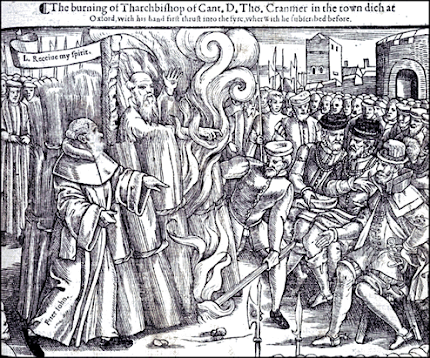
"...crying with a Loud Voice, 'This hand hath offended.' As soon as the fire got up, he was very soon dead, never stirring or crying all the while.His Catholic executioners surely thought Cranmer was making satisfaction to his Protestant God. Yet his doctrine of repentance would have taught him otherwise, for the God he served saved the unworthy.Having believed in his own justification by faith, Cranmer would have thought he could fall totally but not finally. As God's child, the burden of all the multitude of his sins was no cause for him to distrust or dispair of help at his Father's hand; for the incredible richness of God's merciful love for him would never have shone brighter than on that cloudy day, precisely because he, the chief promoter of the new faith, had fallen so far as to become a declared enemy of the Gospel. To Cranmer, his hand in the fire would have been an act of loving service of a heart turned back to God by the power and promise of His immeasurably loving grace. His final resolve would have been a joyous confirmation that he was indeed one of the elect in whom there would be no fault found in the end."
"..Only thing you can't do is override anyone's free will..... so he has another interview with God who explains that 'people don't need Us to intervene in their lives. They have the power to answer their needs and problems themselves. We just have to help them see how.'"
Therefore, it is not irreligious, curious, or superfluous, but essentially wholesome and necessary, for a Christian to know, whether or not the will does any thing in those things which pertain unto Salvation. Nay, let me tell you, this is the very hinge upon which our discussion turns. It is the very heart of our subject. For our object is this: to inquire what "Free-will" can do, in what it is passive, and how it stands with reference to the grace of God. If we know nothing of these things, we shall know nothing whatever of Christian matters, and shall be far behind all People upon the earth. He that does not feel this, let him confess that he is no Christian. And he that despises and laughs at it, let him know that he is the Christian's greatest enemy. For, if I know not how much I can do myself, how far my ability extends, and what I can do God-wards; I shall be equally uncertain and ignorant how much God is to do, how far His ability is to extend, and what He is to do toward me: whereas it is "God that worketh all in all." (1 Corinthians 12:6.) But if I know not the distinction between our working and the power of God, I know not God Himself. And if I know not God, I cannot worship Him, praise Him, give Him thanks, nor serve Him; for I shall not know how much I ought to ascribe unto myself, and how much unto God. It is necessary, therefore, to hold the most certain distinction, between the power of God and our power, the working of God and our working, if we would live in His fear.
Sect. 9.—THIS, therefore, is also essentially necessary and wholesome for Christians to know: That God foreknows nothing by contingency, but that He foresees, purposes, and does all things according to His immutable, eternal, and infallible will. By this thunderbolt, "Free-will" is thrown prostrate, and utterly dashed to pieces. Those, therefore, who would assert "Free-will," must either deny this thunderbolt, or pretend not to see it, or push it from them.
"You shall have no other gods before me. 4 "You shall not make for yourself a carved image, or any likeness of anything that is in heaven above, or that is in the earth beneath, or that is in the water under the earth. 5 You shall not bow down to them or serve them, for I the LORD your God am a jealous God, visiting the iniquity of the fathers on the children to the third and the fourth generation of those who hate me, 6 but showing steadfast love to thousands of those who love me and keep my commandments. (Exodus 20:3-6 ESV)
"Hear, O Israel: The LORD our God, the LORD is one. (Deuteronomy 6:4 ESV)
Present justification is based on the substitutionary work of Christ alone, enjoyed in union with him through faith alone. Future justification is the open confirmation and declaration that in Christ Jesus we are perfectly blameless before God. This final judgment accords with our works. That is, the fruit of the Holy Spirit in our lives will be brought forward as the evidence and confirmation of true faith and union with Christ. Without that validating transformation, there will be no future salvation.
Article XVII
Of Predestination and Election
Predestination to life is the everlasting purpose of God, whereby, before the foundations of the world were laid, He hath constantly decreed by His counsel secret to us, to deliver from curse and damnation those whom He hath chosen in Christ out of mankind, and to bring them by Christ to everlasting salvation as vessels made to honour. Wherefore they which be endued with so excellent a benefit of God be called according to God's purpose by His Spirit working in due season; they through grace obey the calling; they be justified freely; they be made sons of God by adoption; they be made like the image of His only-begotten Son Jesus Christ; they walk religiously in good works; and at length by God's mercy they attain to everlasting felicity.
As the godly consideration of Predestination and our Election in Christ is full of sweet, pleasant, and unspeakable comfort to godly persons and such as feel in themselves the working of the Spirit of Christ, mortifying the works of the flesh and their earthly members and drawing up their mind to high and heavenly things, as well because it doth greatly establish and confirm their faith of eternal salvation to be enjoyed through Christ, as because it doth fervently kindle their love towards God: so for curious and carnal persons, lacking the Spirit of Christ, to have continually before their eyes the sentence of God's Predestination is a most dangerous downfall, whereby the devil doth thrust them either into desperation or into wretchlessness of most unclean living no less perilous than desperation.
Furthermore, we must receive God's promises in such wise as they be generally set forth in Holy Scripture; and in our doings that will of God is to be followed which we have expressly declared unto us in the word of God.
 EARLY beloved brethren, the Scripture moveth us, in sundry places, to acknowledge and confess our manifold sins and wickedness; and that we should not dissemble nor cloak them before the face of Almighty God our heavenly Father; but confess them with an humble, lowly, penitent, and obedient heart; to the end that we may obtain forgiveness of the same, by his infinite goodness and mercy. And although we ought, at all times, humbly to acknowledge our sins before God; yet ought we chiefly so to do, when we assemble and meet together to render thanks for the great benefits that we have received at his hands, to set forth his most worthy praise, to hear his most holy Word, and to ask those things which are requisite and necessary, as well for the body as the soul. Wherefore I pray and beseech you, as many as are here present, to accompany me with a pure heart, and humble voice, unto the throne of the heavenly grace, saying after me;
 LMIGHTY and most merciful Father; We have erred, and strayed from thy ways like lost sheep. We have followed too much the devices and desires of our own hearts. We have offended against thy holy laws. We have left undone those things which we ought to have done; And we have done those things which we ought not to have done; And there is no health in us. But thou, O Lord, have mercy upon us, miserable offenders. Spare thou them, O God, who confess their faults. Restore thou them that are penitent; According to thy promises declared unto mankind in Christ Jesu our Lord. And grant, O most merciful Father, for his sake; That we may hereafter live a godly, righteous, and sober life, To the glory of thy holy Name. Amen.LMIGHTY God, the Father of our Lord Jesus Christ, who desireth not the death of a sinner, but rather that he may turn from his wickedness, and live; and hath given power, and commandment, to his Ministers, to declare and pronounce to his people, being penitent, the Absolution and Remission of their sins : He pardoneth and absolveth all them that truly repent, and unfeignedly believe his holy Gospel. Wherefore let us beseech him to grant us true repentance, and his Holy Spirit, that those things may please him, which we do at this present; and that the rest of our life hereafter may be pure, and holy; so that at the last we may come to his eternal joy; through Jesus Christ our Lord.
 E do not presume to come to this thy Table, O merciful Lord, trusting in our own righteousness, but in thy manifold and great mercies. We are not worthy so much as to gather up the crumbs under thy Table. But thou art the same Lord, whose property is always to have mercy: Grant us therefore, gracious Lord, so to eat the flesh of thy dear Son Jesus Christ, and to drink his blood, that our sinful bodies may be made clean by his body, and our souls washed through his most precious blood, and that we may evermore dwell in him, and he in us. Amen.
Glory be to the Father, and to the Son : and to the Holy Ghost;
Answer. As it was in the beginning, is now, and ever shall be : world without end. Amen.


The following is from the Selected Works of Zwingli. Everything in bold is my emphasis:
I am now compelled to treat of election or else forego my promise, but not so fully as the subject demands. For this is beyond my power and purpose. But I shall show election to be sure, i. e., free and not at all bound, and above baptism and circumcision; nay, above faith and preaching. But this briefly. When most of us read Paul's epistle to the Romans we ponder a little carelessly upon the cause of his mentioning election and the following predestination. He had shown that salvation rests on faith, and faith is not a matter of human power, but of divine spirit; who therefore has faith has at the same time the divine spirit. They who have this are sons of God, walk not after the flesh, but whatever they do is a help to them for good. Now arises the query, why then are they accursed or condemned who do not believe? Since he has fallen on this subject, willingly or not, he treats it worthily about in this order and manner: We are saved by faith, not by works. Faith is not by human power, but God's. He therefore gives it to those whom he has called, but he has called those whom he has destined for salvation, and he has destined this for those whom he has elected, but he has elected whom he willed, for this is free to him and open, as it is for a potter to make diverse vessels from the same lump. This briefly is the argument and sum of election as treated by Paul. He says therefore, Rom. viii. 28: We know that all things work together for good to them that love God. Now lest you should say: Who therefore love God, or to whom are all things for good? he anticipates and replies: To those who according to purpose are of the called. Do not understand this of a human purpose, but of God's, so that the sense is: Who are sanctified of God's purpose, for to be called is here for to be truly sanctified. As when it is said: He shall be called the Son of the Most High. Here shall be called is Hebrew idiom for shall truly be. I return to the argument. Purpose is for Paul that freest deliberation by which God is girded for electing, as in ix. 11 we see when he says: That the purpose of God according to election may stand. His purpose is therefore above election, i. e., first by nature. It may happen among men that something is elected, but there is a reason for its election, e. g., it is elected because it seems useful or right. This purpose or deliberation is not free, but depends on that which is elected. Since Paul wishes to show that God's election is born of his free purpose, and not from those whom he is about to elect, he says that the free purpose is the cause why all things work for good to those who love God. Nothing is ascribed to man's merit. For he adds: For whom he foreknew (pronunciavit) he also predestinated to be conformed to the image of his Son, etc. I have translated προέγνω by "pronunciavit," which word has the same force as if you should say predetermined or foreordained. This is then the apostle's meaning: I said that all will result in good for those who according to God's purpose are of the called. This I would have understood thus: God freely with himself settles upon, prejudges and foreordains (for by this word the word for "purposing" is expounded) whom he will, even before they are born. Whom he thus foreordains he marks out beforehand, i. e., destines them to be conformed to the image of his Son. As if he should say: No one can be conformed to Christ unless he has been destined for this. Paul proceeds: Whom he predestined he also called Here before calling we have predestination or marking out. Whom he called he also justified. But are we not justified by faith? Yes, but calling precedes faith. For Christ warns also that no one can come to him unless the Father have drawn him. To draw and to call are here equivalents. But whom he justified he also glorified, for they who believe are eternally honored with him in whom they have believed. Here then is the knot—How does faith bless or how justify? We see that the first thing is God's deliberation or purpose or election, second his predestination or marking out, third his calling, fourth justification. Since then all these are of God, and faith hardly holds the fourth place, how is it that we say that salvation comes of faith, since wherever faith is there also is justification, or rather, each person's salvation has before been so determined and foreordained with God that it is impossible that one so elected can be condemned? But by a light blow of synecdoche* what seems insoluble dissolves. For faith is used for the election of God, the predestination or calling, which all precede faith, but in the same order. So if you say: God's election, predestination or marking out, calling, beatifies, you will ever say right. Why? Because the harmonious order and connections of these are such that you may use one of these without the other and yet not exclude the others; especially is this the case when you take faith, which is inferior and posterior to election, predestination or calling. Since then the justification which is of faith closely follows calling, we see with no trouble that salvation is attributed to faith because they who have faith are called, elected and foreordained.
But why is salvation attributed to faith above the others? Why does Paul use this link out of the chain? I reply, because that is best known to us. For each one questions and examines conscience according to Peter's word. If it rightly replies, i. e., if with full assurance he thinks correctly of God, he has now the surest seal of eternal salvation. For who has faith is called, who is called is predestined, who is predestined is elected, who is elected is foreordained. But God's election remains firm. Therefore they who have faith are justified. For this is justification, piety, religion and service of the Most High God. So that no condemnation awaits them, for they are not of those who say: Let us sin that the glory of God may be the brighter, but of those who as often as they sin through weakness return to God and pray: Forgive us our sins. They are not of those who, when they have sinned, are so far from returning to a correct state of mind that they fall into impiety and assert that there is no God, but of those who grieve not so much because they have offended every creature as that they have offended God alone, their own heart and soul and mind, and then say: Against thee only have I sinned and done this evil in thy sight. This, I say, is the justification of faith; to these all things are for good, but the contrary to the impious. Adultery and murder were for good to David, for he was righteous through faith. For he repented his deed and did not fall from hope. It was evil to him who was not as other men, because he had not faith, therefore he was not called or predestined or elected.
I think these arguments are brief, as I promised, but clear and sure. But for what purpose? That I may reply to the Catabaptists. For they argue against me in the tract in which they suppose they have refuted me: "How are the Hebrews' infants of the people, sons, and church of God? We believe the elect are of the people of God, like Jacob, by no means those thrust out or repudiated. For, according to Rom. ix. 11-13, when they were yet in their parents' womb and had done neither good nor evil, God said: Jacob have I loved and Esau have I hated. How then could Esau be of God's people? It is then false what Zwingli asserts, that the Hebrews' infants were of the people and church of God." To which I think I may now the more advantageously answer, inasmuch as I have said these few things about election and predestination, in about the following manner: It is sure that with God no one is of his people or of his sons except he whom he has elected, and it is also sure that every one is his whom he has elected. But in this way, O Catabaptists, all your foundation has fallen away. For not only believers (as you would understand "believers" in actuality) are the sons of God, but those who are elect are sons even before they believe, just as you yourselves prove by the example of Jacob.
What then shall we do with the saying: Who believeth not shall be condemned? For infants do not believe, they will then be condemned. Again, the elect were chosen before they were conceived; they are at once then sons of God, even if they die before they believe or are called to faith. You see the chain and order! Faith is in that order the last thing beyond glorification, therefore what precedes it is no less certain than faith itself. For as it is true "he believes, therefore is saved," so it is not less true that "he is called, therefore is saved." (I am not speaking here of that calling of which Christ said: Many are called but few chosen. For there he means the external calling, by which many are invited by the preaching of the word. Now I mean that internal calling which Christ calls "drawing.") It is equally true: He is predestined, therefore saved, and he is elect, therefore saved. Do you not see that whatever is in this chain and precedes faith is equally with faith followed by salvation? For "Who is elect shall be saved" is as true as "Who hath believed shall be saved." On the other hand, equal inferences cannot be drawn by arguing from the prior matters to faith unless we accept faith otherwise than for that fact and certitude of mind which regards the invisible things, about which later. For it does not follow "He is elect, therefore believes." For Jacob was elect when he had not yet believed. Nor does this follow, "He does not believe, therefore is not elect." For the elect are ever elect, even before they believe. When therefore it is said: "Who believeth not shall be condemned," it must be that faith is used for that chain already spoken of, so that the meaning is: "Who is not elect shall not be saved." Or else for this, that it means "to be within the faithful people," or (as best approves itself to my reason) that it is said synecdochically of those alone who have reached that point that they can understand language—Who believeth not shall be condemned. For faith is not of all the elect, as now is clear of elect infants, but it is the fruit of election, predestination and calling, which is given in its fit time. Therefore as that saying: Who believeth shall be saved, does not exclude those who are elect, and who before they arrive at maturity of faith join the band of them that are elect, to damn them the more, so that saying: Who believeth not is condemned, does not include those who are elect but do not reach to maturity of faith, to save them the less. By the words, Who hath believed and Who hath not believed, it may therefore be inferred they are not included who by reason of age are not able to hear, nor those to whom the knowledge of the gospel has not come. It may also be inferred that those sayings, Who hath believed, etc., and Who hath not believed, have not the sense of precedence, as though faith necessarily preceded all, i. e., election, predestination and calling. For if this is true, then that antecedent determination or purpose or predestination of God would not be free, but election would follow then finally, when faith had rendered the man suitable for election. For only those could be elected who already believed, the contrary of which is clear. But the words have the "sense of consequence:" Be assured that he who believes has been elected by the Father and predestined and called. He believes therefore because he has been elected and predestined to eternal salvation, and he who believeth not has been repudiated by the free election of God. And here is disclosed to us the power of the keys, so far as they were given to the apostles. When one says that he believes, the apostle promises him: If thou believest from thy heart, be it sure to thee that thou art called, predestined and elected to eternal salvation. Therefore this man of ours is absolved and justified, about which we have spoken above. But when the apostle sees that there is no faith in those that hear, he is sure that they are rejected. They are then ordered to shake off the dust from their feet, that is, to go quickly from such, not as though now first these deserve to be shunned, but because the apostles are now first made sure of their rejection by their aversion to faith; on the other hand, when they see the faith they are sure of their election. So therefore such words were said as: By their fruits ye shall know them. A good tree cannot bear evil fruit, nor an evil tree good fruit. Who believeth shall doubtless be saved, for faith is the fruit of election, so that, ye apostles, ye may have an indication of success. But who does not believe after arriving at years of maturity for receiving your teaching is not elect; he is an evil tree, so you may know among whom your labor is fruitless.
From all this we make two necessary inferences. First, that we are sure of the salvation of those who show faith when they reach that maturity that ought to show the fruit of election; if they do not show this we are contrariwise sure of their rejection. Behold how we recognize salvation or shipwreck by the faith alone of the elect or rejected who have reached that maturity when we may expect faith, the fruit of election. So that infants born to those who are in the covenant and people of God we may not measure by the norm and touch-stone of faith. Second, since those alone who have heard and afterward either believe or remain in their unfaith are subject to our judgment, we err gravely in judging the infant children both of the Gentiles and of Christians. Of the Gentiles, for no law condemns them, they do not fall under that saying: Who believeth not, etc. Then since the election of God is unrestrained, it is impious for us to exclude from that those of whom we cannot judge from the signs of faith and unfaith whether they are included or not. Of Christians, because we not only assail rashly the election of God, but we do not even believe his word, yet he by it has shown us their election. For when he includes us under Abraham's covenant this word makes us no less certain of their election than of the old Hebrews'. For the statement that they are in the covenant, testament and people of God assures us of their election until the Lord announces something different of some one. Therefore also that objection is stricken out: How then were we sure of Esau's election when the Lord says: Esau have I hated? For we follow the law throughout. But if the Lord does something out of the ordinary the law is not thereby abrogated. For privileges do not make the law common. Though indeed it is my opinion that all infants who are under the testament are doubtless of the elect by the laws of the testament. And when it is said: Where then do you put the infant Esau? Under the testament? But he was rejected. I respond two ways: (1) All judgment of ours about others is uncertain so far as we are concerned, but certain as regards God and his law. E. g., when it is said to an apostle: I believe in Jesus Christ the Son of God, the apostle thinks him who says this of the elect because of the certitude of the word. But they sometimes deceive who thus confess, as did Simon Magus and the false brethren who came in secretly to betray the liberty of the gospel. But God himself is not deceived, nor does the law deceive, for God knows the hearts and reins, i. e., the inmost parts, and the law, if all is just and right, does also not deceive, but is eternal. Therefore we ever judge according to the law, as has been said, and the law for the sake of one or many may not be considered the less universal. (2) The other reason is such as all may not receive, but to me it is sure. All of those infants who are within the elect, who die, are elect. And this is my reason, because when I find no unfaith in any one I have no reason to condemn him; contrariwise, since I have the indubitable word of promise: They shall come and sit down with the God of Abraham, Isaac and Jacob, I shall be impious if I eject them from the company of the people of God. What then of Esau if he had died as an infant? Would your judgment place him among the elect? Yes. Then does election remain sure? It does. And rejection remains also. But listen. If Esau had died an infant he would doubtless have been of the elect. For if he had died then there would have been the seal of election, for the Lord would not have rejected him eternally. But since he lived and was of the non-elect, he so lived that we see in the fruit of his unfaith that he was rejected by the Lord. All our error arises from this, that while we hardly learn all even from the sequel we break in also upon providence. This disposes all, so that not only Esau, but not even a root in the sea, not a weed in the garden or a gnat in the air, lives or dies without it. But what kind of a vessel Esau was or why a gnat has so sharp a sting* we can hardly learn from what is done by them. Since then we learn from the dead mind of Esau that he was rejected of God, in vain do we say: Would that he had died an infant! He could not die whom divine Providence had created that he might live, and live wickedly. You see then, O man, that almost all our ignorance of Scripture arises from our ignorance of Providence. But I return to my subject. Manifest then from all that precedes are those two inferences. That those two sayings: Who believeth, etc., and Who believeth not, etc., are not a touch-stone by which we may measure the salvation of infants, and that we condemn impiously not only the true children of Christians, but those of Gentiles. They alone are subject to our judgment of whom we have the word according to which we can judge. I think I have also satisfied those who say: If by election we come to God Christ is in vain. For this is election, that whom the Lord has destined to eternal salvation before the world was, he equally predestinated, before the world was, to be saved through his Son, as Paul teaches in Eph. i. 4.
A second pair of inferences also follows. First, they teach incautiously who say that the baptism of infants can be tolerated through love, unless they mean that by love all things are done among Christians, and not by command and by force of law, just as Paul says: Owe no one aught, but to love one another. But if they receive love in the place of complaisance and indulgence, as when Paul through love sheared his hair and undertook a vow (for he did this by indulgence in which he spared the weak), now I think they err seriously who say that through love infants should be baptized. For what do they mean by this other than that now one may not omit for the sake of public peace what some time must be omitted when it is permitted? Let them therefore receive my opinion after considering the distinction of love which I premise. Few ceremonies have been left us by Christ—two or three, baptism, the eucharist and the laying on of hands. The first belongs in general to all who are of Christ's church. The second to those only who can interrogate themselves upon their certitude of faith. For the apostle says: Let a man prove himself. The third only to a few, those who superintend the ministry of the word. Now since these ceremonies have clear methods of performance they are improperly said to be done of love when they are done of precept, even though whatever God commands is most pleasing to you because of your piety. So when it is said: Go and teach all nations, baptizing them into the name of the Father, Son and Holy Spirit, there is here the form of law as much as in "Let every male be circumcised." What the law orders cannot be ascribed to indulgence, but that is done of indulgence when at the celebration of the eucharist certain weak ones are spared, and would be so done if the habit of baptizing infants were being restored and certain weak ones were spared from being compelled to baptize infants after the custom and rite. This, I say, would be done of love. The eucharist therefore is not celebrated from love in this way, but it is stopped out of love by many. So it would be with baptism. I warn you here, dearest brethren, to weigh again and again my opinion, for some seem to wish to cover up with their astuteness of words the mouth of your simplicity.
The second necessary inference of the second pair. Whether the Catabaptists or others receive or not my opinion on election, predestination, calling and faith—which assuredly is not mine, but the apostle Paul's, nay, that of God himself, if you estimate carefully the providence of God—still baptism is not at all to be denied infants on account of God's election or reprobation, for neither to Esau or any other who was rejected was circumcision denied. So I regard the whole Catabaptist argument as now overturned, and it is demonstrated that election is above baptism, circumcision, faith and preaching.
[* ]This rhetorical figure wherein the part is put for the whole, or a whole for a part, is considered by Zwingli an unanswerable argument. Instances of it are frequent. E. g., the Athenians are often spoken of as if they comprised all the Greeks, and what they did the Greeks are said to have done.
[* ]"Tuba" means "trumpet;" can he mean the mosquito?

 Posts
All Comments
Posts
All Comments


