>

Martyred for the Gospel

Martyred for the Gospel
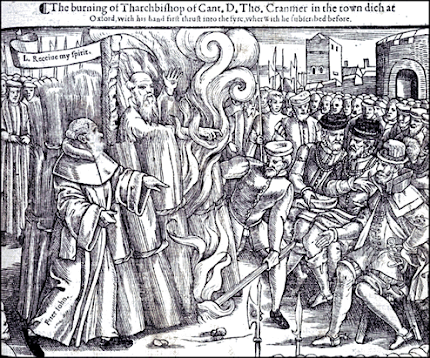
The burning of Tharchbishop of Cant. D. Tho. Cranmer in the town dich at Oxford, with his hand first thrust into the fyre, wherwith he subscribed before. [Click on the picture to see Cranmer's last words.]

Daily Bible Verse

Saturday, January 30, 2010

The Standard Bearer: Why I Will Not Sign the Manhattan Declaration


Click on this link to see the pdf version of The Standard Bearer. While I do not agree with everything that Rev. Clayton Spronk says in this article, his points about the compromises made by the Manhattan Declaration should be taken seriously by every Reformed believer. You can read the article by clicking on All Around Us and then going to page 175 in the pdf file. Here is an excerpt from the remarks by Rev. Spronk:


Not only does a signature affixed to this document overlook Rome’s doctrine, it pats Rome on the back! Do not the Reformed Christians who sign this document remember what else Rome did in the sixteenth and seventeenth centuries? Do they not remember that Rome excommunicated and anathematized people other than those involved in the slave trade, namely, those who were involved in teaching justification by faith alone and all the other great biblical truths of the Reformation? Do they not remember that Rome oppressed faithful, Reformed Christians in a manner that rivals and perhaps surpasses the oppression that slaves experienced under their slave-masters? Rome wreaked havoc on the church and tried to destroy the gospel of Jesus Christ! No, I will not sign the Manhattan Declaration and applaud Rome for seeking the “ common good.”

Resolution R-6: Central Florida Diocese of the Episcopal Church

Resolution R-6: Response to the Election in Los Angeles


The following resolution was presented at 2:15 pm during the convention for the Central Florida Diocese of TEC narrowly passed by a vote of 174 to 152. This close vote shows that even in an allegedly conservative and orthodox diocese there is evidently many theological revisionists and progressivists who deny the authority of Holy Scripture. Scripture clearly condemns homosexual behavior (Romans 1:18-32). Yet 152 voted to uphold the election and consecration of Mary Glaspool as a suffragan bishop in Los Angeles, which is contrary to Scripture because Glaspool is openly lesbian and living in sexual immorality. I would go further than that and say that she is disqualified on the further basis that women are not qualified to serve as pastors, deacons or bishops in light of the Apostle Paul's inspired command for women to not hold positions of authority over men or to teach men (1Timothy 2:12).

The resolution reads as follows:


Title of Resolution: Response to the Election in Los Angeles
Presenter: The Reverend Loren Fox
Date: December 15, 2009

RESOLVED: That this 41st Annual Convention of the Diocese of Central Florida shall understand that, if the consecration of Mary Glaspool as Bishop Suffragan of the Diocese of Los Angeles proceeds in light of Lambeth 1:10, in light off the Windsor Report, in light of the Scriptures, and in light of the Anglican Covenant, those bishops who participate in that consecration will have walked apart from those of us who remain in The Episcopal Church and remain committed to the Faith proclaimed in the Scriptures, received by the one holy catholic, and apostolic Church, and affirmed by the Anglican Communion of which we remain a part.


Glory be to the Father, and to the Son : and to the Holy Ghost;
Answer. As it was in the beginning, is now, and ever shall be : world without end. Amen.


http://www.eskimo.com/~lhowell/bcp1662/

http://www.reasonablechristian.blogspot.com/


Friday, January 29, 2010

BibleWorks 8.0: Leedy's New Testament Sentence Diagramming Module

Last night as I was browsing the features in BibleWorks I decided to try out the Greek sentence diagramming. There are various symbols for different parts of speech whLich you can drag and drop into the window. The most basic one being the subject/predicate division.

Unfortunately, I did not figure out immediately how to get the Greek text into the diagram. I tried to drag and drop from the "Context Window" but that did not work at first. I assumed then that you have to switch to a Greek keyboard and hand type the Greek words into the diagram. However, as I tinkered around I figured out that you simply highlight the appropriate word or phrase and then hold down the left click on the mouse to drag and drop it into the diagram window.

However, the neat thing is that Leedy's Greek NT Diagrams is included. You simply go to the diagramming module and then you will see Leedy's Greek NT Diagrams on the top menu. Simply open the folder and select the book, chapter and verse to view the verse you want to see diagrammed. Also, as you hover the mouse arrow over the Greek words in the diagram you are given the lemma, definition and parsing.

Unfortunately, the Hebrew OT and the Septuagint are not diagrammed for you. To diagram these verses you will need to learn how to manually manipulate the tools in the diagramming module.

Thursday, January 28, 2010

Tuesday, January 26, 2010

Quote of the Day: Charlie J. Ray

You can quote me on this. I said it:


I would rather be a raving neo-fundamentalist any day than to compromise with minimalists who believe almost nothing.

The Presbyterian Church in America: Under Siege by Federal Visionist Dissimulators

BibleWorks 8.0

I received BibleWorks 8.0 in the mail yesterday. I have installed it already and I am learning to get around in the search window, analysis window, and Bible window. The learning curve is slower than with Logos 4 because Bible Works is more technical and there are more selections and menus to get you where you want to go.


However, I am impressed with the overall functionality of the program and the extensive resources provided. For a complete listing of bibles, lexicons, grammars and other books available with the base package see the resource list.

I found that sizing the fonts for readability is less convenient in BibleWorks than Logos because you have to go to the Tools/Options/Fonts menu and then reset all your fonts to a more readable size. This is important for me because I am in my fifties now and need bifocals. Larger print size makes for less eye strain. In Logos you would simply hold down the control key and then use the scroll wheel on your mouse to resize the text in any window. The other difficulty I found was in the modules library window there does not seem to be a way to reset the font to a larger size for easier reading. I will contact support and find out if there is something I have missed.


The links to grammars and lexicons appear in the analysis window, which operates like the information window in Logos 4. To keep the information stable in BibleWorks when you move the mouse pointer you simply hold down the shift key.

I am still learning how to use the search window in Bible Works. It is a bit more tricky to learn because all of the features are not obvious. For example, the search results for the modules and grammars popup in the analysis window. But if you open a library module in another browser window, that is not searchable. All searches must be done from the command line in the search window.

Also, the links which open up in the analysis window for reading appropriate sections in the grammars or lexicons or other resources do not always go to precisely the right area. This means that you must read more of the material to find exactly the right definition and context. But this is a problem with the older databases in Logos as well. The guy at Logos swears that the newer databases are better in Logos 4 but who knows unless you try it?

For Bible Works you really need to have a good working knowledge of Greek and Hebrew and at least some knowledge of Latin to fully appreciate what this software has to offer. But one feature that I really liked was the fact that in the Hebrew verb charts there is a sound button where you can hear each of the forms pronounced. That is a huge help for understanding and learning the correct accents, open and closed syllables, etc.


In addition I was please to find that the morphology of the Hebrew Old Testament, which is the Leningrad and not the Biblia Hebraica Stuttgartensia, got the parsing for niqra' correct in Genesis 24:57. The verb is supposed to be parsed as a qal imperfect first common plural. Niqra' is a homonym with no unique form but the context shows that it is cohortative and not the niphal perfect.

The three Bible dictionaries that come with BibleWorks are available for free in the E-Sword software which is freeware. However, Logos has similar books that are free elsewhere on the internet so that should not be held against Bible Works. E-Sword is a good alternative for the non-professional who does not want to spend much money. However, even in E-Sword to fully use the Greek and Hebrew tools there is a need for at least a basic understanding of root words and how to use Strong's Exhaustive Concordance and Lexicon numbers. E-Sword takes at least some computer savvy to be able to correctly download and install the free modules, so for the less computer literate person even E-Sword would be a technological hazard.


Honestly, Bible Works is not as user friendly as Logos 4 and its look and feel is much more hands on and technical. You really have to know what you are doing to use it. To fully utilize Logos you likewise need to have some technical ability. However, Logos is a bit more visual and intuitive despite my earlier complaints about some of its menus being hard to find and not obvious.


Another point I noticed with Bible Works 8.0 is the Tischendorf NT Critical Apparatus. This is not the most modern and up-to-date apparatus but it is extremely useful if you compare it with what you have in your United Bible Societies 4th Edition or Nestle Aland 26th/27th edition critical apparatus. I have the hard copies of both of those works along with a hard copy of Bruce Metzger's, A Textual Commentary on the Greek New Testament. I can easily compare that with the Tischendorf apparatus in BibleWorks 8.0. The only difficulty I had with the Tischendorf critical apparatus is that there are extensive notes and discussion in Latin. Unless you have at least a rudimentary reading ability for Latin you will not be able to fully apprehend and appreciate the Tischendorf discussion. I do not have a full understanding of Latin but I do know enough to follow the general discussion.


As I said, the greatest hindrance in Bible Works 8.0 is the way the modules are incorporated into the program. There is no search capability of the lexicons and bible dictionaries except as they are related to Bible verse searches which come up in the analysis window. If you simply open a lexicon with the Resources menu you basically are opening the book in a help file format with little of the functionality you get in the main software windows, which are the search window, bible window and the analysis window.


The learning curve is longer with BibleWorks but from I can tell the program is a worthy alternative to Logos 4. Bible Works is especially useful for doing exegesis, particularly because the help file contains a step by step format for doing exegesis papers and for exegesis for sermons. Seminary students and busy pastors will find that BibleWorks gives many more resources for less money than Logos 4. However, if you have a big budget and you are willing to spend Logos 4 has a much larger library and almost an endless supply of add ons and books. Logos 4, I must admit, is more user friendly than Bible Works. I can use Bible Works but it will take longer for me to figure out all the features. As I make more discoveries I will be writing more posts about the capabilities of BibleWorks. I have yet to try out the original language diagramming or the graphical search feature. The biggest selling point for Bible Works, however, is you get more "bang for your buck," as another reviewer put it.

While BibleWorks is not for the fainthearted, it is a great resource when used in conjunction with hard copy commentaries, the internet, and other bible software you might have. I highly recommend BibleWorks for college and seminary students in particular.

Monday, January 25, 2010

My Puritan Roots: The Descendants of the Immigrant John Hand


If you follow the links here you can see the genealogy and the history of my ancestor who was a church planter after the Revolutionary War. See The Emmigrant John Hand and Hiram Hovis Hand.

John Piper's Future Justification Is Incompatible with Romans 8:1

Romans 8:1

Sunday, January 24, 2010

Quote of the Day: Archbishop Henry Orombi (Uganda)

Consider, first, the centrality of the Word of God in faith and life. No honest reading of historic Anglican formularies and the English Reformers can deny the central place of Scripture in Anglicanism. Our worldwide communion is in danger today of confusing doctrine and discipline. The various disciplines of the autonomous provincial churches can be contextualized, but doctrine, based on Scripture, transcends all such cultural distinctions.

We would not be facing the crisis in the Anglican Communion if we had upheld the basic Reformation convictions about Holy Scripture: its primacy, clarity, sufficiency, and unity. Part of the genius of the Reformation was its insistence that the Word of God and the liturgy be in the language of the people—that the Bible could be read and understood by the simplest plowboy. The insistence from some Anglican circles (mostly in the Western world) on esoteric interpretations of Scripture borders on incipient Gnosticism that has no place in historic or global Anglicanism.

Saturday, January 23, 2010

Logos Bible Software Version 4: Further Comments

Well, after extensive haggling with Vincent, one of the technical guys at Logos, I had to concede that the parsing for qara' in Genesis 24:57 is probably a qal imperfect and cohortative. So the Westminster Morphological parsing is correct but imprecise. (See the comments section under Logos 4: Is It Worth It?)

Vincent says that the database for version two Westminister morphological tagging of the Biblia Hebraica Stuttgartensia is not as precise as the newer databases for the same BHS. Thus the results will not be as accurate or precise. According to Vincent the newer databases for the Westminster morphology for the BHS reflect that the qal imperfect plural form is cohortative in Genesis 24:57.

Vincent also says that the newer releases do a better job of linking the Hebrew text, morphology, and lexicons. But I suppose the only way to decide if the newer versions do any better is to invest nearly $500. That's a big piece of change for the average pastor who is working in a church plant or a small to medium sized congregation.

Another issue is the ongoing investment value. Will the library I purchase be accessible and usable in four to five years? And what about the value of the books included in the base packages? How useful are they in actual practice? Most of the commentaries in the Logos Scholar's Edition are completely useless except for perhaps devotional reading. For the serious pastor doing exegesis critical commentaries are essential. The Logos Scholar's Edition is supposed to be a good medium range investment targeted for the busy pastor. But does it deliver?

On the Logos website we are promised that there are extensive commentaries. If you go to the Scholar's Edition link, you'll see another link for a complete listing of LinkBible commentaries included with the base package. In that list, for example, you see the standard Matthew Henry commentary in both the concise and full version. Devotional commentaries are fine but not of much help otherwise. The other concise commentaries are equally useless, mainly the Bible Knowledge Commentary, Holman Concise Commentary, etc. These are acceptable for devotional use but not for sermon preparation.

The only two commentaries listed which might be of use to the busy pastor would be the Bible Exposition Commentary, 23 Volumes, and the Opening Up Commentary Collection, 30 Volumes. I searched the Logos site and found that the Opening Up Commentary Collection looks like a decent pulpit commentary, though I have not actually used or examined the contents. The commentators are mostly evangelical Baptists or Presbyterians and it is recommended by John MacArthur so no problem there.

But what about the Bible Exposition Commentary, 23 Vols.? Well, there seems to be an ambiguity here or else an error on the website. In the listing of the commentaries included the Bible Exposition Commentary is supposed to have 23 volumes. But when I searched the site I found that there are two possibilities. Either they meant Boice's Expositional Commentary, 27 Vols, or they meant Warren Wiersby's Expository Oulines of the OT and NT. The short of it is there is no Bible Exposition Commentary showing up in the search of products matching that description on the Logos website. Either this is an error on the advertisement posting or there is a deliberate misleading of potential customers. I will give the benefit of the doubt to Logos but needless to say this sort of ambiguity needs to be cleared up.

The short answer is do not jump too quickly into buying Logos base packages before you know what you are in reality getting for your investment. Commentaries on a more critical level are going to cost you much more in the Logos 4 system and that is a significant investment for most small time pastors and laymen. While Bible Works 8.0 does not have many commentaries either, the apparent technical advantages just from the biblical texts and tools provided seems to be much more extensive for the investment of $349.00 over against the $472.46 of Logos 4. After January 31st the price for Logos 4 Scholar's Edition goes to $629.95.

In defense of Logos, I have to say that Logos 4 does work well in the new look and appearance and the RAM hogging I observed at first was probably due to the synchronization of the books on intial installation. That process can take a couple of hours or longer depending on the speed of you computer. Logos 4 will work well on new computers with Windows 7 and 64 bit processing but I'm not sure about computers 3-4 years old or older.

The learning curve with Logos 4 is not that bad after I got the hang of it. But I still think the helps file is terrible. I had to have a Logos technician comment on the blog before I figured out how to toggle between the BHS and the LXX in the exegetical guide.

I still have to review Bible Works 8.0 but Logos 4 is still a viable option if you have lots of money to spend with moderate to medium return for your investment. Don't get me wrong, Logos is a great software package if you have a reasonable knowledge of Greek and Hebrew and you know how to use the hard copy tools with which most seminarians are familiar. But the ease of use issue is debatable. Logos 4 also has a much more extensive add on library, including the Word Biblical Commentary, etc. But these additions can involve an extensive investment which will be usable at least in the near future but maybe not forever? The reality is that computers and software become obsolete and have to be upgraded. Logos.com seems to be capitalizing on that by following Microsoft's similar business model. Monopolizing the market is a way to profit quickly and to make the consumer dependent on the dominant format. Logos obviously wants to be the Microsoft of the computer exegesis world. It seems to me that healthy competition is good for the consumer. Don't be too quick to jump on the Logos bandwagon.

Charlie

Friday, January 22, 2010

Evidentialism, Presuppositionalism, and Irrationalism

[My response to a comment at God's Hammer. John Robbin's Not So Quick Quote. The original comment is first and following that is my response.]

Mike said:

Ok, I am still catching up with you all. Still reading through my Clark and Robbins. I am also catching up on R.C.'s errors. I was reviewing some of his writings and he has whole books dedicated to the conclusion that the reformers like Luther and Calvin were soley focused and devoted to faith alone, and that the Roman church rejected this and is therefore an apostate church. He sounds like he is fairly solid. I am not saying I agree with all his conclusions, and his views on God's providence certainly do not go far enough (thank you Gordon Clark). I have just read and watched so many sources from Sproul that seem to be denouncing the Catholic church.

Again…. I am asking the question not arguing the point, help me understand.

I like Robbins and he seems to be excellent so explain to me why every error is linked by to a vast Catholic concpiracy, to include R.C.'s views.

Mike, R.C. Sproul is not linked to a "vast Catholic conspiracy." I don't believe that is the argment that John Robbins had with him. R.C. Sproul is solid on many reformed points of theology. The point of contention is R.C. Sproul's approach to apologetics, which is modeled on evidentialism via the Roman Catholic church father, Thomas Aquinas. Gordon H. Clark's approach was presuppositionalism. Evidentialism begins with reason rather than with Scripture and with faith. Reason, being corrupted by the fall, can never lead to faith. Rather the eyes of the elect are opened through the preaching of the Gospel. So the beginning point is Scripture, not classical arguments for the existence of God.

The other issue is the dispute between Van Til and Clark. Both were presuppositionalists. So what was their point of contention? Van Til took the irrationalist route and denied that propositional truth in Scripture is rational. Van Til falsely accused Clark of "rationalism". By rationalism Van Til meant exalting reason above Scripture, which is not Clark's position at all. Rather Clark said that Scripture is revealed through rational form, i.e., logical and propositional truth statements which are completely rational and understandable and comprehensible.

Basically, Van Til's approach has more in common with neo-orthodoxy than with solid reformed theology. Sproul, on the other hand, is not a presuppositionalist but an evidentialist and thinks that reason can set the stage for accepting the existence of God and the special revelation of God in Scripture.

Presuppositionalism acknowledges that everyone has a presupposition and a predisposition. So the only way to break through the bondage of sin is through God's sovereign intervention and the appointed means of such an intervention is Holy Scripture and the preaching of the Gospel.

I don't totally disregard Sproul. I just reject his evidentialism. As with all theologians there is some adherence to the truth.

At least this is my take on the situation. Sean and the owners of the God's Hammer blog are sure to correct me where I've misunderstood.

Sincerely in Christ,

Charlie


Glory be to the Father, and to the Son : and to the Holy Ghost;
Answer. As it was in the beginning, is now, and ever shall be : world without end. Amen.


http://www.eskimo.com/~lhowell/bcp1662/

Thursday, January 21, 2010

The commentator at the No Way APA site has broken his silence to make the following insightful observation:

Oh Well. . . .

The REC-APA joining seems to have gone by the wayside as the REC has (by pontifical edict) decided to join the even more heretical ACNA with its own Anglo-Catholicism, women ministers, and charismatic tendencies. Proving the "slippery slope" spoken of in Scripture.

(II Cor. 6:14)

I tend to agree.

May the peace of God be with you,

Charlie

Logos Bible 4 Upgrade: Is It Worth It?

I have the old Logos Bible Scholar's Edition. To upgrade it would cost me $472.46. To the credit of Logos I was able to download the free engine for Logos 4 and utilize the purchased modules I already have. Personally, I do not feel that I should have to keep buying the same software over and over again every time there is a new release of Windows or the base Bible software.


Microsoft's new Windows 7 will not run Windows XP, XP Service Pack 1 or Service Pack 2 software. But Windows 7 does work with Windows XP Service Pack 3. So I lost my old XP copy of Zondervan's 1995 version of The Expositor's Bible Commentary. My old laptop burned out the video card so I had to buy a new laptop. So now I am out the $100.00 I spent a few years ago for The Expositor's Bible Commentary software from Zondervan. While the commentary is basically a pulpit commentary, the introductory notes were especially helpful and the commentary is from a basically reformed perspective, although some of it is weak reformed theology.

Microsoft wants to make you spend more money so their new operating system does not include the virtual mode for running XP software. That's going to cost you $89.95 to upgrade from the Home Premium Edition--which comes with most new computers--to Windows 7 Professional Edition.


So the other option I have is to buy The Expositor's Bible Commentary for Logos 4. How much will that cost me to upgrade? Not much. It's only $129.99 if you pre-order. But how much will it cost if you wait until it is released? God only knows but the suggested retail price Logos has on the website is $456.68. See the pricing at The Expositor's Bible Commentary. The Logos pre-order prices are not excessive but the problem is new releases often have numerous bugs and typos. Logos does include a way to report typos which they promise to report to the publishers for correction at the next release.

O.K., I have admit that I love being able to do exegesis on the computer. Logos has been a useful tool. But as I said in an earlier post it does not deliver everything it promises, particularly in the parsing modules. I found several niphal Hebrew forms which were listed as qal in the parsing. I do not know if that was because of errors made by the publisher or if it is an error made by the Logos programmers. The morphological tags were obviously in error on those points.

I have not tried Bible Works 8.0 yet but I am eagerly awaiting the delivery so I can compare it with Logos 4. Stay tuned!

Bible Works 8.0 Soon to Be Reviewed

I have a copy of Bible Works 8.0 on the way in the mail so I will be trying out that software as soon as I receive it. However, before I even receive the package I can tell you that I am extremely impressed with the amount of original language modules, lexicons and grammars Bible Works includes for the base price of $349.00. That beats Logos Scholar's Edition hands down because Logos Scholar Edition is almost $300 more at $629.95 and does not give you as many modules for your money. I have had to buy several addons over the years just to beef up the Logos Bible software. Bible Works does not include Bauer, Arndt and Gingrich's lexicon of New Testament Greek but it does include Brown Driver and Briggs Old Testament Hebrew lexicon. Also, impressive is the inclusion of the apostolic fathers in original Greek with morphology. For a complete listing of the contents see Bible Works Contents.

An Answer to an Agnostic

[I posted the following comment at the Internet Monk site in response to a post by an agnostic called,  A Letter from an Agnostic.]


Dear Agnostic,

Well, there are some positive points in your monologue. First of all you get it that it basically all comes down to one's presuppositions. Atheistic materialism assumes out of hand that there is no God because in doing empirical science there can be no appeal to supernatural intervention, otherwise science degenerates into superstition and mysticism.

However, the philosophy of science has challenged the idea that somehow "science" is neutral. Thomas Kuhn in his classic book, The Structure of Scientific Revolutions argued convincingly that science is basically controlled by sociological power structures very similar to a religious organization like the Roman Catholic Church. In other words, there is a degree of subjectivity in doing science and in determining the current "dogma." Which theory of evolution is the correct one? Do blackholes exist and what about string theory? Can life spontaneously generate itself from a primordial soup of the right combination of amino acids? (No scientist has been able to duplicate the process. You would think if they know how it happened it could be repeated in laboratory conditions).

Really the agnostic position is no better than the atheist position because it presupposes that there can be no rationally acceptable answers. But if that is so then empirical science should become agnostic instead of making theoretical presuppositions and then testing those presuppositions. You assume that the burden of proof is on the Christian. When you said that there is no way to prove Jesus rose from the dead, etc., you're clearly siding presuppositionally with the atheist. But how can the atheist be rationally certain that there is no God apart from presupposing that there is no God? The atheist is on equal ground with the Christian since the burden of proof is equally his to prove there is no God.

Now, I know you're going to ask how we can know that Christianity is true from among all the other world religions. That comes down to rationally and logically comparing religions. There is a reason why Christianity is one of the three major religions in the world. It is because it is superior rationally, ethically, and spiritually. Of course, I am biased and presupposing that.

Forgive me for being blunt here but agnosticism is in fact a choice. You have deliberately chosen not to choose and you do so based on your presupposition that God is unknowable and that Christianity is irrational. But that is far from the case as you intimated in your inner struggle. God is indeed incomprehensible as far as knowing everything about an omnipotent, omnipresent, and omniscient being goes. But incomprehensibility is different from unknowability.

To believe or not to believe is based on your own choices and your own presuppositions since there is no absolute knowledge of anything. We are all in the same situation on that point whether the choice is atheism, agnosticism, Christianity or some other religion.

The bottom line is presupposition. In my opinion Christianity is compatible with science and it is superior to atheism, agnosticism and to any other religion when rationally examined and when one finally decides to believe.

Calvinism takes the position that God will actually cause you to believe, though you must make the choice (John 1:11-13; John 3:1-8). The onus is still on you but God will help you to make that decision if you are willing to stop choosing rebellion and simply submit to the Creator.  Choose you this day whom you will serve.  (Joshua 24:15; Psalm 14:1-3).

Sincerely in Christ,

Charlie


Tuesday, January 19, 2010

Michael Spencer Needs Your Prayers

[I copied this from the White Horse Inn blog. If you feel led to pray or donate, please do. Click on the title to see the links at the White Horse Inn.]

Helping a Friend in Need

UPDATE: For those wishing to donate online, try going to the Internet Monk website and click the “donate/paypal” button on the right hand side of the page.

At the recent Westminster Seminary California faculty conference, Mike Horton said “God doesn’t need your good works, your neighbor does.” In the spirit of this truth, we’re asking you to help a neighbor some of you have never met. Michael Spencer (aka “the Internet Monk“) is a pastor and writer living in Kentucky. He has written two articles for Modern Reformation and has participated in a roundtable discussion on Scripture that will be included in our March/April 2010 issue.

Many of you have benefited from Michael’s honest writing and clear grasp of the gospel. And we’re appealing to you for help on his behalf. Late in 2009 Michael got sick. He had symptoms that didn’t go away. The doctors finally diagnosed cancer and on Christmas Eve a mass was removed from the back of his brain. He’s now trying to recover while facing radiation and chemo treatments. Like many of you, Michael doesn’t have a “cadillac” insurance program. He works for a small Christian boarding school. The resources to care for very ill employees are limited at best. In a few weeks he will be out of a job and employer-paid insurance. The near future looks very tight. Here is an update in Michael’s own words.

This isn’t an appeal for money for White Horse Inn or Modern Reformation. This is an appeal for help for our friend, Michael Spencer. If you can give anything at all, please send it to: Michael and Denise Spencer, PO Box 303, Oneida, KY 40972.

Tim Keller once said that Jesus’ command to love our neighbor as ourselves meant that we meet their needs with the same speed, resources, and passion that we meet our own. Join with us in loving Michael Spencer in his time of need.

ShareThis

Tags: Internet Monk, Michael Spencer

This entry was posted on Monday, January 18th, 2010 at 3:18 pm by Eric Landry and is filed under Friends. You can follow any responses to this entry through the RSS 2.0 feed.

3 Responses to “Helping a Friend in Need”
Dave Begley says:
January 18, 2010 at 4:28 pm
Could you double check the online link please.

Dale in Tx says:
January 18, 2010 at 5:25 pm
The PayPal link isn’t working. Do you know the email used in the account? Then we can just go straight there. Thanks.

Praying for all of the Spencers.

Joe says:
January 19, 2010 at 1:08 pm
Just checked the donation link to PayPal at the iMonk’s site.

Appears to be working fine.

Or, you could just PayPal directly to:

michael [at] internetmonk.com (no spaces, of course).

Leave a Reply
Click here to cancel reply.

Name (required)

Mail (will not be published) (required)

Website


Another Review of Logos Bible 4

Another Look at Logos Bible Version 4


My major complaint with Logos 4 is that it is not “intuitive” or easy to find the features. Older versions at least had a menu. You simply learned the menu and you were on your way. However, with the new version of Logos 4 the menus are often hidden and you have to figure out where it is. For example, in using the Exegetical Guide in Logos Scholar's Version you are given the exegesis from the Septuagint by default when most folks use the Biblia Hebraica Stuttgartensia. I will try to give a screen shot to show you what I mean.


Notice the right panel is blank. I'm trying to get an exegetical guide for Genesis 24:51. But how do I get it to work? After serious searching and no help from the Help File, I found that you have to left click in the status window where the Scripture reference is:


Now it is still not obvious what to do. Notice the little blue arrow to the right of the reference? I left clicked on that and got this:


Now I'm frustrated because there is no indication anywhere of how I'm supposed to toggle the exegesis to the BHS instead of the LXX. Someone from Logos 4 finally saw my complaint on the blog and left a comment telling me to click under Word by Word. But even that instruction is not immediately obvious. I finally figured out that you left click where it says, Septuaginta: Morphologically Tagged Edition and then you get this:


Again, this was not intuitive at all. I learn fast and once I know how it works it's not hard. But my complaint is that the software nowhere tells you this and unless someone tells you or shows you there is no way of knowing how to do this!


Since I'm on this topic, I am planning to do future posts with more examples of what I consider difficulties with Logos 4. Overall I suppose I'm happy with the program because of all the resources offered. But the expensive new packages are out of reach for the average pastor. You'd have to have a mega church to afford some of this stuff and most mega churches could care less about rightly dividing God's Word. To see what I'm talking about check package deals at this link: Logos Bible 4 Packages.

The Scholar's Package is reasonable at $629.95. However, the commentaries included do not rise to the level of even a pulpit commentary. You would almost be better off to purchase commentaries on an individual and as needed basis. The Enhanced Brown Driver and Briggs Hebrew is good and so is the Bauer Gingrich and Arndt Lexicon for New Testament Greek. But there are newer versions of both of these books with greater functionality and critical apparatus for more money.

At any rate, Logos is not a total bust but it is bit slow to pull up some of the popups for information windows and other things. Also, the Power Lookup only works if you know how to use it. But that's another issue for another post.

Given that I have not become totally familiar with the package at this time I'm going to raise my grade of Logos 4 from a C to a B minus.

The peace of God be with you,

Charlie


Monday, January 18, 2010

A Short Review of Logos Bible Version 4

One would expect that a professional scholar's version of a Bible software program like Logos Bible would perform as advertised. Don't get me wrong. The resources in Logos are exceptional, including the Enhanced Brown Driver Briggs Lexicon of Hebrew and Aramaic, etc. The morphological parsing for the LXX and the Nestle-Aland New Testament and the Biblia Hebraica Stuttgartensia is also useful.

However, the promised precision is lacking. There are numerous errors in the morphological parsing information windows and one has to be an expert to know how to highlight the root word and then get a correct definition of the right word form or lemma. Sometimes the information window pops up a noun definition when the parsing shows the word is actually a verb. These sorts of problems are so numerous as to make the parsing useless in many cases.

Another problem I noticed is that the exegetical guide is out of sync. When I tried to do an exegetical study with the guide template I found that when I wanted to do the Hebrew passage in Genesis 24 the exegetical guide did the exegesis on the Septuagint and not the Hebrew! Arrrgh! One would think that a program that costs upwards of $600 would actually DO what the software company promises! I'm sure there are many pastors out there who don't know they're not getting their money's worth from this software.


I've owned Logos for about ten years now and I'm still finding typos and errors in the morphology of the original languages. I don't own all the addins but the ones I do have do not do what is promised. I'm generally happy with the resources provided with the package but the sloppiness regarding typos and the performance of the guide templates and other study aids is terrible. I give this software an overall C grade. Don't waste your money if you're looking for exegetical precision. If you're looking for a program that has good resources, this is a keeper. The trouble is if you don't know Greek or Hebrew that well your search results can be confusing. Knowing how to get the correct results in your lexicons, etc. can be frustrating.

What I find particularly irritating is the high cost of the packages with more resources. If the contents of the lower packages are any indication the likelihood of there being numerous typographical errors and other problems is high. I realize that this software is for a highly specialized market, namely pastors and amateur scholars. However, you would have to be a high paid pastor or scholar to afford these upgrade packages. If you happen to be a genuine scholar who is concerned with exegetical precision, then Logos is a miserable failure. However, if you want lots of resources so you don't need a large hardcopy library then Logos proves to be a useful tool. As I said, however, you have to be an expert to be able search the lexicons, commentaries, and morphology for exact results.

The Real Scandal of the Evangelical Mind

This is an excerpt from an article by Carl Trueman. To read the full article click on thee heading below:
WHY DO EVANGELICAL ACADEMICS CRAVE WORLDLY ACCEPTANCE?

I suspect there are a number of reasons for this problem. First, the context of evangelicalism lends itself to just such confusion. Evangelicalism really does not understand what it is. Is it a movement based on an experience (the new birth), or on theological commitments, or on parachurch institutions? Yet here's the rub: The first (experience) will degenerate into mere subjective mysticism if not connected to the second (theological commitments). The second is now highly disputed among evangelicals, who cannot even agree on the answer to Pilate's question, "What is truth?" And the third (parachurch institutions) too often either forms part of the problem of defining the second, or, in the USA in particular, becomes less a ministry and more a vehicle for a cult of personality, vulnerable to the kind of criticism made by Eric Hoffer, who said that every great cause begins as a movement, becomes a business, and ends up as a racket. Evangelicalism is a sorry mess, neither pure nor simple.

Sign the Petition for Academic Freedom in America

Quote of the Day: John Robbins on Justification by Faith Alone

"What we call Western civilization arose because of the widespread preaching and believing of the Gospel of justification by faith alone. Theologies that deny this doctrine are fatal to both souls and societies."

The late John Robbins of The Trinity Foundation.  The Trinity Review:  The Religious Wars of the 21st Century

The Old Testament Might Be Four Centuries Older Than Previously Thought

God's Providence in Keeping Covenant: Genesis 24:52-67 (Audio)

Church of England May Consider Greater Rights for Partners of Gay Clergy: Institutionalized Immorality Gains Ground


The Sunday Telegraph reports that the Church of England is considering giving greater recognition to homosexual clergy in relationships.

According to the Sunday Telegraph, Bishops and senior clergy will debate at next month's General Synod whether the Church should provide same-sex couples with the same financial benefits as are awarded to married couples.

The private member's motion (to be released this week) calls on the Archbishops' Council, chaired by Rowan Williams, to introduce changes that would "provide for pension benefits to be paid to the surviving civil partners of deceased clergy on the same basis as they are currently paid to surviving spouses".

Alison Ruoff, a conservative-evangelical on the General Synod, expressed concern over the implications of the motion. 
 
"It wouldn't be right for the Church to provide gay clergy's partners with the same pensions as it would mean that the Church would be recognising homosexual relationships in the same way as marriage," she said.

"It would show that the Church is becoming increasingly liberal and moving further from Biblical teaching."

According to the Telegraph around 200 priests are believed to have entered civil partnerships since they were introduced in 2004.

Click here for article

(Source: The Sunday Telegraph, 17/01/10)

Sunday, January 17, 2010

The Providence of God in Keeping Covenant

The Providence of God in Keeping Covenant


Text: Genesis 24:52-67


Introduction:


One of the most prominent themes in the Old Testament is the sovereignty of God. In other words, God is a heavenly king who makes decrees and then makes those decrees actually happen in real history on earth. The story of Abraham, Isaac and Jacob shows clearly how God works not only with individuals but through generations of families. If you will remember, God made a covenant with Abram in Genesis 17 and Abram's name was changed to Abraham, the father of many nations. When Abraham was 99 year-old God promised to make him the father of many nations. However, it looks impossible since both Abraham and Sarah his wife are well advanced in years. In fact, both Abraham and Sarah laughed when God made this promise to them that they would have a male heir. Hence, Isaac's name in Hebrew means literally, "He laughs." Do we believe God's word to us? Exactly what is a covenant anyway?


1. The Idea of Covenant in the Old Testament


a. In the Ancient Near East a covenant between two men or two human parties serves as the model for the covenant between God and man. In case of human covenants the agreement can be between two equals or between a greater and a lesser person in social standings.


b. In the case of the covenant between Abraham and God it is obvious that the greater makes a covenant with the less equal and weaker party. There is no comparison between God our Creator and one of his creatures. A covenant, though similar to a contract, is different because a covenant is a solemn agreement based on an oath taken before God.


I. Howard Marshall says:


In modern times we define a host of relations by contracts. These are usually for goods or services and for hard cash. The contract, formal or informal, helps to specify failure in these relationships.

The Lord did not establish a contract with Israel or with the church. He created a covenant. There is a difference. Contacts are broken when one of the parties fails to keep his promise. If, let us say, a patient fails to keep an appointment with a doctor, the doctor is not obligated to call the house and inquire, "Where were you? Why didn't you show up for your appointment?" He simply goes on to his next patient and has his appointment secretary take note of the patient who failed to keep the appointment. The patient may find it harder the next time to see the doctor. He broke an informal contract.

According to the Bible, however, the Lord asks: Isaiah 49:15 (ESV)

15"Can a woman forget her nursing child, that she should have no compassion on the son of her womb Even these may forget, yet I will not forget you. "

The Bible indicates the covenant is more like the ties of a parent to her child than it is a doctor's appointment. If a child fails to show up for dinner, the parent's obligation, unlike the doctor's, isn't canceled. The parent finds out where the child is and makes sure he's cared for. One member's failure does not destroy the relationship. A covenant puts no conditions on faithfulness. It is the unconditional commitment to love and serve. - Bruce Shelley

I. H. Marshall, Jesus the Savior, IVP, 1990, p. 275ff

c. So we can see that when God promised and made an oath with Abraham and established a covenant relationship with him that God is able to bring it to pass, to bring it into existence because he is God and not a mere human or creature.


Hebrews 6:13–18 (ESV)

The Certainty of God's Promise

13 For when God made a promise to Abraham, since he had no one greater by whom to swear, he swore by himself, 14 saying, "Surely I will bless you and multiply you." 15 And thus Abraham, having patiently waited, obtained the promise. 16 For people swear by something greater than themselves, and in all their disputes an oath is final for confirmation. 17 So when God desired to show more convincingly to the heirs of the promise the unchangeable character of his purpose, he guaranteed it with an oath, 18 so that by two unchangeable things, in which it is impossible for God to lie, we who have fled for refuge might have strong encouragement to hold fast to the hope set before us.


(Compare Genesis 22:15; Psalm 105:9; Luke 1:73).


It is because Abraham believed God and obeyed His command to sacrifice Isaac that all believers on earth are now blessed.


2. God Is In Providential Control


a. On almost every page of the book of Genesis we see that God directing the action behind the scene.

1. God supernaturally makes Sarah bear a son in her old age. (Genesis 21:1-4)

2. God supernaturally provides a sacrifice in the place of Isaac. (Genesis 22:13-14). God will provide. Yahweh yireh. Jehovah Jireh. The LORD will see.


Genesis 22:15–18 (ESV)

15 And the angel of the Lord called to Abraham a second time from heaven 16 and said, "By myself I have sworn, declares the Lord, because you have done this and have not withheld your son, your only son, 17 I will surely bless you, and I will surely multiply your offspring as the stars of heaven and as the sand that is on the seashore. And your offspring shall possess the gate of his enemies, 18 and in your offspring shall all the nations of the earth be blessed, because you have obeyed my voice."


b. Sarah, the wife of Abraham has died (Genesis 23:2) and Abraham himself is around 140 years old. He decides to send his most trusted servant, probably Eliezer, to Ur in Mesopotamia to get a wife for Isaac from among his own people. Eliezer must be at least in his 60's by now and so this is no easy journey for him.

1. Notice first of all that in the first half of chapter 24 the servant prays to God for divine guidance. Abraham does not give the servant Yahoo driving directions. He simply tells him to go to Ur in general and amazingly God is faithful in directing the servant to precisely the right location and the right well to water his camels. The servant prays to God for divine intervention so that he can know the right girl to choose and the sign is that she will offer water from the well to the servant and to his 10 camels, a sign of great wealth for that time period since camels were rare.


2. God answers the prayer and leads Rebekah to do just as the servant prayed. If only we were more faithful in prayer! Gordon Wenham, the British commentator on Genesis 16-50, mentions one of the collects from the Trinity season in reference to these verses in Genesis. The prayer says:


ALMIGHTY and everlasting God, who art always more ready to hear than we are to pray, and art wont to give more than either we desire, or deserve; Pour down upon us the abundance of thy mercy; forgiving us those things whereof our conscience is afraid, and giving us those good things which we are not worthy to ask, but through the merits and mediation of Jesus Christ, thy Son, our Lord. Amen.


3. After an extended negotiation for betrothal, Rebekah and her nurse and her hand maidens depart with the servant to return to Canaan to meet up with Isaac.


3. The Covenant of Marriage


a. We ought to note here that Rebekah is a beautiful young woman to behold. In fact, her name means "Ensnared." In other words, when men look at her they are enticed and trapped by her looks.

b. In the marriage customs of the Ancient Near East wives were negotiated for in arranged marriages. Despite our modern aversion to such practices, arranged marriages tend to endure longer than marriages based on dating and romantic attraction.

c. The value of women as wives is not that they are chattel to be bought and sold like slaves but that a man values a good wife who also happens to be attractive and a good mate. As far back as the Garden of Eden before the fall God saw that it was not good that Adam should be alone. In fact, Rebekah has the final say in whether or not she will accept the marriage proposal and return to Canaan with the servant. (Verses 57-58).

d. Even though Isaac is not present, the servant acts as his proxy and negotiates the terms of the marriage, the dowry, and the betrothal. In that day and time a betrothal is as binding as the marriage itself and the wedding is practically a done deal except for the consummation of the marriage. Here we see another picture of God's sovereignty. We are passive and wait for God to accomplish for us what is out of our control. All Isaac can do is trust God and wait for the servant to return. God keeps the covenant promises and brings them into reality. We do not make the covenant promises happen but God does.

e. Wealth is a sign of God's blessing on Abraham and Rebekah and her family cannot help but see the wealth of Isaac through Abraham. There are 10 camels and even one camel would be hard to afford in those days. Also, the servant gives Laban expensive gifts as well as the gold bracelets and the nose ring he gave Rebekah at the well. But wealth is not the real emphasis. Instead wealth is a sign of a relationship with God where God bestows divine favor on those who believe him and keep his covenant. This is the kind of favor that Abraham, Rebekah's future father-in-law obviously has with God. It is not favor that is earned or merited but rather a favor based on the fact that Abraham believed God's promise which God made to Abraham in the covenant. This is no mere contract but a covenant, a solemn agreement that Almighty God makes with Abraham.


4. The Marriage

a. When Rebekah sees Isaac she is immediately impressed and asks the servant, "Who is THAT man walking in the field towards us?" She's intensely interested.

b. When she learns that it is the servant's master, Isaac, she dismounts the camel and covers herself with her veil as a sign of modesty. We still observe the veil in modern weddings because the veil represents virginity and modesty and humility and virtue on the part of the woman.

c. Also it is noticeable that there is no formal marriage ceremony. Isaac takes Rebekah into his mother's tent and she becomes his wife. We ought not to think that because Isaac did this that there was immorality involved because they were already engaged. In the ancient near eastern culture betrothal is as serious as marriage and so the groom and the bride were committed to one another prior to the marriage. One can recall the story of Mary and Joseph in the NT when Joseph discovered that Mary was pregnant he planned to divorce her quietly because he was a decent man. Even though Joseph and Mary were not yet married, the betrothal was a serious affair and Mary could have been accused of adultery. But Joseph learns that Mary is pregnant by supernatural means and marries her anyway (Matthew 1:18-25). Just as God supernaturally intervened with the birth of Isaac so God supernaturally intervenes in the birth of Jesus, who is the fulfillment of the promise given to Abraham.


Conclusion:


So what does all this mean for us today? First of all, we ought to be believers just as Abraham was a believer. Abraham, despite his doubts and trying to do things his own way—he took Hagar the Egyptian for a concubine rather than trusting God—was blessed by God. Despite trying to do things our own way if we are truly friends of God and in the covenant of grace as God's chosen people, God will indeed bring to pass what He has promised through Abraham. God is sovereign over even our sins and is able to bring the blessing despite our disobedience.


While the blessing is not necessarily health, wealth and prosperity as the television evangelists falsely promise, it is nevertheless a promise that God will meet our needs both in this life and for the life to come. We need not try to cheat and do things our own way or bargain with God. God is able to keep his end of the covenant. Even if we are unfaithful yet he remains faithful and cannot deny himself (2 Timothy 2:13).


The fact that Isaac took Rebekah into his tent immediately does not justify having sex outside of marriage or living together in a common law relationship since this is fornication and adultery. Instead it means that sex is a sacred and intimate bonding between one man and one woman. It is through the covenant of marriage that God preserves the Christian family and brings the promises of Abraham into reality. Of course, we evangelize the whole world because the Gospel is now open to Gentiles as well as the house of Israel. Abraham is truly the father of many nations.


A genuine Christian marriage is not based on worldly ideas of erotic love or romantic love. Rather our commitment to God and to each other comes first. As in an arranged marriage, true love is what happens after the commitment is made. The married couple is then supported in their commitment to their marriage vows by the extended family, the community, the church and God. Isaac took Rebekah into the tent and she became his wife and he loved her. True love involves a prior commitment and on the part of both the man and the wife. The roles God assigned to Adam and Eve in creation manifest in a mutually nurturing and interdependent relationship and true love can only be known inside a committed covenant relationship of marriage. Everything else is a cheap imitation. Furthermore, the idea of a man lording it over his wife is the result of sin and the fall. However, in a Christian marriage we have both parties in an equal relation but with truly male and female roles to play in that relationship.


If we will trust God, we will be blessed. But if we insist on doing things our own way, we face consequences in this life. Just as Abraham and Sarah had marital problems following Abraham's relationship with Hagar, so we too suffer temporal consequences. God's perfect will is for one marriage for life to one partner. But even if we fail at this, God is merciful and forgiving. He will never leave nor forsake those who are chosen in Christ from before the foundation of the world. We are His children who are bought with the precious blood of Jesus Christ. (1 Peter 1:19). God is able to do exceedingly and abundantly beyond what we can imagine. He provides for us in all areas of life. Just as God provided an heir for Abraham and a wife for Isaac so too God will provide for all of our needs in Christ Jesus.


The 1662 Book of Common Prayer make it clear that marriage is a covenant and not merely a contract when it calls the service, THE FORM OF SOLEMNIZATION OF MATRIMONY. Marriage symbolizes the covenant relationship between Christ and the church and reminds us of the covenant God made with Abraham that all believers would be blessed because of God's promises.


Numbers 6:24–27 (ESV)

24 The Lord bless you and keep you;

25 the Lord make his face to shine upon you and be gracious to you;

26 the Lord lift up his countenance upon you and give you peace.

27 "So shall they put my name upon the people of Israel, and I will bless them."

Wednesday, January 13, 2010

New Style "Evangelical" Liberals

NEW-STYLE LIBERALS

So what's changed? Today, many of those I would call liberals would proudly call themselves "evangelical." So why aren't they evangelicals? After all, they affirm miracles, Jesus' physical resurrection, the need for conversion, and the centrality of the cross. Aren't those things what evangelicalism is all about?

Recently, we in Britain have had to confront that very question, with prominent evangelicals denying penal substitution but claiming they are still evangelical. On what grounds? Because (they say) they simply teach what they find in the Bible. They want to live under the Bible. How then, they ask, can they be called liberal? This has come up time and again—over penal substitution, over Clark Pinnock and open theism, over questions of practicing homosexuality. These are said to be possible evangelical views, because evangelicals in good conscience hold them as biblical teaching.


You can read Ovey's complete article at Notes from the Future: Evangelical Liberalism in the UK

Tuesday, January 12, 2010

Morning Prayer in Modern English

Daily Morning Prayer in Modern English from the 1662 BCP and the ESV


[Please note: The following is my work. I have developed a literal following of the 1662 Book of Common Prayer for Morning Prayer with modern English. I have utilized Lynda M. Howell's 1662 BCP website for the general forms and the lectionary and replaced all Scripture with quotes from the English Standard Version. I have retained as much as possible the exact wording of the 1662 BCP but have converted the Elizabethan English into modern English by removing thees and thous and other such archaic forms. Words not listed as "archaic" in modern English dictionaries are retained.]


Morning Prayer for January 17, 2010


Using the 1662 Book of Common Prayer with modern English adaptations and the English Standard Version.


At the beginning of Morning Prayer the Minister shall read with a loud voice some one or more of these Sentences of the Scriptures that follow. And then he shall say that which is written after the said Sentences.


"Again, when a wicked person turns away from the wickedness he has committed and does what is just and right, he shall save his life." (Ezekiel 18:27, ESV)


"For I know my transgressions, and my sin is ever before me." (Psalm 51:3, ESV)


"Hide your face from my sins, and blot out all my iniquities." (Psalm 51:9, ESV)


"and rend your hearts and not your garments." Return to the Lord your God, for he is gracious and merciful, slow to anger, and abounding in steadfast love; and he relents over disaster." (Joel 2:13, ESV)


"To the Lord our God belong mercy and forgiveness, for we have rebelled against him and have not obeyed the voice of the Lord our God by walking in his laws, which he set before us by his servants the prophets." (Daniel 9:9-10, ESV)


"Correct me, O Lord, but in justice; not in your anger, lest you bring me to nothing." (Jeremiah 10:24, ESV)


"O Lord, rebuke me not in your anger, nor discipline me in your wrath." (Psalm 6:1, ESV)


"Repent, for the kingdom of heaven is at hand." (Matthew 3:2, ESV)


"I will arise and go to my father, and I will say to him, "Father, I have sinned against heaven and before you. I am no longer worthy to be called your son. Treat me as one of your hired servants." '" (Luke 15:18-19, ESV)


"Enter not into judgment with your servant, for no one living is righteous before you." (Psalm 143:2, ESV)


"If we say we have no sin, we deceive ourselves, and the truth is not in us. If we confess our sins, he is faithful and just to forgive us our sins and to cleanse us from all unrighteousness." (1 John 1:8-9, ESV)


DEARLY beloved brethren, the Scripture moves us, in sundry places, to acknowledge and confess our manifold sins and wickedness; and that we should not dissemble nor cloak them before the face of Almighty God our heavenly Father; but confess them with an humble, lowly, penitent, and obedient heart; to the end that we may obtain forgiveness of the same, by his infinite goodness and mercy. And although we ought, at all times, humbly to acknowledge our sins before God; yet ought we chiefly so to do, when we assemble and meet together to render thanks for the great benefits that we have received at his hands, to set forth his most worthy praise, to hear his most holy Word, and to ask those things which are requisite and necessary, as well for the body as the soul. Wherefore I pray and beseech you, as many as are here present, to accompany me with a pure heart, and humble voice, unto the throne of the heavenly grace, saying after me;


A general Confession to be said of the whole Congregation after the Minister, all kneeling.


ALMIGHTY and most merciful Father; We have erred, and strayed from your ways like lost sheep. We have followed too much the devices and desires of our own hearts. We have offended against your holy laws. We have left undone those things which we ought to have done; And we have done those things which we ought not to have done; And there is no health in us. But you, O Lord, have mercy upon us, miserable offenders. Spare them, O God, who confess their faults. Restore those who are penitent; According to your promises declared unto mankind in Christ Jesus our Lord. And grant, O most merciful Father, for his sake; That we may hereafter live a godly, righteous, and sober life, To the glory of your holy Name. Amen.

The Absolution, or Remission of sins, to be pronounced by the Priest alone, standing; the people still kneeling.


ALMIGHTY God, the Father of our Lord Jesus Christ, who desires not the death of a sinner, but rather that he may turn from his wickedness, and live; and has given power, and commandment, to his Ministers, to declare and pronounce to his people, being penitent, the Absolution and Remission of their sins : He pardons and absolves all those who truly repent, and unfeignedly believe his holy Gospel. Wherefore let us beseech him to grant us true repentance, and his Holy Spirit, that those things may please him, which we do at this present; and that the rest of our life hereafter may be pure, and holy; so that at the last we may come to his eternal joy; through Jesus Christ our Lord.


The people shall answer here, and at the end of all other prayers, Amen.

If no priest be present the person saying the service shall read the Collect for the Twenty-First Sunday after Trinity, that person and the people still kneeling.


The Twenty-first Sunday after Trinity.

The Collect.

GRANT, we beseech you, merciful Lord, to your faithful people pardon and peace, that they may be cleansed from all their sins, and serve you with a quiet mind; through Jesus Christ our Lord. Amen.


Then the Minister shall kneel, and say the Lord's Prayer with an audible voice; the people also kneeling, and repeating it with him, both here, and wherever else it is used in Divine Service.


OUR Father, which art in heaven, Hallowed be thy Name. Thy kingdom come. Thy will be done in earth, As it is in heaven. Give us this day our daily bread. And forgive us our trespasses, As we forgive them that trespass against us. And lead us not into temptation, But deliver us from evil. For thine is the kingdom, The power, and the glory, For ever and ever. Amen.


OUR Father in heaven, hallowed be your name. Your kingdom come, your will be done, on earth as it is in heaven. Give us this day our daily bread, and forgive us our debts, as we also have forgiven our debtors. And lead us not into temptation, but deliver us from evil. [For yours is the kingdom, the power, and the glory, forever and ever.] Amen. (Matthew 6:9-13, ESV)


Then likewise he shall say,

O Lord, open our lips.
Answer. And our mouth shall show forth your praise.
Priest. O God, make speed to save us.
Answer. O Lord, make haste to help us.

Here all standing up, the Priest shall say,


Glory be to the Father, and to the Son, and to the Holy Spirit;
Answer. As it was in the beginning, is now, and ever shall be, world without end. Amen.
Priest. Praise the Lord.
Answer. The Lord's Name be praised.


Then shall be said or sung this Psalm following; Except on Easter Day, upon which another Anthem is appointed; and on the nineteenth day of every month it is not to be read here, but in the ordinary course of the Psalms.

[Note: The leader reads the first part of the sentence and the people read the second part after the colon.]


Venite, exultemus Domino.


Psalm 95 (ESV)


1 Oh come, let us sing to the Lord : let us make a joyful noise to the rock of our salvation!

2 Let us come into his presence with thanksgiving : let us make a joyful noise to him with songs of praise!

3 For the Lord is a great God : and a great King above all gods.

4 In his hand are the depths of the earth : the heights of the mountains are his also.

5 The sea is his, for he made it : and his hands formed the dry land.

6 Oh come, let us worship and bow down : let us kneel before the Lord, our Maker!

7 For he is our God : and we are the people of his pasture, and the sheep of his hand.

Today, if you hear his voice,8 do not harden your hearts : as at Meribah, as on the day at Massah in the wilderness,

9 when your fathers put me to the test : and put me to the proof, though they had seen my work.

10 For forty years I loathed that generation and said : "They are a people who go astray in their heart, and they have not known my ways."

11 Therefore I swore in my wrath : "They shall not enter my rest."


Glory be to the Father, and to the Son : and to the Holy Spirit;
As it was in the beginning, is now, and ever shall be
: world without end. Amen.


Then shall follow the Psalms in order as they be appointed. And at the end of every Psalm throughout the year, and likewise at the end of Benedicite, Benedictus, Magnificat, and Nunc dimittis, shall be repeated,


Glory be to the Father, and to the Son : and to the Holy Spirit;

Answer. As it was in the beginning, is now, and ever shall be : world without end. Amen.


Then shall be read distinctly with an audible voice the First Lesson, taken out of the Old Testament, as is appointed in the Calendar, except there be proper Lessons assigned for that day : He that reads so standing and turning himself, as he may best be heard of all such as are present. And after that, shall be said or sung, in English, the Hymn called Te Deum Laudamus, daily throughout the Year.

Note, That before every Lesson the Minister shall say, Here begins such a Chapter, or Verse of such a Chapter, of such a Book : And after every Lesson, Here ends the First, or the Second Lesson.


Te Deum Laudamus.


WE praise you, O God : we acknowledge you to be the Lord.
All the earth worships you
: the Father everlasting.
To you all Angels cry aloud
: the Heavens, and all the Powers therein.
To you Cherubim and Seraphim
: continually do cry,
Holy, Holy, Holy : Lord God of Hosts;
Heaven and earth are full of the Majesty
: of your glory.
The glorious company of the Apostles
: praise you.
The goodly fellowship of the Prophets
: praise you.
The noble army of Martyrs
: praise you.
The holy Church throughout all the world
: acknowledges you;
The Father
: of an infinite Majesty;
Your honorable, true
: and only Son;
You are the King of Glory
: O Christ.
You are the everlasting Son
: of the Father.
When you took upon yourself to deliver man
: you did not abhor the Virgin's womb.
When you had overcome the sharpness of death
: you did open the Kingdom of Heaven to all believers.
You sit at the right hand of God
: in the glory of the Father.
We believe that you shall come
: to be our Judge.
We therefore pray that you help your servants : whom you have redeemed with your precious blood.
Make them to be numbered with your Saints
: in glory everlasting.
O Lord, save your people
: and bless your heritage.
Govern them
: and lift them up forever.
Day by day
: we magnify you;
And we worship your Name
: ever world without end.
Vouchsafe, O Lord
: to keep us this day without sin.
O Lord, have mercy upon us
: have mercy upon us.
O Lord, let your mercy abide upon us
: as our trust is in you.
O Lord, in you have I trusted
: let me never be confounded.


Then shall be read in like manner the Second Lesson, taken out of the New Testament. And after that, the Hymn following; except when that shall happen to be read in the Chapter for the day, or for the Gospel on Saint John Baptist's Day.


Benedictus.


Luke 1:68-79 (ESV)

68 "Blessed be the Lord God of Israel : for he has visited and redeemed his people

69 and has raised up a horn of salvation for us : in the house of his servant David,

70 as he spoke by the mouth of his holy prophets : from of old,

71 that we should be saved from our enemies : and from the hand of all who hate us;

72 to show the mercy promised to our fathers : and to remember his holy covenant,

73 the oath that he swore to our father Abraham : to grant us

74 that we, being delivered from the hand of our enemies : might serve him without fear,

75 in holiness and righteousness before him : all our days.

76 And you, child, will be called the prophet of the Most High : for you will go before the Lord to prepare his ways,

77 to give knowledge of salvation to his people : in the forgiveness of their sins,

78 because of the tender mercy of our God : whereby the sunrise shall visit us from on high

79 to give light to those who sit in darkness and in the shadow of death : to guide our feet in the way of peace."


Glory be to the Father, and to the Son : and to the Holy Spirit;
As it was in the beginning, is now, and ever shall be
: world without end. Amen.


Then shall be sung or said the Apostle's Creed, by the Minister and the people standing : Except only such days as the Creed of Saint Athanasius is appointed to be read.


I BELIEVE in God the Father Almighty, Maker of heaven and earth:

And in Jesus Christ his only Son our Lord: Who was conceived by the Holy Spirit, Born of the Virgin Mary: Suffered under Pontius Pilate, Was crucified, dead, and buried: He descended into hell; The third day he rose again from the dead: He ascended into heaven, And sits on the right hand of God the Father Almighty: From there he shall come to judge the living and the dead.

I believe in the Holy Spirit; The holy catholic church; The Communion of Saints; The Forgiveness of sins; The Resurrection of the body, And the Life everlasting. Amen.


And after that these Prayers following, all devoutly kneeling: the Minister first pronouncing with a loud voice,

The Lord be with you.
Answer. And with your spirit.
Minister. Let us pray.
Lord, have mercy upon us.
Christ, have mercy upon us.
Lord, have mercy upon us.


Then the Minister, Clerks, and people shall say the Lord's Prayer with a loud voice.


OUR Father, which art in heaven, Hallowed be thy Name. Thy kingdom come. Thy will be done in earth, As it is in heaven. Give us this day our daily bread. And forgive us our trespasses, As we forgive them that trespass against us. And lead us not into temptation, But deliver us from evil. Amen.

OUR Father in heaven, hallowed be your name. Your kingdom come, your will be done, on earth as it is in heaven. Give us this day our daily bread, and forgive us our debts, as we also have forgiven our debtors. And lead us not into temptation, but deliver us from evil." Amen. (Matthew 6:9-13, ESV)


Then the Priest standing up shall say,

O Lord, show your mercy upon us.
Answer. And grant us your salvation.
Priest. O Lord, save us.
Answer. And mercifully hear us when we call upon you.
Priest. Endue your Ministers with righteousness.
Answer. And make your chosen people joyful.
Priest. O Lord, save your people.
Answer. And bless your inheritance.
Priest. Give peace in our time, O Lord.
Answer. Because there is no one who fights for us, except you, O God.
Priest. O God, make clean our hearts within us.
Answer. And take not your Holy Spirit from us.

Then shall follow three Collects; the first of the day.


The first Collect of the Day.

The Second Sunday after the Epiphany.


The Collect.


ALMIGHTY and everlasting God, who governs all things in heaven and earth; Mercifully hear the supplications of your people, and grant us your peace all the days of our life; through Jesus Christ our Lord. Amen.


The second Collect, for Peace.


O GOD, who is the author of peace and lover of concord, in knowledge of whom stands our eternal life, whose service is perfect freedom; Defend us your humble servants in all assaults of our enemies; that we, surely trusting in your defense, may not fear the power of any adversaries, through the might of Jesus Christ our Lord. Amen.


The third Collect, for Grace.


O LORD, our heavenly Father, Almighty and everlasting God, who has safely brought us to the beginning of this day; Defend us in the same with your mighty power; and grant that this day we fall into no sin, neither run into any kind of danger; but that all our doings may be ordered by your governance, to do always what is righteous in your sight; through Jesus Christ our Lord. Amen.

In Choirs and Places where they sing here follows the Anthem.


Psalm 122 (ESV)

1 I was glad when they said to me : Let us go to the house of the Lord!"

2 Our feet have been standing : within your gates, O Jerusalem!

3 Jerusalem—built as a city : that is bound firmly together,

4 to which the tribes go up : the tribes of the Lord,

as was decreed for Israel : to give thanks to the name of the Lord.

5 There thrones for judgment were set : the thrones of the house of David.

6 Pray for the peace of Jerusalem! : "May they be secure who love you!

7 Peace be within your walls : and security within your towers!"

8 For my brothers and companions' sake : I will say, "Peace be within you!"

9 For the sake of the house of the Lord our God : I will seek your good.


Glory be to the Father, and to the Son : and to the Holy Spirit;

Answer: As it was in the beginning, is now, and ever shall be : world without end. Amen.


Then these five Prayers following are to be read here: Except when the Litany is read; and then only the two last are to be read, as they are there placed.


A Prayer for the President and Those in Authority.


O LORD, our heavenly Father, the high and mighty, King of kings, Lord of lords, the only Ruler of princes, who from your throne behold all the dwellers upon earth; Most heartily we beseech you with your favor to behold and bless your servant, President Barack Obama, and all others in authority; and so replenish them with the grace of your Holy Spirit, that they may always incline to your will, and walk in your way. Endue them plenteously with heavenly gifts; grant them in health and prosperity long to live; strengthen them that they may vanquish and overcome all their enemies; and finally, after this life, they may attain everlasting joy and felicity; through Jesus Christ our Lord. Amen.


A Prayer for the President's Family.


ALMIGHTY God, the fountain of all goodness, we humbly beseech you to bless the First Lady, Michelle Obama and all the President's family: Endue them with your Holy Spirit; enrich them with your heavenly grace; prosper them with all happiness; and bring them to your everlasting kingdom; through Jesus Christ our Lord. Amen.

A Prayer for the Clergy and People.


ALMIGHTY and everlasting God, who alone works great marvels; Send down upon our Bishops, and other Clergy, and all Congregations committed to their charge, the healthful Spirit of your grace; and that they may truly please you, pour upon them the continual dew of your blessing. Grant this, O Lord, for the honor of our only Advocate and Mediator, Jesus Christ. Amen.

A Prayer of St. Chrysostom.


ALMIGHTY God, who has given us grace at this time with one accord to make our common supplications unto you; and do promise, that when two or three are gathered together in your Name you will grant their requests; Fulfill now, O Lord, the desires and petitions of your servants, as may be most expedient for them; granting us in this world knowledge of your truth, and in the world to come life everlasting. Amen.

2 Corinthians 13:14 (ESV)

14 The grace of the Lord Jesus Christ and the love of God and the fellowship of the Holy Spirit be with you all. Amen.


Here ends the Order of Morning Prayer throughout the Year.

Support Reasonable Christian Ministries with your generous donation.