>

Martyred for the Gospel

Martyred for the Gospel
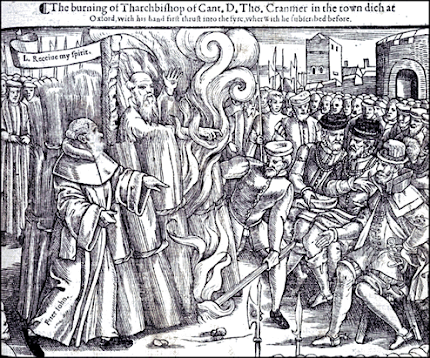
The burning of Tharchbishop of Cant. D. Tho. Cranmer in the town dich at Oxford, with his hand first thrust into the fyre, wherwith he subscribed before. [Click on the picture to see Cranmer's last words.]

Daily Bible Verse

Wednesday, September 30, 2009

D. Martyn Lloyd-Jones on the Primacy of Preaching

D. Martyn Lloyd-Jones on the primacy of preaching.


“People say that the preachers stand in their pulpits and preach their sermons, but that there before them are individuals with their individual problems and sufferings. So the argument runs, you ought to preach less and spend more time doing personal work and counseling and interviewing.


My reply to this argument is to suggest, once more, that the answer is to put preaching into the primary position. Why? For this reason that true preaching does deal with personal problems, so much so that true preaching saves a great deal of time for the pastor.I am speaking out of forty years of experience. What do I mean? Let me explain.


The Puritans are justly famous for their pastoral preaching. They would take up what they called ‘cases of conscience’ and deal with them in their sermons; and as they dealt with these problems they were solving the personal individual problems of those who were listening to them. That has constantly been my experience. The preaching of the Gospel from the pulpit, applied by the Holy Spirit to the individuals who are listening, has been the means of dealing with personal problems of which I as the preacher knew nothing until people came to me at the end of the service saying, ‘I want to thank you for that sermon because if you had known I was there and the exact nature of my problem, you could not have answered my various questions more perfectly. I have often thought of bringing them to you but you have now answered them without doing so.’

The preaching had already dealt with the personal problems. Do not misunderstand me, I am not saying that the preacher should never do any personal work; far from it. But I do contend that preaching must always come first, and that it must not be replaced by anything else.”

(D. Martyn Lloyd-Jones, Preaching & Preachers, p.37)


Shared via AddThis

David Virtue Goes Transexual


Guess Who's Coming to Lunch with David Virtue?


I guess I should not be surprised. But those who place reason above God's revelation in Holy Scripture are prone to such errors. It seems to me that compromising the Gospel leads equally to compromising the moral law of God. David Virtue has gone down a notch in my view. Click on the link to read his interview with Mr. M.

Charlie


The Sixteenth Sunday after Trinity.
The Collect.
O LORD, we beseech thee, let thy continual pity cleanse and defend thy Church; and, because it cannot continue in safety without thy succour, preserve it evermore by thy help and goodness; through Jesus Christ our Lord. Amen.

The Berean Beacon


The Berean Beacon looks to be a reasonable resource for those looking for materials to refute both Eastern Orthodoxy and Roman Catholicism. You might want to read through their site at Berean Beacon.


Charlie

Book Review: Signs of God's Promise

The following book review excerpt is from the T & T Clark blog and is useful in refuting the Anglo-papist views posted at VirtueOnline and else where:


Through much of his career, Cranmer seems to have been engaged in a quest to define the nature of a sacrament and what it signifies. Jeanes picks up the trail in the late 1530s, drawing on an awe-inspiring range of material. Discussion of contemporary documents, including the anonymous, but probably Cranmerian treatise, De Sacramentis (which the author has edited), ancient sources, a large corpus of secondary literature (some of it usefully re-examined) and very recent publications ensures an invaluable presentation of the current state of research. Here, we see the beginnings of the Archbishop’s commitment to a sacramental theology that keeps both dominical sacraments in view. Indeed, it is Jeanes’s contention throughout that Cranmer’s thinking on baptism and the Eucharist was closely interlinked. In particular, his understanding of consecration, sacramental grace and growth in the Christian life involve parity between the major symbolic components – bread, wine and water – as well as between eating and drinking at the Eucharist, and the application of water in baptism.


This leads unavoidably to the question of sacramental presence, and Jeanes illustrates Cranmer’s not always successful attempts to employ analogies showing that the substance of the thing signified need not participate in the sign, though its benefits could be indicated and conveyed. The fact that Cranmer often used words in a sense different from that intended by his fellow-Reformers (‘seal’ in the case of baptism is a prominent example) adds a further degree of complexity.


By the end of the 1530s, Cranmer was articulating a view of sacramental efficacy as God’s work, by grace conveyed by the Holy Spirit, in the recipient. Christ is spiritually present in the faithful recipient – a strong Christological emphasis rather unfortunately subduing the pneumatological element in Jeanes’s view. Jeanes shows Cranmer working with an idea of sacramental grace that is developmental; in other words, grace acts in the recipient over time.


Hence his emphasis on signification: the sacraments are signs of God’s promise of grace. They neither presuppose grace already present in the recipient, nor confer grace at the time of reception – views which, broadly speaking, might be said to be represented respectively by Bucer and Calvin. In Cranmer’s thought, they are a sign that God’s grace is offered to the faithful eucharistic recipient and the candidate for baptism. This is why parents and godparents can make promises on the child’s behalf, just as it explains why the priest may, in 1552, take the remaining bread and wine home for his own use.


From: Signs of God's Promise

Schaff's Church History: Calvin Appealed to Melanchthon's Version of the Augsburg Confession


It is a continual battle to correct the disinformation perpetuated by Anglo-papists and various other dissimulators who wish to use the internet to push unsubstantiated propaganda to further their dishonest agendas. However, the most recent disinformation was an article posted at VirtueOnline suggesting that John Calvin actually believed in "real presence" and agreed with Luther. The evidence for this is allegedly the fact that Calvin signed the Augsburg Confession. (See Novak).

But did John Calvin sign the Augsburg Confession, meaning that he agreed with Luther's view of the eucharist and that the body and blood of Christ are present in, with and under the bread? Absolutely not. However, it is true that Calvin did sign a second revision of the Augsburg Confession done by Philip Melanchthon which changed the doctrine to a lower view.

Although, Calvin did concede to the doctrine of "real presence" his argument concerned the "mode" of the presence of Christ's body and blood in the sacrament. Calvin emphasized that the "mode" is in the sacrament and not in the bread or the wine in a "substantial" way. In other words, the bread and the wine are not the "true" body and blood of Christ nor is the substance of His body and blood in the sacramental elements or with them in any way. (See § 132. The Eucharistic Controversies. Calvin and Westphal.)


It is conceded that Calvin did indeed appeal to the Augsburg Confession of 1540 during the eucharistic controversy with Westphal but it is a version of the Confession that is not as strongly worded as the version of 1530 under Luther. When Westphal decided in 1552 to begin to push the high Lutheran view of the eucharist again Calvin felt compelled to argue against him in an attempt to unify Lutherans and the Reformed. The historical evidence clearly shows in the correspondence between Calvin and Melanchthon that Calvin was able to persuade Melanchthon to soften the high Lutheran view in the second version of the Augsburg Confession which Calvin approved of:

During the progress of this controversy both parties frequently appealed to the Augsburg Confession and to Melanchthon. They were both right and both wrong; for there are two editions of the Confession, representing the earlier and the later theories of its author on the Lord's Supper. The original Augsburg Confession of 1530, in the tenth article, teaches Luther's doctrine of the real presence so clearly and strongly that even the Roman opponents did not object to it. But from the time of the Wittenberg Concordia in 1536, or even earlier, Melanchthon began to change his view on the real presence as well as his view on predestination and free-will; in the former he approached Calvin, in the latter he departed from him. He embodied the former change in the Altered Confession of 1540, without official authority, yet in good faith, as the author of the document, and in the conviction that he represented public sentiment, since Luther himself had moderated his opposition to the Swiss by assenting to the Wittenberg Concordia. The altered edition was made the basis of negotiations with the Romanists at the Colloquies of Worms and Ratisbon in 1541, and at the later Colloquies in 1546 and 1557. It was printed (with the title and preface of the Invariata) in the first collection of the symbolical books of the Lutheran Church (Corpus Doctrinae Philippicum) in 1559; it was expressly approved by the Lutheran princes at the Convention of Naumburg in 1561, after Melanchthon's death, as an improved modification and authentic interpretation of the Confession, and was adhered to by the Melanchthonians and the Reformed even after the adoption of the Book of Concord (1580).

The text in the two editions is as follows:—


Ed. 1530.


"De Coena Domini docent, quod corpus et sanguis Christi vere adsint [the German text adds: unter der Gestalt des Brots und Weins], et distribuantur vescentibus in Coena Domini, et improbant secus docentes." [In the German text: "Derhalben wird auch die Gegenlehre verworfen."]


Ed. 1540.


"De Coena Domini docent, quod cum pane et vino vere exhibeantur corpus et sanguis Christi vescentibus in Coena Domini."


Ed. 1530.


"Concerning the Lord's Supper, they teach that the body and blood of Christ are truly present [under the form of bread and wine], and are distributed to those that eat in the Lord's Supper. And they disapprove of those who teach otherwise." [In the German text: "Wherefore also the opposite doctrine is rejected."]


Ed. 1540.


"Concerning the Lord's Supper, they teach that with bread and wine are truly exhibited the body and blood of Christ to those who eat in the Lord's Supper."


[Disapproval of dissenting views is omitted.]


It is to this revised edition of the document, and to its still living author, that Calvin confidently appealed. [Schaff].


While Calvin did subscribe to a version of "real presence" that "presence" was not the mode of substantial presence in the bread or the wine as the Anglo-papists have tried to twist the words to mean. Clearly, Calvin's view of the real partaking and real presence are by the union of the believer with Christ by faith and so the spiritual or real presence takes place in the believer's heart as he participates in the Lord's Supper. Hence, Calvin is always careful to say that the real presence is in the Supper or sacrament and not in the bread or wine:


"In regard to the Confession of Augsburg," he says in his Last Admonition to Westphal, "my answer is, that, as it was published at Ratisbon (1541), it does not contain a word contrary to our doctrine. If there is any ambiguity in its meaning, there cannot be a more competent interpreter than its author, to whom, as his due, all pious and learned men will readily pay this honor. To him I boldly appeal; and thus Westphal with his vile garrulity lies prostrate .... If Joachim wishes once for all to rid himself of all trouble and put an end to controversy, let him extract one word in his favor from Philip's [Melanchthon] lips. The means of access are open, and the journey is not so very laborious, to visit one of whose consent he boasts so loftily, and with whom he may thus have familiar intercourse. If I shall be found to have used Philip's name rashly, there is no stamp of ignominy to which I am not willing to submit." [Schaff].


I will concede that Schaff is a secondary source. However, I am limited in my access to primary source materials for Calvin and Melanchthon. It should be obvious to all, given the weight of Schaff's scholarship in most circles, that the Anglo-papist version of "real presence" as being consubstantial with or in the bread and wine is clearly rejected by Calvin during the eucharistic controversies of 1552. Calvin rejected the high Lutheran view of Westphal, who opposed Calvin's view that the mode of the presence of the body and blood of Christ is spiritual union of the believer through faith and not a presence of substance either in transubstantiation or in consubstantiation.


Sincerely in Christ,


Charlie


The Sixteenth Sunday after Trinity.

The Collect.

O LORD, we beseech thee, let thy continual pity cleanse and defend thy Church; and, because it cannot continue in safety without thy succour, preserve it evermore by thy help and goodness; through Jesus Christ our Lord. Amen.

Tuesday, September 29, 2009

Real Presence? Did Calvin Sign the Augsburg Confession?

Comment I made on CLASSICAL ANGLICANISM AND THE REAL PRESENCE OF CHRIST IN THE SACRAMENT OF HOLY COMMUNION

by Rev. Victor E. Novak
Special to Virtueonline
www.virtueonline.org
September 15, 2009
I find it odd that Lutherans refused to sign the Consensus Tigurinus of 1549, which was a compromise between the Swiss Reformed at Zurich and Geneva.


Article 24. Transubstantiation and Other Follies.

In this way are refuted not only the fiction of the Papists concerning transubstantiation, but all the gross figments and futile quibbles which either derogate from his celestial glory or are in some degree repugnant to the reality of his human nature. For we deem it no less absurd to place Christ under the bread or couple him with the bread, than to transubstantiate the bread into his body.


Seems to me that Calvin sided with the Reformed folks in the end, not with Luther! I would love to see the proof for that!


Consensus Tigurinus

I'm relying on a secondary source here. However, I will research later to confirm it but note this comment on whether or not Calvin signed the Augsburg Confession:

Sunday, August 09, 2009

Did Calvin Sign the Augsburg Confession?

Calvin did sign the Augsburg Confession, but it was not the original version of this significant document, written in 1530, to which he affixed his name. Calvin approved a revision of the original Augsburg Confession, most especially with regard to the nature of Christ's presence in the Lord's Supper, a compromise position authored by Philip Melancthon, perhaps Luther's greatest aide and subsequent Lutheran theologian. Melancthon penned the revisions between 1540 and 1542. The original version had been acceptable to both those who remained faithful to the Papal party in the Church and those who held to Luther's views in the Church. The language is indeed quite remarkable, and it is no wonder that Calvin objected.


Here is the original version, written in 1530: "Concerning the Lord's Supper, they teach that the body and blood of Christ are truly present, and are distributed to those who eat in the Lord's Supper."

The revised version, written 1540-42 states, "Concerning the Lord's Supper, they teach that 'with' bread and wine are truly exhibited the body and blood of Christ to those who eat in the Lord's Supper."


From:

In Hoc Signo: Did Calvin Sign the Augsburg Confession?

I'm still awaiting a response from Mr. Novak to any of the points made thus far. It would appear that that this piece is based more on secondary sources meant to convince the reader of what cannot be proved from primary sources.

Sincerely in Christ,

Charlie


The Sixteenth Sunday after Trinity.
The Collect.
O LORD, we beseech thee, let thy continual pity cleanse and defend thy Church; and, because it cannot continue in safety without thy succour, preserve it evermore by thy help and goodness; through Jesus Christ our Lord. Amen.
Comment Posted at VirtueOnline: Salvation: A Different Way?


A fellow Evangelical, Steven Cooper, has posted Salvation: A Different Way? at the VirtueOnline website. I made the following comments there with further comments made below in this article.


While the above article is short and unclear, I must say that it is not "Catholic bashing" to point out that Vatican II "apparently" decided that other religions may lead to God by virtue of their worship of Jesus even though they don't know it. Even the likes of Billy Graham has said similar things in an appearance on Robert Schuller's Hour of Power some years ago.


I have to ask, "Do you or do you not believe that Jesus Christ is the only way to heaven?" (Acts 4:11-12; John 14:6). Scripture appears to plainly say that He is the only way to heaven. Not only so, but the 39 Articles unequivocally teach that other religions are not salvific:

THEY also are to be had accursed that presume to say that every man shall be saved by the law or sect which he professeth, so that he be diligent to frame his life according to that law and the light of nature. For Holy Scripture doth set out to us only the name of Jesus Christ, whereby men must be saved.

According to the 39 Articles Jesus Christ is the only way of salvation, even for Jews and Muslims. How "intolerant"! I would go further and say that the Roman Catholic Church is inconsistent with its pre-Vatican II stance that salvation is only through the Roman Catholic Church. Hint: The RCC at one time anathematized Eastern Orthodoxy and Protestants. Officially, the canons of the Council of Trent still condemn the doctrines of grace and the Gospel of Jesus Christ as it is plainly taught in Holy Scripture. All Protestants are "officially" anathematized at Trent based on the doctrinal content of the Protestant message. (See: Canons Concerning Justification).


I would go even further here. Anyone who anathematizes the doctrines of grace--whether it be a church, a minister, or an individual lay person--cannot be saved. And what are the doctrines of grace? Well, there are at least five which are absolutely essential to true Christianity:


1) Sola gratia. We are saved by God's grace alone apart from any cooperation on our part. God gives us everything prior to our believing and conversion.


2) Sola fide. We are saved by faith alone and justified by faith alone as a legal/forensic declaration of "not guilty". Good works have absolutely nothing to do with our justification now or in the future judgment.


3) Sola Scriptura. Scripture alone is the final rule and measure of all doctrinal truth and teaching of local churches, ministers, and members of the church. While it is true that the churches have authority, their authority is secondary to Holy Scripture. All tradition must therefore be tested by canonical Scripture and those traditions contradicting Scripture or repugnant to Scripture are to be rejected.


4) Solus Christus. The only way of salvation is through Jesus Christ. God has appointed that since we are unable to merit salvation, Christ merited it for us by living a sinless life. God has also appointed that since we are unable to pay the penalty for Adam's sin or our own sins, Christ died on the cross for the sins of His elect as their substitute.


5) God alone is to be glorified. This means that we have absolutely no room for pride or boasting since God saves us absolutely and totally by grace and grace alone. He is the author and the finisher of our faith. He gave birth to the New Testament churches through Jesus Christ and the pouring out of the Holy Spirit at Pentecost. God is not obligated to save any and those who pretend to share the glory with God to any degree whatsoever--including prayers to the saints, to Mary, etc. or through penances designed to earn merits for forgiveness--are in fact committing idolatry by putting the creature on equal status with the Creator of heaven and earth and all that exists.


In light of that I have to agree with the late Broughton Knox that it appears that Vatican II has gone in the "pelagian" direction:


Likewise, other religions found everywhere try to counter the restlessness of the human heart, each in its own manner, by proposing "ways," comprising teachings, rules of life, and sacred rites. The Catholic Church rejects nothing that is true and holy in these religions. She regards with sincere reverence those ways of conduct and of life, those precepts and teachings which, though differing in many aspects from the ones she holds and sets forth, nonetheless often reflect a ray of that Truth which enlightens all men. Indeed, she proclaims, and ever must proclaim Christ "the way, the truth, and the life" (John 14:6), in whom men may find the fullness of religious life, in whom God has reconciled all things to Himself.(4)


Now, if you will read the entire document, the position of the Roman Catholic Church at Vatican II, even though it claims that Jesus is the only way, implies that salvation can come from good works:

2. From ancient times down to the present, there is found among various peoples a certain perception of that hidden power which hovers over the course of things and over the events of human history; at times some indeed have come to the recognition of a Supreme Being, or even of a Father. This perception and recognition penetrates their lives with a profound religious sense.


Religions, however, that are bound up with an advanced culture have struggled to answer the same questions by means of more refined concepts and a more developed language. Thus in Hinduism, men contemplate the divine mystery and express it through an inexhaustible abundance of myths and through searching philosophical inquiry. They seek freedom from the anguish of our human condition either through ascetical practices or profound meditation or a flight to God with love and trust. Again, Buddhism, in its various forms, realizes the radical insufficiency of this changeable world; it teaches a way by which men, in a devout and confident spirit, may be able either to acquire the state of perfect liberation, or attain, by their own efforts or through higher help, supreme illumination.


I fail to see how the Roman Catholic Church can escape the charge of "pelagianism" when you couple the Declaration on Non-Christian Religions with the position of the RCC that "proselytization" of Jews, Muslims, Buddhists, etc. is wrong.


I would contend that not only Jews, Muslims and Buddhists need to be "evangelized" with the Gospel and the doctrines of grace but also the Eastern Orthodox, the Roman Catholic Church, and Anglicans in general. Those who teach that salvation can be merited or earned or that there are other ways to achieve heaven through other religions cannot but accept the label of "pelagian."


It is for this reason that the Anglican Church in North America is simply another apostate religion with no light of the true Gospel of grace. Justification is by grace alone through faith alone and through Christ alone. Therefore, since ACNA refutes the doctrines of the Scriptures, the 39 Articles and the 1662 Book of Common Prayer by compromising those documents through dissimulation and equivocation, I can only conclude that ACNA is another TEC only without the homosexuals.


Another commenter, Larry Wells, aka "Inwells", (I love how these Anglo-Catholics prefer to post anonymously or semi-anonymously), said:

In Dominus Iesus, the Pope solidly affirmed what was/is unpopular with liberal RC's: the sound Biblical teaching that salvation is found only in Jesus Christ--even if that salvation is graciously given outside the confines of the RCC, or even beyond the boundaries of conscious Christianity.

I guess Larry thinks that the unsaved don't need to hear the Gospel (Romans 10:13-15). Clearly, the idea that there is an "unconscious" acceptance of Christ in "ignorance" is diametrically opposed to Paul's teaching in Romans that natural revelation is insufficient for salvation (Romans 1:18-21). Not only so, but the Bible teaches that accepting Jesus Christ and His Gospel is essential to a conscious conversion to Christianity as a "personal relationship" with God (Acts 4:11-12; John 14:6; 1 Timothy 2:5; Jude 3).


But to make it even more clear it is necessary to read the Dominus Iesus document carefully. First off, the document was written by Joseph Ratzinger prior to his becoming Pope Benedict XVI and the writing was authorized and endorsed by Pope Paul II. Clearly the document seeks to clarify the position of the Vatican II declaration on non-Christian religions, which theological liberals took to mean theological pluralism. Dominus Iesus, contrary to what Mr. Wells says, actually refutes the idea that there is any sense of an unconscious acceptance of Jesus Christ in other religions or "even beyond the boundaries of conscious Christianity":


15. Not infrequently it is proposed that theology should avoid the use of terms like "unicity", "universality", and "absoluteness", which give the impression of excessive emphasis on the significance and value of the salvific event of Jesus Christ in relation to other religions. In reality, however, such language is simply being faithful to revelation, since it represents a development of the sources of the faith themselves. From the beginning, the community of believers has recognized in Jesus a salvific value such that he alone, as Son of God made man, crucified and risen, by the mission received from the Father and in the power of the Holy Spirit, bestows revelation (cf. Mt 11:27) and divine life (cf. Jn 1:12; 5:25; 5:26; 17:2) to all humanity and to every person.

In this sense, one can and must say that Jesus Christ has a significance and a value for the human race and its history, which are unique and singular, proper to him alone, exclusive, universal, and absolute. Jesus is, in fact, the Word of God made man for the salvation of all. In expressing this consciousness of faith, the Second Vatican Council teaches: "The Word of God, through whom all things were made, was made flesh, so that as perfect man he could save all men and sum up all things in himself.

Ibid.


And to make it even more clear please note several places where Ratzinger refutes the idea of salvation apart from Christ:

20. From what has been stated above, some points follow that are necessary for theological reflection as it explores the relationship of the Church and the other religions to salvation.


Above all else, it must be firmly believed that "the Church, a pilgrim now on earth, is necessary for salvation: the one Christ is the mediator and the way of salvation; he is present to us in his body which is the Church. He himself explicitly asserted the necessity of faith and baptism (cf. Mk 16:16; Jn 3:5), and thereby affirmed at the same time the necessity of the Church which men enter through baptism as through a door".77 This doctrine must not be set against the universal salvific will of God (cf. 1 Tim 2:4); "it is necessary to keep these two truths together, namely, the real possibility of salvation in Christ for all mankind and the necessity of the Church for this salvation".78


It seems to me that liberals like our friend Larry Wells cannot help themselves from twisting, distorting and dissimulating even papal statements from the Roman Catholic Church, which they "claim" to support and agree with. If anything, this only proves the point made by Protestants that having a pope, a magisterium, and an allegedly infallible teaching office guarantees absolutely nothing. Larry is ample proof of this. Clearly, Pope John Paul II and Joseph Ratzinger saw the danger of liberal view that there can be an "unconscious" conversion to Christ through other religions in the Vatican II statement, Declaration on the Relation of the Church to Non-Christian Religions.


Let me further clarify my own position, however. While I agree with the gist of the Dominus Iesus document and that Jesus Christ is the only way of salvation and that conscious acceptance of the Gospel is absolutely necessary to salvation, I disagree that the Roman Catholic Church is preaching the true Gospel since the Canons Concerning Justification made at the Council of Trent anathematize the very Gospel itself. Obviously, I reject Ratzinger's thesis that the Roman Catholic Church is the only way of salvation as well. It cannot be ignored that the official position of the Roman Catholic Church has not changed since the Council of Trent where the Protestant understanding of the Gospel and justification by faith alone is anathematized in the Canons Concerning Justification:

Canon 4.
If anyone says that man's free will moved and aroused by God, by assenting to God's call and action, in no way cooperates toward disposing and preparing itself to obtain the grace of justification, that it cannot refuse its assent if it wishes, but that, as something inanimate, it does nothing whatever and is merely passive, let him be anathema.


Canon 5.
If anyone says that after the sin of Adam man's free will was lost and destroyed, or that it is a thing only in name, indeed a name without a reality, a fiction introduced into the Church by Satan, let him be anathema.


Canon 6.
If anyone says that it is not in man's power to make his ways evil, but that the works that are evil as well as those that are good God produces, not permissively only but also propria et per se, so that the treason of Judas is no less His own proper work than the vocation of St. Paul, let him be anathema.


Canon 7.
If anyone says that all works done before justification, in whatever manner they may be done, are truly sins, or merit the hatred of God; that the more earnestly one strives to dispose himself for grace, the more grievously he sins, let him be anathema.


Canon 9.
If anyone says that the sinner is justified by faith alone,[114] meaning that nothing else is required to cooperate in order to obtain the grace of justification, and that it is not in any way necessary that he be prepared and disposed by the action of his own will, let him be anathema.

Canon 11.
If anyone says that men are justified either by the sole imputation of the justice of Christ or by the sole remission of sins, to the exclusion of the grace and the charity which is poured forth in their hearts by the Holy Ghost,[116] and remains in them, or also that the grace by which we are justified is only the good will of God, let him be anathema.


Canon 12.
If anyone says that justifying faith is nothing else than confidence in divine mercy,[117] which remits sins for Christ's sake, or that it is this confidence alone that justifies us, let him be anathema.


Canon 13.
If anyone says that in order to obtain the remission of sins it is necessary for every man to believe with certainty and without any hesitation arising from his own weakness and indisposition that his sins are forgiven him, let him be anathema.


Canon 14.
If anyone says that man is absolved from his sins and justified because he firmly believes that he is absolved and justified,[118] or that no one is truly justified except him who believes himself justified, and that by this faith alone absolution and justification are effected, let him be anathema.


Canon 15.
If anyone says that a man who is born again and justified is bound ex fide to believe that he is certainly in the number of the predestined,[119] let him be anathema.


Canon 16.
If anyone says that he will for certain, with an absolute and infallible certainty, have that great gift of perseverance even to the end, unless he shall have learned this by a special revelation,[120] let him be anathema.


Canon 17.
If anyone says that the grace of justification is shared by those only who are predestined to life, but that all others who are called are called indeed but receive not grace, as if they are by divine power predestined to evil, let him be anathema.


Canon 18.
If anyone says that the commandments of God are, even for one that is justified and constituted in grace,[121] impossible to observe, let him be anathema.


I could go on but it should be obvious to any Anglican who has read the 39 Articles that many of these canons condemn the doctrines laid out during the English Reformation. In particular one should pay attention to Articles 9-18 which deal with personal salvation. These canons not only condemn the English Reformation but the Lutheran and the Swiss and Dutch branches of the Protestant Reformation. This is particularly why I cannot understand the statements made by James I. Packer and others who wish to relegate the doctrine of justification by faith alone to the "fine print" of the Gospel. Obviously, the Reformation is not over and the doctrine of justification by faith alone is not a secondary matter. It is absolutely a primary matter of the Christian faith.


With that in mind, I fail to see how Anglo-Catholicism is in any way a "via media" between Rome and the English Reformation. On the contrary, Anglo-Catholicism is a sell out on two fronts. First of all, Anglo-Catholicism gives place to the Roman Catholic doctrines of justification, purgatory, prayers to the saints, apostolic succession and other unbiblical positions which are not supported by Holy Scripture. Secondly, as our Anglo-Catholic friend, Larry Wells, shows above the Anglo-Catholics have sold out to theological pluralism which in turn leads to moral relativism and the emphasis on social justice and human rights in the here and now. Such an emphasis then naturally gravitates to the idea of homosexual rights as a basic human right rather than a perverse immorality condemned unequivocally in Holy Scripture. Thus, Anglo-Catholicism is a dismal failure from the point of view of both Roman Catholicism and from conservative and reformed Protestant views drawn from Holy Scripture as the only infallible and authoritative rule for faith, doctrine, and practice.


Sincerely in Christ,


Charlie


Charlie is a bi-vocational minister with a Bachelor of Arts degree in theology and bible from Southeastern University, Lakeland, Florida, 1991 and a master of divinity from Asbury Theological Seminary, Wilmore, Kentucky, 1995. While studying at Asbury, a Wesleyan holiness and Arminian school of theology in the Evangelical tradition, Charlie read Calvin's Institutes of the Christian Religion in a seminar with church history professor Dr. Thomas O'Malley. He also took a Christian philosophy class with Dr. Jerry Walls in which Walls argued for the primacy of "free will" above God's sovereignty in all matters of salvation and providence. These two classes in conjunction with reading the entire Bible from cover to cover convinced him that the Reformed interpretation of Scripture is in fact the most faithful to God and to a complete and systematic understanding of Holy Scripture. Charlie teaches a Sunday school class for adults and does occasional pulpit fill for Christ Church Longwood, in Longwood, Florida, whose rector is David Knox. Charlie also maintains a reforming Anglican blog at Reasonable Christian.


The Sixteenth Sunday after Trinity.

The Collect.


O LORD, we beseech thee, let thy continual pity cleanse and defend thy Church; and, because it cannot continue in safety without thy succour, preserve it evermore by thy help and goodness; through Jesus Christ our Lord. Amen.

Monday, September 28, 2009

J. C. Ryles Quote of the Day: From the J. C. Ryles Quotes Blog

Careless Christianity?


“Sanctification is a thing which depends greatly on a diligent use of Scriptural means. When I speak of ‘means’, I have in view Bible-reading, private prayer, regular attendance on public worship, regular hearing of God’s Word, and regular reception of the Lord’s Supper.

“I lay it down as a simple matter of fact, that no one who is careless about such things must ever expect to make much progress in sanctification. I can find no record of any eminent saint who ever neglected them.”

two ways to live : : the choice we all face

two ways to live : : the choice we all face

Posted using ShareThis

The Anglican Communion and Eastern Orthodoxy

Miguel,

With all due respect to you and your religious beliefs, the Greek Orthodox Church is no better than Roman Catholicism or the Anglican Communion. The issue of homosexual immorality, ordination of open homosexuals and even the consecration of homosexual bishops pales in comparison to the foundational doctrines laid out in Holy Scripture. The Scriptures plainly teach that justification is by faith alone and that righteousness/deification/sanctification are forensically imputed to the believer by grace through faith and that Christ alone has merited salvation for us by living a sinless life for us in our place and by dying for our sins for us on the cross.

Please forgive me for being blunt here but Eastern Orthodoxy is a man-made religion based on human traditions rather than God's infallible and inerrant Word. Wherever the Greek Orthodox Church departs from Scripture it has departed from Christ.
As the 39 Articles clearly state:

XIX. Of the Church.
THE visible Church of Christ is a congregation of faithful men, in the which the pure word of God is preached and the sacraments be duly ministered according to Christ's ordinance in all those things that of necessity are requisite to the same. As the Church of Jerusalem, Alexandria, and Antioch have erred: so also the Church of Rome hath erred, not only in their living and manner of ceremonies, but also in matters of faith.

May God grant you the grace to stand on Holy Scripture alone as the only source of apostolic doctrine which is the binding and infallible rule for faith and practice!
Sincerely in Christ,

Charlie


[See this link for reference: http://melkite.net/].

The Sixteenth Sunday after Trinity.

The Collect.

O LORD, we beseech thee, let thy continual pity cleanse and defend thy Church; and, because it cannot continue in safety without thy succour, preserve it evermore by thy help and goodness; through Jesus Christ our Lord. Amen.

Dissimulation, revisionism, and equivocation..... Comments made at VirtueOnline


On 23/09/2009 15:10, "Charlie J. Ray" <cranmer1959@gmail.com> wrote:

Re: Classical Anglicanism and the Real Presence of  Christ...
The theological errors committed in this piece are too  numerous to answer in a mere comment at the end of the page. However, for  starters Article 29 clearly forbids any idea of real presence in, with, or  under the elements. In other words, the bread and wine are not  consubstantially the body and blood of Christ as this author mistakenly  asserts.

Second of all, Calvin does not assert what the author  asserts that he asserted. In fact, anyone reading the introductory remarks  of Calvin in the Institutes on the topic will note immediately that Calvin  views the reception to be by faith, i.e. "in" the believer and NOT in the  elements:
"First, we must attend to what a sacrament is. It seems  to me, then, a simple and appropriate definition to say, that it is an  external sign, by which the Lord seals on our consciences his promises of  good-will toward us, in order to sustain the weakness of our faith, and we  in our turn testify our piety towards him, both before himself, and before  angels as well as men. We may also define more briefly by calling it a  testimony of the divine favour toward us, confirmed by an external sign,  with a corresponding attestation of our faith towards Him."

Calvin,  J., & Beveridge, H. (1996). Institutes of the Christian religion  (electronic ed.) (IV, xiv, 1). Oak Harbor, WA: Logos Research  Systems.

A sacrament, according to Calvin, is a matter of attesting  our faith towards God and it is an external sign that "seals on our  CONSCIENCES" and sustains "the weakness of our faith." How in the world  someone can twist this around to support "real presence" as  Anglo-Catholics and others contend is beyond me!

Calvin further  particularizes his view as a "spiritual eating" and which is very similar  to Cranmer's Zwinglian view:

"The sum is, that the flesh and blood  of Christ feed our souls just as bread and wine maintain and support our  corporeal life. For there would be no aptitude in the sign, did not our  souls find their nourishment in Christ. This could not be, did not Christ  truly form one with us, and refresh us by the eating of his flesh, and the  drinking of his blood. But though it seems an incredible thing that the  flesh of Christ, while at such a distance from us in respect of place,  should be food to us, let us remember how far the secret virtue of the  Holy Spirit surpasses all our conceptions, and how foolish it is to wish  to measure its immensity by our feeble capacity. Therefore, what our mind  does not comprehend let faith conceive—viz. that the Spirit truly unites  things separated by space. That sacred communion of flesh and blood by  which Christ transfuses his life into us, just as if it penetrated our  bones and marrow, he testifies and seals in the Supper, and that not by  presenting a vain or empty sign, but by there exerting an efficacy of the  Spirit by which he fulfils what he promises. And truly the thing there  signified he exhibits and offers to all who sit down at that spiritual  feast, although it is beneficially received by believers only who receive  this great benefit with true faith and heartfelt gratitude."


Calvin,  J., & Beveridge, H. (1996). Institutes of the Christian religion  (electronic ed.) (IV, xvii, 10). Oak Harbor, WA: Logos Research  Systems.

Furthermore, the position of the Articles and the 1662  Prayer Book is not one of real presence in the elements themselves but  rather the Zwinglian view which our friend above misunderstands as a  "empty" sign. The sign is only "empty" if one does not have real faith, as  Calvin states above. It is only beneficial to those who have genuine  faith. But Calvin says it is not mere faith in Christ and merely an  external sign but it is a faith that spiritually feeds upon the virtual  body and blood of Christ, which the bread and wine "signify".

Cranmer himself is even more direct:

"But let all these  papists together show any one authority, either of Scripture, or of  ancient author, either Greek or Latin, that saith as they say, that Christ  called not bread and wine his body and blood, but individuum vagum; for my  part I shall give them place, and confess that they say  true."


"And if they can show nothing for them of antiquity, but  only their own bare words, then it is reason that they give place to the  truth confirmed by so many authorities, both of Scripture and of ancient  writers, which is, that Christ called very material bread his body, and  very wine made of grapes his blood."


"Now this being fully  proved, it must needs follow consequently, that this manner of speaking is  a figurative speech: for in plain and proper speech it is not true to say,  that bread is Christ's body, or wine his blood. For Christ's body hath a  soul, life, sense, and reason: but bread hath neither soul, life, sense,  nor reason."


"Likewise in plain speech it is not true, that we  eat Christ's body, and drink his blood. For eating and drinking, in their  proper and usual signification, is with the tongue, teeth, and lips to  swallow, divide, and chaw in pieces: which thing to do to the flesh and  blood of Christ, is horrible to be heard of any Christian."


"So  that these speeches, "To eat Christ's body," "and drink his blood," "To  call bread his body," "or wine his blood," be speeches not taken in the  proper signification of every word, but by translation of these words,  "eating" and "drinking," from the signification of a corporal thing to  signify a spiritual thing; and by calling a thing that signifieth, by the  name of the thing which is signified thereby: which is no rare nor strange  thing, but an usual manner and phrase in common  speech."


[Archbishop Thomas Cranmer. A Defense of the True and  Catholic Doctrine of the Sacrament of the Body and Blood of Our Saviour  Christ. (East Essex: Focus Ministries Trust, 1987).  Reprint.


I might add that the Declaration of Principles of  the REC do likewise condemn ANY real presence IN the bread or wine,  WHATSOEVER. Anyone reading the historical documents of the REC at  "objective" historical websites can see this plainly. The trouble is the  REC has sold out to the Anglo-Catholics and have now adopted the  postmodern revisionism hermeneutic to make their own Declaration of  Principles say what they PLAINLY DO NOT SAY! It is this sort of dishonesty  that eventually leads to saying homosexuality is a "gift" of God rather  than a curse of the sinful nature!

How long will it be before the  REC and the ACNA start to question the immorality of homosexuality? How  long before they begin to endorse what they now oppose? I give it maybe 30  years at most. Before long the ACNA and TEC will be one again. They will  be asking each other why there was a split?

The fact of the matter  is this: when ministers and theologians have to lie and dissimulate to  justify a doctrine (real presence) it will not be long before that same  approach is applied to other issues, including Scriptural authority on  justification by faith alone. All of this, I would contend, leads  inevitably to the precipice of theological relativism and  compromise.

It truly is amazing how often the author refers to  secondary sources or makes empty assertions about Zwingli, Calvin, and  Cranmer without giving any references to firsthand or original sources at  all.

This sort of dishonesty is why I am no longer a minister with  the REC!

Sincerely yours in Christ,

Charlie

   <http://www.virtueonline.org/portal/modules/news/comment_edit.php?com_itemid=11186&com_order=0&com_mode=flat&com_id=111728> <http://www.virtueonline.org/portal/modules/news/comment_reply.php?com_itemid=11186&com_order=0&com_mode=flat&com_id=111728>
 cranmer59 <http://www.virtueonline.org/portal/userinfo.php?uid=7711>   Posted: 2009/9/23  11:55  Updated: 2009/9/23  11:55

   Not too shy to talk

 Joined:  2008/12/1
 From:  Casselberry, Florida
 Posts:  39

   Re:  Classical Anglicanism and the Real Presence of Christ...
 In another place Cranmer says:


"By these  words of Cyril appeareth his mind plainly, that we may not grossly and  rudely think of the eating of Christ with our mouths, but with our faith,  by which eating, although he be absent hence bodily, and be in the eternal  life and glory with his Father, yet we be made partakers of his nature, to  be immortal, and have eternal life and glory with him.

"And thus is  declared the mind as well of Cyril as of Hilarius.

"And here may be  well enough passed over Basilius, Gregorius Nyssenus, and Gregorius  Nazianzenus, partly because they speak little of this matter, and because  they may be easily answered unto by that which is before declared and  often repeated, which is, that a figure hath the name of the thing whereof  it is the figure, and therefore of the figure may be spoken the same thing  that may be spoken of the thing itself.

"And as concerning the  eating and drinking of Christ's flesh and drinking of his blood, they  spake of the spiritual eating and drinking thereof by faith, and not of  corporal eating and drinking with the mouth and teeth.

"Likewise  Eusebius Emissenus is shortly answered unto; for he speaketh not of any  real and corporal conversion of bread and wine into Christ's body and  blood, nor of any corporal and real eating and drinking of the same, but  he speaketh of a sacramental conversion of bread and wine, and of a  spiritual eating and drinking of the body and blood. After which sort,  Christ is as well present in baptism (as the same Eusebius plainly there  declareth) as he is in the Lord's table: which is, not carnally and  corporally, but by faith, and spiritually. But of this author is spoken  before more at large in the matter of transubstantiation.

"And now  I will come to the saying of St. Ambrose, which is always in their mouths.  'Before the consecration,' saith he, as they allege, 'it is bread; but  after the words 'of consecration it is the body of Christ.'

"For  answer hereunto, it must be first known what consecration  is.

"Consecration is the separation of any thing from a profane and  worldly use unto a spiritual and godly use.

"And therefore when  usual and common water is taken from other uses, and put to the use of  baptism, in the name of the Father, and of the Son, and of the Holy Ghost,  then it may rightly be called consecrated water, that is to say, water put  to a holy use.

"Even so when common bread and wine be taken and  severed from other bread and wine, to the use of the holy communion, that  portion of bread and wine, although it be of the same substance that the  other is from which it is severed, yet it is now called consecrated or  holy bread and holy wine.

"Not that the bread and wine have or can  have any holiness in them, but that they be used to an holy work, and  represent holy and godly things. And therefore St. Dionyse calleth the  bread holy bread, and the cup an holy cup, as soon as they be set upon the  altar to the use of the holy communion.

"But specially they may be  called holy and consecrated, when they be separated to that holy use by  Christ's own words, which he spake for that purpose, saying of the bread,  This is my body; and of the wine, This is my blood.

"So that  commonly the authors, before those words be spoken, do take the bread and  the wine but as other common bread and wine; but after those words be  pronounced over them, then they take them for consecrated and holy bread  and wine.

"Not that the bread and wine can be partakers of any  holiness or godliness, or can be the body and blood of Christ; but that  they represent the very body and blood of Christ, and the holy food and  nourishment which we have by him. And so they be called by the names of  the body and blood of Christ, as the sign, token, and figure is called by  the name of the very thing which it showeth and  signifieth."


[Works, Book III, Chapter XV].


See: http://reasonablechristian.blogspot.com/2009/02/cranmer-on-eating-and-drinking-body-and.html

   <http://www.virtueonline.org/portal/modules/news/comment_edit.php?com_itemid=11186&com_order=0&com_mode=flat&com_id=111729> <http://www.virtueonline.org/portal/modules/news/comment_reply.php?com_itemid=11186&com_order=0&com_mode=flat&com_id=111729>
 cranmer59 <http://www.virtueonline.org/portal/userinfo.php?uid=7711>   Posted: 2009/9/23  12:05  Updated: 2009/9/23  12:05

   Not too shy to talk

 Joined:  2008/12/1
 From:  Casselberry, Florida
 Posts:  39

   Re:  Classical Anglicanism and the Real Presence of Christ...
At least Bob has it half right. There is no real  presence in the bread and wine but the real presence takes place by faith IN the worthy receiver, who is worthy only by faith and not by his own  merits.

I must say this is the most honest comment I have ever seen  Bob make. He has given me cause to think there might be hope for him after  all. If he could just move the real presence from the bread and wine to  where it belongs we might have something to talk about. After receiving  it? No, the real presence is always by faith and in the receiver, not in  the elements.

If only Anglicans would believe the plain teaching of  Scripture, the Articles and the 1662 BCP! (In that order!)

In  Christ,

Charlie

   <http://www.virtueonline.org/portal/modules/news/comment_edit.php?com_itemid=11186&com_order=0&com_mode=flat&com_id=111731> <http://www.virtueonline.org/portal/modules/news/comment_reply.php?com_itemid=11186&com_order=0&com_mode=flat&com_id=111731>
 cranmer59 <http://www.virtueonline.org/portal/userinfo.php?uid=7711>   Posted: 2009/9/23  12:35  Updated: 2009/9/23  12:35

   Not too shy to talk

 Joined:  2008/12/1
 From:  Casselberry, Florida
 Posts:  39

   Re:  Classical Anglicanism and the Real Presence of Christ...
 Selected Works: Cranmer on the Lord's Supper:

http://books.google.com/books?id=mFgYAAAAYAAJ&printsec=frontcover&dq=thomas+cranmer&lr=#v=onepage&q=&f=false

Please  read the original and primary sources.

"We acknowledge but one  altar, the Cross of Calvary. We know but one priest, even the "Priest  forever after the order of Melchizedek." We restore the simple table of  the Lord. We proclaim the elements of bread and wine to be only symbols,  tokens, "pledges of His love." We commemorate the one perfect, finished  sacrifice. We adore Him with unmeasured love. We feed on Him only in  our hearts, by faith."


Bishop George D. Cummins
First  Bishop of the Reformed Episcopal Church

Quoted at: Redemption  Traditional Reformed Episcopal Church <http://www.redemptiontrec.org/Paged.html>


Reasonable Christian: Cranmer On Eating and Drinking the  Body and Blood of Christ <http://reasonablechristian.blogspot.com/2009/02/cranmer-on-eating-and-drinking-body-and.html>

   <http://www.virtueonline.org/portal/modules/news/comment_edit.php?com_itemid=11186&com_order=0&com_mode=flat&com_id=111732> <http://www.virtueonline.org/portal/modules/news/comment_reply.php?com_itemid=11186&com_order=0&com_mode=flat&com_id=111732>
 cranmer59 <http://www.virtueonline.org/portal/userinfo.php?uid=7711>   Posted: 2009/9/23  12:38  Updated: 2009/9/23  12:38

   Not too shy to talk

 Joined:  2008/12/1
 From:  Casselberry, Florida
 Posts:  39

   Re:  Classical Anglicanism and the Real Presence of Christ...
 At last we agree on something, Mathman!

   <http://www.virtueonline.org/portal/modules/news/comment_edit.php?com_itemid=11186&com_order=0&com_mode=flat&com_id=111733> <http://www.virtueonline.org/portal/modules/news/comment_reply.php?com_itemid=11186&com_order=0&com_mode=flat&com_id=111733>
 cranmer59 <http://www.virtueonline.org/portal/userinfo.php?uid=7711>   Posted: 2009/9/23  13:01  Updated: 2009/9/23  13:01

   Not too shy to talk

 Joined:  2008/12/1
 From:  Casselberry, Florida
 Posts:  39

   Re:  Classical Anglicanism and the Real Presence of Christ...
 This view is called "receptionism", and it is  rejected in the Thirty-nine Articles. Article XXVIII teaches: "The Body of  Christ is given, taken, and eaten, in the Supper," (italics added).  Despite the teachings of Scripture and of Article XXVIII, receptionism  historically has had influence among Anglicans.
The author  stated the above without putting the full quote which is:

The  body of Christ is given, taken, and eaten in the Supper, only after an  heavenly and spiritual manner. And the mean whereby the body of Christ is  received and eaten in the Supper is Faith.

Article 28 <http://www.eskimo.com/~lhowell/bcp1662/articles/articles.html#28>

Furthermore, the 1662 Book of Common  Prayer likewise places the eating of the true body and blood of Christ in  the heart of the believer by faith:

THE Body of our Lord Jesus  Christ, which was given for thee, preserve thy body and soul unto  everlasting life. Take and eat this in remembrance that Christ died for  thee, and feed on him in thy heart by faith with  thanksgiving.

Feed on Him WHERE? FEED ON HIM IN  THY HEART BY FAITH with thanksgiving.

The Lord's Supper, 1662 Book of Common Prayer <http://www.eskimo.com/~lhowell/bcp1662/communion/index.html>

The  Alice In Wonderland method of exegesis and interpretation is rampant in  Anglo-Catholic circles these days. What a word plainly means no longer  plainly means what it plainly means!

To quote Gillis  Harp:

"When I use a word," Humpty Dumpty said, in rather a  scornful tone, "it
means just what I choose it to mean—neither more nor  less."
"The question is," said Alice, "whether you CAN make words mean  so many
different things."
"The question is," said Humpty Dumpty,  "which is to be master—that?s all."
(from Through the Looking  Glass)


Churchman: Recovering Confessional Anglicanism, by Gillis J.  Harp <http://www.churchsociety.org/churchman/documents/Cman_116_3_Harp.pdf>

If Novak's article proves anything, it is the utter  dishonesty and dissimulation rampant in the Reformed Episcopal Church  which has adopted the Anglo-Catholic method of interpreting Scripture, the  39 Articles, the 1662 Book of Common Prayer, and their own Declaration of  Principles!

Sincerely in Christ,

Charlie


From:  http://www.virtueonline.org/portal/modules/news/article.php?storyid=11186&com_id=111735&com_rootid=111735&com_mode=flat&com_order=0#comment111735

The Fifteenth Sunday after Trinity


The Collect.

KEEP, we beseech thee, O Lord, thy Church with thy perpetual mercy: and, because the frailty of man without thee cannot but fall, keep us ever by thy help from all things hurtful, and lead us to all things profitable to our salvation; through Jesus Christ our Lord. Amen.

Saturday, September 26, 2009

Re: How hellish is Hell?

The final judgment is not merely eschatology. It is a primary doctrine and was one of the "fundamentals" of the faith during the 1920's in the modernist controversy. Annihilationism is the position of John Stott, the Anglican Evangelical but it is still a heresy. I think Stott should be avoided as a resource for Evangelicals for that reason.


Donald Bloesch advocates that hell is not final. Even though it is a place of everlasting torment, Bloesch advocates that there will be a "second chance" in hell. Those who repent in hell get to go to heaven. He thinks only those who refuse to repent in hell are eternally tormented. But Bloesch is a Barthian. Hint: He wants to provide a modified universalism something along the lines of Barth's universal election doctrine. Bloesch pretends to be "reformed" but his view is actually a neo-evangelical form of neo-orthodoxy. He likewise rejects propositional truth and instead thinks the Bible is inerrant only as you "experience" God through the Spirit. Bloesch is also a charismatic, btw. Sound familiar?


No, eternal punishment is not secondary or even tertiary. It is PRIMARY. Saying eternal torment in hell as part of the final judgment of the wicked is merely an optional doctrine makes about as much sense as saying justification by faith alone is in the fine print of the Gospel.


Sincerely in Christ,


Charlie

Support Reasonable Christian Ministries with your generous donation.