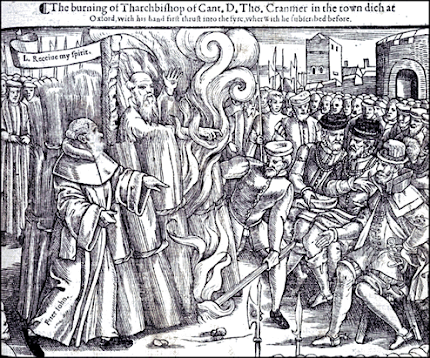
Martyred for the Gospel
Daily Bible Verse
Friday, March 20, 2009
Is "Good" Good Enough for God?
Sunday, March 15, 2009
The Doctrine of Grace Alone: Sola Gratia in Scripture and the Thirty-nine Articles of Religion
During the Protestant Reformation the primary language used by the western side of the Christian Church was Latin. Out of that reform movement to correct areas where the Roman Catholic Church had moved away from the teaching of Holy Scripture and from the church fathers as understood from the biblical perspective, five Latin phrases arose which summarized in capsule form what the Reformation movement was all about. One of those slogans was sola gratia or grace alone.
What exactly is the doctrine of grace alone? In order to give a complete answer one must look both to Scripture and to church history. Actually, the issue raised goes all the way back to the time of Paul in his debates with the Judaizers (See Galatians 1:6-9). However, the problem of justification by good works occurs again in the 4th century in the controversy between Augustine, bishop of Hippo in north Africa, and the followers of Pelagius in Britain. In laying a background for this discussion the Scriptures must first be examined.
Moreover, the issue of grace has as much to do with the doctrine of original sin as with the issue of merits or good works. The premise in the Bible is that when Adam and Eve rebelled against God a curse came upon them and upon all of their descendants, that is all of humankind. The curse was that spiritual and physical death would result if they ate from the tree of the knowledge of good and evil:
"...then the Lord God formed the man of dust from the ground and breathed into his nostrils the breath of life, and the man became a living creature. And the Lord God planted a garden in Eden, in the east, and there he put the man whom he had formed. And out of the ground the Lord God made to spring up every tree that is pleasant to the sight and good for food. The tree of life was in the midst of the garden, and the tree of the knowledge of good and evil." (Genesis 2:7-9, ESV)
"The Lord God took the man and put him in the garden of Eden to work it and keep it. And the Lord God commanded the man, saying, “You may surely eat of every tree of the garden, but of the tree of the knowledge of good and evil you shall not eat, for in the day that you eat of it you shall surely die.”" (Genesis 2:15-17, ESV) 1
So the biblical view of grace must first understand that humankind became totally corrupt or tainted by sin in every area of the human nature, including the ability to think and reason clearly. Moreover, the gifts allowing humankind to think without the influence of sin are removed and both man's thoughts and his will are corrupted:
"The Lord saw that the wickedness of man was great in the earth, and that every intention of the thoughts of his heart was only evil continually." (Genesis 6:5, ESV) 2
The essence of the created human nature would include all that makes us human. However, to summarize in capsule form, the human nature is basically three elements: intellect, will, and emotion. Most theologians would include that the human nature is both a physical body and an immortal soul unified in one human personal being. For the purposes of this essay the tripart view of the human nature, body, soul, and spirit will be rejected because it seems to be based more in Greek philosophy than a biblical view of humanity. It is the biblical emphasis on the creation of humanity, both male and female in the image and likeness of God (Genesis 1:26), rather than philosophical definitions which should dominate our theological thinking. However, it must be admitted that some philosophical and theological definitions are unavoidable. For the Christian any understanding of the human image and likeness it must be recognized that in the eschatological judgment those who are lost will face God's punishment in both body and soul:
"And do not fear those who kill the body but cannot kill the soul. Rather fear him who can destroy both soul and body in hell." (Matthew 10:28, ESV) 3
Thus, there is a legitimate point that there is a unified human nature which is composed of both body and soul which, according to Paul's theology, can only be separated at death. (See 1 Thessalonians 5:23; 2 Corinthians 5:6-10). Even those who are credited with righteousness and inherit eternal life are raised from the dead in a new and glorified body. (See 1 Corinthians 15; Luke 24:36-42). In other words, a proper understanding of the image and likeness is a holistic one rather than trichotomist.
Only in the context of the human image and likeness being totally and completely tainted and corrupted by sin can we understand the necessity and purpose of God's grace. It is precisely because of Adam's forfeiture of God's supernatural gifts, which enabled humanity to choose only good and not evil, that humanity has become corrupted by original sin and has become actually sinful in thought, word and deed, in what is done and left undone. (See “A general Confession...” in 1662 BCP). To put it in biblical terms, humankind has become corrupt through and through such that the image and likeness of God within the human nature is almost unrecognizable. (Genesis 6:5; Psalm 51:5, 10; Psalm 58:3; Isaiah 48:8). Humans have become slaves to sin until Christ frees them from that slavery. (Roman 3:10-18; Romans 6:16-20; John 8:31-38).
This would bring us to the controversy between Augustine of Hippo and the school of Pelagius. Augustine understood from his own conversion experience that humanity is in bondage to sin. When Augustine read Romans and Galatians he understood that mankind was in such slavery as to be spiritually dead and in complete subservience to original and actual sins. The problem was so severe, according to Augustine, that only God Himself could intervene. Pelagius, on the other hand, was more concerned with antinomianism and lawlessness because his observations in Britain were that many Christians were using grace as an excuse and an opportunity for sin. Pelagius therefore emphasized man's ability to choose by free will between doing good and doing evil. The problem with Pelagius, however, is that he went so far in the direction of human freedom that he denied original sin and the depravity of the human race.
In response to Pelagius, Augustine's treatise on nature and grace says that if humankind is inherently righteous by nature then individuals ought to be able to actually do what is righteous and therefore they do not need a Savior:
Chapter 2 [II.]—Faith in Christ Not Necessary to Salvation, If a Man Without It Can Lead a Righteous Life.
Therefore the nature of the human race, generated from the flesh of the one transgressor, if it is self-sufficient for fulfilling the law and for perfecting righteousness, ought to be sure of its reward, that is, of everlasting life, even if in any nation or at any former time faith in the blood of Christ was unknown to it. For God is not so unjust as to defraud righteous persons of the reward of righteousness, because there has not been announced to them the mystery of Christ’s divinity and humanity, which was manifested in the flesh. (1 Timothy 3:16). For how could they believe what they had not heard of; or how could they hear without a preacher? For “faith cometh by hearing, and hearing by the word of Christ.” But I say (adds he): Have they not heard? “Yea, verily; their sound went out into all the earth, and their words unto the ends of the world.” (Romans 10:17-18). Before, however, all this had been accomplished, before the actual preaching of the gospel reaches the ends of all the earth—because there are some remote nations still (although it is said they are very few) to whom the preached gospel has not found its way,—what must human nature do, or what has it done—for it had either not heard that all this was to take place, or has not yet learnt that it was accomplished—but believe in God who made heaven and earth, by whom also it perceived by nature that it had been itself created, and lead a right life, and thus accomplish His will, uninstructed with any faith in the death and resurrection of Christ? Well, if this could have been done, or can still be done, then for my part I have to say what the apostle said in regard to the law: “Then Christ died in vain.” (Galatians 2:21). For if he said this about the law, which only the nation of the Jews received, how much more justly may it be said of the law of nature, which the whole human race has received, “If righteousness come by nature, then Christ died in vain.” If, however, Christ did not die in vain, then human nature cannot by any means be justified and redeemed from God’s most righteous wrath—in a word, from punishment—except by faith and the sacrament of the blood of Christ. (From A Treatise on Nature and Grace, Chapter 2).
Without going into a detailed and lengthy discussion of the debate between Augustine and Pelagius, it should be noted that Paul himself said that man's ability to reason by nature and by the light he has in and of himself is insufficient to lead him to salvation:
"For the wrath of God is revealed from heaven against all ungodliness and unrighteousness of men, who by their unrighteousness suppress the truth. For what can be known about God is plain to them, because God has shown it to them. For his invisible attributes, namely, his eternal power and divine nature, have been clearly perceived, ever since the creation of the world, in the things that have been made. So they are without excuse. For although they knew God, they did not honor him as God or give thanks to him, but they became futile in their thinking, and their foolish hearts were darkened." (Romans 1:18-21, ESV) 4 (See Article 18).
This brings us to the doctrine of grace in the Reformed confessions of faith, most specifically, the Thirty-nine Articles of Religion. The original Forty-two Articles of Religion were composed by Archbishop Thomas Cranmer in 1553. However, under Elizabeth I some of Cranmer's views were softened and thus the Forty-two Articles were edited and reduced to Thirty-nine Articles, though the Cranmerian view of the sacraments were essentially kept--though the anti-Lutheran views of the Lord's Supper were softened but not completely removed. (See Article 29).. Be that as it may, the soteriological portions of the Thirty-nine Articles are essentially Augustinian and were influenced to a large degree by the Lutheran confessions of faith such as the Wurtemberg Confession. Where appropriate comparison between the Forty-two Articles and the Thirty-nine Articles will be made.
For the sake of organization reference will be made to Articles 9-18 which deal with grace and with the issues of original sin and “personal” religion. In particular, the order which Cranmer chose for the Forty-two Articles and the later editors chose for the Thirty-nine Articles is important. The significance of the logical order of Articles 9-18 is that the reformers begin with the doctrine of original sin in Article 9 and the issue of grace is mentioned immediately afterwards in Article 10.
In essence sola gratia means that since humankind is spiritually dead and in bondage to the sinful nature only a supernatural intervention can restore what was lost in the fall. Calvinists call this irresistible grace but the Articles call it “prevenient” grace. In fact, this is where John Wesley got the term he used in the 18th century to justify his Arminian views, including universal atonement rather than particular atonement. For Wesley, particular grace given to individuals would limit the potential for salvation for all humankind. So Wesley's view is a return to semi-pelagianism whereby every single individual receives prevenient grace so that the will is again free enough to choose to accept or reject Jesus Christ. According to Wesley, all men receive a grace that only works for less than 30% of the human race--if we are generous in calling all who are members of a visible Christian church “Christian.” The Calvinist view or the Augustinian view, however, is that election precedes regeneration and as such God gives particular grace or irresistible grace beforehand to those he chose to save. Thus, grace is given beforehand or “preveniently” to those whom God has elected unconditionally before the creation of the world. In other words, when God gives the elect his unconditional grace; such grace is always efficacious and always brings the elect to conversion and saving faith. It should be carefully noted that the 42 Articles of 1553 and the 1563/1571 versions preceded the Arminian controversy of 1618-19 when the Synod of Dort finalized the Dutch Reformed response to the five points of the Remonstrants. Thus, the Arminian party is a later development after the finalization of the Thirty-nine Articles of Religion in 1571.
But sola gratia also means an exclusion of any credit or merit given to sinners on account of their good works. Grace precedes faith and thus even our faith is a gift of God and even our repentance is a gift of God preceding any actual believing we do. The Scriptures make this clear, especially in the epistles of Paul:
"And you were dead in the trespasses and sins in which you once walked, following the course of this world, following the prince of the power of the air, the spirit that is now at work in the sons of disobedience— among whom we all once lived in the passions of our flesh, carrying out the desires of the body and the mind, and were by nature children of wrath, like the rest of mankind. But God, being rich in mercy, because of the great love with which he loved us, even when we were dead in our trespasses, made us alive together with Christ—by grace you have been saved—" (Ephesians 2:1-5, ESV)
"For by grace you have been saved through faith. And this is not your own doing; it is the gift of God, not a result of works, so that no one may boast." (Ephesians 2:8-9, ESV) 5
Paul's great discourse on predestination and election ends with the doctrine of total depravity in Ephesians 2:1-3. Thus, in Paul's theology sinners are indeed spiritually dead and unable to raise themselves from the dead or even to respond to the Gospel at all (Colossians 2:13-14). For Paul it is literally God who makes the sinner live again “even when we were dead in our trespasses.” Even Luke places our ability to repent in the hands of God who sovereignly bestows that gift of repentance:
"When they heard these things they fell silent. And they glorified God, saying, “Then to the Gentiles also God has granted repentance that leads to life.”" (Acts 11:18, ESV) 6
Article 9 clearly says that pelagianism is to be rejected. Sin is more than just sinning the first actual sin and following in the footsteps of Adam. Rather sin, according to Cranmer and the Thirty-nine Articles, is the very corruption of the human nature and the divine image and likeness. This corruption can only be overcome by God's unconditional grace which is sovereignly bestowed upon His elect. Article 10 tells us that the condition is so bad that a man is completely unable to turn to God or to render himself willing to accept Jesus Christ or even exercise faith. Not only that but any good works done prior to becoming a true believer in Christ are unacceptable to God because they are not done in faith and because God's standards are not lowered so that sinful humans may meet a lowered bar of the moral law. (See Article 13). The sinner cannot have a good will or do good works unless Christ works in the sinner's heart beforehand.
Since the whole of humanity is fallen in Adam, only a fully human and fully divine second Adam could redeem the human race from original sin and all actual sins. Furthermore, this fully divine man must also be sinless and perfect so as to be a lamb without blemish for the perfect sacrifice atoning for the sins of all the elect scattered throughout the world. Jesus Christ is this perfect man. (See Article 15).
It follows therefore that salvation and justification before an omnipotent and absolutely holy God must be accomplished for the elect because they are weak and powerless in their sins and completely unable to turn to God. (See Jeremiah 17:9-10; Romans 5:6; Romans 8:7; John 15:5). It is an irresistible grace that draws the elect to Christ when they hear the voice of the good shepherd. (See John 6:37; 5:25; 10:3-5).
It is grace alone which regenerates and effectually calls the elect to saving faith. It is grace in the beginning, grace in enduring and persevering to the end, and grace will lead the sinner home. And this grace is bestowed before the sinner believes and is in fact the cause and source of his ability to believe in the first place. In the words of the Calvinist and Reformed Anglican, John Newton:
Amazing Grace, how sweet the sound,
That saved a wretch like me.
I once was lost but now am found,
Was blind, but now I see.
T'was Grace that taught my heart to fear.
And Grace, my fears relieved.
How precious did that Grace appear
The hour I first believed.
Through many dangers, toils and snares
I have already come;
'Tis Grace that brought me safe thus far
and Grace will lead me home.
(From Amazing Grace).
1 The Holy Bible : English standard version. 2001. Wheaton: Standard Bible Society.
2 Ibid.
3 Ibid.
4 Ibid.
5 Ibid.
6 Ibid.
The Ninth Commandment
This page may be considered an extension to the overall forum and blog rules for the PuritanBoard. It may appear unnecessary to spell out proper Chirstian conduct in an online forum as the forum rules already outline generally exhibiting a charitable and Christ like attitude online. Yet, prudence has demonstrated that many do not appreciate the full import of the 9th Commandment as it governs our interpersonal attitudes and communications toward our fellow man. The internet is especially prone to the most rank violations of this Commandment and, while men love to revel in satire or misrepresent for tactical purposes in winning a debate, the Commandment is trampled wantonly underfoot. The standards are higher here and will be upheld by the moderators. The following guidelines apply:
What Does God Positively Require of us in our Conduct Toward our Neighbors?
Consider what the Westminster Catechism teaches concerning the Ninth Commandment:
Q143: Which is the ninth commandment?
A143: The ninth commandment is, Thou shalt not bear false witness against thy neighbor.[1]
1. Exod. 20:16
Q144: What are the duties required in the ninth commandment?
A144: The duties required in the ninth commandment are, the preserving and promoting of truth between man and man,[1] and the good name of our neighbor, as well as our own;[2] appearing and standing for the truth;[3] and from the heart,[4] sincerely,[5] freely,[6] clearly,[7] and fully,[8] speaking the truth, and only the truth, in matters of judgment and justice,[9] and in all other things whatsoever;[10] a charitable esteem of our neighbors;[11] loving, desiring, and rejoicing in their good name;[12] sorrowing for,[13] and covering of their infirmities;[14] freely acknowledging of their gifts and graces,[15] defending their innocence;[16] a ready receiving of a good report,[17] and unwillingness to admit of an evil report,[18] concerning them; discouraging talebearers,[19] flatterers,[20] and slanderers;[21] love and care of our own good name, and defending it when need requireth;[22] keeping of lawful promises;[23] studying and practicing of whatsoever things are true, honest, lovely, and of good report.[24]
(1. Zech. 8:16 2. III John 1:12 3. Prov. 31:8-9 4. Psa. 15:2 5. II Chr. 19:9 6. I Sam. 19:4-5 7. Josh. 7:19 8. II Sam. 14:18-20 9. Lev. 19:15; Prov. 14:5, 25 10. II Cor. 1:17-18; Eph. 4:25 11. Heb. 6:9; I Cor. 13:7 12. Rom. 1:8; II John 1:4; III John 1:3-4 13. II Cor. 2:4; 12:21 14. Prov. 17:9; I Peter 4:8 15. I Cor. 1:4-5, 7; II Tim. 1:4-5 16. I Sam. 22:14 17. I Cor. 13:6-7 18. Psa. 15:3 19. Prov. 25:23 20. Prov. 26:24-25 21. Psa. 101:5 22. Prov. 22:1; John 8:49 23. Psa. 15:4 24. Phil. 4:8);
The framers of the WCF wisely noted something about the commandments that many men do not oft consider these days: even as God forbids us from sinning by bearing false witness, the exact opposite is required. That is, we are required to uphold the truth and others' good name. All conversations, regardless of media, (oral or written) ought to be carried out in a truthful manner, preserving the truth and the good name of all parties. All our communications must be “from the heart”—that is, free from deceit, hypocrisy, or ulterior motive, in keeping with Psalm 15:2 “He who walks with integrity, and works righteousness, And speaks truth in his heart. 3 He does not slander with his tongue, Nor does evil to his neighbor, Nor takes up a reproach against his friend”. Therefore, our words must be sincere, spoken freely, and with clarity (without insinuation, confusion, and devoid of a manner, or intonation that hides or blurs the truth).
Remember, as well, the Biblical principle that a witness or testimony is only taken as true on the basis of at least two witnesses: meaning, it must be two who can testify with the same clarity as to the actuality of the matter. This principle is not only for “legal or court testimony” but also “in all other things whatsoever”. The Divines continue by stating: “a charitable esteem of our neighbors”; showing that the Scriptures require the disposition of the mind must be first and foremost “charitable”. We must always put forward a posture of love to our neighbors, to desire a good name for them, and to rejoice in that good name. However, this is not enough, as the WCF notes, for the Scriptures require of us a: “sorrowing for, and covering of their infirmities”; This requirement is difficult, but it is founded upon the lawful principle of love for our neighbor and concern for his good name. Rather than exposing his infirmities through sinful speech to others, or criticizing him and defaming his good name, either publicly or privately, our love must cover his infirmities. While it is our duty to humbly and privately reprove and warn him of his sin and help him to seek repentance, we must use great care when speaking to others to protect their reputation. We are required to defend them when they are falsely accused. Defending those who are innocent is our duty at all times; however, the inference here is greater because even when we know their infirmities and shortcomings we are to remain constant in their defense, and avoid communicating their faults to others! Many times it is easier to receive an evil report of them than a good report, and then compound that sin by repeating the evil to someone else. This is exactly why we must be unwilling to receive an evil report.
It is our duty to discourage any conversation and/or attitude we might see in others, or ourselves, which does not edify the body of Christ as the Spirit of God, through the Apostle Paul required in: Ephesians 4:29 “Let no unwholesome word proceed from your mouth, but only such a word as is good for edification according to the need of the moment, that it may give grace to those who hear. 30 And do not grieve the Holy Spirit of God, by whom you were sealed for the day of redemption. 31 Let all bitterness and wrath and anger and clamor and slander be put away from you, along with all malice. 32 And be kind to one another, tender-hearted, forgiving each other, just as God in Christ also has forgiven you.”
When wrongfully accused we do have the right to defend ourselves. However, it is not a requirement, especially when a previous covenant has been made between individuals which would keep us from defending ourselves. We are required to keep our covenant promises and not break them, even if it causes us hurt and gives us grief.
In conclusion, consider what the Apostle Paul wrote in Philippians 4:8 “Finally, brethren, whatever is true, whatever is honorable, whatever is right, whatever is pure, whatever is lovely, whatever is of good report, if there is any excellence and if anything worthy of praise, let your mind dwell on these things.” Our life’s example will demonstrate that what we meditate on will be witnessed by what we practice in our daily lives.
What Does God Forbid?
Having first addressed the positive statement of the Ninth Commandment’s requirement, let us continue by asking what is forbidden.
LC Q 145: What are the sins forbidden in the ninth commandment?
A145: The sins forbidden in the ninth commandment are, all prejudicing the truth, and the good name of our neighbors, as well as our own,[1] especially in public judicature;[2] giving false evidence,[3] suborning false witnesses,[4] wittingly appearing and pleading for an evil cause, outfacing and overbearing the truth;[5] passing unjust sentence,[6] calling evil good, and good evil; rewarding the wicked according to the work of the righteous, and the righteous according to the work of the wicked;[7] forgery,[8] concealing the truth, undue silence in a just cause,[9] and holding our peace when iniquity calleth for either a reproof from ourselves,[10] or complaint to others;[11] speaking the truth unseasonably,[12] or maliciously to a wrong end,[13] or perverting it to a wrong meaning,[14] or in doubtful and equivocal expressions, to the prejudice of truth or justice;[15] speaking untruth,[16] lying,[17] slandering,[18] backbiting,[19] detracting,[20] tale bearing,[21] whispering,[22] scoffing,[23] reviling,[24] rash,[25] harsh,[26] and partial censuring;[27] misconstructing intentions, words, and actions;[28] flattering,[29] vainglorious boasting,[30] thinking or speaking too highly or too meanly of ourselves or others;[31] denying the gifts and graces of God;[32] aggravating smaller faults;[33] hiding, excusing, or extenuating of sins, when called to a free confession;[34] unnecessary discovering of infirmities;[35] raising false rumors,[36] receiving and countenancing evil reports,[37] and stopping our ears against just defense;[38] evil suspicion;[39] envying or grieving at the deserved credit of any,[40] endeavoring or desiring to impair it,[41] rejoicing in their disgrace and infamy;[42] scornful contempt,[43] fond admiration;[44] breach of lawful promises;[45] neglecting such things as are of good report,[46] and practicing, or not avoiding ourselves, or not hindering: What we can in others, such things as procure an ill name.[47]
(1. I Sam. 17:28; II Sam. 1:9-10, 15-16; 16:3 2. Lev. 19:15; Hab. 1:4 3. Prov. 6:16, 19; 19:5 4. Acts 6:13 5. Jer. 9:3, 5; Acts 24:2, 5; Psa. 3:1-4; 12:3-4 6. Prov. 17:15; I Kings 21:9-14 7. Isa. 5:23 8. Psa. 119:69; Luke 16:5-7; 19:8 9. Lev. 5:1; Acts 5:3, 8-9; II Tim. 4:6 10. I Kings 1:6; Lev. 19:17 11. Isa. 59:4 12. Prov. 29:11 13. I Sam. 22:9-10; Psa. 52:1 14. Psa. 56:5; John 2:19; Matt. 26:60-61 15. Gen. 3:5, 26:7, 9 16. Isa. 59:13 17. Lev. 19:11; Col. 3:9 18. Psa. 1:20 19. Psa. 15:3 20. James 4:11; Jer. 38:4 21. Lev. 19:16 22. Rom. 1:29-30 23. Gen. 21:9; Gal. 4:29 24. I Cor. 6:10 25. Mattt. 7:1 26. Acts 28:4 27. Gen. 38:24; Rom. 2:1 28. Neh. 6:6-8; Rom. 3:8; Psa. 69:10; I Sam. 1:13-15; II Sam. 10:3 29. Psa. 12:2-3 30. II Tim. 3: 31. Luke 18:9, 11; Rom. 12:16; I Cor. 4:6; Acts 12:22; Exod. 4:10-14 32. Job 4:6, 27:5-6 33. Matt. 7:3-5 34. Prov. 28:13; 30:20; Gen. 3:12-13; 4:9; Jer. 2:35; II Kings 5:25 35. Gen. 9:22; Prov. 25:9-10 36. Exod. 23:1 37. Prov. 29:12 38. Acts 7:56-57; Job 31:13-14 39. I Cor. 13:5; I Tim. 6:4 40. Num. 11:29; Matt. 21:15 41. Ezra 4:12-13 42. Jer. 48:27 43. Psa. 35:15-16, 21; Matt. 27:28-29 44. Jude 1:16; Acts 12:22 45. Rom. 1:31; II Tim. 3:3 46. I Sam. 2:24 47. II Sam. 13:12-13; Prov. 5:8-9; 6:33).
We begin with the basic principle that we ought to protect our neighbor’s good name. In applying this principle, we must not prejudice the minds of our brethren against others in such a way that would lead to the defamation of our neighbor’s good name. Consequently, we must not disclose anything to others who have no reasonable interest in a matter of sin, or of supposed sin, thus clouding objectivity and leading to the surmising of evil. Further, a Christian must never have a haughty or high minded attitude when others’ names are being defamed, and ought never to derive secret satisfaction from an evil report concerning his neighbor. It should also be noted that Christians are forbidden to conceal the truth, to keep silent, or to withhold Biblical correction, according to place and station, if they witness their neighbor’s good name being unjustly defamed. We are also forbidden to make complaints to others who are not a party to the issue. Christians are not permitted to speak the truth inappropriately, or to speak the truth maliciously to a wrong end, perverting the matter to a wrong meaning. We are also forbidden to speak or write in a way that brings in doubtful and equivocal expressions which prejudices the truth and justice or would cause others to be swayed to such a prejudicial view. This type of speech would include sinful hyperbole and ridicule.
We are forbidden to speak untruthfully, because this is tantamount to lying, slandering, backbiting, detracting, tale bearing, whispering, scoffing, reviling, rash, or harsh. The Scriptures define as sinful any unjust censuring or condemning of an individual wherein he might be deprived of his good name and reputation, unless the accused is permitted proper means and due process to ensure a right and proper defense. Also we are to be careful not to misrepresent our intentions, words, and actions to the detriment of our neighbor by the use of flattering, vainglorious boasting, consequently then, thinking or speaking too highly or too shamefully of ourselves or others. We must also be careful that we do not become involved in exaggerating smaller faults, and then hiding, excusing, or justifying such sins. When appealing for a confession, we are not to reveal further infirmities as a means for inflicting additional injury on our neighbor. We are not to be engaged in raising false rumors, receiving and approving sinful reports, or refusing to listen to a just defense in the proper venue as ascribed by God’s Word. Christians must avoid raising suspicions about their neighbor. They must not be found rejoicing in the disgrace and ill repute that has been brought to bear on those who have been the object of said sins by those seeking to injure their good name and reputation.
Therefore, a Christian is always required to follow the proper God-ordained method of dealing with such issues, and those in authority are duty bound to insure that all procedure be conducted according to the Scriptures. To allow such a sin to continue would be a sin for us. God has set up appropriate means within the church or civil government where these matters should be handled with proper procedures that are not open for sinful, public interactions, where the use of false and/or misleading language could lead to a perverting of the truth or use words that promote misunderstanding, thus leaving people with the impression that there has been sin committed when there is no true evidence of such.
The Ninth Commandment broken in the Heart, Gesture, Right, and Word (by James Durham)
The following is excerpted from James Durham's Practical Exposition of the Ten Commandments (Naphtali Press, 2003) page 388. In is one of the shorter lectures but very searching.
That we may sum up this command (which is broad) into some few particulars, we may consider it: 1. First, as it is broken, (1) In the heart. (2)
In the gesture. (3) In right. (4) In word.
(1) First, in heart a man may fail,[1] By suspecting others unjustly; this is called evil surmising (1 Tim. 6:4), or as it is in the original, evil suspicion; which is when men are suspected of some evil without ground, as Potiphar suspected Joseph, or it is jealousy, when this suspicion is mixed with fear of prejudice to some interest we love, so Herod was jealous when Christ was born, and the neighboring kings when Jerusalem was abuilding. There is, I grant, a right suspicion, such as Solomon had of Adonijah, and wherein Gedaliah failed in not crediting Johannan’s information about Ishmael’s conspiracy against his life.
[2] By rash judging and unjust concluding concerning a man’s state, as Job’s friends did; or his actions, as Eli did of Hannah, saying that she was drunk, because of the moving of her lips; or his end, as the Corinthians did of Paul, when he took wages, they said it was covetousness, and when he took it not, they said it was want of love (see Rom. 14:4 and 2 Cor. 12:4, etc).
[3] By hasty judging, too soon passing sentence in our mind from some seeming evidence of that which is only in the heart, and not in the outward practice, this is but to judge before the time, and hastily (Matt. 7:1).
[4] There is light judging, laying the weight of conclusions upon arguments or midses [means] that will not bear it, as Job’s friends did, and as the Barbarians suspected Paul to be a murderer, when they saw the viper on his hand (Acts 25:4). Thus the King Ahaseurus trusted Haman’s calumny of the Jews too soon.
[5] The breach of this command in the heart may be when suspicion of our neighbor’s failing is kept up, and means not used to be satisfied about it, contrary to that, Matt. 18:15, If thy brother offend thee, etc; and when we seek not to be satisfied, but rest on presumptions, when they seem probable.
(2) Secondly, in gesture this command may be broken, by nodding, winking, or such like (and even sometimes by silence) when these import in our accustomed way some tacit sinister insinuation, especially when either they are purposed for that end, or when others are known to mistake because of them, and we suffer them to continue under this mistake.
(3) Thirdly, by writing this command may be broken (as Ezra 5:6; Neh. 6:5), where calumniating libels are written, and sent by their enemies against the Jews and Nehemiah; in which respect many fail in these days.
(4) Fourthly, but words are most properly the seat wherein this sin is subjected, whether they be only or merely words, or also put in writing, because in these our conformity or disconformity to truth does most appear.
Conclusion
Please enjoy the Puritanboard and engage in rigorous debate within. We enjoin you, however, to honor God in the way you do so by obeying what He has to say with respect to the way we not only refrain from slandering our neighbor but also in the way we work to uphold his good name. Refrain from posting or spreading articles from other web-log sites in which the authors’ or contributors’ manifest a hatred of others through slander and gossip, even upon the pretence of humility, excusing their actions with feigned concern for their reclamation, do sin against them and against God. Further, the Ninth Commandment permits those who have been injured publicly by slander and gossip, by the unrighteous actions of those who seek to defame their good name, to publicly defend their cause for establishing the truth. For this reason such actions are considered just and good according to the Law of God.
In the Grace of Christ,
Rev. C. Matthew McMahon, Ph.D.
Rev. Bruce Buchanan
Mr. Chris Coldwell
Mr. Joshua Hicks
Mr. Rich Leino
Saturday, March 14, 2009
Saturday, March 07, 2009
The Consensus Tigurinus
The following confession of faith is an agreement made by the churches of the Swiss Reformation in Zurich, representing the Zwinglians, and Geneva, representing the Calvinists. James I. Packer has said that Cranmer and the other English Reformers of this period were not unaware of this agreement and probably had it in mind when formulating their own theology of the sacrament. Packer says,
Dix in reply (Cranmer Dixit et non timuit: Church Quarterly Review, April 1948, pp. 145ff.; July 1948, pp. 44ff., and published separately) tried to drive a wedge between Cranmer and Bucer, arguing that Cranmer's view of the eucharistic reception of Christ was (a) in harmony with that of the contemporary Swiss school, people like Hooper and Bullinger, and (b) out of line with Bucer's. He was more convincing on (a) than on (b), though he was wrong to think that by proving (a) he confirmed his thesis that Cranmer was a Zwinglian: Swiss doctrine had advanced well beyond memorialism by the 1540's. (Dix never noticed the Consensus Tigurinus, let alone saw its significance.) After this, Dr. C.C. Richardson (Zwingli and Cranmer on the Eucharist: Cranmer Dixit et Contradicixit, Evanston, 1949) maintained that it was nominalist philosophy which moved Cranmer and Zwingli to reject the real presence and corporal feeding on Christ, and Dr. Mascall would evidently like to agree (op. cit. pp. 117-21). But with Cranmer, at any rate, the motives prompting this rejection were not philosophical and rationalistic, but biblical and Christological: he was seeking to do justice to the view of the eucharist forced on him by the Bible and its patristic expositors, that it is a means whereby God makes present to our faith and savingly imparts to our souls (not a part of Christ, but) 'whole Christ', God, man, and Mediator, in all the power of His incarnation, passion, resurrection, and ascension; so that it is a means of grace in a far richer sense than expositors of the real presence ever suspected. (James I. Packer, "Cranmer in Some Recent Writing," The Work of Thomas Cranmer. Vol. 2. Ed. G.E. Duffield. (Berkshire: Sutton Courtney Press, 1964). Pp. xl-xli.
Clearly then, even the Anglo-Catholic theologian Dom Gregory Dix thought that Cranmer was a Zwinglian. Of course this means that Dix would never try to say that Cranmer taught or believed in real presence in the elements themselves. James I. Packer thought Dix was wrong but affirmed that Cranmer did not teach real presence and that Zwinglianism itself did not teach a bare memorial in the 1540's. The Consensus Tigurinus is proof enough that the distinctions between the Calvinist view, the Cranmerian view, and the Zwinglian view were not insurmountable and were in actuality closer than Anglo-Catholics are willing to admit.
The Consensus Tigurinus
John Calvin (1549) translated by Henry Beveridge
Mutual Consent in Regard to the Sacraments Between the Ministers of the Church of Zurich and John Calvin, Minister of the Church of Geneva. Now published by those who framed it.
Article 1. The Whole Spiritual Government of the Church Leads us to Christ.
Seeing that Christ is the end of the law, and the knowledge of him comprehends in itself the whole sum of the gospel, there is no doubt that the object of the whole spiritual government of the Church is to lead us to Christ, as it is by him alone we come to God, who is the final end of a happy life. Whosoever deviates from this in the slightest degree, can never speak duly or appositely of any ordinances of God.
Article 2. A True Knowledge of the Sacraments from the Knowledge of Christ.
As the sacraments are appendages of the gospel, he only can discourse aptly and usefully of their nature, virtue, office, and benefit, who begins with Christ: and that not by adverting cursorily to the name of Christ, but by truly holding for what end he was given us by the Father, and what blessings he has conferred upon us.
Article 3. Nature of the Knowledge of Christ.
We must hold therefore that Christ, being the eternal Son of God, and of the same essence and glory with the Father, assumed our flesh, to communicate to us by right of adoption that which he possessed by nature, namely, to make us sons of God. This is done when ingrafted by faith into the body of Christ, and that by the agency of the Holy Spirit we are first counted righteous by a free imputation of righteousness, and then regenerated to a new life: whereby being formed again in the image of our heavenly Father, we renounce the old man.
Article 4. Christ a Priest and King.
Thus Christ, in his human nature, is to be considered as our priest, who expiated our sins by the one sacrifice of his death, put away all our transgressions by his obedience, provided a perfect righteousness for us, and now intercedes for us, that we may have access to God. He is to be considered as a repairer, who, by the agency of his Spirit, reforms whatever is vicious in us, that we may cease to live to the world and the flesh, and God himself may live in us. He is to be considered as a king, who enriches us with all kinds of blessings, governs and defends us by his power, provides us with spiritual weapons, delivers us from all harm, and rules and guides us by the sceptre of his mouth. And he is to be so considered, that he may raise us to himself, the true God, and to the Father, until the fulfilment of what is finally to take place, viz., God be all in all.
Article 5. How Christ Communicates Himself to Us.
Moreover, that Christ may thus exhibit himself to us and produce these effects in us, he must be made one with us, and we must be ingrafted into his body. He does not infuse his life into us unless he is our head, and from him the whole body, fitly joined together through every joint of supply, according to his working, maketh increase of the body in the proportion of each member.
Article 6. Spiritual Communion. Institution of the Sacraments.
The spiritual communion which we have with the Son of God takes place when he, dwelling in us by his Spirit, makes all who believe capable of all the blessings which reside in him. In order to testify this, both the preaching of the gospel was appointed, and the use of the sacraments committed to us, namely, the sacraments of holy Baptism and the holy Supper.
Article 7. The Ends of the Sacraments
The ends of the sacraments are to be marks and badges of Christian profession and fellowship or fraternity, to be incitements to gratitude and exercises of faith and a godly life; in short, to be contracts binding us to this. But among other ends the principal one is, that God may, by means of them, testify, represent, and seal his grace to us. For although they signify nothing else than is announced to us by the Word itself, yet it is a great matter, first, that there is submitted to our eye a kind of living images which make a deeper impression on the senses, by bringing the object in a manner directly before them, while they bring the death of Christ and all his benefits to our remembrance, that faith may be the better exercised; and, secondly, that what the mouth of God had announced is, as it were, confirmed and ratified by seals.
Article 8. Gratitude.
Now, seeing that these things which the Lord has given as testimonies and seals of his grace are true, he undoubtedly truly performs inwardly by his Spirit that which the sacraments figure to our eyes and other senses; in other words, we obtain possession of Christ as the fountain of all blessings, both in order that we may be reconciled to God by means of his death, be renewed by his Spirit to holiness of life, in short, obtain righteousness and salvation; and also in order that we may give thanks for the blessings which were once exhibited on the cross, and which we daily receive by faith.
Article 9. The Signs and the Things Signified Not Disjoined but Distinct.
Wherefore, though we distinguish, as we ought, between the signs and the things signified, yet we do not disjoin the reality from the signs, but acknowledge that all who in faith embrace the promises there offered receive Christ spiritually, with his spiritual gifts, while those who had long been made partakers of Christ continue and renew that communion.
Article 10. The Promise Principally to Be Looked To in the Sacraments.
And it is proper to look not to the bare signs, but rather to the promise thereto annexed. As far, therefore, as our faith in the promise there offered prevails, so far will that virtue and efficacy of which we speak display itself. Thus the substance of water, bread, and wine, by no means offers Christ to us, nor makes us capable of his spiritual gifts. The promise rather is to be looked to, whose office it is to lead us to Christ by the direct way of faith, faith which makes us partakers of Christ.
Article 11. We Are Not to Stand Gazing on the Elements.
This refutes the error of those who stand gazing on the elements, and attach their confidence of salvation to them; seeing that the sacraments separated from Christ are but empty shows, and a voice is distinctly heard throughout proclaiming that we must adhere to none but Christ alone, and seek the gift of salvation from none but him.
Article 12. The Sacraments Effect Nothing by Themselves.
Besides, if any good is conferred upon us by the sacraments, it is not owing to any proper virtue in them, even though in this you should include the promise by which they are distinguished. For it is God alone who acts by his Spirit. When he uses the instrumentality of the sacraments, he neither infuses his own virtue into them nor derogates in any respect from the effectual working of his Spirit, but, in adaptation to our weakness, uses them as helps; in such manner, however, that the whole power of acting remains with him alone.
Article 13. God Uses the Instrument, but All the Virtue Is His.
Wherefore, as Paul reminds us, that neither he that planteth nor he that watereth is any thing, but God alone that giveth the increase; so also it is to be said of the sacraments that they are nothing, because they will profit nothing, unless God in all things make them effectual. They are indeed instruments by which God acts efficaciously when he pleases, yet so that the whole work of our salvation must be ascribed to him alone.
Article 14. The Whole Accomplished by Christ.
We conclude, then, that it is Christ alone who in truth baptizes inwardly, who in the Supper makes us partakers of himself, who, in short, fulfils what the sacraments figure, and uses their aid in such manner that the whole effect resides in his Spirit.
Article 15. How the Sacraments Confirm.
Thus the sacraments are sometimes called seals, and are said to nourish, confirm, and advance faith, and yet the Spirit alone is properly the seal, and also the beginner and finisher of faith. For all these attributes of the sacraments sink down to a lower place, so that not even the smallest portion of our salvation is transferred to creatures or elements.
Article 16. All Who Partake of the Sacraments Do Not Partake of the Reality.
Besides, we carefully teach that God does not exert his power indiscriminately in all who receive the sacraments, but only in the elect. For as he enlightens unto faith none but those whom he hath foreordained to life, so by the secret agency of his Spirit he makes the elect receive what the sacraments offer.
Article 17. The Sacraments Do Not Confer Grace.
By this doctrine is overthrown that fiction of the sophists which teaches that the sacraments confer grace on all who do not interpose the obstacle of mortal sin. For besides that in the sacraments nothing is received except by faith, we must also hold that the grace of God is by no means so annexed to them that whoso receives the sign also gains possession of the thing. For the signs are administered alike to reprobate and elect, but the reality reaches the latter only.
Article 18. The Gifts Offered to All, but Received by Believers Only.
It is true indeed that Christ with his gifts is offered to all in common, and that the unbelief of man not overthrowing the truth of God, the sacraments always retain their efficacy; but all are not capable of receiving Christ and his gifts. Wherefore nothing is changed on the part of God, but in regard to man each receives according to the measure of his faith.
Article 19. Believers Before, and Without the Use of the Sacraments, Communicate with Christ.
As the use of the sacraments will confer nothing more on unbelievers than if they had abstained from it, nay, is only destructive to them, so without their use believers receive the reality which is there figured. Thus the sins of Paul were washed away by baptism, though they had been previously washed away. So likewise baptism was the laver of regeneration to Cornelius, though he had already received the Holy Spirit. So in the Supper Christ communicates himself to us, though he had previously imparted himself, and perpetually remains in us. For seeing that each is enjoined to examine himself, it follows that faith is required of each before coming to the sacrament. Faith is not without Christ; but inasmuch as faith is confirmed and increased by the sacraments, the gifts of God are confirmed in us, and thus Christ in a manner grows in us and we in him.
Article 20. The Benefit Not Always Received in the Act of Communicating.
The advantage which we receive from the sacraments ought by no means to be restricted to the time at which they are administered to us, just as if the visible sign, at the moment when it is brought forward, brought the grace of God along with it. For those who were baptized when mere infants, God regenerates in childhood or adolescence, occasionally even in old age. Thus the utility of baptism is open to the whole period of life, because the promise contained in it is perpetually in force. And it may sometimes happen that the use of the holy Supper, which, from thoughtlessness or slowness of heart does little good at the time, afterward bears its fruit.
Article 21. No Local Presence Must Be Imagined.
We must guard particularly against the idea of any local presence. For while the signs are present in this world, are seen by the eyes and handled by the hands, Christ, regarded as man, must be sought nowhere else than in Heaven, and not otherwise than with the mind and eye of faith. Wherefore it is a perverse and impious superstition to enclose him under the elements of this world.
Article 22. Explanation of the Words "This Is My Body."
Those who insist that the formal words of the Supper, "This is my body; this is my blood," are to be taken in what they call the precisely literal sense, we repudiate as preposterous interpreters. For we hold it out of controversy that they are to be taken figuratively, the bread and wine receiving the name of that which they signify. Nor should it be thought a new or unwonted thing to transfer the name of things figured by metonymy [modern spelling: metonymy] to the sign, as similar modes of expression occur throughout the Scriptures, and we by so saying assert nothing but what is found in the most ancient and most approved writers of the Church.
Article 23. Of the Eating of the Body.
When it is said that Christ, by our eating of his flesh and drinking of his blood, which are here figured, feeds our souls through faith by the agency of the Holy Spirit, we are not to understand it as if any mingling or transfusion of substance took place, but that we draw life from the flesh once offered in sacrifice and the blood shed in expiation.
Article 24. Transubstantiation and Other Follies.
In this way are refuted not only the fiction of the Papists concerning transubstantiation, but all the gross figments and futile quibbles which either derogate from his celestial glory or are in some degree repugnant to the reality of his human nature. For we deem it no less absurd to place Christ under the bread or couple him with the bread, than to transubstantiate the bread into his body.
Article 25. The Body of Christ Locally in Heaven.
And that no ambiguity may remain when we say that Christ is to be sought in Heaven, the expression implies and is understood by us to intimate distance of place. For though philosophically speaking there is no place above the skies, yet as the body of Christ, bearing the nature and mode of a human body, is finite and is contained in Heaven as its place, it is necessarily as distant from us in point of space as Heaven is from Earth.
Article 26. Christ Not to Be Adored in the Bread.
If it is not lawful to affix Christ in our imagination to the bread and the wine, much less is it lawful to worship him in the bread. For although the bread is held forth to us as a symbol and pledge of the communion which we have with Christ, yet as it is a sign and not the thing itself, and has not the thing either included in it or fixed to it, those who turn their minds towards it, with the view of worshipping Christ, make an idol of it.
Addendum: See also, Wikipedia, Consensus Tigurinus. Note that the document was published in 1549, well within Archbishop Cranmer's time frame. Cranmer would have been aware of it and Wikipedia says it was received well in England.
See also, Phillip Schaff, History of the Christian Church, Volume VIII: Modern Chrisitanity: The Swiss Reformation, § 132. The Eucharistic Controversies. Calvin and Westphal. Christian Classics Ethereal Library.
Wednesday, March 04, 2009
Cranmer Rejects Spiritual Presence in the Bread and Wine
"And if you will ask me the question, who be those false prophets and seducers of the people, the answer is soon made; the Romish Antichrists and their adherents, the authors of all error, ignorance, blindness, superstition, hypocrisy, and idolatry."
"For Innocentius the Third, one of the most wicked men that ever was in the see of Rome, did ordain and decree that the host should be diligently kept under lock and key."
"And Honorius the Third not only confirmed the same, but commanded also that the priests should diligently teach the people from time to time, that when they lifted up the bread called the Host, the people should then reverently bow down, and that likewise they should do, when the priest carrieth the Host unto sick folks. These be the statutes and ordinances of Rome, under pretense of holiness, to lead the people unto all error and idolatry; not bringing them by bread unto Christ, but from Christ unto bread."
"But all that love and believe Christ himself, let them not think that Christ is corporally in the bread, but let them lift up their hearts unto heaven, and worship him sitting there at the right hand of his Father. Let them worship him in themselves, whose temples they be, in whom he dwelleth and liveth spiritually: but in no wise let them worship him as being corporally in the bread; for he is not in it, neither spiritually, as he is in man; nor corporally, as he is in heaven; but only sacramentally, as a thing may be said to be in the figure, whereby it is signified."
Thus is sufficiently reproved the third principle error of the papists, concerning the Lord's Supper, which is, that wicked members of the Devil do eat Christ's very body, and drink his blood."
Archbishop Thomas Cranmer, "The Eating and Drinking," Book IV, Chapter XI. The Work of Thomas Cranmer. Courtney Library of Reformation Classics. Vol. 2. G.E. Duffield, ed. (Berkshire: Sutton Courtney Press, 1964). Page 214.
Monday, March 02, 2009
Episcopal Priests Celebrate the Life of Aborted Babies
Charlie
Cranmer: The Presence of Christ
The Third Book teacheth the manner how Christ is present in his SupperNow this matter of transubstantiation being, as I trust, sufficiently resolved, which is the first part before rehearsed, wherein the papistical doctrine varieth from the catholic truth, order requireth next to intreat of the second part, which is of the manner of the presence of the body and blood of our Saviour Christ in the sacrament thereof, wherein is no less contention than in the first part.For a plain explication whereof, it is not unknown to all true faithful Christian people, that our Saviour Christ, being perfect God, and in all things equal and coeternal with his Father, for our sakes became also a perfect man, taking flesh and blood of his blessed mother and Virgin Mary, and, saving sin, being in all things like unto us, adjoining unto his divinity a most perfect soul and most perfect body; his soul being endued with life, sense, will, reason, wisdom, memory, and all other things required to the perfect soul of man;and his body being made of very flesh and bones, not only having all members of a perfect man's body in due order and proportion, but also being subject to hunger, thirst, labour, sweat, weariness, cold, heat, and all other like infirmities and passions of man, and unto death also, and that the most vile and painful upon the cross. And after his death he rose again with the selfsame visible and palpable body, and appeared therewith, and showed the same unto his Apostles, and specially to Thomas, making him to put his hands into his side and to feel his wounds. And with the selfsame body he forsook this world, and ascended into heaven, (the apostles seeing and beholding his body when it ascended,) and now sitteth at the right hand of his Father, and there shall remain until the last day, when he shall come again to judge the quick and the dead.This is the true catholic faith which the Scripture teacheth, and the universal Church of Christ hath ever believed from the beginning, until within these four or five hundred years last past, that the Bishop of Rome, with the assistance of his papists, hath set up a new faith and belief of their own devising, that the same body really, corporally, naturally, and sensibly is in this world still, and that in an hundred thousand places at one time, being enclosed in every pix and bread consecrated.And although we do affirm according to God's word, that Christ is present in all persons that truly believe in him, in such sort, that with his flesh and blood he doth spiritually nourish them and feed them thereof, as well by the promise of his word, as by the sacramental bread and wine in his holy Supper, which he did institute for the same purpose, yet we do not a little vary from the heinous errors of the papists.For they teach, that Christ is in the bread and the wine: but we say, according to the truth, that he is in them that worthily eat and drink the bread and wine.They say, that when any man eateth the bread and drinketh the cup, Christ goeth into his mouth or stomach with the bread and wine, and no further: but we say, that Christ is in the whole man, both in the body and soul of him that worthily eateth the bread and drinketh the cup, and not in his mouth and stomach only.They say, that Christ is really in the sacramental bread, being reserved an whole year, or so long as the form of the bread remaineth; but after receiving thereof, he flyeth up, say they, from the receiver unto heaven, as soon as the bread is chawed in the mouth, or changed in the stomach: but we say, that Christ remaineth in the man that worthily receiveth it, so long as the man remaineth a member of Christ."
(Page 123-124. Courtney Library of Reformation Classics. Book III. The Work of Thomas Cranmer).
Sunday, March 01, 2009
Hooker Distnguishes Between Imputed Righteousness and Inherent Sanctification
There is a glorifying righteousness of men in the world to come; and there is a justifying and a sanctifying righteousness here. The righteousness wherewith we shall be clothed in the world to come is both perfect and inherent. That whereby we are justified is perfect, but not inherent. That whereby we are sanctified, inherent, but not perfect. This openeth a way to the plain understanding of that grand question, which hangeth yet in controversy between us and the Church of Rome, about the matter of justifying righteousness.
Richard Hooker: The Virgin Mary Was a Sinner
Now concerning the righteous, there neither is nor ever was any mere natural man absolutely righteous in himself: that is to say, void of all unrighteousness, of all sin. We dare not except, no not the blessed Virgin herself, of whom although we say with St. Augustine, for the honour's sake which we owe to our Lord and Saviour Christ, we are not willing, in this cause, to move any question of his mother; yet forasmuch as the schools of Rome have made it a question, we must answer with Eusebius Emissenus,[The quotation that follows has not been traced, but it probably comes from a treatise or homily wrongly attributed to Eusebius of Emesa.] who speaketh of her, and to her, to this effect: "Thou didst by special prerogative nine months together entertain within the closet of thy flesh the hope of all the ends of the earth, the honour of the world, the common joy of men. He, from whom all things had their beginning, hath had his own beginning from thee; of thy body he took the blood which was to be shed for the life of the world; of thee he took that which even for thee he paid. The mother of the Redeemer herself, otherwise than by redemption, is not loosed from the band of that ancient sin." If Christ have paid a ransom for all,[1 Tim 2:6] even for her, it followeth that all without exception were captives.