>

Martyred for the Gospel

Martyred for the Gospel
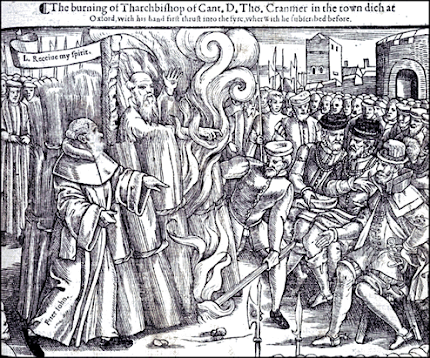
The burning of Tharchbishop of Cant. D. Tho. Cranmer in the town dich at Oxford, with his hand first thrust into the fyre, wherwith he subscribed before. [Click on the picture to see Cranmer's last words.]

Daily Bible Verse

Friday, January 30, 2009

Cranmer's Immortal Bequest: A Further Comment

Archbishop Thomas Cranmer's Immortal Bequest


In 1990 Eerdman's published a book by Samuel Leuenberger, a conservative Swiss Reformed minister. Leuenberger was investigating the subject of evangelical themes in liturgical worship because he saw that many in the evangelical tradition had a low regard for liturgical worship. For those who do not know what liturgy is the word describes the formal rituals used for public worship. Our liturgy is an order dating back to the original development of Christian worship in the time of Christ and the apostles and also to the second to the fourth centuries in the writings of church fathers like Tertullian and Augustine of Hippo.


To Leuenberger's surprise he found that Archbishop Cranmer's services for worship as represented in the 1662 Book of Common Prayer, the first fully Protestant prayer book published during the English Reformation, were overtly evangelical and revivalistic. In other words, Leuenberger discovered what low church Anglicans since the 19th century have widely known. Cranmer, in editing the 1662 Book of Common Prayer, had taken the forms of worship which date to the earliest times of the universal Christian church and applied them to his newfound understanding of the Holy Scriptures. In an article on the Church Society website Leuenberber says:


The liturgies in this prayer book had a special attraction for me because of a certain discovery: I noticed that legitimate elements from the Early Church have been integrated with their aesthetic qualities intact without neglecting the most important factor: the liturgies, particularly Morning Prayer, Evening Prayer, and Holy Communion (the chief services) are permeated through and through with a genuine reformed theology having revivalistic elements. It was because I came to a living faith through the witness of evangelical circles in the Anglo-Saxon world, that the importance of a revivalistically-oriented liturgy was so relevant to me. It is often the case that liturgy and ceremony are rejected by evangelically minded churches. This fact became for me a challenge to show through the Book of Common Prayer that liturgy and revivalistic theology can go along together without contradicting one another. It became a concern to me to present the Book of Common Prayer authorized in 1662 as one of the most precious gems among Christian liturgies.


[From: "Archbishop Cranmer’s Immortal Bequest: The Book of Common Prayer of the Church of England: An Evangelistic Liturgy." Churchman 106/1 1992 by Samuel Leuenberger.


We as Reformed Anglicans should pay particular attention to the 1662 Book of Common Prayer. This is especially true since the 1979 BCP was formulated by theologically liberal Episcopalians who do not and did not believe that Holy Scripture is the final authority in doctrinal matters. Leuenberger argues that subsequent versions of the Book of Common Prayer downplay the moral law of God, which convicts us of sin. For example, the original communion service always included a reading of the Ten Commandments where each law concluded with the prayer,Lord, have mercy upon us, and incline our hearts to keep this law.” Many references to the wrath of God and our status as “miserable sinners” in the general confession of our sins are removed from later versions of the Book of Common Prayer. For this reason, later versions are much more pelagian. The 1979 BCP has a terrible catechism because it practically never mentions original sin or the doctrine of total depravity as it is taught in Scripture.


If there is to be a true renewal in the Anglican Communion, then we must recover the original liturgy of the 1662 Book of Common Prayer. Perhaps that means updating some of the language to modern English. However, deletions and reduction of the liturgy only waters down the biblical content of the services as they were formulated by Cranmer and other English Reformers who are our spiritual forefathers. If we are to have true growth and renewal in the Anglican churches, then we must recover the original Protestant understanding of the Thirty-nine Articles of Religion and teach them to our people. Liturgy is repeated weekly. Thus, if we are faithful to the 1662 Book of Common Prayer we will be literally instructing the people in the biblical understanding of the law and Gospel. As Cranmer argued, the truly “catholic” faith is the Protestant understanding of the Gospel and not Roman Catholic and Anglo-Catholic innovations introduced centuries later. The Protestant Reformers read the Bible and saw that the catholic faith is most purely presented in Holy Scripture alone and not in the traditions of men which developed over time. When Anglicans realize this and recover this lost emphasis on Holy Scripture, the 1662 Book of Common Prayer, and the Thirty-nine Articles of Religion then we will see true revival and renewal within the Anglican Communion. Let it begin with Christ Episcopal Church, Longwood!


Podcast: Wild Boar News: The Demise of Billy Graham

[Click on the title to hear the podcast].


This podcast discussing the heterodoxy of Billy Graham is from A Puritan's Mind website. Dr. Matthew McMahon was a friend of mine in Bible college. Since then, independently of each other, God has sovereignly led both of us to the doctrines of grace. Matthew is a Presbyterian, while I have been led sovereignly to the Reformed Anglican side of things.

Unfortunately, few Anglicans/Episcopalians are truly Reformed anymore. The vast majority of them are apostate having either embraced the theological liberalism of the Episcopal Church USA or otherwise denying the authority of Holy Scripture. Likewise, the Anglican Communion in Canada and the United Kingdom is by and large theologically liberal and apostate. This would include the current Archbishop of Canterbury, Rowan Williams, who has himself ordained an openly gay priest.

The other side of the Anglican Communion which is supposed to be theologically conservative -- GAFCON, Anglican Communion Network, and the American Anglican Council -- is dominated by Angl0-Catholicism, which is itself heretical and promotes justification by works, sacerdotal views of baptism and the Lord's supper, veneration of the saints, mariolatry, and numerous other errors.

Unfortunately, Tractarianism or Anglo-Catholicism is merely a hidden Roman Catholicism masquerading as a middle way between Protestantism and the Roman Catholic view. Anytime we see such an assertion that poison can be compromised with truth our internal heresy alarms ought to be ringing. "Is Tractarianism Popery?" by the Rev. John Cummings is a worthy analysis of Tractarianism from a 19th century perspective. Anyone who thinks compromising with heresy is a good thing is obligated to read this chapter from Cummings' book, Lectures on Romanism: Being Illustrations and Refutations of Romanism and Tractarianism.

Matthew McMahon rightly points out in this podcast that the problem of compromise for the sake of ecumenical unity leads to heresy. Billy Graham has been quoted as saying that those who have not heard the Gospel may know Jesus and not even know it. Graham appeared on the Hour of Power program with Robert Schuller advocating the heresy known as "God's Wider Mercy," which was first introduced by theologian Clark Pinnock who also advocates "Open Theism," another openly heretical theology.

The problem is not just with the Anglican Communion but with Evangelicalism at large. When the focus becomes ecumenical unity even Evangelicals like Charles Colson and James I. Packer get sucked in. As much as I admire James I. Packer, he is too willing to fellowship with heretics in the Anglo-Catholic tradition for the sake of unity in the Anglican Communion. Until Evangelicals begin to care more about biblical orthodoxy and scriptural authority than ecumenical fellowship the downward spiral will continue. Leaders like Billy Graham, Robert Schuller, Charles Colson, Ravi Zacharias and others unwilling to stand for Gospel truth over against Roman Catholicism and Tractarianism and "God's Wider Mercy" and "Open Theism" are setting the stage for an even greater defection to apostasy.

Until Evangelical Anglicans are willing to challenge the Anglo-Catholics with the same level of conviction that they have challenged the consecration of homosexual bishops and the ordination of homosexual ministers there will be only a further slide into outright apostasy. The Anglican Church in North America pretends to adhere to the 1662 Book of Common Prayer and the 1562 version of the Thirty-nine Articles of Religion but in fact takes the Tractarian view of these documents. Such duplicity is at best a facade which is an outright lie.

Until Evangelicals in general are willing to forsake the approval of men (Ephesians 6:5-8; Galatians 1:10; Colossians 2:22-24) and stand for the truth the Evangelical movement will continue down the road to apostasy and theological liberalism like that espoused by Billy Graham and Robert Schuller. We are to be slaves of Christ and not slaves of men.


May God have mercy on us all!

Charlie

Thursday, January 29, 2009

Cranmer's Immortal Bequest

An article at the Church Society describes briefly Samuel Leuenberger's book, Archbishop Cranmer's Immortal Bequest: The Book of Common Prayer of the Church of England:
An Evangelistic Liturgy
.

Monday, January 26, 2009

Hugh Latimer and Thomas Cranmer Against Anglo-Catholicism

First let's see what Hugh Latimer has to say about Anglo-Catholic and Roman Catholic doctrine:

What should it mean, that God would have us so diligent and earnest in prayer? Hath he such pleasure in our works? Many talk of prayer, and make it a lip-laboring. Praying is not babbling; nor praying is not mockery. It is, to miserable folk that are oppressed, a comfort, solace and a remedy. But what maketh our prayer to be acceptable to God? It lieth not in our power; we must have it by another mean. Remember what God said of his Son: Hic est Filius meus dilectus, in quo mihi bene complacui; "This is my dear Son, in whom I delight." He hath pleasure in nothing but in him. How cometh it to pass that our prayer pleaseth God? Our prayer pleaseth God, because Christ pleaseth God. When we pray, we come unto him in the confidence of Christ's merits, and thus offering up our prayers, they shall be heard for Christ's sake. Yea, Christ will offer them up for us, that offered up once his sacrifice to God, which was acceptable; and he that cometh with any other mean than this, God knoweth him not.

This is not the missal sacrifice, the popish sacrifice, to stand at the altar, and offer up Christ again. Out upon it that ever it was used! I will not say nay, but that ye shall find in the old doctors this word sacrificium; but there is one general solution for all the doctors that St Augustine sheweth us: "The sign of a thing hath oftentimes the name of the thing that it signifieth." As the supper of the Lord is the sacrament of another thing, it is a commemoration of his death, which suffered once for us; and because it is a sign of Christ's offering up, therefore he bears the name thereof. And this sacrifice a woman can offer as well as a man; yea, a poor woman in the belfry hath as good authority to offer up this sacrifice, as hath the bishop in his pontificalibus, with his mitre on his head, his rings on his fingers, and sandals on his feet. And whosoever cometh asking the Father remedy in his necessity for Christ's sake, he offereth up as acceptable a sacrifice as any bishop can do. [The Fourth Sermon Preached Before King Edward, 1549]


Latimer is a bit outspoken here. Latimer says straight up that anyone who comes to God on his own merits or any other means except the merits of Christ is lost. God does not know such a man. Latimer is saying that Roman Catholics are not known by God nor are they saved. By implication I would contend that means Anglo-Catholics are likewise unknown by God because they attempt to come to God on their own terms rather than solely on the merits of Christ.

Now, let us see what Cranmer has to say about baptism and the Lord's supper as means of grace:

The sum of Damascene his doctrine in this matter is this. That as Christ, being both God and man, that in him two natures; so that he two nativities, one eternal and the other temporal. And so likewise we, being as it were double men, or having every one of us two men in us, the new man and the old man, the spiritual man and the carnal man, have a double nativity: one of our carnal father, Adam, by whom, as by ancient inheritance, cometh unto us malediction and everlasting damnation; and the other of our heavenly Adam, that is to say, of Christ, by whom we be made heirs of celestial benediction and everlasting glory and immortality.

And because this Adam is spiritual, therefore our generation by him is plainly set forth in baptism, and our spiritual meat and food is set forth in the holy Communion and Supper of the Lord. And because our sights be so feeble that we cannot see the spiritual water wherewith we be washed in baptism, nor the spiritual meat wherewith we be fed at the Lord's table; therefore to help our infirmities, and to make us the better to see the same, as it were before our eyes, by sensible signs and tokens, which we be daily used and accustomed unto.

And because the common custom of men is to wash in water, therefore our spiritual regeneration in Christ, or spiritual washing in his blood, is declared unto us in baptism by water. Likewise our spiritual nourishment and feeding in Christ, is set before our eyes by bread and wine, because they be meats and drinks which chiefly and usually we be fed withal; that as they feed the body, so doth Christ with his flesh and blood spiritually feed the soul.

And therefore the bread and the wine be called examples of Christ's flesh and blood, and also they be called his very flesh and blood, and also they be called his very flesh and blood, to signify unto us, that as they feed us carnally, so do they admonish us that Christ with his flesh and blood doth feed us spiritually and most truly unto everlasting life.

****

For although he say, that Christ is the spiritual meat, yet as in baptism the Holy Ghost is not in the water, but in him that is unfeignedly baptized; so Damascene meant not, that Christ is in the bread, but in him that worthily eateth the bread.

And though he say, that the bread is Christ's body and the wine his blood, yet he meant not that the bread considered in itself, or the wine in itself being not received, is his flesh and blood; but to such as by unfeigned faith worthily receive the bread and wine, to such the bread and wine are called by Damascene the body and blood of Christ, because that such persons through the working of the Holy Ghost be so knit and united spiritually to Christ's flesh and blood, and to his Divinity also, that they be fed with them unto everlasting life.

Futhermore Damascene sayeth not, that the sacrament should be worshipped and adored, as the papists term it, which is plainly idolatry, but that we must worship Christ, God and man. And yet we may not worship him in bread and wine, but sitting in heaven with his Father, and being spiritually within ourselves. [The Work of Thomas Cranmer, "The Presence of Christ." The Courtney Library of Reformation Classics. Ed. G. E. Duffield. (Sutton Courtney Press: Berkshire, 1964). Pp. 189-191.]


So according to Cranmer, how is Christ present in the Lord's supper? Cranmer says that Christ is present in those who believe!


And with the selfsame body he forsook this world, and ascended into heaven, (the apostles seeing and beholding his body when it ascended,) and now sitteth at the right hand of his Father, and there shall remain until the last day, when he shall come to judge the quick and the dead.

This is the true catholic faith which the Scripture teacheth, and the universal Church of Christ hath ever believed from the beginning, until these four or five hundred years last past, that the Bishop of Rome, with the assistance of his papists, hath set up a new faith and belief of their own devising, that the same body really, corporally, naturally, and sensibly is in this world still, and that in an hundred thousand places at one time, being enclosed in every pix and bread consecrated.

And although we do affirm according to God's word, that Christ is in all persons that truly believe in him, in such sort, that with his flesh and blood he doth spiritually nourish them and feed them, and giveth them everlasting life, and doth assure them thereof, as well by the promise of his word, as by the sacramental bread and wine in his holy Supper, which he did institute for the same purpose, yet we do not a little vary from the heinous errors of the papists.

For they teach, that Christ is in the bread and the wine: but we say, according to the truth, that he is in them that worthily eat and drink the bread and wine. (Cranmer, "The Presence of Christ." Pp. 123-124).


So anyone who can read with comprehension can see that Cranmer calls the papists, and by implication, the Anglo-Catholics, innovators of a new doctrine that is not the catholic or the Scriptural faith. Cranmer is solidly Protestant and says that communion takes place through the presence of Christ in believers through the Spirit.

I do not know how much more plain this could be. Anyone who takes the time to read Latimer and Cranmer will immediately know why they were burned at the stake. They dared to challenge Roman Catholic doctrine on the basis of Holy Scripture. Can we do anything less today regarding the challenge of papists and Anglican papists? I think not.


Peace.

Saturday, January 24, 2009

The Demise of Evangelical Conviction

Unfortunately, organizations that have been traditionally Evangelical have become increasingly infiltrated by crypto-liberals. One example of that is the National Association of Evangelicals. A recent lobbyist for the NAE was Richard Cizik, the vice president of governmental affairs. Cizik had the misfortune of coming out of the closet in favor of civil unions for homosexuals, something strictly forbidden in Holy Scripture. Christianity Today magazine apparently thinks Cizik was some sort of hero while the rest of us "Fundamentalists" think he is an apostate pretending to be an "Evangelical."

Evangelicalism as a whole has become increasingly compromised not only with the world and the secular culture via the church growth movement and the pentecostal/charismatic movement but also with Roman Catholicism. These are serious signs of a departure from Biblical Christianity as Dr. Michael Horton has shown in his serious of radio broadcasts last year on the theme of "Christless Christianity." Charles Colson, though allegedly a Presbyterian, has spearheaded this false union with Rome via the document "Evangelicals and Catholics Together." Unfortunately, Colson does not get it. The Council of Trent has never been reversed and the ECT document is flawed in that it still allows for justification by merits. If this is in doubt to anyone, then the response of the Presbyterian Church of America to ECT is a must read.

Colson credits his interaction with Richard John Neuhaus' conversion from Lutheranism to Roman Catholicism as a factor in his compromise with the Roman view of merits as a means of justification. Colson obviously has not read the Roman Catholic catechism and seems to think the Reformation is no longer necessary. But compromise of the Gospel leads to heresy and even outright theological liberalism if Richard Cizik is any example. Any time the emphasis becomes man centered and man's efforts, the eventual result is theological liberalism and antinomianism. This is the irony of it all. Neuhaus himself believed in a qualified universal salvation, hinting that he would have liked to see univeral salvation become the mainstream doctrine.

If Charles Colson is any indication, Evangelicalism is in serious trouble. Anyone who is willing to sacrifice the Gospel itself for a political agenda, even if it is against abortion, is in danger of hellfire. Christianity Today is likewise far from the stronghold of Evangelical convictions it once held. Evangelical seminaries are compromising with neo-orthodoxy and liberal theology in droves. Soon the word "Evangelical" will be a completely meaningless term. When folks call Roman Catholics "Evangelical" with a straight face it is time to invent a new term to represent those of us who still confess the faith of the Bible and of the Protestant Reformation.

Probably the only magazine I could still call faithful to Evangelical convictions is World Magazine. I recommend it highly for those who wish to get a truly "Evangelical" report on events in the United States and the world at large from a Christian perspective.

Monday, January 19, 2009

The Roman Catholic Doctrine of Merits After Baptism

I find it amazing the lengths the Roman Catholic Church will go to justify their view that good works justify us before God. Since Christ died on the cross for our sins and all of our sins are paid for, there should be nothing more we must do to earn, merit, or pay for our own sins. However, the Roman Catholic view is that Christ did not pay for all our sins. Instead "the merit of good works" is appointed to supplement Christ's work on the cross. This doctrine also denigrates Christ's perfect life of obedience and the imputation of his merits to us. The Roman Catholic view makes man's salvation ultimately depend on man's merits rather than Christ's imputed merits and it makes Christ's substitutionary atonement on the cross ineffectual for sins committed after baptism. For those who doubt this, read this statement and think about the implications of it:


"2008 The merit of man before God in the Christian life arises from the fact that God has freely chosen to associate man with the work of his grace. The fatherly action of God is first on his own initiative, and then follows man's free acting through his collaboration, so that the merit of good works is to be attributed in the first place to the grace of God, then to the faithful. Man's merit, moreover, itself is due to God, for his good actions proceed in Christ, from the predispositions and assistance given by the Holy Spirit."

In other words, instead of the cross being the complete sacrifice for all our sins, the Roman Catholic view is saying that God has appointed our good works or merits as a means of justification because God has determined it so. According to the CCTC, prevenient grace given to all men makes man's work acceptable to God. This is essentially semi-pelagianism. Total depravity is cancelled out by prevenient grace so all men now have a choice. Semi-pelagianism is really no better than out and out pelagianism because for all practical pursposes it says the same thing as pelagianism. Man makes himself worthy of salvation by doing good works and man makes himself worthy of God's acceptance by working and meriting God's favor.

What the Roman Catholics give with one hand they take away with the other. Are all men sinful and without hope? If so, then only God can save them. If even one sin cannot be atoned for by our actions, then we need Christ to pay for all our sins. The irony is that the Roman Catholic view not only undermines the doctrine of sin and the fall, but it also undermines the atoning death of Christ because now Christ dies in vain because His death could not pay the penalty for all sins. Instead the sinner must now do penance and merit forgiveness. What kind of hope is this? Did Christ die in vain?

"I am astonished that you are so quickly deserting him who called you in the grace of Christ and are turning to a different gospel— not that there is another one, but there are some who trouble you and want to distort the gospel of Christ. But even if we or an angel from heaven should preach to you a gospel contrary to the one we preached to you, let him be accursed." (Galatians 1:6-8, ESV)

While the Roman view acknowledges that all sins are wiped out up to the point of baptism, after that point man must work or merit forgiveness. Why? In the Roman view, because God said so. In other words, the Roman Church said so. This is because they place Tradition above Scripture. The Bible over and over says that Christ paid for all of our sins yet Rome says that sins after baptism require penances which merit man's forgiveness:

"2010 Since the initiative belongs to God in the order of grace, no one can merit the initial grace of forgiveness and justification, at the beginning of conversion. Moved by the Holy Spirit and by charity, we can then merit for ourselves and for others the graces needed for our sanctification, for the increase of grace and charity, and for the attainment of eternal life. Even temporal goods like health and friendship can be merited in accordance with God's wisdom. These graces and goods are the object of Christian prayer. Prayer attends to the grace we need for meritorious actions."

Notice it says "initial grace of forgiveness and justification." The short of it is the Roman view only believes that sins before baptism are freely forgiven by the sacrifice of Christ. All sins after that point must now be paid for by both Christ's sacrifie AND man's merits. The cross is not enough. No thank-you. I will go with Scripture and not with what Rome has to say. Christ paid it all. If anyone doubts that Rome teaches that you save yourself by your own good works, then read this paragraph and explain the way out of the Roman Catholic dilemma.


"For Christ has entered, not into holy places made with hands, which are copies of the true things, but into heaven itself, now to appear in the presence of God on our behalf. Nor was it to offer himself repeatedly, as the high priest enters the holy places every year with blood not his own, for then he would have had to suffer repeatedly since the foundation of the world. But as it is, he has appeared once for all at the end of the ages to put away sin by the sacrifice of himself. And just as it is appointed for man to die once, and after that comes judgment, so Christ, having been offered once to bear the sins of many, will appear a second time, not to deal with sin but to save those who are eagerly waiting for him." (Hebrews 9:24-28, ESV)


"But if it is by grace, it is no longer on the basis of works; otherwise grace would no longer be grace." (Romans 11:6, ESV)


May God have mercy on us all!

Sunday, January 18, 2009

Scripture the Final Revelation: A Further Critique of George Conger's Theology

Charismatics still do not understand the fact that Scripture is the only binding revelation we have from God. We are not guided by personal revelations, impressions, or visions but we are to be guided solely and exclusively by Holy Scripture. Where Scripture is silent we may use our personal discretion in making moral decisions and decisions in everyday life such as finances, where to go to college, what job to take, whom we should marry, etc. However, we should always acknowledge that God is providentially in control and even when we make bad decisions He can still work it for our good.

The guiding principle for any decision making process is, "Do not go beyond what is written." (See 1 Corinthians 4:6). This means that we are not just bound to not violate a moral law revealed in Scripture such as, "Do not commit adultery." (See Mark 10:19; Luke 18:20; James 2:11). It also means that we are not to speculate about spiritual issues and then try to claim it as "divine revelation." According to Paul, this sort of super spirituality leads to vanity, pride, and self-exaltation. While charismatics will say that such speculation is revelation on a secondary level, in actual practice they wind up making such human speculation equal with Scripture. Even Wayne Grudem, the Reformed charismatic, says that prophecies in church ought to be prefaced by the words, "I believe this is what the Lord is saying." This is equivalent to saying it is personal opinion. Grudem also acknowledges that "prophecy" today is fallible and prone to human error. Thus, it is really moot and pointless for charismatics to pretend that this "charismatic gift" is something supernatural for really it is merely the natural man trying to reproduce what is essentially supernatural and infallible in the New Testament and apostolic witness.

Most of the so-called "charismatic gifts" today are really just man trying to exalt himself and impress others with his superiority in spiritual matters. The truth is we are all on a level playing field. We are all sinners. We all err. We all see through a glass darkly. Charismatics have nothing more than anyone else has, despite their claims to the contrary. We have only one infallible word from God. It is called Holy Scripture. All else is human interpretation of Scripture. Even commentaries, creeds, and confessions of faith may sometimes err. If this is true of the collective thinking of conservative and Reformed scholarship, it is most certainly true of man's attempts to replicate the supernatural.

I would not for one minute question God's ability to do the supernatural or perform a miracle. However, when men claim to be able to do this my heresy/false miracles detector goes off. As Christians we ought to be aware that in the last days there will be many false prophets and charlatans out there. (See Matthew 7:15; 24:11-14; 24:24; 2 Peter 2:1). If it sounds too good to be true, it is too good to be true. Of course God answers prayers. Of course God can do miraculous things. But that is not the norm and we should not need to see the dead raised in order to believe. We follow God's Word, not signs, wonders and miracles. The short of it is that miracles are not the proof of the Gospel. It is the Word of God:

"But Abraham said, ‘They have Moses and the Prophets; let them hear them.’ And he said, ‘No, father Abraham, but if someone goes to them from the dead, they will repent.’ He said to him, ‘If they do not hear Moses and the Prophets, neither will they be convinced if someone should rise from the dead.’ " (Luke 16:29-31, ESV)

"Then he said to them, "These are my words that I spoke to you while I was still with you, that everything written about me in the Law of Moses and the Prophets and the Psalms must be fulfilled." Then he opened their minds to understand the Scriptures, and said to them, "Thus it is written, that the Christ should suffer and on the third day rise from the dead, and that repentance and forgiveness of sins should be proclaimed in his name to all nations, beginning from Jerusalem." (Luke 24:44-47, ESV)

The point here is that the resurrection even of Jesus Christ will not convince those who refuse to believe if they do not believe Moses and the Prophets. It is Holy Scripture which in the final analysis proves that Jesus is who He claimed to be. The resurrection is merely the icing on the cake. Even if someone is raised from the dead, including Jesus Christ Himself, if they will not hear Moses and the Prophets and Christ, they will not believe. It is the Holy Spirit Himself who brings us to faith by hearing the Scriptures and the Gospel preached, for it is the Bible which testifies to these things.

I was a Pentecostal/Charismatic for over ten years and was often disappointed that the anecdotes told in church were never backed up with solid evidence. I was also disappointed that the so-called miracles in evangelistic services were often just smoke and mirrors. Any debunker can see through the doubletalk and the ambiguity meant to mislead the gullible.

However, in the Bible the miracles were irrefutably supernatural so that even the critics could not deny that something beyond the natural had occurred. The short of it is that we are obligated to believe that the miracles of the Bible did indeed happen because the Bible is inerrant and infallible. However, we are to test the spirits today to see if they are of God. (See 1 John 4:1-6).We are to make sure that the doctrines being taught are in line with Scripture and that we are not being led astray by lying signs and wonders (Matthew 24:24; II Thessalonians 2:9).

I think Calvin's comments on the miracles claimed by the Roman Catholics is still relevant to us today regarding miracle claims by charismatics and Roman Catholics. Calvin notes that the "charismatics" of his day disputed the teachings of Scripture by appealing to the lack of miracles performed by Reformed and Gospel preachers:

"Nevertheless, they cease not to assail our doctrine, and to accuse and defame it in what terms they may, in order to render it either hated or suspected. They call it new, and of recent birth; they carp at it as doubtful and uncertain; they bid us tell by what miracles it has been confirmed; they ask if it be fair to receive it against the consent of so many holy Fathers and the most ancient custom; they urge us to confess either that it is schismatical in giving battle to the Church, or that the Church must have been without life during the many centuries in which nothing of the kind was heard. Lastly, they say there is little need of argument, for its quality may be known by its fruits, namely, the large number of sects, the many seditious disturbances, and the great licentiousness which it has produced. No doubt, it is a very easy matter for them, in presence of an ignorant and credulous multitude, to insult over an undefended cause; but were an opportunity of mutual discussion afforded, that acrimony which they now pour out upon us in frothy torrents, with as much license as impunity, 12 would assuredly boil dry."

"1. First, in calling it new, they are exceedingly injurious to God, whose sacred word deserved not to be charged with novelty. To them, indeed, I very little doubt it is new, as Christ is new, and the Gospel new; but those who are acquainted with the old saying of Paul, that Christ Jesus “died for our sins, and rose again for our justification” (Rom. 4:25), will not detect any novelty in us. That it long lay buried and unknown is the guilty consequence of man’s impiety; but now when, by the kindness of God, it is restored to us, it ought to resume its antiquity just as the returning citizen resumes his rights."

*******
"3. In demanding miracles from us, they act dishonestly; for we have not coined some new gospel, but retain the very one the truth of which is confirmed by all the miracles which Christ and the apostles ever wrought. But they have a peculiarity which we have not—they can confirm their faith by constant miracles down to the present day! Way rather, they allege miracles which might produce wavering in minds otherwise well disposed; they are so frivolous and ridiculous, so vain and false. But were they even exceedingly wonderful, they could have no effect against the truth of God, whose name ought to be hallowed always, and everywhere, whether by miracles, or by the natural course of events. The deception would perhaps be more specious if Scripture did not admonish us of the legitimate end and use of miracles. Mark tells us (Mark 16:20) that the signs which followed the preaching of the apostles were wrought in confirmation of it; so Luke also relates that the Lord “gave testimony to the word of his grace, and granted signs and wonders to be done” by the hands of the apostles (Acts 14:3). Very much to the same effect are those words of the apostle, that salvation by a preached gospel was confirmed, “The Lord bearing witness with signs and wonders, and with divers miracles” (Heb. 2:4). Those things which we are told are seals of the gospel, shall we pervert to the subversion of the gospel? What was destined only to confirm the truth, shall we misapply to the confirmation of lies? The proper course, therefore, is, in the first instance, to ascertain and examine the doctrine which is said by the Evangelist to precede; then after it has been proved, but not till then, it may receive confirmation from miracles. But the mark of sound doctrine given by our Saviour himself is its tendency to promote the glory not of men, but of God (John 7:18; 8:50). Our Saviour having declared this to be test of doctrine, we are in error if we regard as miraculous, works which are used for any other purpose than to magnify the name of God."


[Calvin's Institutes of the Christian Religion, "Prefatory Address."

Calvin's reasoning here is hard to refute if one's position is that Scripture alone is the final word. However, if Scripture is not the final word and there is some sort of ongoing revelation today, then follow the charismatics. I for one will follow the Bible. I will not and cannot believe what someone teaches if it is not first proved from Holy Scripture. Signs, wonders, miracles, prophecies, and revelations today are not the source of doctrine. The Bible is our only infallible source of doctrine. I would submit to you that if you believe otherwise, you're setting yourself up to be deceived.

There are those who think we should never publicly question a sermon. However, a sermon is delivered publicly and is therefore open to public scrutiny. We are to test the doctrinal content of all sermons by the Word of God, the Holy Scriptures. I welcome the examination of all that I write or say in public. The minister who is committed to Scripture as the only infallible rule of faith and practice would be out of character to say otherwise.


Sola Scriptura!

Charlie

Saturday, January 17, 2009

Calvin Against Common Grace

"When Paul says that that which may be known of God is manifested by the creation of the world, he does not mean such a manifestation as may be comprehended by the wit of man (Rom. 1:19); on the contrary, he shows that it has no further effect than to render us inexcusable (Acts 17:27). And though he says, elsewhere, that we have not far to seek for God, inasmuch as he dwells within us, he shows, in another passage, to what extent this nearness to God is availing. God, says he, “in times past, suffered all nations to walk in their own ways. Nevertheless, he left not himself without witness, in that he did good, and gave us rain from heaven, and fruitful seasons, filling our hearts with food and gladness,” (Acts 14:16, 17). But though God is not left without a witness, while, with numberless varied acts of kindness, he woos men to the knowledge of himself, yet they cease not to follow their own ways, in other words, deadly errors." 1

It is clear from this quote from the Institutes that Calvin saw that the goodness of God expressed to the reprobate does nothing to bring them to conversion and they continue on in their "deadly errors" despite God's open show of His goodness in the Old Testament and in the New Testament.


1. Calvin, J., & Beveridge, H. (1996). Institutes of the Christian religion (electronic ed.) (Book I, v, 14). Oak Harbor, WA: Logos Research Systems.

Wednesday, January 14, 2009

"The Sinner neither Able nor Willing: The Doctrine of Absolute Inability "

This link is to a video sermon by John MacArthur and is sponsored by Ligonier Ministries. Click on this title to view the video: "The Sinner neither Able nor Willing: The Doctrine of Absolute Inability." Sadly, today most people have little to no understanding of basic doctrines of the Bible. This isn't a new doctrine. It has been held and believed by Christians since the time of the Apostle Paul and even down to the time of the Reformation.

Does the Roman Catholic Catechism Teach Justification by Faith Alone?

In the next several days I will do short commentaries on The Catechism of the Catholic Church to show how it is defective and how it departs from the biblical doctrine of justification by faith alone. I have decided to do this commentary because someone who claims to be "Protestant" and "Calvinistic" also claims to be "Anglo-Catholic." (See Tracts for the Times). This person gave me references in the Roman catechism with the remark that he did not see a problem with these statements. I intend to show that in fact Anglo-Catholics and Roman Catholics share the same view of justification, which is heretical and not the gospel at all. (Click here for a straightforward explanation of justification by faith alone by Dr. John H. Gerstner).

I will also frankly admit that many "Evangelicals" today think that the Protestant Reformation is over and that Rome and Protestants are now one. That is expressed in the document, Evangelicals and Catholics Together. Oddly enough one of the endorsers of that document is also a member of The Alliance of Confessing Evangelicals, which produced The Cambridge Declaration. The two documents are contradictory to say the least. I'm extemely displeased that James I. Packer and Gerald Bray, both Evangelical Anglicans, signed ECT. However, other Evangelicals, including R. C. Sproul and Michael Horton saw through the weaknesses of this document and responded with An Appeal to Evangelicals.

Moreover, paragraph 1989 from CCTC shows that the Roman Catholic/Anglo-Catholic view confuses justification with sanctification:

"1989 The first work of the grace of the Holy Spirit is conversion, effecting justification in accordance with Jesus' proclamation at the beginning of the Gospel: 'Repent, for the kingdom of heaven is at hand.'38 Moved by grace, man turns toward God and away from sin, thus accepting forgiveness and righteousness from on high. 'Justification is not only the remission of sins, but also the sanctification and renewal of the interior man.'"39

As Reformed believers we should be careful to distinguish between justification and sanctification. In fact, the footnote shows that this idea of justification and sanctification being one and the same thing comes from the Council of Trent. It should be noted that the Council of Trent officially condemned the Gospel of Jesus as it is understood from Holy Scripture and by the Protestant Reformers. This paragraph emphasizes the logical flow from the Roman Catholic doctrine of infused righteousness. In other words, at baptism the believer is infused with righteousness which is the basis of his justification. In the Roman Catholic view he is made inherently or actually righteous as if he or she were as pure as Christ Himself at baptism. Thus, all sins past and present, including the guilt of original sin are washed away and the believer is made pure within and without. However, the Roman Catholics would not deny that this includes a legal declaration of righteousness up to the point of baptism. But the Protestant view is that the legal/forensic declaration includes all sins committed in the past, the present, and the future--not just sins committed before baptism but all sins committed after baptism as well. All we need to do when sin is committed after conversion and baptism is to confess our sins and repent of them. Of course, we must pay the consequences for our sins in this life but that has nothing to do with our eternal standing with God. If I commit a crime, I must do prison time but that has absolutely nothing to do with my state of justification if I truly repent of my sins.

The problem is that we are not made inherently righteous when we are converted. We are both saints and sinners simultaneously (see Romans 7). We not only have a new nature but the old nature is still there as well. This is why Protestants insist on the distinction between justification and sanctification. Justification is a legal declaration whereby we are declared not guilty of our sins and not guilty of the original sin of Adam (see Romans 4:1-8). It is not an inherent righteousness or righteousness infused into the heart. Rather, it is a righteousness that is not our own credited to us. We remain sinners while we are declared righteous. A foreign righteousness is imputed or credited to us even though it is not our own. This righteousness is the perfect obedience and the perfect righteousness of Christ himself.

On the other hand, our sanctification is both positional and progressive. At conversion we are separated to God and then we progress imperfectly toward Christian maturity. Only at our death are we entirely sanctified and sinless in every respect. This is in fact our glorification.

I would also disagree with the statement's obvious semi-pelagianism, which was condemned as a heresy at the Council of Orange in 529 A.D. I do not agree that we cooperate with God's grace. This view essentially says that total depravity and original sin is cancelled out by a general grace given to all men. However, the Bible makes it clear that only the elect will be drawn to Christ and only the elect are effectually called. Man is unable to respond to the call of the Gospel unless grace is given to individuals. Those individuals who actually receive grace are indeed irresistibly drawn to repentance, conversion, and faith. Those who are not converted have not received grace to believe. (See the Thirty-Nine Articles of Religion, Articles IX-XVIII: Personal Religion). If grace is given to all, then grace is essentially ineffective and the deciding factor is man. The problem with this view is it makes God unable to save anyone at all and salvation is left to chance and the capricious wills of sinful men. God is in heaven wringing His hands and hoping someone will choose Him. But the biblical view is that God actually saves exactly who He intends to save out of sheer mercy and grace. This is the point upon which the Gospel stands or falls. Those who claim to be both Protestant and Anglo-Catholic are misrepresenting the facts.


More on this later.

38 Mt 4:17.
39 Council of Trent (1547): DS 1528.

Tuesday, January 13, 2009

Quote of the Day: Preach the Bible

"Scripture must take us beyond our perceived needs to our real needs and liberate us from seeing ourselves through the seductive images, cliche's, promises and priorities of mass culture. It is only in the light of God's truth that we understand ourselves aright and see God's provision for our need. The Bible, therefore, must be taught and preached in the church. Sermons must be expositions of the Bible and its teachings, not expressions of the preacher's opinions or the ideas of the age. We must settle for nothing less than what God has given."

Monday, January 12, 2009

Billy Graham Versus Article XVIII


Is Jesus Christ really the only way of salvation? Can we be saved by the "light we have"? Or do we believe what the Bible says?

John 5:24-25 (ESV) 24 Truly, truly, I say to you, whoever hears my word and believes him who sent me has eternal life. He does not come into judgment, but has passed from death to life. 25 "Truly, truly, I say to you, an hour is coming, and is now here, when the dead will hear the voice of the Son of God, and those who hear will live.

John 14:6 (ESV) 6 Jesus said to him, "I am the way, and the truth, and the life. No one comes to the Father except through me.

Acts 4:12 (ESV) 12 And there is salvation in no one else, for there is no other name under heaven given among men by which we must be saved."


Even the English Reformers believed that Jesus Christ is the only way of salvation:


Article XVIII

Of obtaining eternal salvation only by the name of Christ

They also are to be had accursed that presume to say that every man shall be saved by the law or sect which he professeth, so that he be diligent to frame his life according to that law and the light of nature. For Holy Scripture doth set out to us only the name of Jesus Christ, whereby men must be saved. 
(Acts 4:10, 12).


Now let us compare what the Bible and the Thirty-Nine Articles of Religion have to say with what Billy Graham and Robert Schuller have to say:


Just as a followup to the article above I want to point out that the Cambridge Declaration also challenges Billy Graham's position:


"We also earnestly call back erring professing evangelicals who have deviated from God's Word in the matters discussed in this Declaration. This includes those who declare that there is hope of eternal life apart from explicit faith in Jesus Christ, who claim that those who reject Christ in this life will be annihilated rather than endure the just judgment of God through eternal suffering, or who claim that evangelicals and Roman Catholics are one in Jesus Christ even where the biblical doctrine of justification is not believed."

Sunday, January 11, 2009

A Critique of Today's Sermon Preached by Rev. George Conger

This morning Christ Episcopal Church of Longwood, Florida had a guest minister, Rev. George Conger, from the Florida Diocese, deliver the sermon. It seemed obvious to me that he thinks he is not bound by God's Holy Scriptures or by the Thirty-Nine Articles of Religion. While the Thirty-Nine Articles of Religion are not equal in authority to Holy Scripture, they are in fact a confession of faith. Since Scripture is the final and sole authority in matters of faith and practice, there can be nothing equal to them in authority, especially church tradition. That being said, however, the Thirty-Nine Articles of Religion are a confession of what we believe the Scriptures do in fact teach and as much as the Articles are an accurate expression of the true teaching of the Holy Scriptures they are in fact binding doctrine. Just as the creeds are binding doctrine insofar as they teach what Scripture teaches, so the Articles are a Protestant document and are binding in matters of faith because they are a "universal" or "catholic" expression of Protestant doctrine.

The first indication of an apostate minister is that he will refuse to preach the Bible and instead preach his own "story" or "experience." What becomes authoritative for faith and doctrine and practice in such a case is not Holy Scripture but the minister's personal experiences and church tradition. Anglo-Catholics and charismatics in fact hate Holy Scripture and will refuse to take it at face value. Somewhere in the sermon they will denigrate the authority of Scripture. In this case the minister threw aside the Bible and uplifted himself in its place. In one of his remarks he said that he would not "beat someone over the head with the Bible" or quote from the Prayer Book on such and such a page. Clearly, this fellow has a problem with God's Word. His view seems to be that anyone who actually believes that the Bible is God's special revelation to man is guilty of bibliolatry or worshipping the Bible. But I ask you, if the Bible is a letter from God Himself to mankind, how can it be idolatry or worship of the Bible if we take God at His Word? If God says it, we ought to believe it. Jesus says this: Matthew 4:4 (ESV) 4 But he answered, "It is written, " ‘Man shall not live by bread alone, but by every word that comes from the mouth of God.’" The Scriptures here make it plain that we do not live by every word that comes from the mouth of George Conger or from the mouth of David Knox or even from the mouth of Charlie Ray. The Scriptures declare that we are to live by every word that comes from the mouth of God. Ministers are fallible and God's Word is eternal, infallible, and binding upon each of us.

Over and over again, Jesus points us to the Holy Scriptures. In fact, if we count the apostles Paul, James and Peter along with Jesus Christ Himself, there are over 51 references to the Holy Scriptures in the New Testament. After the resurrection Jesus pointed to the Old Testament Scriptures as proof of who He is and that His ministry was from God:

Luke 24:27 (ESV) And beginning with Moses and all the Prophets, he interpreted to them in all the Scriptures the things concerning himself.

Luke 24:32 (ESV) They said to each other, "Did not our hearts burn within us while he talked to us on the road, while he opened to us the Scriptures?"

Luke 24:45 (ESV) Then he opened their minds to understand the Scriptures,


Brethren, anytime a minister gets up to preach and never once opens the Bible to expound and explain the Word of God, that ought to be a red flag. Any true minister of God will follow the example of Jesus Christ and explain to the disciples more fully the teachings of the Bible about Jesus Christ.

The second point I would like to make is that the Thirty-Nine Articles of Religion in fact state that only Scripture gives us any doctrine of salvation and justification that is binding:


Article VI
Of the sufficiency of the Holy Scripture for Salvation

Holy Scripture containeth all things necessary to salvation: so that whatsoever is not read therein, nor may be proved thereby, is not to be required of any man, that it should be believed as an article of the faith, or be thought requisite or necessary to salvation.

In the name of Holy Scripture, we do understand those Canonical books of the Old and New testament, of whose authority was never any doubt in the Church. ...


Also, even more to the point, the first eight articles of the Thirty-Nine Articles of Religion are called "catholic." That is they are to be universally accepted. And contrary to Rome and Anglo-Catholicism/Tractarianism, the "catholic" faith is Protestant and teaches that the Bible alone is the sufficient rule for faith and practice. We are not obligated to believe man's traditions or the traditions of Rome or the traditions of Anglo-Catholics. We are bound to believe only what can be proved straight from the Bible. Liberalism and the charismatics believe man's experience is equal in authority to God's Word, the Holy Bible. However, the one true and catholic faith teaches that the Bible is the final word in all matters of faith and in matters of salvation. Obviously, our guest speaker today does not believe that. He believes that the Anglo-Catholic view is equal to Holy Scripture.

Another point on which I disagreed with the minister today is that he implied that there is a purgatory by his telling of a joke where the pope, Billy Graham, and Oral Roberts were sent to hell for thirty days before they could be admitted to heaven. However, Article XXII clearly says there is no purgatory. The minister also implied in the joke that the "sacraments have efficacy" to save even the devil. This is complete and utter nonsense. The sacraments are tokens and signs of something beyond the bread and the wine. The signs point to a greater reality which is the once and for all sacrifice of Jesus Christ on the cross at Calvary. Where there is no true faith the signs and tokens do not effectively convey anything at all to the recipients. Thus, the signs cannot have the power to save the devil or anyone else apart from a true faith in Jesus Christ and his atoning death on the cross. It is Christ and Him crucified which saves us. And the signs always point to Jesus Christ and the cross.

Furthermore, the minister, George Conger said that there are seven sacraments. This is in direct contradiction to the "catholic" faith which is expressed in the Thirty-Nine Articles of Religion:

Article XXV

Of the Sacraments

Sacraments ordained of Christ be not only badges or tokens of Christian men's profession, but rather they be certain sure witnesses and effectual signs of grace and God's good will towards us, by the which He doth work invisibly in us, and doth not only quicken, but also strengthen and confirm, our faith in Him.

There are two Sacraments ordained of Christ our Lord in the Gospel, that is to say, Baptism and the Supper of the Lord.

Those five, commonly called Sacraments, that is to say, Confirmation, Penance, Orders, Matrimony, and Extreme Unction, are not to be counted for Sacraments of the Gospel, being such as have grown partly of the corrupt following of the Apostles, partly are states of life allowed in the Scriptures; but yet have not the like nature of Sacraments with Baptism and the Lord's Supper, for that they have not any visible sign or ceremony ordained of God.

The Sacraments were not ordained of Christ to be gazed upon or to be carried about, but that we should duly use them. And in such only as worthily receive the same, have they a wholesome effect or operation: but they that receive them unworthily, purchase to themselves damnation, as S. Paul saith.


I might further point out that George Conger said that God is not in control of all that happens. He therefore does not agree with the Thirty-Nine Articles of Religion or the Holy Scriptures on that point of doctrine as well. The Bible clearly teaches the sovereignty of God in places like Isaiah 45:7; Ephesians 1:11; Romans 11:33; Hebrews 6:17; Romans 9:15- 18). And the doctrine of predestination is clearly taught both in Scripture (Ephesians 1:4-5, 9, 11; Romans 8:30; 2 Timothy 1:9; 1 Thessalonians 5:9) and in Article XVII of the Thirty-Nine Articles.

I might also point out that all suffering in this world is the result of the fall of Adam. Not only is this taught in the Bible (Genesis 3:16-19; Romans 5:12-14; Deuteronomy 28:58-61; 29:22-24; Romans 8:18-23) but it is also taught in Article IX:

Of Original or Birth Sin

Original sin standeth not in the following of Adam (as the Pelagians do vainly talk), but it is the fault and corruption of the nature of every man that naturally is engendered of the offspring of Adam, whereby man is very far gone from original righteousness, and is of his own nature inclined to evil, so that the flesh lusteth always contrary to the spirit; and therefore in every person born into this world, it deserveth God's wrath and damnation. And this infection of nature doth remain, yea, in them that are regenerated, whereby the lust of the flesh, called in Greek phronema sarkos (which some do expound the wisdom, some sensuality, some the affection, some the desire of the flesh), is not subject to the law of God. And although there is no condemnation for them that believe and are baptized, yet the Apostle doth confess that concupiscence and lust hath itself the nature of sin.


The vanity and pride of man is always the source of pelagianism. Man wants to think he is equal with God so man preaches that we can do the things God does. Man wants to be powerful like God so man preaches that "baptism" of the Holy Spirit makes you like God. But the Bible teaches the opposite. Every Christian is baptized with the Holy Spirit at conversion. If you are a Christian you have already been baptized with the Holy Spirit. However, the minister today suggested that baptism with the Holy Spirit is something in addition to regeneration and conversion. The Bible clearly says that all Christians have the Holy Spirit and are baptized with the Holy Spirit:

Matthew 3:11 (ESV) 11 "I baptize you with water for repentance, but he who is coming after me is mightier than I, whose sandals I am not worthy to carry. He will baptize you with the Holy Spirit and fire.

Mark 16:16 (ESV) 16 Whoever believes and is baptized will be saved, but whoever does not believe will be condemned.

Acts 1:5 (ESV) 5 for John baptized with water, but you will be baptized with the Holy Spirit not many days from now."

Acts 2:38 (ESV) 38 And Peter said to them, "Repent and be baptized every one of you in the name of Jesus Christ for the forgiveness of your sins, and you will receive the gift of the Holy Spirit.

Acts 2:41 (ESV) 41 So those who received his word were baptized, and there were added that day about three thousand souls.

Acts 10:47 (ESV) 47 "Can anyone withhold water for baptizing these people, who have received the Holy Spirit just as we have?"

Romans 6:3 (ESV) 3 Do you not know that all of us who have been baptized into Christ Jesus were baptized into his death?

1 Corinthians 12:13 (ESV) 13 For in one Spirit we were all baptized into one body—Jews or Greeks, slaves or free—and all were made to drink of one Spirit.

Galatians 3:27 (ESV) 27 For as many of you as were baptized into Christ have put on Christ.

Titus 3:5-7 (ESV) 5 he saved us, not because of works done by us in righteousness, but according to his own mercy, by the washing of regeneration and renewal of the Holy Spirit,6 whom he poured out on us richly through Jesus Christ our Savior,7 so that being justified by his grace we might become heirs according to the hope of eternal life.


The problem today is that there are many false prophets who wish to steer people away from God's Word. They wish to steer people away from the catholic faith which is confessed in the Protestant views expressed in the Thirty-Nine Articles of Religion.

I would also say that part of the problem today is the departure of the Episcopal Church USA from the 1662 Book of Common Prayer. The 1979 Book of Common Prayer is full of Anglo-Catholic doctrines in the liturgy and out and out pelagianism in the catechism. It is no wonder that the Episcopal Church has gone liberal. But in my opinion, the so-called "conservatives" who are starting the new common cause partnerships and the new province, The Anglican Church in North America, are in fact dissimulators who hide the fact that they do not like the Protestant faith or the low church side of Anglicanism. Anglo-Catholics would like to usurp the authority of the Bible and re-interpret the Thirty-Nine Articles of Religion by using Tract 90 as a commentary on the Articles. This is not only dishonest and misleading but it is to present another gospel which is not the Gospel at all. Moreover, the Homily on Justification clearly contradicts Tract 90 when it is read in its entirety. The misquoting of the Homily by John Henry Newman was so obviously out of context that Newman was finally forced to quit the Anglican Church and become a Roman Catholic.

I cannot judge any man's soul. However, I can judge the man's doctrine. It is obvious to me that Rev. George Conger's sympathies lie with the Anglo-Catholics and not with God's Holy Scriptures, which are the final word in all matters of justification, faith, and salvation.

In his writings on the sacrament of the Lord's Supper, Archbishop Thomas Cranmer once said:
Now let the papists show some authority for their opinion, either of Scripture, or of some ancient author. And let them not constrain all men to follow their fond devices, only because they say it is so, without any other ground or authority but their own bare words. For in such wise credit is to be given to God's Word only, and not to the word of any man. [The Work of Thomas Cranmer. "The Third Book Teacheth the Manner How Christ Is Present in His Supper." The Courtney Library of Reformation Classics. Ed. G.E. Duffield. (Berkshire: Sutton Courtney Press, 1964). Page 144].


Peace!

Saturday, January 10, 2009

Changes Made to the Thirty-Nine Articles of Religion

I have a copy of Gerald Bray's Documents of the English Reformation, (Minneapolis: Fortress, 1994). For those who would deny that the Thirty-Nine Articles of Religion teach justification by faith only in Article XI I would like to quote the 1552 edition of the Forty-Two Articles in which the parts in bold were deleted in 1563 and 1571. The parts in parentheses were added in 1563/1571:


Justification by only faith in Jesus Christ, in that sense, as is declared in the Homily of Justification, is most certain and wholesome doctrine for Christian men.

(We are accounted righteous before God only for the merit our Lord and Saviour Jesus Christ by faith, and not for our own works or deservings. Wherefore, that we are justified by faith only, is a most wholesome doctrine, and very full of comfort, as more largely is expressed in the Homily of Justification). (Bray, p. 291).

The original Latin reads as follows:


Iustifcatio ex sola fide Iesu Christi, eo sensu quo in Homelia de iustificatione explicatur, est certissima et sluberrima Christianorum doctrina.

(Tantum propter meritum Domini ac Servatoris nostri Iesu Christi per fidem, non propter opera et merita nostra, iusti coram Deo reputamur; quare sola fide nos iustificari, doctrina est saluberrima, ac consolationis plenissima, ut in Homelia de iustidficatione hominis fusius explicatur.) (Bray, p. 291).


And Article XVII has the following sentences in bold left out after the 1563/1571 revision:


Article XVII

Of Predestination and Election

Predestination to life is the everlasting purpose of God, whereby, before the foundations of the world were laid, He hath constantly decreed by His own judgement (counsel) secret to us, to deliver from curse and damnation those whom He hath chosen (in Christ) out of mankind, and to bring them (by Christ) to everlasting salvation by Christ as vessels made to honour. Whereupon such as have (Wherefore they which be endued with) so excellent a benefit of God given unto them be called according to God's purpose by His Spirit working in due season; they through grace obey the calling; they be justified freely; they be made sons (of God)by adoption; they be made like the image of His only-begotten Son Jesus Christ; they walk religiously in good works; and at length by God's mercy they attain to everlasting felicity.

As the godly consideration of Predestination and our Election in Christ is full of sweet, pleasant, and unspeakable comfort to godly persons and such as feel in themselves the working of the Spirit of Christ, mortifying the works of the flesh and their earthly members and drawing up their mind to high and heavenly things, as well because it doth greatly (e)stablish and confirm their faith of eternal salvation to be enjoyed through Christ, as because it doth fervently kindle their love towards God: so for curious and carnal persons, lacking the Spirit of Christ, to have continually before their eyes the sentence of God's Predestination is a most dangerous downfall, whereby the devil may (doth) thrust them either into desperation or into a recklessness of most unclean living no less perilous than desperation.

Furthermore, although the decrees of predestination are unknown to us, yet we must receive God's promises in such wise as they be generally set forth in Holy Scripture; and in our doings that will of God is to be followed which we have expressly declared unto us in the word of God. (Bray, p. 295).

De Praedestinatione


Praedestinatio ad vitam est aeternum Dei propositum, quo, ante iacta mundi fundamenta, suo consilio, nobis quidem occulto, constanter decrevit eos, quos in Christo elegit ex hominum genere, a maledicto et exitio liberare, atque ut vasa in honorem efficta per Christum ad aeternam salutem adducere. Unde qui tam praeclaro Dei beneficio sunt donati, illi, Spiritu eius opportuno tempore operante, secundum propositum eius vocantur; iustificatur gratis; adoptantur in filios Dei; unigeniti eius Iesu Christi imagini efficiuntur conformes; in bonis operibus sancti ambulant; et demum ex Dei misericordia pertingunt ad sempiternam felicitatem.

Quemadmodum Praedestinationis et Electionis nostrae in Christo pia consideratio dulcis, suavis, et ineffabilis consolationis plena est vere piis et his qui sentiunt in se vim Spiritus Christi, facta carnis et membra quae adhuc sunt super terram mortificantem, animumque ad coelestia et superna rapientem, tum quia fidem nostram de aeterna salute consequenda per Christum plurimum stabilit atque confirmat, tum quia amorem nostrum in Deum vehementer accendit: ita hominibus, curiosis carnalibus et Spiritu Christi destitutis, ob oculos perpetuo versari Praedestinationis Dei sententiam perniciosissimum est praecipitium, unde illos diabolus protrudit vel in desperationem vel in aeque pernitiosam impurissimae vitae securitatem.

Deinde licet praedestinationis decreta sunt nobis ignota, promissiones tamen divinas sic amplecti oportet, ut nobis in sacris literis generaliter propositae sunt; et Dei voluntas in nostris actionibus ea sequenda est quam in verbo Dei habemus deserte revelatam. (Bray, p. 295).


We can clearly see that the 42 Articles were much more overtly Calvinistic and Reformed, especially in Article XVII where we see a more explicit statement made on double predestination.

Dissimilitude in High Places: An Article from the TRECUS Website

(This article is taken from the Traditional Reformed Episcopal Church in the United States (TRECUS) website.

Dissimilitude in High Places

On the official Reformed Episcopal Church (REC) website, there is a little article entitled:

"The Reformed Episcopal Church Declaration of Principles: Their Historical Context."

If one reads this article, essentially a Declaration Denial, and compares it to the historic Declaration of Principles, one wonders what the state of mind of the unnamed author was at the time it was written. Certainly it lacks intellectual honesty.

The Declaration of Principles of the Reformed Episcopal Church is that short statement outlining the raison d’être adopted on the REC’s very founding date. It is composed of four sections. The First and Fourth Sections outline bedrock beliefs as indicated by the terms “declares its belief” and “condemns and rejects the following erroneous and strange doctrines as contrary to God’s Word”. The Second and Third Sections outline preferences of the REC, not dogma, with terms such as “not as of Divine right” and “Retaining a liturgy which shall not be imperative”.


This article is going to gloss over the middle Sections of the Declaration of Principles. The observations in the Declaration Denial regarding the Second and Third Sections are just as intellectually shallow and transparent as are the comments on the First and Fourth Sections. More can be said at another time. This post is designed to deal with the egregious revisionism aimed at First and Fourth Sections.

The irony of the Neo-REC is that the two imperative sections are taken as optional, while the two sections expressing preference (episcopacy and liturgy) are taken as requirements. To this point, note what the “official” RE position on the First Section as stated in the Declaration Denial is:


First, the opening principle clearly recognizes Scripture as a primary authoritative document, but not exclusively so. (emphasis added)


How can such a twisting of meaning be construed from the clear text of the Declaration of Principles which says:


The Reformed Episcopal Church, holding “the faith once delivered unto the saints,” declares its belief in the Holy Scriptures of the Old and New Testaments as the Word of God, and the sole Rule of Faith and Practice;” ?

One wonders what meaning the revisionist author uses for the phrase “sole Rule of Faith and Practice” to be able to state “but not exclusively so”? Did he miss the word “sole”? Every one in the Evangelical world knows what that phrase means, except the author of the Declaration Denial. He goes on to say in the Declaration Denial:


. . .and thus, ancient creeds as interpreted by their English Commentary, the Thirty-nine Articles of Religion, are also authoritative. (emphasis added)

So the Declaration Denial author puts the Creeds and the Thirty-nine Articles, imperfect as they are, on the same level as God’s Word. This is an affront to the Founders of the REC (and Free Church of England – a sister denomination holding the same Declaration of Principles) and the successive generations of biblically faithful Reformed Episcopalians! It is important to note that the Thirty-five Articles of Religion originally adopted by the Founders of the REC incorporated a much stronger Article on Scripture (V) than the Thirty-nine (VI). Thus the Thirty-five had to be made culturally irrelevant recently to clear the path for these other “authorities”.

The Declaration Denial’s statement limiting the understanding of these additional authorities to the interpretation “by their English Commentary”, sounds much like the infamous remark: “If the King James Bible was good enough for St. Paul, it is good enough for me!” Who made the “English Commentaries” god? Would the Tracts for our Times, English commentaries on the Thirty-nine Articles, fall into this additional authority? God forbid!

Section Four of the original Declaration of Principles states:


This Church condemns and rejects the following erroneous and strange doctrines as contrary to God’s Word;

First, That the Church of Christ exists only in one order or form of ecclesiastical polity:

Second, That Christian Ministers are “priests” in another sense than that in which all believers are “a royal priesthood:”

Third, That the LORD’S Table is an altar on which the oblation of the Body and Blood of Christ is offered anew to the Father:

Fourth, That the Presence of Christ in the LORD’S Supper is a presence in the elements of the Bread and Wine:

Fifth, That Regeneration is inseparably connected with Baptism.

This Section Four of the Declaration of Principles is quite clear. Read the preface to Section Four again:


This Church condemns and rejects the following erroneous and strange doctrines as contrary to God’s Word;

Now, as one raised in the REC, this is telling. To say something is contrary to God’s Word is the most condemning thing to be said of a Christian doctrine. But since the Neo-RECs have established by the Declaration Denial that the Scripture is NOT the sole rule of Faith and Practice, but some vague interpretation of historical documents have equal standing, there is an obvious divide between the traditional Reformed Episcopalian and the Neo-Reformed Episcopalian.

Witness how every point in the Fourth Section is violated in the Neo-REC at some point, in spirit, if not overtly:

First; As per the new Constitution and Canons one must be confirmed by an “acceptable” bishop to be a full member of the church. This is certainly tied to the Apostolic Succession nonsense denied by the Founders.

Second: How many ministers now call themselves “priests”? or “Father”? Or even offer a “Mass”? Anathemas to traditional Reformed Episcopalians until the current leadership.

Third and Fourth: Clearly violated by the new REC Neo-Oxfordian BCP, especially in the Prayer of Humble Access where the words were added: “Grant us, therefore, gracious Lord, so to eat the flesh of thy dear Son Jesus Christ, and to drink his blood, that our sinful bodies may be made clean by his body, and our soul washed through his most precious blood . . .” (Oh, there is an asterisk by this phrase that essentially says “Just kidding”, but what kind of a way is that to observe the Lord’s Table?)

[Note: This is the only point in the article I would disagree with. Clearly the original wording of the Prayer of Humble Access in the 1662 Book of Common Prayer does include these words. CJR.].

Fifth: Also clearly violated in the new Neo-Oxfordian BCP with the addition of the word “regeneration” - re-born, in the Baptismal Service and the rubric for that same addition essentially ridiculing the Founders of the REC.


The Declaration Denial says of Section Four:


Specifically, these denials should in no way be understood as rejecting the clear language of documents subscribed to in the Declaration of Principles (The Scriptures, Book of Common Prayer, Thirty-Nine Articles, etc.) (1) The Articles allow the use of the word priest as the anglicized version of the word presbyter by their consistent use of it to describe a minister of the Word and Sacrament (XXXII, XXXVI), and not as someone who can uniquely provide atonement (XXXI) is clear. (2) Table and altar are used interchangeably in Holy Scripture (Malachai 1:10, 12), suggesting the table of Holy Communion is an altar of praise and thanksgiving. (3) The Articles affirm belief in the real presence of Christ when they say, The Body of Christ is given, taken, and eaten, in the Supper, only after an heavenly and spiritual manner (XXVIII). (4) The Holy Scriptures (Titus 3:5) and the Catechism of the BCP speak of baptism as an outward sign of an inward grace such that regeneration should be understood as normally occurring at Holy Baptism, but not inseparable with Baptism.

Wow! What dissimulation! The Thirty-nine articles are NOT subscribed to in the Declaration of Principles, there is only a only vague allusion to them and the substance of the Doctrines of Grace in the Thirty-nine Articles. In fact the Thirty-nine were edited to the REC Thirty-five Articles which CANNOT be understood to allow any of the Anglo-catholic points argued above. Thus, the logical need on the part of the Neo-Oxfordians to discredit the Thirty-five Articles – the historic position of the Founders of the REC.

Further, where in the Declaration of Principles does it state that the BCP is any authority? Absolutely no where! Even if it did, which Book of Common Prayer is an additional authority? Not 1662,(else why would the original REC develop its own BCP), nor the 1928 – which did not exist when the REC was founded, nor was it adopted by the REC until the Neo-REC leaders came to power in the last decade?

Finally, using the Old Testament (Malachai 1:10: Who is there even among you that would shut the doors for nought? neither do ye kindle fire on mine altar for nought. I have no pleasure in you, saith the LORD of hosts, neither will I accept an offering at your hand.) to justify use of the term “altar” – how theologically shallow, deceitful, and manipulative. Christ ended the use of the altar by His one completed sacrifice!

The Reformed Episcopal Church no longer holds to the Declaration of Principles. They have declared it a artifact of its time by the Declaration Denial. No longer binding, just a historical curiosity. In that same Declaration Denial they have set up authorities as alternates to Scripture, following the path of the Jehovah’s Witnesses, Mormons, etc., all who have alternate authorities. To be sure the authorities cited by the Declaration Denial may be more biblical than the Book of Mormon, but they are nonetheless words of men, and have been used to deny the Word of God.

The Evangelical Connexion - The Free Church of England otherwise known as the Reformed Episcopal Church still holds to the plain wording of the Declaration of Principles, holding fast to the faith of the Reformation, the faith of the Scripture, and the faith of the Founders of the FCE and REC. (http://www.fce-ec.org.uk/) Pray for the remnant of the REC that they may find their way back to biblical, Reformed Christianity.


JTB

Adobe PDF

Friday, January 09, 2009

Cranmer's Last Speech

Thomas Cranmer's Final Speech, Before Burning (March 21, 1556)

"Every man desireth, good people, at the time of their deaths, to give some good exhortation that others may remember after their deaths, and be the better thereby. So I beseech God grant me grace, that I may speak something at this my departing, whereby God may be glorified and you edified.

First, it is an heavy case to see that many folks be so much doted upon the love of this false world, and so careful for it, that for the love of God, or the love of the world to come, they seem to care very little or nothing therefore. This shall be my first exhortation: That you set not overmuch by this false glosing world, but upon God and the world to come. And learn to know what this lesson meaneth, which St John teacheth, that the love of this world is hatred against God.

The second exhortation is, that next unto God, you obey your king and queen, willingly and gladly, without murmur and grudging. And not for fear of them only, but much more for the fear of God: Knowing, that they be God's ministers, appointed by God to rule and govern you. And therefore whoso resisteth them, resisteth God's ordinance.

The third exhortation is, that you love all together like brethren and sisters. For alas, pity it is to see, what contention and hatred one Christian man hath to another; not taking each other, as sisters and brothers; but rather as strangers and mortal enemies. But I pray you learn and bear well away this one lesson, To do good to all men as much as in you lieth, and to hurt no man, no more than you would hurt your own natural and loving brother or sister. For this you may be sure of, that whosoever hateth any person, and goeth about maliciously to hinder or hurt him, surely, and without all doubt, God is not with that man, although he think himself never so much in God's favour.

The fourth exhortation shall be to them that have great substance and riches of this world, that they will well consider and weigh those sayings of the Scripture. One is of our Saviour Christ himself, who saith, It is hard for a rich man to enter into heaven; a sore saying, and yet spoke by him, that knew the truth. The second is of St John, whose saying is this, He that hath the substance of this world, and seeth his brother in necessity, and shutteth up his mercy from him, how can he say, he loveth God? Much more might I speak of every part; but time sufficeth not. I do but put you in remembrance of things. Let all them that be rich, ponder well those sentences; for if ever they had any occasion to shew their charity, they have now at this present, the poor people being so many, and victuals so dear. For though I have been long in prison, yet I have heard of the great penury of the poor. Consider, that that which is given to the poor is given to God; whom we have not otherwise present corporally with us, but in the poor.

And now forsomuch as I am come to the last end of my life, whereupon hangeth all my life passed, and my life to come, either to live with my Saviour Christ in heaven, in joy, or else to be in pain ever with wicked devils in hell; and I see before mine eyes presently either heaven ready to receive me, or hell ready to swallow me up; I shall therefore declare unto you my very faith, how I believe, without colour or dissimulation. For now is no time to dissemble, whatsoever I have written in times past.

First, I believe in God the Father Almighty, Maker of heaven and earth, &c. and every article of the Catholic faith, every word and sentence taught by our Saviour Christ, his Apostles and Prophets, in the Old and New Testament.

And now I come to the great thing that troubleth my conscience more than any other thing that ever I said or did in my life: and that is, the setting abroad of writings contrary to the truth. Which here now I renounce and refuse, as things written with my hand contrary to the truth which I thought in my heart, and writ for fear of death, and to save my life, if it might be: and that is, all such bills, which I have written or signed with mine own hand, since my degradation; wherein I have written many things untrue. And forasmuch as my hand offended in writing contrary to my heart, therefore my hand shall first be punished. For if I may come to the fire, it shall be first burned. And as for the Pope, I refuse him, as Christ's enemy and antichrist, with all his false doctrine."

* * * *

Fire being now put to him, he stretched out his right hand, and thrust it into the flame, and held it there a good space, before the fire came to any other part of his body; where his hand was seen of every man sensibly burning, crying with a loud voice, 'This hand hath offended.' As soon as the fire got up, he was very soon dead, never stirring or crying all the while.


Excerpted from: Todd, Henry John. The Life of Archbishop Cranmer, Vol II. London: Gilber and Rivington, 1831. 499-504.

Tuesday, January 06, 2009

J. C. Ryle Comments on John 12:32

"We have, lastly, in these verses, a great PROPHECY delivered. The Lord Jesus declared, "I, if I be lifted up from the earth, will draw all men unto me." Concerning the true meaning of these words, there can be but one opinion in any honest mind. They do not mean, as is often supposed, that if the doctrine of Christ crucified is lifted up and exalted by ministers and teachers, it will have a drawing effect on hearers. This is undeniably a truth, but it is not the truth of the text. They simply mean that the death of Christ on the cross would have a drawing effect on all mankind. His death as our Substitute, and the Sacrifice for our sins, would draw multitudes out of every nation to believe on Him and receive Him as their Savior. By being crucified for us, and not by ascending a temporal throne, He would set up a kingdom in the world, and gather subjects to Himself."

"How thoroughly this prophecy has been fulfilled for eighteen centuries, the history of the Church is an abundant proof. Whenever Christ crucified has been preached, and the story of the cross fully told, souls have been converted and drawn to Christ, in every part of the world, just as iron-filings are drawn to a magnet. No truth so exactly suits the needs of all children of Adam, of every color, climate, and language, as the truth about Christ crucified."

"And the prophecy is not yet exhausted. It shall yet receive a more complete accomplishment. A day shall come when every knee shall bow before the Lamb that was slain, and every tongue confess that He is Lord to the glory of God the Father. He who was "lifted up" on the cross shall yet sit on the throne of glory, and before Him shall be gathered all nations. Friends and foes, each in their own order, shall be "drawn" from their graves, and appear before the judgment-seat of Christ. Let us take heed in that day that we are found on His right hand!"

Even more to the point, J. C. Ryle believed in an unconditional election of individuals before the creation of the world:

"The true doctrine of Election I believe to be as follows. God has been pleased from all eternity to choose certain men and women out of mankind, whom by His counsel secret to us, He has decreed to save by Jesus Christ. None are finally saved except those who are thus chosen. Hence, the Scripture gives to God’s people in several places the name of “God’s Elect,” and the choice or appointment of them to eternal life is called 'God’s election.'”


"Those men and women whom God has been pleased to choose from all eternity, He calls in time, by His Spirit working in due season. He convinces them of sin. He leads them to Christ. He works in them repentance and faith. He converts, renews, and sanctifies them. He keeps them by His grace from falling away entirely, and finally brings them safe to glory. In short, God’s eternal Election is the first link in that chain of a sinner’s salvation of which heavenly glory is the end. None ever repent, believe, and are born again, except the Elect. The primary and original cause of a saint’s being what he is, is eternal God’s election." (From, "Election," by J. C. Ryle).

Ryle nails it down even more in the following comment:

"After all, whatever men may please to say, there is no denying that the Election of some men and women to salvation is a simple matter of fact. That all professing Christians are not finally saved, but only some, — that those who are saved owe their salvation entirely to the free grace of God and the calling of His Spirit, — that no man can at all explain why some are called unto salvation and others are not called, — all these are things which no Christian who looks around him can pretend for a moment to deny. Yet what does all this come to but the doctrine of Election?" ("Election.")

"Right views of human nature are certain to lead us to the same conclusion. Once admit that we are all naturally dead in trespasses and sins, and have no power to turn to God, — once admit that all spiritual life in the heart of man must begin with God, — once admit that He who created the world by saying, “Let there be light,” must shine into man’s heart, and create light within him, — once admit that God does not enlighten all professing Christians in this manner, but only some, and that He acts in this matter entirely as a Sovereign, giving no account of His matters, — once admit all this, and then see where you are. Whether you know it or not, you admit the whole doctrine of Election!" ("Election.")

Support Reasonable Christian Ministries with your generous donation.