>

Martyred for the Gospel

Martyred for the Gospel
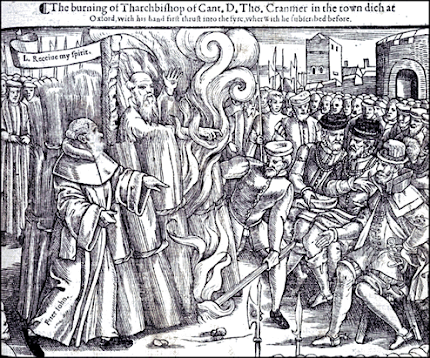
The burning of Tharchbishop of Cant. D. Tho. Cranmer in the town dich at Oxford, with his hand first thrust into the fyre, wherwith he subscribed before. [Click on the picture to see Cranmer's last words.]

Daily Bible Verse

Wednesday, October 29, 2008

Good Versus Evil: The Dark Night of the Soul

The era of illustrated novels has now generated the popularity of cinematic spectacles on the big screen which propose to deal with the deeper philosophical and theological problem of man's inherent evil. Unfortunately, the attempt in the medium of film is often superficial at best. While the movie, The Dark Knight, does a fair job of depicting human depravity, the film does little to point us to the source of such depravity and even less to show us a solution to the endemic problem common to all cultures and to all humankind.


While I must admit that I found the movie enjoyable, in other ways the plot merely rehashed some of the lines from the cartoon series on Fox, including the introduction of the villain Harvey Dent. The basic theme of the movie is that where evil prevails something, anything must be done to stop it. In this case, enter the Batman, a millionaire turned vigilante because of the murder of his parents at the hands of criminals. Implied in the character development of the film, there is a fine line between what pushes one man toward evil and another toward a greater common good. The Joker turns to evil because he was mutilated with a knife by his stepfather who carved a smile on his face when he was merely a boy. Infuriated by the assault, the Joker blames a world, an entire culture for creating the circumstances, the environment which allowed this injustice against an innocent youth. So the Joker's solution to the problem of evil is to utilize the same evil in revenge against an unsympathetic and uncaring world.


The other villain is initially a good guy. Harvey Dent is a district attorney out to save Gotham City from the criminal element but does not realize the extent and depth of the Joker's depravity and willingness to do whatever it takes to dominate and terrorize those who stand for good. The film's allusion to modern Islamic terrorism is chilling and effectively provokes American audiences, drawing them into the storyline. As a literary device designed to help the audience to suspend disbelief and enter into the narrative, this allusion is admirably effective. When Dent's fiancee, with whom Batman is also in love, and he are both kidnapped and held hostage at two different locations, Batman is forced to choose which to save before the final blast. Unfortunately, the twist of fate is set up by the Joker as a lose lose situation. Despite Batman's valiant effort to save him, Dent is almost killed and receives third degree burns destroying half of his face.


Dent implicitly blames God for his deformity. In revenge he sets out in random fashion to take out anyone in his way. When confronting an enemy he flips a coin which decides the fate of the person confronting him. The implication for Dent is that misfortune and bad events in life are arbitrary and capricious. Dent, once a fighter of crime, has now become what he formerly hated. He has become evil himself. Moreover, evil has this way of corrupting those who would fight against it. Only the Batman seems to overcome this tendency for becoming totally depraved by evil in response to a perceived injustice on the part of God and society. However, the irony, despite Batman's pledge not to kill, is that Batman himself resorts to violence and vigilante tactics beyond the pale of legitimate law enforcement. Apparently, however, Batman has the secret approval of the police commissioner which is a backdoor and tacit approval of his illegal fight against crime.


What I find particularly troubling about this film is the portrayal of good and evil as equals. In theological jargon, this is known as dualism. One line of the Joker is that Batman "completes" him. The Joker seems to need good in order to enjoy doing evil. Vigilantism, on the other hand, seems to imply that fighting a greater evil justifies lesser evils to achieve the end. In other words, the means justifies the end which is protecting innocent lives and the American way of life. Unfortunately, it was this same sort of utilitarian thinking and pragmatism which led to the atomic bomb attacks against Japan during World War II.


In anthropological studies ethnocentrism tends to see one's own culture as better and more worthy than other cultures, vilifying one's opponents so that whatever means to ensure the survival of one's own culture and way of life is therefore justified. This is the justification used for many wars, including the war in Iraq, which in hindsight has turned out to be unjustified based on false intelligence provided by the British.


Who knows what evil lurks in the hearts of men? The Shadow knows and so does Batman. The philosophical problem with this movie is its naive assumption that humankind in general is basically good and that only a few are totally depraved. Somehow, us good guys, even though we make small compromises with evil in order to prevail over evil, will eventually win out over the psychopathic, sociopathic terrorism of criminals, serial killers and unjust dictators who wish to take over the world. The implication of the film on another level, however, is a blind fatalism due to random chance that one person will go over the edge into sociopathic and heartless evil while another chooses to compromise with evil only to the degree necessary to preserve good and right.


However, the writers have forgotten the theme of the J. R. R. Tolkien trilogy. Compromising with evil to any degree leads to total corruption. Those who touch the ring are enticed by its power and drawn into a deeper compromise with evil. Not even Gandalf dares to touch the ring, despite his inherent goodness and heroic triumph over evil.


Moveover, the characters of the Joker and Harvey Dent show the potential and the depths of human depravity. While the film implies that this potential is there for anyone, it really says that the rest of us are not that bad after all. The theological problem of evil, however, is not dealt with at all in the film. The problem begins with the fall of Adam and Eve and consequently all humanity has become totally depraved and corrupt. While not every single individual actually becomes as evil as another in degree or in actual sins or crimes committed, the potential is there for everyone. The doctrine of total depravity does not mean that every person commits the most evil and despicable acts that psychopaths commit. Yet every area of the human nature is tainted and corrupted by evil. Our ability to properly reason and think clearly is defective such that we often make poor decisions even when we think we are doing the right thing. Since the fall, we have lost the ability to always do only good. Now we do both good and evil and even our best efforts fall short of the mark of God's perfect goodness. While we view ourselves as basically good, despite the occasional misstep or weakness, from the point of view of penultimate good, we fall miserably short.


The age old doctrine of pelagianism rears its ugly head again in this film. Man is basically good until he commits some terrible evil. We are born with a clean slate until we screw it up and corrupt ourselves through wrong choices. And we all know that the upper classes are more civilized and the poor and lower classes are corrupt through and through by their bad choices. Batman, it seems, is a good rich guy who has to fight the depravity of lower class criminals who deserve what they get. He's a little better than the criminal because he's only using evil methods to fight evil, though he won't go so far as to actually kill anyone.


The problem is that no one is good. We have all become corrupt and except for the grace of God we could all potentially do even more terrible things than the Joker did in this film. Both rich and poor, both genders, adult and child, everyone without exception is to one degree or another evil and totally corrupted through and through. We are rotten to the core. Furthermore, we should realize that evil does not happen by random chance. Nor is evil equal with good. In the creation there was no evil. Evil is merely a corruption of the good and cannot exist in the first place without God's permission! Thus, the theological error of dualism implied in The Dark Knight is unjustified as well. Augustine of Hippo once said that God willingly permits that which is against His will. In that sense, God decrees evil because He allows through secondary causes to allow free moral agents to choose between good and evil. Because of Adam's rebellion God removes the spiritual gifts and abilities which allow mankind to choose only good. After eating from the tree of the knowledge of good and evil, mankind now knows evil as well. The problem, however, is that mankind is unable to prevail over this knowledge and succumbs to its enticement by his or her own choice. It is in this sense that the Protestant Reformers, citing Jesus in John 8:31-38, held that mankind is in total bondage to sin and evil. While not all vestiges of good are removed, to sin or do evil to any degree at all makes us slaves of sin.


The real hope of the Christian gospel for the problem of evil is light. Jesus is the light of the world. He is the light that shines in the darkness. He comes to His own and His own receive Him not (John 1:1-13). Unlike Batman, Jesus does not fight evil with evil methods. God, being ultimately and essentially good and omnibenevolent in His very being and attributes, cannot possibly compromise with evil to any degree at all. To do so to any degree would make God evil. If anyone doubts this, let him or her examine humanity at large and examine his or her own heart. Who can say that they have never done anything sinful or wrong? God triumphs over evil by sending His own Son to suffer the penalty of God's own justice against evil creatures. Not only does Jesus Christ live a perfect life never once sinning but He also suffers our just penalty for us on the cross so that God's just wrath against evil is satisfied and appeased. Jesus Christ triumphs over evil by suffering and humiliating Himself in dying a criminal's death on the cross even though He Himself was completely and totally innocent.


Why should we settle for a dark hero like the Batman who can only offer us a compromise with evil when we have a Savior who never compromised with evil even once? Why should we doubt that God is in control over evil and only permits it for His own glorious triumph over it in the end? While we may never understand why God decreed to allow human rebellion, we can understand that God wishes for us to make our own choices. The problem is everyone chooses sin unless there is an intervention. Like the reality TV show, Intervention, where drug addicts are confronted with their own evil behavior and the consequences it has on everyone around them, God intervenes and convicts us of our sinfulness and our rebellion. Not every addict has an intervention. Some go through life and end up in jail or dead and never experience an intervention.


Likewise, God being just, does not intervene in every sinner's life. He can and does justly leave some of humankind in bondage to their addiction to evil. God is not obligated to show mercy to even one of us and could justly damn every single one of us just as the United States thought it was just to wipe out every single man, woman and child in Nagasaki and Hiroshima with the atomic bombs dropped in WWII. The difference, however, is that the U.S. did this unjustly while God himself is completely just in His judgments. He can and does judge us with natural disasters such as tsumanis and famines. He can and does judge nations through wars and terrorist attacks. He can and does judge us with premature death and a host of diseases. Who can say to God, why did you do this to me?


This seems harsh but when we realize the devastation wreaked upon all humankind by Adam's rebellion, when we see the depths of human evil and humanity's own inhumanity to our fellow man, our neighbor, then we realize that God is merely giving us what we deserve. Mercy is not receiving what we deserve. And if God decides to show mercy to a few chosen out of the mass of humanity by sheer mercy and grace, what is that to you?


Jesus Christ died on the cross to save sinners. When we are willing to acknowledge the depths of our depravity and evil, then and only then are we ready to cry out to God for mercy and it is at that point that He abundantly pardons. Where sin or evil abounded grace does much more abound! Only God can set us free from our bondage to sin and even then we remain sinners who imperfectly follow after Christ. This is why salvation and justification must be by grace alone through faith alone. It is the gift of God to undeserving sinners. The real question we have to ask ourselves is whether or not we will let our anger at God and what we perceive as injustices in our everyday lives dominate us and excuse our own evil actions? When we excuse ourselves we are actually becoming the very thing we hate. We become unjust, depraved, corrupt and evil. Only Jesus Christ can make us good enough to deserve God's forgiveness and He does this by dying on the cross, not by making us perfect. As Luther said, Christians are both sinners and saints at the same time.


Finally, Christianity transcends all historical settings and cultural settings and justly condemns all cultures and societies as sinful and evil to varying degrees. God's justice against humanity is not arbitrary nor is it capricous but is in fact a just sentence against us all. This judgment applies even to the United States where we publicly endorse the genocide of unborn children and undermine God's original creation of marriage as that between one man and one woman. In one sense at least, Islamic fundamentalists rightly judge the United States as a depraved and wicked nation. From the perspective of Holy Scripture, it would seem that God's judgment is the same. The only way forward is to plead for national and individual repentance. In some sense we all bear responsibility for what Adam did back then and for what our nation does today. Sin is both an individual responsibility and a collective and community responsibility. All Americans in the end must answer for what the nation as a whole decides to do. While repentance does not seem to be happening at this point, Christians can know that in the end God wins. Evil shall never prevail.


Colossians 2:13-15 (ESV)13 And you, who were dead in your trespasses and the uncircumcision of your flesh, God made alive together with him, having forgiven us all our trespasses, 14 by canceling the record of debt that stood against us with its legal demands. This he set aside, nailing it to the cross. 15 He disarmed the rulers and authorities and put them to open shame, by triumphing over them in him.


Romans 3:3-8 (ESV)3 What if some were unfaithful? Does their faithlessness nullify the faithfulness of God? 4 By no means! Let God be true though every one were a liar, as it is written, “That you may be justified in your words, and prevail when you are judged.” 5 But if our unrighteousness serves to show the righteousness of God, what shall we say? That God is unrighteous to inflict wrath on us? (I speak in a human way.) 6 By no means! For then how could God judge the world? 7 But if through my lie God’s truth abounds to his glory, why am I still being condemned as a sinner? 8 And why not do evil that good may come?—as some people slanderously charge us with saying. Their condemnation is just.


1 Peter 2:24 (ESV)24 He himself bore our sins in his body on the tree, that we might die to sin and live to righteousness. By his wounds you have been healed.


Romans 4:5-8 (ESV)5 And to the one who does not work but believes in him who justifies the ungodly, his faith is counted as righteousness, 6 just as David also speaks of the blessing of the one to whom God counts righteousness apart from works: 7 “Blessed are those whose lawless deeds are forgiven, and whose sins are covered; 8 blessed is the man against whom the Lord will not count his sin.”[1]

Soli Gloria Deo!


[1] The Holy Bible : English standard version. 2001. Wheaton: Standard Bible Society.

Sunday, October 26, 2008

Evangelical Connexion of the Free Church of England: Bishop's Letter Convocation 2005

The following letter makes clear that the sister church of the Reformed Episcopal Church, which is the Free Church of England is also going Anglo-Catholic. However, The Evangelical Connexion of the Free Church of England, is solidly Protestant and Reformed and completely opposed to any compromise with Tractarianism. Please click on the title to read the letter in pdf format on the Free Church of England website:

Bishop's Letter Prepared for Convocation 2005


Soli Gloria Deo!

[Please note: I was unaware that there is a break away group from the Free Church of England called The Evangelical Connexion of the Free Church of England. Apparently, the Free Church of England is also going in a Tractarian direction. Please see the comment below.]


Friday, October 24, 2008

Excerpt from an Interview with John Hendrix of Monergism.com

GD: There has been resurgence of the Reformed Christianity in the USA. What factors under God have led to this?

JH: Some book publishers like Banner of Truth certainly helped lay the early foundation by re-publishing so many great Reformed and puritan works. But it also appears that God has used the Internet in some amazing ways. This is my theory so take it with a grain of salt, but prior to the Internet many Christians lived in relatively isolated denominational cloisters and had limited engagement with the ideas and exegesis of other Christian traditions. The Internet allows all ideas to be put on the table and when people take the time to read about Reformed Theology, I believe many see it as being the most faithful to Scripture. This is why so many Christians have been persuaded when weighing it against the ideas of their own denomination or tradition. So in theory, the role that the Internet has played has been to place ideas side by side and let the readers determine which ideas best fit the Biblical data. The Holy Spirit has used this medium mightily in this difficult time to be alive. Ultimately it is God who opens people’s eyes and understanding, but the means of grace is more widely available with the advent of the Internet.

GD: It is evidently a good thing that sites like "Monergism" have made Reformed theological resources readily available on the internet. We should use modern means of communication just like the Reformers utilised the printing press. But do you think that there is a danger that "Googling" can sometimes replace proper thought, reflection and research? What can be done to avoid producing "instant experts" who have read something on the net and then think they know it all?


JH: Phil Johnson once said: “My advice to young Calvinists is to learn your theology from the historic mainstream Calvinist authors, not from blogs and discussion forums on the Internet. Some of the forums may be helpful in pointing you to more important resources.” I have to agree with Phil here. Understanding the Scripture takes a great deal of reflection and prayer. It is true that many of us are quick to claim expertise but I believe when something novel appears we need to take the time to weigh it carefully with the Christians who have gone before us. After having debated with non-Calvinists for many years now I have some advice for those who wish to persuade others of the same: patience, patience, patience. You would think that proving beyond a doubt that something is scriptural would be enough to persuade someone but this is not usually the case. Like a farmer we must seed the garden and let God do the rest. Many of us are often too eager to bring others on board. It is not necessary. Just stick with the text of Scripture, reason with them, but be humble and patient for the outcome. I have witnessed some of the most unlikely folks come to embrace the fullness of God’s grace in Christ this way.

Thursday, October 23, 2008

Does the Bible Teach Double Predestination?

Of Predestination and Election: 39 Articles of Religion

Article XVII

Of Predestination and Election

Predestination to life is the everlasting purpose of God, whereby, before the foundations of the world were laid, He hath constantly decreed by His counsel secret to us, to deliver from curse and damnation those whom He hath chosen in Christ out of mankind, and to bring them by Christ to everlasting salvation as vessels made to honour. Wherefore they which be endued with so excellent a benefit of God be called according to God's purpose by His Spirit working in due season; they through grace obey the calling; they be justified freely; they be made sons of God by adoption; they be made like the image of His only-begotten Son Jesus Christ; they walk religiously in good works; and at length by God's mercy they attain to everlasting felicity.

As the godly consideration of Predestination and our Election in Christ is full of sweet, pleasant, and unspeakable comfort to godly persons and such as feel in themselves the working of the Spirit of Christ, mortifying the works of the flesh and their earthly members and drawing up their mind to high and heavenly things, as well because it doth greatly establish and confirm their faith of eternal salvation to be enjoyed through Christ, as because it doth fervently kindle their love towards God: so for curious and carnal persons, lacking the Spirit of Christ, to have continually before their eyes the sentence of God's Predestination is a most dangerous downfall, whereby the devil doth thrust them either into desperation or into wretchlessness of most unclean living no less perilous than desperation.

Furthermore, we must receive God's promises in such wise as they be generally set forth in Holy Scripture; and in our doings that will of God is to be followed which we have expressly declared unto us in the word of God.


De Praedestinatione

Praedestinatio ad vitam est aeternum Dei propositum, quo, ante iacta mundi fundamenta, suo consilio, nobis quidem occulto, constanter decrevit eos, quos in Christo elegit ex hominum genere, a maledicto et exitio liberare, atque ut vasa in honorem efficta per Christum ad aeternam salutem adducere. Unde qui tam praeclaro Dei beneficio sunt donati, illi, Spiritu eius opportuno tempore operante, secundum propositum eius vocantur; iustificatur gratis; adoptantur in filios Dei; unigeniti eius Iesu Christi imagini efficiuntur conformes; in bonis operibus sancti ambulant; et demum ex Dei misericordia pertingunt ad sempiternam felicitatem.

Quemadmodum Praedestinationis et Electionis nostrae in Christo pia consideratio dulcis, suavis, et ineffabilis consolationis plena est vere piis et his qui sentiunt in se vim Spiritus Christi, facta carnis et membra quae adhuc sunt super terram mortificantem, animumque ad coelestia et superna rapientem, tum quia fidem nostram de aeterna salute consequenda per Christum plurimum stabilit atque confirmat, tum quia amorem nostrum in Deum vehementer accendit: ita hominibus, curiosis carnalibus et Spiritu Christi destitutis, ob oculos perpetuo versari Praedestinationis Dei sententiam perniciosissimum est praecipitium, unde illos diabolus protrudit vel in desperationem vel in aeque pernitiosam impurissimae vitae securitatem.

Deinde promissiones divinas sic amplecti oportet, ut nobis in sacris literis generaliter propositae sunt; et Dei voluntas in nostris actionibus ea sequenda est quam in verbo Dei habemus deserte revelatam.


Provenance
Composed in 1552/3, but altered since.

Tuesday, October 21, 2008

The Implications of "Common Grace"

"One important question is how the "true light, that enlightens everyone" operates. Is it a steady illumination? If we conceive of all human nature as always and everywhere graced, as many contemporary Catholic theologians do, what would be the result? On the one hand, we would be genuinely open to truth, insight, and goodness wherever we find them. We would also recognize that God is behind that truth and goodness. Unfortunately, considering divine illumination this way often blurs the distinction between the saved and the unsaved. Some theologians begin to treat the good impulses of those who do not know Jesus as if they have the potential to save. Noble Buddhists and Hindus, whether they want it or not, get labeled "anonymous Christians." The constant illumination model does not require us to end up with hope-so universalism, but it has often led Christians there."


From the Christianity Today review of He Shines in All That Is Fair, by Richard J. Mouw.(http://www.christianitytoday.com/ct/2002/july8/4.49.html).

Monday, October 20, 2008

Is the Doctrine of Common Grace Reformed? An Audio Debate Between Richard J. Mouw and David Engelsma

Click on these links to hear a streaming audio of the debate between Richard Mouw and David Engelsma.

"A Debate On Common Grace 9/12/ 03 Distributed by the Evangelism Society of Southeast Protestant Reformed Church, Grand Rapids, Michigan."

For Mouw's presentation of the affirmative view click here:  Mouw Affirms Common Grace

For Engelsma's negative assessment click here: David Engelma's Negative Assessement of Common Grace

For the rebuttals section of the debate click here: Rebuttals by Both Debaters

For the question and answer segment click here: Question and Answer Segment


You can click on the title of this article to see the original web page where this debate is posted. There is a full transcript of the debate, rebuttals, and question and answer segments. Click here: Is the Doctrine of Common Grace Reformed?

You will need Real Player to hear the audio. You can google Real Player and download it at the appropriate website. Make sure you download the free version of Real Player.

Charlie

Sunday, October 19, 2008

The Reformed Worldview: The Failure of Common Grace

The Reformed Worldview: The Failure of Common Grace

by Prof. David J. Engelsma

This paper was taken from a series of four Editorials by Prof. David J. Engelsma which was published in The Standard Bearer (A Reformed Semi-monthly magazine) from May 15, to September 15, 1998

Very much on the foreground in Reformed circles in North America of late is the subject of the "Reformed Worldview." The reason is that 1998 is the 100th anniversary of Abraham Kuyper's influential lectures at Princeton Theological Seminary on Calvinism as a worldview. Recently, a conference was held at Princeton on the theme, "Religion, Pluralism and Public Justice: Abraham Kuyper's Legacy for the 21st Century." The sponsors were Princeton Seminary, the Free University of Amsterdam (founded by Kuyper), Calvin College, and the Center for Public Justice.

At this conference, theological pygmies and apostates from Harvard, Princeton, and Amsterdam contented themselves with lambasting Kuyper for his now politically incorrect views on women and race. The Protestant Reformed Churches (PRC) regard certain teachings of Kuyper as grievous errors. These errors have caused, and still do cause, the PRC real suffering. Worse still, they have corrupted the Reformed churches. But the shallow, narrow modernists at the Princeton conference who concentrated on taking Kuyper to task for alleged patriarchy and racism are not worthy to stand in Kuyper's shadow whether as a Reformed theologian or as a world-class thinker.

On March 6 and 7 of this year, the Calvin Center for Christian Scholarship held a conference at Calvin College in Grand Rapids on the theme, "Abraham Kuyper Revisited: The Stone Lectures Centennial." The keynote lecture was an intriguing speech by premier Christian Reformed thinker Nicholas P. Wolterstorff on "Kuyper's Significance for the 21st Century." The subject of the speech was the Reformed worldview in light of Kuyper's lectures on Calvinism at Princeton, the "Stone Lectures."

Two exceptionally fine books have already been published in commemoration of the centennial of Kuyper's Princeton lectures. One is Abraham Kuyper: A Centennial Reader, edited by James D. Bratt, professor at Calvin College (Eerdmans, 1998). This consists of many of Kuyper's shorter writings on topics related to his conception of the Reformed worldview. Most of them appear in English translation for the first time. Among them are the important articles, "Common Grace" (excerpts from Kuyper's three volumes on Gemeene Gratie); "Calvinism: Source and Stronghold of Our Constitutional Liberties"; "Common Grace in Science"; and "Sphere Sovereignty" (Kuyper's famed inaugural address at the Free University in 1880).

The other volume is a brilliant, thorough analysis of Kuyper's six lectures on Calvinism by the British scholar, Peter S. Heslam. The title makes plain that the subject is worldview: Creating a Christian Worldview: Abraham Kuyper's Lectures on Calvinism (Eerdmans, 1998).

In this subject of worldview, particularly the Reformed worldview, and more particularly still the Reformed worldview proposed by Abraham Kuyper, the Protestant Reformed Churches have a special interest. They have rejected the worldview put forward by Kuyper in his "Stone Lectures," root and branch. Because of their rejection of the Kuyperian worldview, they are charged with espousing "world-flight."

How, after 100 years, the Reformed community evaluates the worldview that Abraham Kuyper taught in 1898 demands the closest attention of the Protestant Reformed Churches.

The Meaning of "Worldview"

Several terms are commonly used to refer to the same reality. "Worldview" is one. Others are "world-and-life-view," "life-view," and the German word, "weltanschauung." James Sire describes a "worldview," or "world-and-life-view," this way: "A worldview is a set of presuppositions (or assumptions) which we hold (consciously or subconsciously) about the basic make up of our world" (The Universe Next Door, InterVarsity Press, 1976). In his study of the worldview advocated by Abraham Kuyper in his lectures on Calvinism, Peter S. Heslam defines "worldview" as "a set of beliefs that underlie and shape all human thought and action."

By "worldview," I understand a comprehensive, unified view of the whole of creation and its history, including creation's origin, meaning, and goal and including my own life, in light of the triune, true, living God.

Every worldview, at bottom, is religious, that is, it either takes the true God into account or finds it impossible to ignore Him. It is not merely the case that every worldview has its god and is shaped by this god. The fact is that every worldview reckons with the true God. Either the worldview is formed in submission to Him (by the regenerated believer), or it is formed as rebellion against Him (by the unregenerated unbeliever). This is the teaching of Romans 1:18ff.

The particular, comprehensive view of creation that people hold, and that holds them, demands a certain life in the whole of creation. A worldview moves those who hold it to live in accordance with the worldview. Inasmuch as it is a worldview, it warrants and requires life of a certain kind in the wide world. The whole of earthly life, work as well as worship, is determined by the worldview.

When we speak (as I do) of a "Reformed" worldview, we maintain that the Reformed faith taught by John Calvin, developed by orthodox Calvinistic theologians, and authoritatively set forth in the Reformed creeds calls believers and their children to live distinctively in all the spheres of earthly life, and shows them how to do so.

The Reformed faith is not only a body of doctrines to be believed and confessed, although it certainly is such a body of doctrines. It does not only command a certain worship on the Lord's Day, although it certainly does command this. The Reformed faith is a view of the whole, wide world. It is an outlook on all of life. It opens up to Reformed believers all of creation and impels them to live enthusiastically in all of creation's ordinances.

The Reigning Worldview in Reformed Christendom

The reigning worldview among Reformed Christians, especially (though not exclusively) in the Netherlands and North America, is that proposed by Abraham Kuyper in his lectures on Calvinism at Princeton in 1898. These lectures have been published many times in several languages. They are in print still today. The English title is Lectures on Calvinism.

The worldview of the Lectures on Calvinism, and therefore the reigning worldview in Reformed Christendom, may be called, "the worldview of common grace."

Kuyper's purpose with the lectures was to put forward Calvinism as a worldview that would successfully challenge the threatening worldview of modernism. That doctrine which serves as the basis of Kuyper's Calvinistic worldview is common grace. The doctrine of common grace, according to Kuyper, is not only genuinely Reformed but also one of the main pillars in the Reformed temple, a veritable Jachin or Boaz. In the opening lecture, "Calvinism a Life-System," when he comes to explain the Christian's attitude toward the world, Kuyper says:


(Calvinism) has at once placed to the front the great principle that there is a particular grace which works Salvation, and also a common grace by which God, maintaining the life of the world, relaxes the curse which rests upon it, arrests its process of corruption, and thus allows the untrammelled development of our life in which to glorify Himself as Creator (Lectures on Calvinism, Eerdmans, 1953, p. 30).

That the worldview advocated by Kuyper is basically a worldview of common grace is recognized by all. In his exposition of Kuyper's lectures on Calvinism, Heslam writes:


Kuyper's idea that common grace allowed for the development of the powers God had invested in human culture provided the foundation for his discussion of the vocation of the Christian in the world outside the church (p. 119, emphasis added).

Summing up, in the section headed "Conclusion," Heslam states that for Kuyper Calvinism was the very means by which culture could be transformed according to God's ordinances. Common grace served as the theological justification for this argument, providing as it did the necessary bridge across the gap created by the antithesis between the world corrupted by sin and Christ's work of re-creation (pp. 268, 269, emphasis added).

According to Abraham Kuyper, common grace is the basis of the Calvinistic worldview inasmuch as this alleged grace of God, supposedly shared by all men and women, regenerate and unregenerate alike, does several things. First, it restrains sin in the ungodly, so that they are not totally depraved. Second, it enables the ungodly to see and approve the truth made known by general revelation and to do what is good and right in natural life. Thus, by common grace they can develop the creation positively, that is, according to God's standard and toward God the Creator. The ungodly, whether helped by the saints or by themselves, are able to create a good culture. And, third, common grace permits Christians, indeed calls them, to join hearts and hands with the ungodly in this positive development of culture.

Kuyper did not hesitate to claim that the effect of common grace is the positive development of the world of ungodly men and women and their system of life to the glory of God the Creator. Common grace realizes the carrying out by unbelievers of God's mandate to Adam in Paradise to have dominion over the earth. In his lecture, "Calvinism and Art," having asserted (apparently without embarrassment) that the Renaissance was not a "sinful effort," but "a divinely ordered movement," Kuyper denies that humanity is an "aimless mass of people which only serves the purpose of giving birth to the elect." He then states:


On the contrary, the world now, as well as in the beginning, is the theater for the mighty works of God, and humanity remains a creation of His hand, which, apart from salvation, completes under this present dispensation, here on earth, a mighty process, and in its historical development is to glorify the name of Almighty God (Lectures on Calvinism, p. 162; see also p. 30).

This is the glorification of God by a "development" that is ethically good, a "development" that is praiseworthy, a "development" that has its source and impetus in grace, a grace of God.

Kuyper's worldview of common grace prevails in Reformed circles today. It has captured much of the mind also of non-Reformed, evangelical Christianity in North America, especially in the strategic educational centers, the colleges and the universities.

The PRC, however, repudiate this worldview.

Why?

And does this imply that they reject the very idea of a Reformed worldview, a Calvinistic "world-and-life-view"?

The Failure of Common Grace

In the previous part of this editorial, I described the worldview that Abraham Kuyper proposed for Reformed Christians. This is a worldview of common grace. According to the Dutch Reformed theologian, all men and women receive a certain grace from God during this life. This grace restrains the power of sin in the unregenerated so that they are not totally depraved, as otherwise they would be. It enables them to love, seek, and do what is good and right in natural life. By this grace they can, and often do, create a culture that is good, that is, a culture that glorifies God and that God approves. This common grace permits, indeed requires, Christians to cooperate with unbelievers in their positive development of culture.

Common grace is the foundation and driving force of the life and work of the Reformed Christian in the world. It determines how the Reformed Christian lives in the various ordinances and spheres of creation and how he relates to the ungodly in everyday life.

Kuyper laid out this common grace worldview in six lectures at Princeton Theological Seminary in 1898. The lectures have been published as Lectures on Calvinism.

Through Kuyper's powerful influence, the worldview of common grace dominated in the Reformed Churches in the Netherlands and in the Christian Reformed Church in North America. The Christian Reformed Church made the worldview of common grace official, binding doctrine in her synodical decisions of 1924 adopting common grace. Conservative Presbyterians also embraced it. Kuyper's lectures were given at Princeton in 1898, then a conservative Presbyterian seminary. B. B. Warfield was in Kuyper's audience and enthusiastically approved the worldview advocated in the lectures. Over the years, many non-Reformed, evangelical schools and theologians also made the worldview of common grace their own.

Kuyper's worldview of common grace prevails in Reformed circles still today. This was evident at a conference commemorating the centennial of Kuyper's Stone Lectures this past March. The conference was held at Calvin College in Grand Rapids. The sponsor was the Calvin Center for Christian Scholarship. The theme of the conference was "Abraham Kuyper Revisited: The Stone Lectures Centennial."

Professor Nicholas Wolterstorff, a leader in the Christian Reformed Church, especially in the area of Christian education, gave the keynote address. His speech was titled, "Kuyper's Significance for the 21st Century." The philosopher and teacher correctly observed that the topic of Kuyper's Stone Lectures was the vital, perennial issue, "How shall the Christian live in the world?" Wolterstorff frankly acknowledged that Abraham Kuyper showed Reformed Christians the way and that Wolterstorff could not improve on Kuyper's instruction in 1898. Common grace remains the foundation of the Reformed worldview and the power of the Reformed life in the world.

Since 1924 the Protestant Reformed Churches (PRC) have taken lonely exception to the worldview proposed by Abraham Kuyper. Kuyper's worldview of common grace was the real subject of the three points of common grace adopted by the Christian Reformed Church in 1924, points which the PRC repudiate.


Relative to the first point which concerns the favorable attitude of God towards humanity in general and not only towards the elect, synod declares it to be established according to Scripture and the Confession that, apart from the saving grace of God shown only to those that are elect unto eternal life, there is also a certain favor or grace of God which He shows to His creatures in general….

Relative to the second point, which is concerned with the restraint of sin in the life of the individual man and in the community, the Synod declares that there is such a restraint of sin according to Scripture and the Confession…. God by the general operations of His Spirit, without renewing the heart of man, restrains the unimpeded breaking out of sin, by which human life in society remains possible.

Relative to the third point, which is concerned with the question of civil righteousness as performed by the unregenerate, synod declares that according to Scripture and the Confessions the unregenerate, though incapable of doing any saving good, can do civil good…. God without renewing the heart so influences man that he is able to perform civil good…. (cited in Herman Hoeksema, The Protestant Reformed Churches in America, 2nd ed. 1947, pp. 317, 354, 377).

In view of the fundamental importance of a church's and individual's worldview and in view of the popularity of the Kuyperian, common grace worldview, it is necessary to remind ourselves why we say no, and must say no, to the worldview of common grace. First, of a grace of God that restrains sin in the unregenerate; that enables the ungodly outside of Christ to know, love, seek, and do the good; that empowers the wicked to develop a good culture; and that permits, and even requires, the holy people of God to cooperate with the world that hates God in carrying out the mandate of Genesis 1, Scripture knows nothing.

The complete lack of biblical basis for the grace that Kuyper taught in his lectures at Princeton is reflected in the lectures themselves. They are not biblical. The contents of the six lectures are totally lacking in explanation of Scripture. Indeed, they are virtually void of references to Scripture. I urge all to whom this is important to re-read the lectures from this viewpoint. In what admittedly was not a scientific study, I scanned the lectures page by page to note quotations of Scripture, as well as Scriptural exposition. There are only a few quotations of Scripture with exact reference-as few as two or three, perhaps 20 allusions to or quotations of Scripture without reference, and no explanation of Scripture whatever. The lectures are theoretical and philosophical, not biblical. The worldview of common grace of Abraham Kuyper in the Lectures on Calvinism is a theory spun out of the magnificent mind of Kuyper. It is not the mind of Jesus Christ as revealed in Scripture.

Scripture teaches the very opposite. Only the elect, renewed, believing saints have learned Christ so that, by grace, they put off the old man and put on the new man and live rightly in every sphere of earthly life. The unregenerated walk in the vanity of their mind, having the understanding darkened, being alienated from the life of God through the ignorance that is in them, giving themselves over unto lasciviousness, to work all uncleanness with greediness (Eph. 4:17ff.). Those outside of Christ are ignorant of the good (which is God, always and only God!), hate the good, despise the good, and are incapable of doing the good (Eph. 4:18; Rom. 1:18-32; 3:11; John 15:5). The culture that the wicked are developing in history, as willing slaves of Satan, is a culture of the glory, pleasure, and advantage of man; a culture of lawlessness; a culture of death; a culture of the kingdom of the beast (I John 2:15, 16; Matt. 24:12; Rev. 13, 18). Rather than oneness in worldview and cooperation in carrying out the calling implied in worldview, Scripture teaches radical difference, separation, and antithesis (Psalm 147:19, 20; Deut. 33:28; II Cor. 6:14-18; Rev. 18:4).

Second, the Reformed confessions do not so much as mention the common grace that is supposed to be the very foundation of the Christian worldview, much less emphasize and extol it as the vital doctrine that Kuyper made of it. In fact, the only reference to "common grace" in the "Three Forms of Unity" is a condemnation of it as part and parcel of the Arminian heresy:


The Synod rejects the errors of those … who teach that the corrupt and natural man can so well use the common grace (by which they understand the light of nature), or the gifts still left him after the fall, that he can gradually gain by their good use a greater, viz., the evangelical or saving grace and salvation itself. And that in this way God on His part shows Himself ready to reveal Christ unto all men … (Canons of Dordt, III, IV, Rejection of Errors/5).

Is it unreasonable that Reformed churches and Christians expect that a truth so basic as to be the foundation of their worldview be found in the creeds? Is it unworthy of Reformed churches and Christians to note with alarm that the proposed foundation of their worldview-common grace-contradicts the fundamental doctrines of their faith as set forth in the creeds? Whereas the creeds teach particular grace, the proposed foundation of the Reformed worldview teaches common grace. Whereas confessional Calvinism teaches the total depravity of the unregenerated, the proposed foundation of the Reformed worldview teaches the restraint of sin in the unregenerated, so that they can do works that are good and thus develop culture to the glory of God. Whereas the confessions teach the radical spiritual separation of the elect church from the reprobate world, a holy people in an unholy world, the proposed foundation of the Reformed worldview teaches a oneness in divine grace and a cooperation in obedience to a divine calling.

The doctrine of common grace as put forward by Kuyper on behalf of the Reformed worldview conflicts with the confessional Reformed doctrine of predestination. At the very least the theory of common grace rudely shoves the truth of predestination into the background. Let no one dismiss this charge as merely a piece of Protestant Reformed logic-chopping. In his superb analysis of Kuyper's lectures at Princeton, the British scholar, Peter S. Heslam, calls attention to this very thing, namely, that in the interests of common grace Kuyper deliberately downplayed predestination.


Although the doctrine of election, or predestination as Kuyper preferred to call it, is often considered to be the most characteristic element of Calvinistic theology, Kuyper gave no special attention to it in his exposition of Calvinism in the Stone Lectures. This doctrine did not in fact feature as prominently in his writings as might be expected, not only because of his commitment to Calvinist theology, but also because he considered it to be the cor ecclesiae ("heart of the church"-DJE), and central to the Reformed confession. His De gemeene gratie (Kuyper's three-volume work, Common Grace-DJE) provides an indication as to why this was the case. There he criticized Reformed theologians for having made predestination the chief focus of their attention, paying only scant regard to the workings of God's grace in the world outside the church, expressed in the doctrine of common grace (Creating a Christian Worldview: Abraham Kuyper's Lectures on Calvinism, Eerdmans, 1998, p. 116).

This is implicit admission by Kuyper himself that his theory of common grace conflicts with Reformed predestination. Predestination threatens Kuyper's common grace. Therefore the only thing to do when proclaiming common grace is to ignore predestination.

This is a damning indictment of common grace.

Predestination may never be ignored, that is, really, denied by silence.

Predestination may not be ignored in the matter of the Reformed worldview.

Whatever supposedly Christian worldview can make its way and hold its own only by ignoring predestination is thereby exposed as false.

The Reformed, Christian worldview is in perfect harmony with God's election and reprobation from eternity. It has its source and foundation in predestination. The power of the Christian life that flows from and expresses the Christian's worldview is the particular grace of election.

Whatever else the Christian worldview may be, it is a view of life and work in all of creation as holiness unto the triune God. Making this worldview known to Israel and calling Israel to the life that expresses it, Moses grounded the worldview in God's election: "the LORD thy God hath chosen thee to be a special people unto himself, above all people that are upon the face of the earth" (Deut. 7:6).

The apostle did the same to the church of the new covenant: we should be holy and without blame before Him, "according as He hath chosen us in Him before the foundation of the world" (Eph. 1:4).

Explaining why the Protestant Reformed Churches (PRC) repudiate Abraham Kuyper's worldview of common grace, the previous part of this editorial contended that the worldview of common grace is neither biblical nor confessional.

A third reason is that, although there are scattered, ambiguous references to a "common grace" in the writings of John Calvin, common grace in Calvin does not have the meaning, the prominence, or the role ascribed to it by Kuyper. This is to say that for the Reformer common grace is not the foundation and impetus of the Christian worldview.

In his fine study of Kuyper's Princeton lectures on a Calvinistic worldview, Peter S. Heslam repeatedly calls attention to this remarkable fact. Heslam states that at Princeton Kuyper wanted to confront the Presbyterians with "the traditional teachings of the Reformed faith." He then adds, "the one exception to this pattern was the doctrine of common grace, which was not normally considered one of the essential or fundamental doctrines of Calvinism, and does not occupy a prominent position in Calvin's theology" (Creating a Christian Worldview: Abraham Kuyper's Lectures on Calvinism, Eerdmans, 1998, p. 140). In fact, Calvin spoke of God's common grace only "occasionally" (p. 178).

When Heslam comes to his "final conclusions" concerning Kuyper's efforts at establishing a Calvinistic worldview in the lectures at Princeton, wittingly or unwittingly he passes a devastating judgment, not only upon Kuyper's common grace and the worldview of which it is the foundation but also upon the entire body of Reformed theology that has been affected by Kuyperian common grace. As for the common grace of Kuyper's lectures, Heslam says:


The doctrine of common grace, which is not a major element in traditional Calvinistic theology, became, under the influence of Kuyper's objectives, a doctrine of overriding and central importance. His insistence on the centrality of this doctrine in the Calvinistic worldview was an attempt to make explicit an element that was implicit in Calvin's thought, and to give systematic expression to an aspect of Calvin's theology that had none of the coherence Kuyper ascribed to it (pp. 259, 260).

This is bad enough: the very foundation of the supposedly Calvinistic worldview is constructed from what is at best merely a minor element in Calvin himself. Or, as another contemporary student of Kuyper has recently put it, Kuyper built his elaborate theory of common grace out of mere "hints and pieces" in earlier Reformed theology (James Bratt, Abraham Kuyper: A Centennial Reader, Eerdmans, 1998, p. 165).

That the doctrine of common grace as taught by Abraham Kuyper is not to be found in Calvin, or in traditional Calvinistic theology, is widely recognized today. The liberal Dutch Reformed theologian Hendrikus Berkhof has written, "In theology-apart from his broad development of the doctrine of common grace-Kuyper closely followed the Calvinistic tradition, even in its scholastic form" (Two Hundred Years of Theology: Report of a Personal Journey, Eerdmans, 1989, p. 109; emphasis added).

The Christian Reformed Church, however, thinks that common grace is an essential, fundamental, and major dogma of the Reformed faith. She has made it official, binding dogma in her fellowship and has deposed consistories for refusing subscription to it.

What is far worse, indeed intolerable, is the effect that Kuyper's theory of common grace had on the whole body of Reformed theology. In the words of Heslam: "Kuyper's treatment of traditional Reformed doctrine amounted to a radical reinterpretation and reapplication of its central tenets" (p. 259). Kuyper set about to modernize Calvinism mainly by means of his doctrine of common grace. The result, says Heslam, agreeing here with critics of Kuyper within Reformed circles, who charged that Kuyper broke with traditional Calvinism, "may justifiably be called 'neo-Calvinism' and cannot be taken as an accurate and reliable guide to the theology of John Calvin" (p. 260).

Mind! The theology that Kuyper reinterpreted and reapplied by means of common grace is not Calvinism, but "neo-Calvinism," and is not "an accurate and reliable guide to the theology of John Calvin."

Why do the Protestant Reformed Churches repudiate Kuyperian common grace and the worldview of which it is the foundation? Apart from any other reason, because Kuyper's common grace is not the teaching of Calvin or the Calvinistic tradition and because it corrupts the whole of Calvinistic, Reformed theology.

Fourth, it is the fatal flaw of the common grace worldview that it calls regenerated children of God, who have the new life of the risen Christ by the indwelling of the Holy Spirit, to live their earthly lives on the basis and in the power of common grace, the grace that they supposedly share with unbelievers. This monstrous evil of the worldview of common grace is seldom recognized. Kuyper himself, so far as I can tell, did not explicitly state this, or even address this issue, in his lectures. But this is the impression that very definitely is left by the lectures, as it is the clear and necessary implication of the thrust of the lectures. Believers and unbelievers share God's common grace. This common grace is the basis of their cooperation in developing culture. In the ordinances and spheres of creation, therefore, as regards developing culture, believers must live and work by common grace.

If there were no other objection to Kuyper's worldview than this, this would be sufficient to expose Kuyper's worldview as erroneous and condemnable. If one thing characterizes the life of the Christian in the world according to Scripture, it is that the believing child of God lives his life on the basis of and by the power of the indwelling Spirit of Jesus Christ, that is, in the power of (particular) regenerating, sanctifying grace. He lives his one, entire life in the power of regenerating grace, not only his life of worship on the Lord's Day but also his life of "culture" throughout the week. If there were another kind of grace than the grace of God in Christ Jesus (and there is not), the believer would spurn it as useless and dangerous for his holy life. By the quickening grace of Christ, and only by the quickening grace of Christ (Eph. 2:1-10), do the Ephesians live the holy life in the church, in society, in marriage, and in labor to which they are called in chapters 4-6. By the sanctification of the Spirit, and only by the sanctification of the Spirit (I Pet. 1:2), do the elect strangers manifest an excellent behavior in the various ordinances of creation as they are exhorted to do in I Peter 2:11ff.

To choose another grace for life and work in the world is to choose another Lord and Savior than Jesus Christ.

Where does the Bible instruct the elect believer that, in addition to the regenerating grace of Christ that raised him from death to life, he also possesses common grace and that this common grace is to be the power of his cultural life? By regenerating grace, he believes, worships, prays, and loves his fellow-saints. By common grace, he builds a family, does his job, submits to civil government, gets an education, and plays the piano. In the "spiritual" realm, he lives out of Christ. In everyday, "earthly" life, he lives, not out of Christ but out of common grace that he shares with Socrates, members of the Teamsters Union, Thomas Paine, John Dewey, and Liberace. This is not only false doctrine, with dangerous consequences; it is nonsense.

Fifth, the PRC reject the Kuyperian worldview in 1998 because, after 100 years of the implementation of the Kuyperian worldview by Reformed churches, groups, and individuals in the Netherlands, North America, and other places, the worldview of common grace has proved to be a colossal failure.

Common grace has failed! It has failed obviously! It has failed miserably! It has failed disastrously!

Where is the transformation of culture in the Netherlands by the Reformed Churches in the Netherlands, by the Free University, and by all the societies that adopted and carried out Kuyper's common grace worldview? The culture of the Netherlands has the distinction of being one of the most corrupt, lawless, God-dishonoring cultures in the world.

Where is the transformation of culture in North America by the Christian Reformed Church, by Calvin College, by the Institute for Christian Studies, by all the other Christian Reformed schools, by Princeton Theological Seminary, and by other organizations devoted to the worldview of common grace? North American culture is not far behind the depraved way of life in the Netherlands.

The worldview of common grace has not made Dutch society or North American culture Christian and Reformed. Not one whit! But it has made the Reformed Churches in the Netherlands and the Christian Reformed Church in North America and their schools thoroughly worldly.

Kuyper intended his theory of common grace to be a bridge between the Reformed church and the world over which the Reformed believers would move into the world to "Christianize" the world. Kuyper forgot something about bridges. Bridges allow for two-way traffic. Over the bridge of common grace, during the past 100 years, the world has poured into the Reformed Churches in the Netherlands, the Free University of Amsterdam, the Christian Reformed Church in North America, Calvin College, and the other organizations that espouse the worldview of common grace.

Common grace has driven out or silenced the gospel-truth of particular grace. Predestination, limited atonement, and irresistible grace are a dead letter. The Reformed Churches in the Netherlands have got rid even of the letter (the Reformed creeds). Universalism in various forms prevails. Universalism is the mind of the world.

Opened up to the world's way of life by common grace, the churches, their people, and especially their schools adopt the world's explanation of origins (evolution); accept the world's demolition of the family (feminist denial of the headship of the husband in the home and church); and approve the world's adultery (divorce on any ground and remarriage for guilty and innocent parties alike). The Reformed Churches in the Netherlands have sunk away into the deepest, filthiest depths of the wicked world. They sanction sodomy and lesbianism. The Christian Reformed Church, having already declared that the homosexual condition is not sinful (because she insists on listening to the world), is now reduced to a struggle, on her assemblies, to keep out homosexual practice.

Men graced by God with the gift of discerning spirits saw it coming. In the early 1900's Henry Danhof, Herman Hoeksema, and George Ophoff warned the Christian Reformed Church, as Dutch ministers warned the Reformed Churches in the Netherlands, that the adoption of Kuyper's worldview of common grace would certainly result in a deluge of worldliness. The entire church world at the end of the 20th century can see that the prophecy is fulfilled.

Why do the PRC reject the worldview of common grace? Because God's powerful, frightening judgment in history upon Kuyper's worldview is that it has been weighed and found wanting. It has transformed no culture. It has destroyed the churches and schools that embraced it.

The worldview of common grace is hay and stubble that Abraham Kuyper built on the foundation. It will be burned in the day of Christ.

The worldview of common grace is a worldview that has failed.

-DJE

The Protestant Reformed Churches reject the common grace worldview proposed by Abraham Kuyper because this worldview has failed. For some 100 years, the Reformed Churches in the Netherlands have practiced Kuyper's (and, I may add, Herman Bavinck's) worldview. The result has been not only that Dutch culture has not been "Christianized" but also that the Reformed Churches in the Netherlands, with the Free University associated with these churches, have become thoroughly worldly. Common grace has been a bridge by which the world has invaded and destroyed these churches.

The Christian Reformed Church in North America threw up the bridge of the common grace worldview a little later. It did this by its synodical adoption of the "three points of common grace" in 1924. The Christian Reformed Church made Kuyper's theory of common grace official church dogma. The purpose of the Christian Reformed Church was to establish a worldview by which she and her members could live in all areas of life and influence society.

The result has been the same as in the Netherlands. North American society has not become Calvinistic or Christian; Grand Rapids, Michigan has not become Calvinistic. But the Christian Reformed Church, with her schools, has become worldly. She has become worldly in doctrine, e.g., the nature of Scripture, origins, and the extent of the grace of God in Jesus Christ, and in life, e.g., Sabbath observance, marriage, the headship of the husband in home and church, and the dance. In a number of instances, the Christian Reformed Church has explicitly appealed to common grace in support of its abandonment of the historic Christian and Reformed position.

The disastrous failure of Kuyperian common grace is evident also in other churches and, especially, in many non-Reformed but Christian colleges. In the nature of the case, Christian schools espouse and teach a worldview. As the writings of Bernard Ramm, Arthur Holmes, and others show, evangelical colleges too have embraced the common grace worldview of Abraham Kuyper. Not one is holding out against the mind and ways of the ungodly world, whether as regards the doctrine of Scripture, the truth of creation, feminism, or sexual morality.

The reason why the worldview of common grace corrupts the churches and schools is that this worldview breaches the antithesis. The antithesis (for a long time now an unfamiliar and unpopular word in Reformed and evangelical circles) is the spiritual separation and warfare that God Himself has established between His holy people and the unholy world of men and women outside of Jesus Christ. From the very beginning, in the first proclamation of the gospel, Jehovah God put enmity between Christ and all those who are His, on the one hand, and the children of the devil, on the other hand (Gen. 3:15). God effectually calls all the members of Christ's church out of the world (I Pet. 2:9). The urgent exhortation to believers and their children in all ages is, "Come out from among them, and be ye separate" (II Cor. 6:14-18). This separation has its source and foundation in God's decree of election by which God eternally separated the church from the reprobate, ungodly world (Deut. 7:6; John 15:19).

Such is the importance of the antithesis that it constitutes the salvation of the church. Nothing less. The blessing of Israel by the Old Testament Mediator was this: "Israel then shall dwell in safety alone" (Deut. 33:28). It was exactly the purpose and power of the cross of Christ that it "deliver us" not only from the guilt of sin but also "from this present evil world" (Gal. 1:4). The warning to the saints is that to dally with the world in communion and cooperation is to perish with the world. Positively, the saints escape the world's sins and plagues only in the way of separating from the world. "Come out of her, my people, that ye be not partakers of her sins, and that ye receive not of her plagues" (Rev. 18:4).

It is appalling that by his common grace worldview Abraham Kuyper played fast and loose with the antithesis in the interests of political power and cultural influence. It is more appalling still (and inexcusable) that Reformed churches, schools, and theologians continue to play fast and loose with the antithesis by maintaining the worldview of common grace in the face of the testimony of history that this worldview wreaks havoc with the antithesis.

Peter S. Heslam has recently called attention to the fact that Kuyper's theory of common grace contradicts the biblical truth of the antithesis, which truth Kuyper also advocated. In his analysis of Kuyper's Lectures on Calvinism, the speeches at Princeton University in 1898 that proposed the worldview of common grace, Heslam observes:


That Kuyper was able to display a positive approach to the arts was largely due to his doctrine of common grace, which in this lecture, in contrast to his lecture on science, is emphasized at the expense of his doctrine of the antithesis, which plays no significant role. This discrepancy is one of the clearest indications of what is perhaps the central tension in Kuyper's thought between the antithesis and corresponding isolation on the one hand, and common grace and corresponding engagement and accommodation on the other. It was a tension Kuyper never resolved, and a comparison of his Stone Lecture on art with that on science demonstrates how it led to flaws in the overall coherence of his thought.

Heslam goes on to speak of the fundamental tension in Kuyper's thought-a recurrent theme throughout this book, and expressed at its most basic level in the dichotomy between his ideas of antithesis and of common grace. The final passage of the Stone Lectures is added evidence that this was a tension Kuyper himself was unable to resolve (Creating a Christian Worldview: Abraham Kuyper's Lectures on Calvinism, Eerdmans, 1998, pp. 222, 249).

By "tension," the British scholar means irreconcilable contradiction so that where common grace rules, the antithesis is driven out.

The most ardent disciples of the Kuyper of common grace (there was another Kuyper) themselves have been forced to acknowledge and lament the bitter fruits of common grace.

In May, 1952, Dr. Cornelius Van Til told a full house of Calvin Seminary and College faculty and students that if the common grace doctrine of the Christian Reformed Church prevailed one might as well blow up the science building of Calvin College with an atom bomb. This remark mightily irked the leadership of the Christian Reformed Church. It has always puzzled me-not the statement but that Van Til made it. For all his hedging and qualifying, Van Til held the same doctrine of common grace that Kuyper taught in his Lectures on Calvinism and that the Christian Reformed Church adopted in its decretals of 1924.

In any case, that was the science building that has given the Christian Reformed Church Howard Van Till's denial of creation, Davis Young's denial of the flood, and the 1991 report on creation and science that affirmed full-blown theistic evolution.

The Rev. H. J. Kuiper, sworn foe that he was of the Protestant Reformed confession of the antithesis, felt compelled to draw up and circulate a petition in which he and his allies charged that the professors at Calvin College "give instruction which is more or less colorless and neutral…. They stress common grace far more than the antithesis…. There is no pronounced spiritual atmosphere in our college." This petition, signed by 147 persons, was presented to the Christian Reformed synod of 1952 (see Henry Stob, Summing Up Remembrance, Eerdmans, 1955, pp. 318, 319).

In the fascinating speech that Prof. Nicholas Wolterstorff gave earlier this year at a conference commemorating the centennial of Kuyper's Stone Lectures (to which I referred in the previous editorials), the Christian Reformed philosopher and teacher offered the judgment that the sad decline of the Reformed Churches in the Netherlands and of the Free University was due to their stress on common grace at the expense of the antithesis. To my delight (and surprise), Prof. Wolterstorff reminded his largely Christian Reformed audience that for Kuyper there was another doctrine in addition to common grace that is basic to the life of the Christian in the world. That doctrine, according to Wolterstorff, is the antithesis.

The trouble is that Wolterstorff supposes that common grace and the antithesis can and must be held "in balance." This is impossible. Biblically, theologically, and logically, they are contraries. History has proved that they cannot and will not share the field of thought and conduct. When in the question-period Wolterstorff was asked for guidelines to hold common grace and the antithesis "in balance," he frankly admitted that he could not give any.

The common grace worldview has failed. Even its advocates at the end of the 20th century have remarked the failure.

It has failed because it is the contradiction and destruction of the antithesis.

God has judged the common grace worldview in history. In its utter failure to influence the world, and in the worldliness of the churches and schools that embraced it, God has written upon it His "Mene, Mene, Tekel, Upharsin."

Reformed people must not then celebrate the anniversary of the formal propounding of that worldview. How bizarre! As though those oppressed by the system of Marx and Engels were, after the collapse of Communism, to celebrate the anniversary of the writing of Das Kapital.

There should rather be a day, or a week, of repentance with fasting and mourning.

There ought to be, at the very least, a critical reexamination of Kuyper's worldview.

Why in all the commemoration of Kuyper's Lectures on Calvinism, from Princeton in the East to Escondido in the West, is there never so much as one small spot on the platform or one secondary place in the program for a man who is critical of the worldview of common grace? Critical, on behalf of the Reformed churches, on behalf of Reformed education, and, yes, on behalf of a truly Reformed worldview.

There is one other reason why the Protestant Reformed Churches reject Kuyper's worldview of common grace. It is unhistorical. Kuyper intended that with this worldview Calvinism would have a powerful impact upon nations, societies, and cultures. He had particularly in mind his own Netherlands and the United States.

This is not, in fact, how Calvinism has ever influenced nations and cultures. Calvinism has certainly had an impact on nations and cultures, a tremendous impact. Think of Germany, of Scotland, of the Netherlands, of the United States. Just as Christianity has affected nations and cultures.

But Calvinism never made this impact by means of some innocuous, feeble "common grace." Wherever it went, in those earlier, glorious days, it went as the gospel of sovereign, particular grace and as the judgment upon man and all his works of total depravity. It affected nations and cultures exactly as a worldview of the one, special grace of God in Jesus Christ. This aroused the opposition that convulsed the nation. This saved the elect who then lived the antithetical, holy life that had real impact upon the life of the nation. Ask the secular historians.

And I dare say that should God yet will that Calvinism-the Reformed faith- powerfully affect nations and civilizations, this would, and could only, take place by a bold gospel of particular grace that establishes and calls for the antithesis.

Not by lectures on common grace.

Saturday, October 18, 2008

Everything Proceeding From the Corrupt Nature of Man Damnable

In Book II. Chapter 3 we see that the common grace folks once again take Calvin out of context. Calvin clearly says that these "natural" abilities are corrupted because they proceed from the corrupt human nature:

"But it will be said, that the word flesh applies only to the sensual, and not to the higher part of the soul. This, however, is completely refuted by the words both of Christ and his apostle. The statement of our Lord is, that a man must be born again, because he is flesh. He requires not to be born again, with reference to the body. But a mind is not born again merely by having some portion of it reformed. It must be totally renewed. This is confirmed by the antithesis used in both passages. In the contrast between the Spirit and the flesh, there is nothing left of an intermediate nature. In this way, everything in man, which is not spiritual, falls under the denomination of carnal. But we have nothing of the Spirit except through regeneration. Everything, therefore, which we have from nature is flesh. Any possible doubt which might exist on the subject is removed by the words of Paul (Eph. 4:23), where, after a description of the old man, who, he says, “is corrupt according to the deceitful lusts,” he bids us “be renewed in the spirit” of our mind. You see that he places unlawful and depraved desires not in the sensual part merely, but in the mind itself, and therefore requires that it should be renewed. Indeed, he had a little before drawn a picture of human nature, which shows that there is no part in which it is not perverted and corrupted. For when he says that the “Gentiles walk in the vanity of their mind, having the understanding darkened being alienated from the life of God through the ignorance that is in them, because of the blindness of their heart,” (Eph. 4:17, 18), there can be no doubt that his words apply to all whom the Lord has not yet formed anew both to wisdom and righteousness."
(Book II. iii. 1)


2......Let it be a fixed point, then, that men are such as is here described, not by vicious custom, but by depravity of nature. The reasoning of the Apostle, that there is no salvation for man, save in the mercy of God, because in himself he is desperate and undone, could not otherwise stand. I will not here labour to prove that the passages apply, with the view of removing the doubts of any who might think them quoted out of place. I will take them as if they had been used by Paul for the first time, and not taken from the Prophets. First, then, he strips man of righteousness, that is, integrity and purity; and, secondly, he strips him of sound intelligence. He argues, that defect of intelligence is proved by apostasy from God. To seek Him is the beginning of wisdom, and, therefore, such defect must exist in all who have revolted from Him. He subjoins, that all have gone astray, and become as it were mere corruption; that there is none that does good. He then enumerates the crimes by which those who have once given loose to their wickedness pollute every member of their bodies. Lastly, he declares that they have no fear of God, according to whose rule all our steps should be directed. If these are the hereditary properties of the human race, it is vain to look for anything good in our nature. I confess indeed, that all these iniquities do not break out in every individual. Still it cannot be denied that the hydra lurks in every breast. For as a body, while it contains and fosters the cause and matter of disease, cannot be called healthy, although pain is not actually felt; so a soul, while teeming with such seeds of vice, cannot be called sound. This similitude, however, does not apply throughout. In a body however morbid the functions of life are performed; but the soul, when plunged into that deadly abyss, not only labours under vice, but is altogether devoid of good.

3. Here, again we are met with a question very much the same as that which was previously solved. In every age there have been some who, under the guidance of nature, were all their lives devoted to virtue. It is of no consequence, that many blots may be detected in their conduct; by the mere study of virtue, they evinced that there was somewhat of purity in their nature. The value which virtues of this kind have in the sight of God will be considered more fully when we treat of the merit of works. Meanwhile however, it will be proper to consider it in this place also, in so far as necessary for the exposition of the subject in hand. Such examples, then, seem to warn us against supposing that the nature of man is utterly vicious, since, under its guidance, some have not only excelled in illustrious deeds, but conducted themselves most honourably through the whole course of their lives. But we ought to consider, that, notwithstanding of the corruption of our nature, there is some room for divine grace, such grace as, without purifying it, may lay it under internal restraint. For, did the Lord let every mind loose to wanton in its lusts, doubtless there is not a man who would not show that his nature is capable of all the crimes with which Paul charges it (Rom. 3 compared with Ps. 14:3, &c). What? Can you exempt yourself from the number of those whose feet are swift to shed blood; whose hands are foul with rapine and murder; whose throats are like open sepulchres; whose tongues are deceitful; whose lips are venomous; whose actions are useless, unjust, rotten, deadly; whose soul is without God; whose inward parts are full of wickedness; whose eyes are on the watch for deception; whose minds are prepared for insult; whose every part, in short, is framed for endless deeds of wickedness? If every soul is capable of such abominations (and the Apostle declares this boldly), it is surely easy to see what the result would be, if the Lord were to permit human passion to follow its bent. No ravenous beast would rush so furiously, no stream, however rapid and violent, so impetuously burst its banks. In the elect, God cures these diseases in the mode which will shortly be explained; in others, he only lays them under such restraint as may prevent them from breaking forth to a degree incompatible with the preservation of the established order of things. Hence, how much soever men may disguise their impurity, some are restrained only by shame, others by a fear of the laws, from breaking out into many kinds of wickedness. Some aspire to an honest life, as deeming it most conducive to their interest, while others are raised above the vulgar lot, that, by the dignity of their station, they may keep inferiors to their duty. Thus God, by his providence, curbs the perverseness of nature, preventing it from breaking forth into action, yet without rendering it inwardly pure.

4. The objection, however, is not yet solved. For we must either put Cataline on the same footing with Camillus, or hold Camillus to be an example that nature, when carefully cultivated, is not wholly void of goodness. I admit that the specious qualities which Camillus possessed were divine gifts, and appear entitled to commendation when viewed in themselves. But in what way will they be proofs of a virtuous nature? Must we not go back to the mind, and from it begin to reason thus? If a natural man possesses such integrity of manners, nature is not without the faculty of studying virtue. But what if his mind was depraved and perverted, and followed anything rather than rectitude? Such it undoubtedly was, if you grant that he was only a natural man. How then will you laud the power of human nature for good, if, even where there is the highest semblance of integrity, a corrupt bias is always detected? Therefore, as you would not commend a man for virtue whose vices impose upon you by a show of virtue, so you will not attribute a power of choosing rectitude to the human will while rooted in depravity (see August. lib. 4, Cont. Julian). Still, the surest and easiest answer to the objection is, that those are not common endowments of nature, but special gifts of God, which he distributes in divers forms, and, in a definite measure, to men otherwise profane. For which reason, we hesitate not, in common language, to say, that one is of a good, another of a vicious nature; though we cease not to hold that both are placed under the universal condition of human depravity. All we mean is that God has conferred on the one a special grace which he has not seen it meet to confer on the other. When he was pleased to set Saul over the kingdom, he made him as it were a new man. This is the thing meant by Plato, when, alluding to a passage in the Iliad, he says, that the children of kings are distinguished at their birth by some special qualities—God, in kindness to the human race, often giving a spirit of heroism to those whom he destines for empire. In this way, the great leaders celebrated in history were formed. The same judgment must be given in the case of private individuals. But as those endued with the greatest talents were always impelled by the greatest ambitions (a stain which defiles all virtues and makes them lose all favour in the sight of God), so we cannot set any value on anything that seems praiseworthy in ungodly men. We may add, that the principal part of rectitude is wanting, when there is no zeal for the glory of God, and there is no such zeal in those whom he has not regenerated by his Spirit. Nor is it without good cause said in Isaiah, that on Christ should rest “the spirit of knowledge, and of the fear of the Lord,” (Isa. 11:2); for by this we are taught that all who are strangers to Christ are destitute of that fear of God which is the beginning of wisdom (Ps. 111:10). The virtues which deceive us by an empty show may have their praise in civil society and the common intercourse of life, but before the judgment-seat of God they will be of no value to establish a claim of righteousness.
(Book II. iii. 2-4).

Calvin Attributes Art, Science and Other Skills to Corrupt Natural Abilities, Not "Common Grace"

Lest any one, however, should imagine a man to be very happy merely because, with reference to the elements of this world, he has been endued with great talents for the investigation of truth, we ought to add, that the whole power of intellect thus bestowed is, in the sight of God, fleeting and vain whenever it is not based on a solid foundation of truth. Augustine (supra, sec. 4 and 12), to whom, as we have observed, the Master of Sentences (lib. 2 Dist. 25), and the Schoolmen, are forced to subscribe, says most correctly that as the gratuitous gifts bestowed on man were withdrawn, so the natural gifts which remained were corrupted after the fall. Not that they can be polluted in themselves in so far as they proceed from God, but that they have ceased to be pure to polluted man, lest he should by their means obtain any praise.


17. The sum of the whole is this: From a general survey of the human race, it appears that one of the essential properties of our nature is reason, which distinguishes us from the lower animals, just as these by means of sense are distinguished from inanimate objects. For although some individuals are born without reason, that defect does not impair the general kindness of God, but rather serves to remind us, that whatever we retain ought justly to be ascribed to the Divine indulgence. Had God not so spared us, our revolt would have carried along with it the entire destruction of nature. In that some excel in acuteness, and some in judgment, while others have greater readiness in learning some peculiar art, God, by this variety commends his favour toward us, lest any one should presume to arrogate to himself that which flows from His mere liberality. For whence is it that one is more excellent than another, but that in a common nature the grace of God is specially displayed in passing by many and thus proclaiming that it is under obligation to none. We may add, that each individual is brought under particular influences according to his calling. Many examples of this occur in the Book of Judges, in which the Spirit of the Lord is said to have come upon those whom he called to govern his people (Judges 6:34). In short, in every distinguished act there is a special inspiration. Thus it is said of Saul, that “there went with him a band of men whose hearts the Lord had touched,” (1 Sam. 10:26). And when his inauguration to the kingdom is foretold, Samuel thus addresses him, “The Spirit of the Lord will come upon thee, and thou shalt prophesy with them, and shalt be turned into another man,” (1 Sam. 10:6). This extends to the whole course of government, as it is afterwards said of David, “The Spirit of the Lord came upon David from that day forward,” (1 Sam. 16:13). The same thing is elsewhere said with reference to particular movements. Nay, even in Homer, men are said to excel in genius, not only according as Jupiter has distributed to each, but according as he leads them day by day, ὁιον ἐπ ἠ̂μαρ ἄγησι. And certainly experience shows when those who were most skilful and ingenious stand stupefied, that the minds of men are entirely under the control of God, who rules them every moment. Hence it is said, that “He poureth contempt upon princes, and causeth them to wander in the wilderness where there is no way,” (Ps. 107:40). Still, in this diversity we can trace some remains of the divine image distinguishing the whole human race from other creatures.D41

D41 Calvin again stresses the fact that there are “remains,” remnants, or rudiments of the image of God still discernible in the natural man. These “remains” not only distinguish man from the beasts, but also comprise the faculties by which man can attain to some knowledge, can do some relatively good deeds, and can be apprehended by the external word of the Law and the Gospel. But by these “rudiments” man can neither truly know God, nor do the real good, nor truly know (have a true understanding) of the Law or the Gospel.


Calvin, J., & Beveridge, H. (1996). Institutes of the Christian religion (electronic ed.) (II, ii, 16). Oak Harbor, WA: Logos Research Systems.


I checked the same passage in the Ford Lewis Battles translation published by Westminster Press. The editors there read "common grace" into what Calvin had to say. However, the Beveridge translation clearly leans toward the image of God and natural abilities. Since the doctrine of common grace was not yet in vogue in Beveridge's time, I think Beveridge has the better understanding of the text. You will also note that Beveridge translates "common grace" as "general kindness." Seems to me that Battles has a biased translation.


Also, Battles has a footnote on page 276 of the Westminster edition:

#64. Neither common grace nor special grace here mentioned has any relation to the salvation of the possessor. Special grace endowment of capacity, virtue, or heroism by which a man is fitted to serve the divine purpose in this world, while he himself may remain in the common state of human depravity. Cf. II. iii. 4 where Calvin views in this light Camillus, Saul, and the Homeric heroes referred to by Plato.


Again, this passage in no way supports the doctrine of common grace unless one reads biased editors and late comers with an agenda. Calvin himself is plain enough in saying that these are natural abilities which are corrupted by the fall. He even mentions that Augustine says the "free" or "gratuitous" gifts were removed from man by God after the fall (II. ii. 16).

Common Grace Refuted: Calvin's Commentary on Hebrews 6:5 and 10:29 in the Institutes of the Christian Religion

Book III, Chapter iii, 23-25.

Therefore, when he speaks of those falling away “who were once enlightened, and have tasted of the heavenly gift, and were made partakers of the Holy Ghost, and have tasted of the good word of God, and the powers of the world to come,” we must understand him as referring to those who, with deliberate impiety, have quenched the light of the Spirit, tasted of the heavenly word and spurned it, alienated themselves from the sanctification of the Spirit, and trampled under foot the word of God and the powers of a world to come. The better to show that this was the species of impiety intended, he afterwards expressly adds the term willfully. For when he says, “If we sin willfully, after that we have received the knowledge of the truth, there remaineth no more sacrifice for sins,” he denies not that Christ is a perpetual victim to expiate the transgressions of saints (this the whole Epistle, in explaining the priesthood of Christ, distinctly proclaims), but he says that there remains no other sacrifice after this one is abandoned. And it is abandoned when the truth of the Gospel is professedly abjured.

24. To some it seems harsh, and at variance with the divine mercy, utterly to deny forgiveness to any who retake themselves to it. This is easily disposed of. It is not said that pardon will be refused if they turn to the Lord, but it is altogether denied that they can turn to repentance, inasmuch as for their ingratitude they are struck by the just judgment of God with eternal blindness. There is nothing contrary to this in the application which is afterwards made of the example of Esau, who tried in vain, by crying and tears, to recover his lost birthright; nor in the denunciation of the Prophet, “They cried, and I would not hear.” Such modes of expression do not denote true conversion or calling upon God, but that anxiety with which the wicked, when in calamity, are compelled to see what they before securely disregarded—viz. that nothing can avail but the assistance of the Lord. This, however, they do not so much implore as lament the loss of. Hence all that the Prophet means by crying, and the apostle by tears, is the dreadful torment which stings and excruciates the wicked in despair. It is of consequence carefully to observe this: for otherwise God would be inconsistent with himself when he proclaims through the Prophet, that “If the wicked will turn from all his sins that he has committed,”—“he shall surely live, he shall not die,” (Ezek. 18:21, 22). And (as I have already said) it is certain that the mind of man cannot be changed for the better unless by his preventing grace. The promise as to those who call upon him will never fail; but the names of conversion and prayer are improperly given to that blind torment by which the reprobate are distracted when they see that they must seek God if they would find a remedy for their calamities, and yet shun to approach him.

25. But as the Apostle declares that God is not appeased by feigned repentance, it is asked how Ahab obtained pardon, and averted the punishment denounced against him (1 Kings 21:28, 29), seeing, it appears, he was only amazed on the sudden, and afterwards continued his former course of life. He, indeed, clothed himself in sackcloth, covered himself with ashes, lay on the ground, and (as the testimony given to him bears) humbled himself before God. It was a small matter to rend his garments while his heart continued obstinate and swollen with wickedness, and yet we see that God was inclined to mercy. I answer, that though hypocrites are thus occasionally spared for a time, the wrath of God still lies upon them, and that they are thus spared not so much on their own account as for a public example. For what did Ahab gain by the mitigation of his punishment except that he did not suffer it alive on the earth? The curse of God, though concealed, was fixed on his house, and he himself went to eternal destruction. We may see the same thing in Esau (Gen. 27:38, 39). For though he met with a refusal, a temporal blessing was granted to his tears. But as, according to the declaration of God, the spiritual inheritance could be possessed only by one of the brothers, when Jacob was selected instead of Esau, that event excluded him from the divine mercy; but still there was given to him, as a man of a groveling nature, this consolation, that he should be filled with the fulness of the earth and the dew of heaven. And this, as I lately said, should be regarded as done for the example of others, that we may learn to apply our minds, and exert ourselves with greater alacrity, in the way of sincere repentance, as there cannot be the least doubt that God will be ready to pardon those who turn to him truly and with the heart, seeing his mercy extends even to the unworthy though they bear marks of his
displeasure.
In this way also, we are taught how dreadful the judgment is which awaits all the rebellious who with audacious brow and iron heart make it their sport to despise and disregard the divine threatening. God in this way often stretched forth his hand to deliver the Israelites from their calamities, though their cries were pretended, and their minds double and perfidious, as he himself complains in the Psalms, that they immediately returned to their former course (Psalm 78:36, 37). But he designed thus by kindness and forbearance to bring them to true repentance, or leave them without excuse. And yet by remitting the punishment for a time, he does not lay himself under any perpetual obligation. He rather at times rises with greater severity against hypocrites, and doubles their punishment, that it may thereby appear how much hypocrisy displeases him. But, as I have observed, he gives some examples of his inclination to pardon, that the pious may thereby be stimulated to amend their lives, and the pride of those who petulantly kick against the pricks be more severely condemned.

Calvin, J., & Beveridge, H. (1996). Institutes of the Christian religion (electronic ed.) (III, iii, 23). Oak Harbor, WA: Logos Research Systems.

Support Reasonable Christian Ministries with your generous donation.