>

Martyred for the Gospel

Martyred for the Gospel
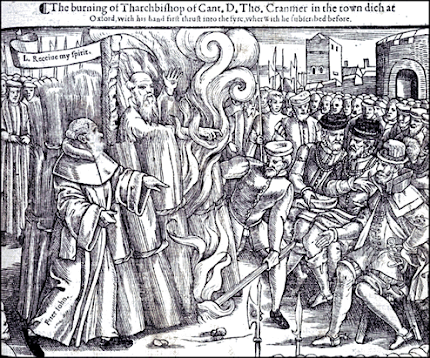
The burning of Tharchbishop of Cant. D. Tho. Cranmer in the town dich at Oxford, with his hand first thrust into the fyre, wherwith he subscribed before. [Click on the picture to see Cranmer's last words.]

Daily Bible Verse

Saturday, March 24, 2007

Why the 39 Articles of Religion Should Be Retained: Shall Anglicanism Abandon Its Confession of Faith Today?

[Note: The following article is from the Traditional Protestant Episcopal Church website. I agree with this article and its assessment of Anglo-Catholicism. To see the original website click on the title to this entry.]

At the General Convention of the Protestant Episcopal Church in October, 1925, at New Orleans, a resolution was moved and passed under Anglo-Catholic leadership providing that the Articles of Religion be omitted from the Prayer Book. By divine Providence, the resolution failed to be upheld at the subsequent Convention held in the fall of 1928, when the "new" Prayer Book was introduced.

What were the reasons for the action of the Convention in 1925? Every concerned churchman has the right and duty to know the history and theology of his Church; inasmuch as the suppression of the Thirty-Nine Articles involves the faith and therefore, the very life of the Church. Yet, few laymen or clergy are aware of this historic maneuver to do away with the Articles on the part of the Anglo-Catholics and liberals. Is there still a need to defend the value and used of the Articles today? Is there still a "plot" to remove them from the faith and practice of Anglicanism world-wide? What is the future fate of the Articles in relation to present Anglican thinking and Prayer Book revision?

The Articles of Religion were framed during the Reformation. They are clearly based upon Holy Writ; they include only those doctrines which are to be found in the Scriptures, and reject those which are not. The Articles define the distinctive doctrines of the English Church and condemn those of the Roman or Papal Church, which were known from centuries of experience to be sources of oppression, extortion, and immoral conduct. They were adopted and set forth in their present form in 1801 by the then Protestant Episcopal Church in the United States as its confession of faith; they have never been revoked or amended and have always been printed in the Book of Common Prayer.

The historic position of the Articles is beyond dispute; yet, the Articles are not merely of historical value -- they are the official statement of what the Church believes. They are the Magna Carta of its faith, its doctrinal constitution. Only until recently, clergy were required to subscribe to the Articles at the time of ordination. The Articles defended the laity against arbitrary clergy who would foist on their congregations illicit or forbidden teachings. Ignore them, hide them, or abolish them, and the Church is left without an adequate rule and guide: every clergyman could do as he pleases and teach according to personal whim. Such license causes strife and ultimate disintegration.

The Articles clearly teach that the Bible, not the clergy, is the source of both doctrine and authority in the Church. Doctrine and usages based only upon the approval of the General Councils, though representing the entire Church Catholic, are declared to have "neither strength nor authority", and Article XIX expressly repudiates ancient Churches themselves as sources of sound doctrine and usage. (BCP p. 561)

These declarations lead to a momentous conclusion: for Anglicans the source of faith is the Bible and Bible alone. It is not the writings of the medieval Churchmen; not the acts of the General Councils; not the "ancient" Catholic Church, as the Anglo-Catholics mistakenly content, but the Holy Scriptures solely and exclusively.

The historic faith of the Anglican Communion is presently under attack from many sides. Secular humanism, communism, sexual immorality, and heretical teachings of all sorts seem to find a tolerant audience amongst some portion of Anglican believers. Prayer Book revision, higher criticism, and inclusive language lectionaries have been promoted in nearly every Church in the world-wide Anglican Communion. The ordination of women (to the diaconate, presbyterate, and even to the episcopate) is receiving common acceptance. Should this situation be "tolerated" much less promoted? what remedy do we have to combat such ills besetting the Anglican ethos?

Conservative Anglo-Catholics would have us believe that their form of non-papal Catholicism would save Anglicanism from its present ills and provide a bulwark against future departures from the Faith. They blame what they style "liberal Protestantism" for the demise of the historic Church and blast any form of "fundamentalism" as the enemy of reason and true religion.

The Anglo-Catholic churchman dreams of some ideal (but historically nonexistent) church that fulfills the ephemeral goal of a "bridge" Church--a via media--between Rome and Canterbury. They would be willing to retain some of the "trappings" of true Anglicanism, but would repudiate any reformational character in their idealized theology. Some do more than dream: some have taken their dreams and put them into action by attempting to rewrite history and to alter or eliminate the Protestant foundations of Anglicanism as found in the Articles of Religion.

On the one hand, the Anglo-Catholics (better called Anglo-Romanist - but certainly not High Churchmen) pretend that their opposition to the Articles is based upon their obsolescence; that they have fallen out of use. We know, however, that the teachings of the Articles on the Trinity , the Person of Christ, the Sacraments, the ministry, and so on are not "out of date". For Orthodox believers they cannot be out of date: they are believed by the great mass of orthodox, biblical Christians everywhere.

The real reason why the Anglo-Catholics wish to suppress the Articles is exactly and precisely because they are not out of date or obsolete. They do stand solidly athwart the path of these aggressors, who for this very reason are trying to thrust them aside. They denounce and condemn the very doctrines and innovations which this party is trying to foist upon the Church. Remember that it was the Anglo-Catholics who first called for toleration of higher criticism of the Bible; the first to call for changes in the liturgy and the Prayer Book; the first to ordain women; the first to ordain practicing homosexuals; the first to promote Marxism and "social justice" causes; and the first to involve the Anglican Communion in the hopeless moral of the World and National Council of Churches, as well as ecumenism.

The Articles are no more obsolete than they were framed nearly four centuries ago. Strangely, Anglo-Catholics have given them a new vitality, have made them a living need in the Church today. They are once more, as in the sixteenth century, a defense and bulwark of the Primitive and Protestant faith against the errors of Romanism.

In order to lull the suspicions of the laity, until it is too late to save the Protestant faith of the Anglican Churches, some Anglo-Catholics assert that only nonessential doctrines are involved in the controversy: that those who seek to defend the Articles are being contentious over trifles, risking Christian charity by "knit picking". If this is so, why do they labor so zealously to do away with the Articles, and force their own doctrines upon gullible churchmen. Why do they cause strife and heart burning in so many parishes which were formerly at peace in their churchmanship? Why do they imperil the unity of the Church by insisting upon innovations? Why do they violate their own ordination vows, in order to teach what they say is trivial and unimportant?

The truth is that the questions at issue are no trivial controversies between hairsplitting theologians. In order to understand the motives which impel Anglo-Catholics to suppress the Articles and the Protestantism of our faith, we must first know what their theology and purposes are. They aim to abolish the historic teachings of the Protestant Episcopal Church, and to substitute certain beliefs of the Roman and Papal Church.

Anglo-Catholicism teaches, as does Roman Catholicism, that there are seven sacraments; that purgatory is an "intermediate" state of the dead; and the sacrifice of Our Lord on the Cross is "renewed" in the sacrament of the Lord's Supper; that baptism regenerates a soul "ex opere operatio"; that a priest is an "icon" of Christ and has power to forgive sins in "Confession".

Even those who style themselves "conservatives" in the Anglo-Roman camp cannot agree upon the truth. Some ordain women to the diaconate, but not to the priesthood. Some ordain women in lower orders, but refuse them the episcopate. Some use modern revisions of the Prayer Book; some use only the historic BCP; some use both. Some condone homosexuality; some do not. Some believe in the he plenary inspiration of the Scripture; some do not. In short, they are a "mixed" group, both eclectic and syncretic in their theology and practice.

The real issue is no trivial controversy or narrow-minded intolerance: the real issue is as broad as the difference between despotism and liberty, between progress and reaction, between an advance to higher and nobler conceptions of religion and reversion to those which are whimsical and barbarous. The true son of the Church aims to keep his Church loyal to the plain teachings of Christ. The Anglo-Catholic aims to drag it back to the crassly paganized Christianity of the Middle Ages, with its magic, fetishism, and idolatry.

The Articles of Religion are no guaranteed remedy for the evils which so beset the twentieth century Church, nor are they an immutable answer to the ills of the declining Anglican Communion. Yet, they stand through the test of history and controversy in Anglicanism as the bastion of Biblical truth which cannot be denied by sincere churchmen. They were written by men: they are not infallible. But they have never been supplanted, even in the nearly seventy years of church history since General Convention first sought to officially remove them.

Perhaps what the Anglo-Catholics failed to accomplish in 1925 will yet come to pass in your lifetime. The liberals will do away with the Articles as a confessional statement and the conversatives will join with Rome. If this does take place, the Christian world will be the less for it and that which was once one of the noblest expressions of Biblical Christianity will have passed into oblivion. May god defend us and prevent such a victory of the Anti-Christ! May our children and our children's children live to enjoy the precious Protestant heritage of our Anglican faith!

Sunday, March 18, 2007

Law and Gospel Compared to Practical Antinomianism in Modern Evangelicalism

Generally, the problem today among Evangelical churches and denominations is a growing division between theological and biblical doctrine and actual practice. There is also a departure from a solid theological grounding in Holy Scripture. This dichotomy between modern "tradition" and Biblical theology as it was developed and understood from a Reformational perspective is such that heterodoxy and even heresy seems to have become rampant and acceptable in many Evangelical churches.

The only law that seems of concern to most Evangelicals today is the law of tithing, since that law directly benefits the pocketbooks of those who are in the employ of the church. There seems to be a fine line between "hirelings" who fleece God's sheep and lead them astray with doctrines to tickle their ears and shepherds who are ministers worthy of financial support of their ministries. One will not hear most Evangelicals today preach against divorce and remarriage because that law runs counter to modern tradition which is practically the same as that of the surrounding culture. If one is unhappy in a marriage, take the easy way out and get a divorce. God will forgive one's sins, no matter how many times one divorces and remarries. Jesus, however, seems to have had a more absolutist view on the subject since He called such practices "adultery."

Most ministers today will balk at the idea of preaching law, justice, morality, and judgment by God. After all, God must be presented only as a God of love and mercy, not a God who is holy and just and requires a just penalty for violations of His absolute moral law. Human propensity to soften the absolute attributes of God's very nature is such that new theologies want to make God more in man's image than having humans created in God's image and likeness. One obvious example of this is the Evangelical capitulation to process theology with a deceptively "conservative" spin. A popular advocate of this view, Dr. Gregory Boyd, a former oneness pentecostal become trinitarian arminian and Baptist, seems to have a problem with God's absolute sovereignty. For all practical purposes, human rebellion against God continues unabated within Evangelicalism.

The real irony, however, is that churches and ministers today think they are avoiding preaching "fire and brimstone," the wrath of God, and the law. However, most fail to distinguish between the moral law and the ceremonial law and the civil law recorded in Scripture. Even more telling, they do not recognize the three uses of the moral law that have been defined by the Reformers in various confessions and creeds. The first use of the moral law of God is to convict us of our total failure to attain the righteousness commanded by God. In realizing our total depravity and our sinfulness of nature and action, we are driven to cry out to Christ for mercy. The second use of the moral law is to define for Christians their moral duty before God, though they fall short of keeping it perfectly. And, finally, the third use of the moral law is to maintain peace and harmony in society by setting general guidelines for the civil laws passed by any society.

Most churches major on the second use of the law by focusing on volunteer work or tithing. By doing this they place a false sense of guilt upon the Christian as if not doing these things somehow makes them guilty of not being Christian at all. Thus, most sermons these days contain more law than Gospel. More duty than grace. So it seems to me that grace is overlooked in favor of good works as some sort of means of earning or meriting one's place in the church. It's almost a shell game. Salvation is free but church membership is going to cost you. And everyone knows that church membership is essential to getting to heaven since the church is God's appointed means of preaching and teaching the Gospel, administering baptism and the Lord's Supper, and a requirement for entry into the kingdom. In effect, they are making good works the ground for justification by going through the back door.

Even Martin Luther, the father of the Protestant Reformation, emphasized that good preaching should utilize both law and Gospel in every sermon. Furthermore, the Bible itself has law and gospel interchangeably used on almost every page. The trouble is that most ministers fail to understand the Bible because they fail to systematically read it. And even worse, they fail to understand the most basic creeds and confessions of the Reformed Christian faith, confessions and creeds which could simplify their task greatly if only they knew them.

Moreover, a further irony is that these same churches utilizing "law" to get people to donate money and to volunteer to work in the church, also have low views of marriage and divorce. They might briefly mention sins like fornication and adultery but in actual practice they turn a blind eye to these sins as long as the parishioner is tithing and giving lots to the church coffers. Until and unless the sin becomes publicly known, it will not be confronted. This is obvious from the huge number of fallen ministers and church members who have gone years without being disciplined, despite the fact that many people already knew about their indiscretions long before they came to public light. So the same churches emphasizing the parts of the moral law that benefit them personally, are mostly antinomian in actual practice.

A further problem is that Arminianism is the dominate theology today and that particular theology tends to low ball God's absolute moral law so that man can appear to other men as keeping themselves "sinless." However, this definition of sin is based on a faulty theological definition perpetrated upon Christianity by John Wesley, who said that sin is any willful violation of a "known" moral law of God. Thus, Wesley discounted for all practical purpose sins committed in ignorance, sins of not doing what we are required to do or sins of omission, and falling short of the mark of God's absolute holiness. Thus, Arminianism and the Wesleyan holiness theology has contributed to a practical antinomianism where man rewrites God's law to his liking and then meets his own view of the law as if God were not aware of man's lowballing of the requirements. But God does not grade on a curve. Either we score 100% or we fail.

So what am I suggesting? Firstly, we should be rightly preaching the law and the Gospel. To preach nothing but law is in effect to place a millstone around the necks of the Christians who hear it. To preach nothing but grace and the Gospel is to preach an antinominan view, since we as Christians are still commanded to obey God's word. And finally, no one can preach the law and gospel properly without understanding what the law and the gospel are and how they relate to each other. It is essential that ministers are able to differentiate between the moral, ceremonial and civil laws of the Bible. Ideally, they should know what the three uses of the moral law are and how they are applicable to the Christian today. And lastly, the minister should be well versed in the confessional statement of his own tradition or church. For Anglicans, this confession of faith is the 39 Articles of Religion.

The peace of God be with you!

Tuesday, March 13, 2007

Human Rights in Conflict With the Freedom of Religion?

The worldwide move among more liberal european countries to make it illegal to preach or teach or speak against homosexuality is gaining momentum. Soon this momentum will move to the United States and Canada. It seems that the homosexual political movement will soon make it illegal for Christians to speak against their sinful lifestyle. It's a shame that Christianity is being dominated by the heathen.

See: http://www.belfasttelegraph.co.uk/news/local-national/article2342138.ece

Sunday, March 11, 2007

Quote of the Day: Confessional Theology As A Guide to Proper Interpretation of the Bible

  • "Men must interpret to the best of their ability each particular part of Scripture separately, and then combine all that the Scriptures teach upon every subject into a consistent whole, and then adjust their teachings upon different subjects in mutual consistency as parts of a harmonious system. Every student of the Bible must do this, and all make it obvious that they do it by the terms they use in their prayers and religious discourse, whether they admit or deny the propriety of human creeds and confessions. If they refuse the assistance afforded by the statements of doctrine slowly elaborated and defined by the Church, they must make out their own creed by their own unaided wisdom. The real question is not, as often pretended, between the word of God and the creed of man, but between the tried and proved faith of the collective body of God's people, and the private judgment and the unassisted wisdom of the repudiator of creeds."

A. A. Hodge

Quoted in, "What Is 'Confessional' Interpretation of the Bible?"
by Michael Marlowe at http://www.bible-researcher.com/confessional.html

Tuesday, March 06, 2007

The Man is the Head of the Woman.

1 Corinthians 11:3, 7-12

3But I want you to understand that the head of every man is Christ, the head of a wife[a] is her husband, and the head of Christ is God.

***
7For a man ought not to cover his head, since he is the image and glory of God, but woman is the glory of man. 8For man was not made from woman, but woman from man. 9Neither was man created for woman, but woman for man. 10That is why a wife ought to have a symbol of authority on her head, because of the angels.[b] 11Nevertheless, in the Lord woman is not independent of man nor man of woman; 12for as woman was made from man, so man is now born of woman. And all things are from God.

New King James Version

Saturday, March 03, 2007

Evangelical "Liberalism" or Selling Out to Society

After having read the Holy Scriptures for years, a flash of insight hit me many times that Evangelical churches today are not standing with Scripture but with the society/world at large on issues like feminism, easy divorce and a host of other issues. How long will it be before Evangelical churches give up to the world on issues like hell and homosexuality? After the world applies enough pressure the church is sure to cave in, given its track record so far. Already we see a weakening on the issue of abortion so that women can get an abortion in extenuating circumstances like incest or rape. She can just say that her husband raped her, right?

Increasingly it seems that so-called Christians read their own views of morality and justice back into Scripture rather than letting Scripture interpret Scripture as the Protestant Reformers would have us to do. Where Scripture says that divorce and remarriage, except in the case of adultery or desertion, constitutes adultery, the modern Evangelical churches have added extra biblical exceptions like "mental abuse," "irreconcilable differences," and "what's best for the children." Funny that Jesus wouldn't have agreed.

Where the Bible clearly says that Adam was created first and given charge over the Garden and over teaching his wife the commandments of God (see Genesis 2:15-25 ESV), modern Evangelicals insist that women are equal in authority over men. However, in the Genesis account of the fall, God came first to Adam to ask what happened (see Genesis 3:8-13). He didn't go first to Eve. The spiritual line of authority begins and ends with the man. Only after speaking to Adam did God then go to Eve and ask her what she had done wrong.

I might also mention that the Bible teaches that Adam is the federal head of the human race and that his sin made all of his children and progeny guilty of his original sin and that his sin made all of his children actual sinners (Romans 3:10-18, 23; 5:12-19). It was Adam's sin and not Eve's sin that brought the curse on the human race (Romans 5:12, 15, 18, 19), though we should not neglect to mention that Eve was punished for her part in the affair (Genesis 3:16). Finally, both the man and the woman were driven out of the Garden. It is interesting to note here that the text simply says "the man was driven out..." referring to both the man and his wife (Genesis 3:24). Thus, humankind or mankind is both a unity of the two genders and at the same time Adam is the federal head of the entire human race, being created first (see 1 Timothy 2:13; Romans 5).

I should also point out that the New Testament clearly teaches that women are not to usurp the authority of men in the church (1 Timothy 2:12). Moreover, Paul says that women are to keep silent in the church (1 Timothy 2:11). They are not to teach or be in authority over men. Paul also says that women are to be in submission to their husbands (1 Peter 3:1-6). What Evangelical church stands for those verses anymore? Most either ignore them or explain them away with extremely questionable exegesis.

The Protestant doctrine of sola Scriptura says that the Holy Scriptures are the final authority in all matters of faith and practice. Even according to the Anglican view that Scripture, Tradition, and Reason are three legs on the stool, Scripture is to be over both tradition and reason with the latter two being submitted to Scripture. Modern Pentecostals and Wesleyans add experience as the fourth leg on the stool but tend to place experience above the other three legs in practice. Unfortunately, this has introduced liberal existentialism into the mix where Scripture should be the last word in controversial matters. Evangelicalism in general seems to be placing everyday experience on the same par with Scripture. Thus, Evangelicalism is accommodating itself to culture much in the same way that theological liberals have. The only difference is the one has liberal social values and the other more conservative social values. The problem, however, is that once the door is opened to sentimental views of what is fair and what is not fair, then God's revelation in Holy Scripture becomes subject to man's feelings and experiences rather than being an objective standard for morality, faith, doctrine, and theology (2 Timothy 3:15-17).

This accommodation to secular culture is most obvious in Evangelical compromises with the world against the biblical doctrine of marriage:

  • Divorce? When the president of your denomination, the members of your family, and your favorite evangelical celebrities divorce at the same rate as their liberal and secular counterparts, you are far more likely to treat the subject as a tragedy than as a sin. Evangelical publishers produce books, mainly for women, on how to live after the tragedy of divorce. We are all sinners, these books say. Your spouse and, to some extent, you as well have sinned, or at least made mistakes, but there is forgiveness, and life goes on.
  • For now, most evangelicals draw the line at abortion, euthanasia and homosexual expression. Will preaching on these subjects change as cultural accommodation changes, or have evangelicals at last found the absolute lines and boundaries to which they will adhere?
  • * From anti secularization to religious change
  • Mainline Protestants made similar accommodations a century ago, when they adapted to the new norms of a culture they had largely shaped. Something similar happened in Catholicism after the G.I. Bill and Vatican II, and after many Catholics moved into the middle class. But the evangelical case has been the most sudden, drastic and disguised.
  • [From: Will success spoil evangelicalism? - Evangelical emphasis on money has changed religious values. Christian Century, July 19, 2000 by Martin E. Marty http://www.findarticles.com/p/articles/mi_m1058/is_21_117/ai_63904104/pg_3 ].

While this criticism of Evangelical success in the United States is not new, it certainly needs to be revisited. This is particularly true when considering politically correct views on male/female relations and race relations in particular. Are we basing our theology of gender relations on God's revelation in Scripture or are we basing it on current sociological trends in society at large? Has Evangelicalism lost its biblical and protestant reformation roots? Have Evangelicals become just another social club where the latest fad is what is true? Do Evangelicals take the easiest way out of God's wrath, which is to deny it exists?

To the law and to the testimony: if they speak not according to this word, it is because there is no light in them. Isaiah 8:20 KJV

4 Point Calvinists?

I find myself a bit peeved with the willingness of at least one four pointer to pull Reformed theologians out of context in order to justify his own bad exegesis of the biblical text. The worst example is his misquoting of Charles Hodge, whom I just happened to be reading at the present time. Hence, I knew immediately that the author of the site, Eric Svendsen, was either unable to read with comprehension (which is highly unlikely given his educational level) or he deliberately quoted the author out of context to serve his own agenda. (You can see Svendsen's article by clicking on the title of this article or clicking here: http://ntrminblog.blogspot.com/2005/02/limited-atonement-debate-in-historical.html).

The point of Hodge's comment is to take into account both common grace which benefits all mankind and particular grace, which is given only to the elect. Thus, the benefits of the atonement secure common grace for all mankind, restraining evil and providing for their care and sustenance. Thus, Charles Hodge says:
  • In like manner, the express declarations that it was the incomprehensible and peculiar love of God for His own people , which induced Him to send His Son for their redemption, that Christ came into the world for that specific object; that He died for His sheep; that He gave Himself for his Church; and that the salvation of all for whom He thus offered Himself is rendered certain by the gift of the Spirit to bring them to faith and repentance... page 561.
The author takes the remainder of the passage out of context by placing in italics the part that he agrees with. However, Hodge clearly says that Christ died for the elect particularly although the atonement does benefit mankind at large by granting them "common" grace. In fact, Hodge goes to great lengths to prove that Christ died only to redeem the elect and it is most certain that Hodge is indeed an advocate of limited or particular atonement. To prove this I will do my own quoting of Hodge:

  • Admitting, however, that the Augustinian doctrine that Christ died specially for his own people does account for the general offer of the gospel, how is it to be reconciled with those passages which, in one form or another, teach that He died for all men? In answer to this question, it may be remarked in the first place that Augustinians do not deny that Christ died for all men. What they deny is that He died equally, and with the same design, for all men. He died for all, that He might arrest the immediate execution of the penalty of the law upon the whole of our apostate race; that He might secure for men the innumerable blessings attending their state on earth, which, in one important sense, is a state of probation; and that He might lay the foundation for the offer of pardon and reconciliation with God, on condition of faith and repentance. Those are universally admitted consequences of His satisfaction, and therefore they all come within His design. By this dispensation it is rendered manifest to every intelligent mind in heaven and upon earth, and to the finally impenitent themselves, that the perdition of those that perish is their own fault. (Systematic Theology, Volume II, page 558).
  • There is another class of passages with which it is said that the Augustinian doctrine cannot be reconciled; such, namely, as speak of those perishing for whom Christ died. In reference to these passages it may be remarked, first, that there is a sense, as before stated that Christ did die for all men. His death had the effect of justifying the offer of salvation to every man; and of course was designed to have that effect. He therefore died sufficiently for all. In the second place, these passages are, in some cases at least, hypothetical. When Paul exhorts the Corinthians not to cause those to perish for whom Christ died, he merely exhorts them not to act selfishly toward those for whom Christ had exhibited the greatest compassion. The passage neither asserts nor implies that any may actually perish for whom Christ died. None perish whom He came to save; multitudes perish to whom salvation is offered on the ground of His death. (Page 561).
  • In review of the subject, it is plain that the doctrine that Christ died equally for all men with the purpose of rendering the salvation of all men possible, has no advantage over the doctrine that He died specifically for his own people, and with the express purpose of rendering their salvation certain.....
  • [Systematic Theology, Charles Hodge. 3 Vols. (Grand Rapids: Eerdmans, 1995. Reprint).
It is obvious that Svendsen has an agenda since anyone reading the chapter in Hodge's Systematic Theology can immediately see that Hodge is in fact DEFENDING particular atonement and that he is NOT advocating any such thing as amyraldian or 4 point views. What Hodge IS doing is trying to explain "apparent" passages that would discredit the Augustinian view which he is in fact defending. I find it amazing that someone with Svendsen's academic credentials could so deliberately misrepresent Hodge. It's almost equivalent to lying, imho.

While I haven't had time to look at his quotes from Calvin, in light of his misreading of Hodge OUT OF CONTEXT, I highly suspect that the author has likewise misquoted Calvin. I have read the Institutes of the Christian Religion from cover to cover and I have never seen anywhere that Calvin advocates anything other than particular atonement. The general call or general invitation is given to all men but only the elect will be saved. Christ died only for the elect even though his death is sufficient to save all. Many are called but few are chosen.

The peace of God,

Charlie

Support Reasonable Christian Ministries with your generous donation.