>

Martyred for the Gospel

Martyred for the Gospel
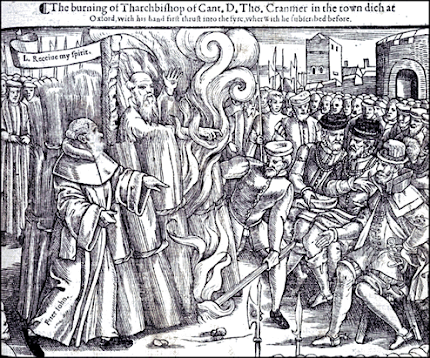
The burning of Tharchbishop of Cant. D. Tho. Cranmer in the town dich at Oxford, with his hand first thrust into the fyre, wherwith he subscribed before. [Click on the picture to see Cranmer's last words.]

Daily Bible Verse

Thursday, August 31, 2006

Calvinist and Anglican?


The majority of Calvinists appear to be either Presbyterians of different flavors or Reformed Baptists of one kind or another. It's rare to hear of an Episcopalian or an Anglican who is Calvinist, other than J.I. Packer maybe.

I've found only one explicitly Calvinist or Reformed expression of Anglicanism here in the US and that would be the Traditional Protestant Episcopal Church, which is itself a split from the Reformed Episcopal Church. I take it there is a similar church in England called the Church of England (Continuing). Both denominations reject apostolic succession but hold to a loose episcopal form of church polity and stick to a plain interpretation of the Thirty-nine Articles of Religion, which are clearly Protestant if not overtly Calvinistic. But I might add that the Articles do include a section outlining double predestination.

Anyway, I'm pleased to note that the blog readership is growing. May God grant the increase of His church through His many graces. Amen.

Addendum:  This was written several years ago.  Since that time I did more investigation.  Unfortunately my investigation produced evidence that the Traditional Protestant Episcopal Church is actually a hodge podge of Calvinism, high church Arminianism, and certain Anglo-Catholic emphases.   The use of the 1928 Book of Common Prayer rather than the 1662 BCP is problematic precisely because of the Anglo-Catholic doctrines incorporated into the prayers and services.

Furthermore, since that time the TPEC has merged with the Anglican Orthodox Church headed by Bishop Jerry Ogles.  The AOC has no doctrinal statement that nails down any doctrinal position other than the the 39 Articles of Religion.  Of course, if we follow the 39 Articles as they are plainly and logically stated that is a sufficient doctrinal statement.  But when the 39 Articles become a wax nose that can be molded to justify high church Arminianism and Anglo-Catholicism then their logical propositions are flatly denied and the truth is obscured.  Ambiguity, equivocal theology, and heterodoxy seems to be the modus operandi of the Anglican Orthodox Church. 

Charlie J. Ray, August 17, 2013

Sunday, August 27, 2006

Karl Barth and Universalism

I still find myself bothered by the comments of a seminarian from an allegedly "conservative" Southern Baptist seminary I will not name. The seminarian contended that he "had no problem with saying that Karl Barth was saved."

While the legitimacy of Barth's theological work does not necessarily depend on whether or not he was a genuine Christian--since the natural gifts given in the divine image and likeness of God in humankind gives great intellectual ability to even the non-elect--it is very significant that Barth was more than once accused of an "implicit" universalism in his theology. More importantly, Barth never denied this charge. While many accuse those of us who are concerned by Barth's theological errors of being "certain without knowledge," it is general knowledge readily available in quotes and in many secondhand sources on the internet and in theological journals that Barth indeed had universalist themes underlying his theology.

Thus, it is not a logical fallacy to come to legitimate conclusions about a theologian's work based on "common" knowledge, that is, knowledge that is generally known to be accurate. It's rather like knowing the Protestant Reformation happened in the 16th century or that John Calvin was an advocate of double predestination. One may quibble about the details, but the general facts do not change any more than gravity will disappear.

Thus, those of us who are orthodox, confessing Evangelicals within the Protestant mainstream are rationally justified in doubting Barth's salvation. Why? First off, universalism is a heresy that says that people who do not make a conscious conversion to faith in Jesus Christ as God our Savior are able to be saved regardless of whether or not they have converted to Christian faith. If this is not true, then it leads even more people who do not know Christ away from conversion and thus to hell. It follows, then, that Barth led people astray with a false sense of security when they should have been evangelized with the Gospel of Jesus Christ. This is particularly true of theological liberalism which utilized Barth's theology to shore up their own universalist and inclusivist theologies.

Thus, I have to doubt the salvation of anyone who would "have no problem" with a theologian who deliberately led people astray. Even more telling is the fact that Barth consciously and deliberately rejected the Gospel as understood by Evangelical and Protestant Christians. Barth practically mocked Evangelicalism at times. Pride goes before destruction. I wonder if Barth is so proud now? I suppose only God knows the answer to that question.

It is not popular to "earnestly contend for the faith once delivered to the saints." However, the apostles all gave their lives for the Christian faith. Jesus Christ himself died a sinner's death on the cross to atone for all our sins, even though he was an innocent man. Furthermore, Jesus said that anyone who is not willing to forsake all and follow after him is not worthy of the kingdom of God.

Those who seek intellectual prestige among godless and liberal scholars and theologians more than seeking after the truth and defending the faith have committed a form of idolatry where man's opinion takes precedence over divine revelation in Holy Scripture, which is the final authority in all theological matters. It is to exalt reason above revelation. Barth's major fallacy is to do the same despite his denials of such. Barth's theological method essentially places his own reasoning and philosophical views above the written word of God's revelation in Holy Scripture.

May we never forget that God gave us our intellect as part of the image and likeness of himself. Let us use it to glorify God and to enjoy him forever.

Glory be to the Father, and to the Son, and to the Holy Ghost; as it was in the beginning, is now, and ever shall be, world without end. Amen.

Monday, August 21, 2006

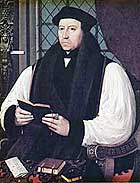
Archbishop Thomas Cranmer

I thought this would be an appropriate portrait to include in the blog since Archbishop Thomas Cranmer was the primary figure in the English Reformation. Let us never forget that he was in no wise an Anglo-Catholic and that he gave his life for the Protestant cause. Cranmer would be appalled at the current state of the Anglican communion, particularly Anglo-Catholicism, ordination of women and homosexuals, and a host of other departures from orthodoxy.

May God grant us mercy!

Sunday, August 20, 2006

Is There A True Remnant Left?

The current crisis within the worldwide Anglican communion is a terrible wound in the visible body of Christ on earth. Jesus said that wherever two or three are gathered together in His name that He would be among them. However, the situation today is such that one has to wonder if there is much of a visible church left? Not only is there a wound, but gangrene has set in and the flesh is rotting.

The essence of the Protestant Reformation has become so muddled by the charismatic/pentecostal movement, and by the church growth movement that was spawned by the charismatic/pentecostal theology as well, that today hardly anyone understands where Evangelicalism began. The five solas of the Continental and English reformation movements are almost unheard of.

This is precisely what is wrong with Anglicanism as a whole today. The Tractarian and Anglo-Catholic attack upon Evangelicalism and the Protestant side of the English Reformation practically won out such that today one will not see many Anglican provinces or dioceses that advocate the Thirty-nine Articles of Religion as the Protestant document it truly is. Instead one hears ambiguous speech about the via media, Reformed Catholicism or Reformed Anglicanism. The truth of the matter is that the English reformers were all solidly Protestant and would be appalled at the state of Anglicanism today.

In fact, where the doctrine of justification by faith alone is taught in the eleventh article and in article fourteen Christians are said to be unprofitable servants and cannot do supererogatory works, Anglo-Catholics contradict this and take a more or less Roman Catholic view. The eleventh article also cites the homily on justification as a reference to establish the doctrine in more detail. Anyone reading the homily on justification will discover that there is no emphasis on good works as meriting salvation for Christians after their initial baptism.

The homily on justification is crystal clear. The English reformers understood that justification is an "imputed" righteousness and did not have the Anglo-Catholic view of an infused righteousness. The homily also makes clear that the English reformers understood justification to be apart from good works, albeit the homily also rejects any antinomian interpretation of this doctrine. (See http://www.anglicanlibrary.org/homilies/bk1hom03.htm for a firsthand read of the homily on justification).

Furthermore, it is the opinion of most confessing Evangelical Protestants, including Lutherans, by the way, that the very heart of the Gospel message is the doctrine of justification by faith alone. Without the doctrine of an imputed righteousness there is no Gospel. Thus, one may legitimately ask whether or not a great many Evangelical and mainline churches are preaching the Gospel today? One may legitimately ask if the majority of Anglican/Episcopal churches are preaching the Gospel today? While the doctrine may exist in some official document hidden from public view, for all practical purposes the doctrine of justification by faith alone, or sola fide, is not being preached from pulpits these days.

The Alliance of Confessing Evangelicals has written an excellent response to the so-called "Gift of Salvation" document where Evangelicals and Roman Catholics have tried to reach some sort of unofficial agreement. The "Appeal To Evangelicals" response by the Alliance of Confessing Evangelicals states the central issue between Protestants and Roman Catholics:

  • Central and essential to the biblical doctrine of justification and to the Reformation doctrine of sola fide is the concept of the "imputation" of the righteousness of Christ to the believer. Historically Rome has always contended that the basis of justification is the righteousness of Christ, but it is a righteousness that is "infused" into the believer rather than being "imputed" to him. This means that the believer must cooperate with and assent to that gracious work of God, and only to the extent that Christ's righteousness "inheres" in the believer will God declare the person justified.

  • Protestants disagree, pointing to the critical difference between "infused" righteousness and "imputed" righteousness. Sola fide affirms that we are justified on the basis of Christ's righteousness for us, which is accomplished by Christ's own perfect active obedience apart from us, not on the basis of Christ's righteousness in us. Thus, the good news of the Gospel is that we do not have to wait for righteousness to be accomplished in us before God counts us justified in his sight. He declares us to be just on the basis of Christ's imputed righteousness.

  • Without the imputation of righteousness the Gospel is not good news because we can never know if we are standing before God in a justified and therefore saved state. We will have to wait for some ultimate, but by no means guaranteed, salvation. The Gospel is not good news if believers may face thousands of years in purgatory before they come at last to heaven.

From: http://www.alliancenet.org/partner/Article_Display_Page/0,,PTID307086%7CCHID560462%7CCIID1415576,00.html

It is precisely this emphasis on justification which the English reformers held. In fact, many of them, including Archbishop Thomas Cranmer, Latimer, Ridley and others gave their very lives in martyrdom. Thus, I can only conclude that the majority of Anglicans today who refuse to accept the doctrine of justification by faith alone as it is taught in the Thirty-nine Articles of Religion and in the homily on justification are not accepting the very Gospel itself. Sadly, this is also true of a great many Evangelical churches these days as well. Where the Gospel is sidelined by church growth principles and meeting "felt needs," there is no gospel. Where tradition replaces Holy Scripture and the very Gospel itself there is no Anglican church.

Is there a remnant of true believers and true churches on the earth? One prays there is. But their number is becoming less and less. If there is to be a revival of the Gospel, there must be a call to return to biblical preaching and to the Gospel as God has revealed it to us in the Holy Scriptures. May the body of Christ and the true visible church never perish from the earth. One who believes in God's sovereignty knows that it never will disappear, but at this time things look bleak indeed.

Lord have mercy!

Christ have mercy!

Lord have mercy!

Glory be to the Father, and to the Son, and to the Holy Ghost; as it was in the beginning, is now, and ever shall be, world without end.

Amen.


Tuesday, August 15, 2006

African Christianity and African Anglicanism

I'm quoting from a recent Anglican Communion News Service release here (ACNS 4175 KENYA 15 AUGUST 2006). My comments will appear below the quote:

The Bible is more than a text: it is our life

We underscore that all Christians in every place and time do have a pre-Christian past connecting them with the present. We maintain that no significant and enduring theology in the history of Christian thought has ever proceeded on the basis of a religious vacuum. What constitutes the pre-Christian preparation for the Gospel will vary in different cultural settings. We reject the early missionary and armchair anthropological conclusions of some Western scholars that African religion and philosophy had nothing significant to offer. Such skewed thoughts may explain the seeming lack of a Christian theology in Africa until recently. The Living God, as known and hallowed in many African pre-Christian indigenous traditions, is the God and Father of our Lord Jesus Christ named in many vernacular translations of the Bible. It is possible therefore, to make a case for the indigenous ancestry of African Christian experience. We recognise a valid pre-Christian preparation for the Gospel in African religious and cultural traditions. Within them, we find an authentic transmission of the Gospel in Africa and hear Christ's call to Africans. It is what Africans do with Jesus Christ that matters - that is, how Africans respond to Jesus Christ in the complexities of contemporary life and society. This is the most vital theological challenge facing African Christians and African churches today. The rest of the world will learn from the African response.

My response:

I would agree with the post here except that I would apply what is known about God in pre-Christian African religions to the concept of common grace and natural revelation. I am not sure that I would say that these "gods" are the same God and Father of Judaism and Christianity, though there are certainly elements of genuine revelation present in all religions that precede and exist alongside Christianity. However, noticing the competing truth claims rules out that these "gods" are the same God of the Bible. Islam and Christianity are incompatible for this reason and so are other competing religions, be they pre-Christian indigenous religions or whatever. This is not to say that Africans have no valid contribution to the philosophy of religions or to theology in general. On the contrary, I think a multicultural understanding of the Gospel of Jesus Christ informs all cultures which are part of the Gospel of Jesus Christ and the catholic body of Christ. This does not mean that we should compromise the essential doctrines of the faith or the catholic creeds in order to do this.

Another post from the news that I agree with:

'Prosperity gospel' is a lie

The so called 'prosperity gospel' is a misrepresentation of the Gospel and an alien import to Africa. Drawing from the example of Job, we maintain that suffering and poverty are not necessarily the result of sin, ignorance and lack of faith and that righteousness, understanding and faith do not necessarily lead to good health and prosperity. The 'Prosperity gospel' leads to a false sense of wellness, security and, ultimately, false hope. It is exploitation and often adds pain to the sufferer. In African culture, prosperity was linked to work ethic and communal co-existence.

My remarks:

This is a very concise and yet forthright statement against American pop culture and Christian Science being syncretized with the Christian Gospel. The short of it is that the modern charismatic movement has essentially committed idolatry by confusing the success of capitalism and upward mobility with the Gospel. God expects us to live and work within our calling. And as Emil Brunner has pointed out, modern secularization of the theology of calling has misled people into confusing economic success with God's blessing and God's call. Furthermore, despite American pragmatism, the health and wealth gospel, which is a false gospel, does not work universally in every culture. That speaks volumes about whether or not it is genuinely from God as we understand Him from the Holy Scriptures.

The health and wealth gospel has its roots in Christian Science and New Thought, as has been adequately demonstrated by Evangelical critics of the word of faith movement and other aberrations of the Gospel within the pentecostal/charismatic movement. I find it refreshing that Africans are wise to this deviant view of and distortion of the Gospel of Jesus Christ.

Friday, August 11, 2006

Pannenberg's Critique of Barth's Appeal to Paradox

The effects of Barth's use of neo-Kantian philosophy in developing his theology often led him to appeal to paradox. Also, according to Wolfhart Pannenberg, this is particularly true of Barth's development of christology and the two natures of Christ. "Barth's emphasis upon the 'dynamic' character of the divine-human unity in Christ does not overcome the dilemma of the orthodox doctrine of the communication of attributes; it avoids it" [ Pannenberg, GOD, JESUS AND MAN. (Philadelphia: Westminster, 1977), page 303]. Because Barth, like many of the early patristic theologians and the later Protestant theologians of the Reformation era, began with the incarnation instead of beginning with the historical Jesus and working backwards, Pannenberg believes that Barth cannot offer a satisfactory answer of how Christ can be both God and man without compromising either of the two natures. The definition of Chalcedon tried to preserve the tension between these two seemingly irreconcilable theological assertions.

The point about Barth's view of Christology, however, seems to apply to his entire theological method. According to Pannenberg, any appeal to paradox is simply avoiding the issue and avoiding any further investigation or work, which is the antithesis of what doing theology is supposed to be about in the first place:

  • "'No trespassing' signs against 'betrayal of the mystery' ... are of little help. The majority of the patristic theologians, with all respect for the mystery of the incarnation, would surely have viewed as presumptuous a demand to stop trying to think through a formulation like 'incarnation,' which after all only arose from thought about Jesus, and to let it stand as a mystery. True respect for the mystery can express itself, among other ways, just in the attempt to understand it fully. ...It (patristic theology) protected the mystery by means of antinomies and negations where the content of Christology, because of the state of the discussion at the time, could not be positively and coherently expressed without decisive abbreviations. But patristic theology was never satisfied with such a situation. It continually made new efforts to transcend the embarrassment of concrete imperfections in its understanding of that which had been laid hold of in faith. Only after the attempt to transcend these imperfections may one greet the difficulties that emerge on a new plane as a sign of the profound mystery of Jesus' reality, which in spite of the most penetrating understanding can never be so ultimately resolved that there would remain no reason for further questioning." [Pannenberg, page 303].

Thus, it seems to me that Barth's doctrine of Scripture can be criticized on the same basis that Pannenberg criticizes Barth's christology. Because Barth disregards any idea of revelation being possible in written form, he too readily appeals to mystery and individual illumination. This highly individualistic and experiential view of Scripture makes Scripture, for all practical purposes, incomprehensible. Trying to figure out what Scripture says revelationally would be more like trying to pin jello to the wall if we take Barth's understanding of Scripture literally. I'm not sure how consistent Barth's theology is on this point, since some have pointed out that the sacraments and Scripture are mere "tokens" of God's grace to us.

However, it seems to me that Barth's famous comment, "Jesus loves me this I know, for the Bible tells me so," is really inconsistent with Barth's view of Scripture. If the Bible tells us anything at all, we can't consider it to be revelation because revelation is separate and distinct from the written word itself. This disjunction between revelation and word is such that Barth's view of Scripture pragmatically amounts to mystery and that Scripture communicates practically nothing. It is merely a token of what we might think God is saying. Barth's neo-Kantian assumptions make it impossible for him to concede that the Bible is a historical document that reveals Jesus Christ to us mediately through the story of the Bible. Without the Bible we know nothing at all about Jesus Christ as an historical person or His mission or His preaching and teaching. Without Scripture we cannot develop a theological understanding of who Christ was and is and ever shall be, world without end.

The short of it is that despite the volumes of theological work Barth has done Pannenberg is right to say that Barth too easily evades issues and leaves them to mystery and paradox. Neo-orthodoxy essentially solves nothing because in the end it winds up appealing to mystery in an attempt to short circuit any critical or negative assessment of its approach to theology. As Pannenberg puts it,

  • "To retreat from the problems inescapably bound up with a particular approach with the explanation that it has to do with a mystery means the abandonment of the effort given to theology to understand critically its own statements. The situation is similar in Otto Weber's critique of the Antiochene theologians who are otherwise close to his own position: 'They could . . . . not think in paradoxes . . .' People who are prepared to refuse to continue thinking at specific points are hardly gifted in that particular art. Had the only issue been the 'paradox,' patristic Christology could have been satisfied with the formulas of Ignatius and saved itself the intellectual wear and tear of the following centuries" (Pannenberg, pp. 303-304).

Neo-orthodoxy ends up not being an answer to liberal theology or postmodernism after all, since it refuses to continue thinking about how the written word can indeed convey the very oracles of God to man and how that written word is indeed revelation and perfectly understandable propositional truth. Neo-orthodoxy winds up begging the same question Pilate asked: "What is truth?"

Barth's view isn't compatible with the doctrine of infallibility and inerrancy of Scripture. But that is not the real issue. The real issue is revelation. In fact, Barth's view of the doctrine of Scripture is an attack upon the authority of Scripture as any form of revelation from God at all. If there is no comprehensible revelation in human words, then for all practical purposes we can know nothing about God in any meaningful terms at all. To retreat from the theological doctrine of divine revelation in all aspects, including natural revelation and special revelation in Holy Scripture and Jesus Christ and to then appeal to mystery or paradox, etc., is to misinterpret the doctrine of illumination of Scripture by the Holy Spirit and to instead make it to fit with a modernist skepticism of the noumenal via neo-Kantianism and other philosophical attacks upon theology.

It is a grave mistake to think that Barth has contributed something new or different, especially when Barth hides behind mystery and paradox at every turn. Of course, at the end of the road we may eventually have to appeal to mystery. But as Pannenberg points out, it is inexcusable to appeal to mystery before we have exhausted every effort to arrive at a theological resolution of the dilemma. Furthermore, it is not wrong for churchmen and laymen to use abbreviated solutions to the dilemma since not everyone is called to be a theologian of the church. This is merely shorthand for much more complex issues. While the orthodox creeds do not solve all the dilemmas, they do nicely summarize shortened solutions that work. In this regard I find the Chicago Statement on Biblical Inerrancy and other modern statements on the doctrine of Scripture to be extremely helpful. While those Evangelicals tending toward neo-orthodoxy might vehemently and strongly disagree, I believe those of us holding down the fort should not give in to pressures to accept Barth's principles of mystery and paradox as if that were somehow really dealing with the issue at hand. No, we must continue to think hard about the doctrine of Scripture. We must never put up the 'No Trespassing' sign and say that Barth's solution is any solution at all.

Thursday, August 10, 2006

Was Karl Barth One of God's Elect?

Dear John,

Since I don't have access to Barth's writings online and since I don't have any of his works in my personal library, due to financial considerations, I am forced to utilize online resources to answer your charges. As further evidence that I am rationally justified in rejecting Barth as a genuine Christian, I would suggest that you read the following online article, written by a "non-Evangelical" scholar, by the way. The author argues convincingly for Barth's "inclusivist, universalist, and pluralistic" views on soteriology. Thus, to say that Barth is a born-again Christian despite his rejection of the binding authority of Holy Scripture is self-contradictory:

"To conclude, it has been the author’s intention to argue that in contrast to the prevailing interpretation of Barth as one of the most significant advocates of exclusivism to argue that there are ample resources within the Barthian schema to construct an inclusivist soteriology. Given the aseity of God and Barth’s rejection of modern foundationalism one is a priori committed to an inscrutable God wholly reliant on the miraculous operation of the Spirit in what may be termed a revelatory epistemology. Thus Hart, (1999: 130) can write of Barth that 'the doctrines of election and the Holy Spirit serve to underwrite something very close to a committed pluralism'. Consequently, while one may be sure of their own convictions as true it is simply not verifiable apart from a divine work. This, in turn, leads to a recognition that knowledge of God may indeed extend further than that of one particular religious grouping. Secondly, Barth’s doctrine of election, means that far from an exclusivism, concludes that all humanity regardless of creed is actually justified before God and it is only the bi-polar aspect of revelation that prevents this descending into a pluralistic universalism. Finally, the emphasis in Barth on Humanity’s gracious participation in divine life through the Trinitarian life of God opens up the possibility that, while not cognitively asserting faith in God through the reconciling work of Christ, one can still respond to special revelation through the Spirit’s omnitemporal operation."

From: http://www.quodlibet.net/gillingham-barth.shtml

I might also point out that Barth's theology is overtly connected to Kantian philosophy because of influences upon him as a student at Marburg:

"Crucial as a backdrop to Barth’s revelatory theology as it developed is the work of Immanuel Kant and especially the neo-Kantians he studied under at Marburg. For Kant the only basis for knowledge is the phenomena consequently God is not a suitable subject for epistemology relegated instead to the arena of faith (Ward, 1997: 115; Fisher, 1988: 7-122). Marrying this concept with the post-lapsarian noetic consequences, resulting in utter alienation from God, Barth was able to conclude that humanity is in an impossible predicament in that God is, humanly speaking, a thoroughly non-cognitive entity, and therefore, noumena. There is consequently no natural knowledge of God (Barth, CD1/2: 257; Hart, 2000: 42).

"The only hope for reconciliation then, is naturally impossible viz. miraculous."

The above is from: Is Barth’s Theology Necessarily Exclusivist? © Richard Gillingham in, Quodlibet Journal: Volume 5 Number 2-3, July 2003 http://www.quodlibet.net/

"While Bolich's effort to secure a fair hearing for Barth among American evangelicals is long overdue, questions must be raised about his approach and emphases. In the first place, it is misleading to claim that Barth's theology moved in an 'ever more orthodox' direction, as though he would have been satisfied to be located somewhere between the options of liberalism and bona fide orthodoxy. A fiercely independent thinker, he resisted accommodation to the unexamined assumptions of evangelicalism (never clearly spelled out here) as much as it resists other theological and political "isms."

From: http://theologytoday.ptsem.edu/jan1981/v37-4-bookreview7.htm

This second article makes it clear that Barth totally rejected any identification with Evangelicalism and judging by the implications of his theology itself, one is rationally justified in rejecting the possibility of his salvation. It seems to me that Barthian theology, if adopted by Evangelicalism, is a concession back toward a middle ground with theological liberalism and postmodernism. Instead of conceding to Kantian philosophy, as most of modern neo-orthodoxy and postmodern theology does, Evangelicals should be attempting to forge their own responses from a completely different model and philosophical presupposition. It seems to me that there are errors within the Kantian framework and inconsistencies with that worldview that Evangelicals could exploit to their advantage.

One suggested approach is the challenge issued to the materialistic assumptions of modern science by the philosophy of science work of Thomas Kuhn in, The Structure of Scientific Revolutions. Essentially, even science is not totally objective, thus this harsh dichotomy between the phenomenal and the noumenal is not as hard as previously supposed by theologians and philosophers of every flavor.

Again, if you and your "gang" would stop attacking me indirectly and interact on a more objective level, the disagreements might not have escalated to the point they did. It is rather obvious that Evangelicals have a strongly and mixed review of Barth and it shouldn't surprise you that many of us don't think he was "saved." While that might seem to be irrelevant to you, it is entirely relevant from both the point of orthodoxy and from the point of view of how "critically" we are to read Barth's works. There is no such thing as total objectivity. I prefer to err on the side of faith and orthodoxy.

"'The purpose of Bolich's book is "to show how the person and work of Karl Barth can provide inspiration and direction for a healthy renewing and reforming of evangelical theology today.' American evangelicalism is undergoing an identity crisis, and in the author's judgment Barth's theology offers resources to help resolve this crisis. This volume reviews previous evangelical responses to Barth, including negative (Van Til, Clark, Gerstner, Pinnock, Schaeffer, Montgomery) as well as positive critics (Carnell, Daane, Brown, Bloesch, Ramm, Bromiley). Aligning himself with the latter group, the author emphasizes that to listen and learn from Barth, 'it is not necessary to accept every, or even any, thought of Barth without revision or qualification.'"

From: http://theologytoday.ptsem.edu/jan1981/v37-4-bookreview7.htm.

I align myself with orthodoxy and the church and those Evangelical theologians who aren't afraid to challenge neo-orthodoxy and other aberrant views. It should be noted also that even those giving Barth's theology positive merit do not give him blanket approval nor do they make papal pronouncements of his absolution before God and Evangelicalism as though they knew for a fact whether or not he were genuinely one of God's elect.

Peace,

Charlie

Wednesday, August 09, 2006

Earnestly Contending For the Faith

Judging from recent developments in the Anglican Communion at large and the Protestant Episcopal Church U.S.A., it seems that Anglicanism is in trouble. The so-called via media between the English Reformation and Roman Catholicism, pushed so hard by the Anglo-Catholics and Tractarians of the nineteenth century, has merely opened the door for more theologically liberal Anglo-Catholics to attack the very foundations of the Christian faith.

For decades the Episcopal Church U.S.A. has been ordaining homosexual priests and, some say, even consecrating homosexual bishops. The difference was that in previous times these homosexuals were supposed to be chaste or celibate and not practicing the homosexual lifestyle. However, these days the ECUSA is openly ordaining practicing homosexuals as priests and even consecrated an openly gay bishop.

Not only this but the authority of Scripture and the belief in the supernatural is refuted openly. In a recent news article the new presiding bishop, Katharine Jefferts Schori, a controversial consecration as well, was teaching teenagers that heaven is just a place in the heart and not a real place in the hereafter (see http://www.nevadaappeal.com/article/20060807/NEWS/108070064/-1/rss02). If Christianity is merely a myth, the implication is that all gods and even the God of the Bible are simply constructs of the human imagination, an attempt to find meaning in a materialistic universe.

It is troubling that those who claim to be Christians are actually advocating a form of practical atheism where revelation is all but discounted and the supernatural is in question. If this world is all there is and there is no resurrection, the Apostle Paul says that our faith is in vain (see 1 Corinthians 15:12-19). We are of all men most miserable if our hope is merely in living a good life here on earth, especially since the majority of the Christians in the world have a meager existence and struggle just for the basic necessities of life.

But the problem with apostasy is not limited to liberal mainline denominations. Apparently, even fundamentalist charismatic preachers are leaving the fold. Bishop Carlton Pearson has in the last couple of years decided that universalism is true and that hell is only for those who consciously reject Jesus Christ. Those who are in other religions don't really need to be converted, etc., etc.

The end times are indeed upon us. Let us pray for the whole state of Christ's church!

Peace.

Neo-Evangelicalism On the Rise?

In a recent blog post at Chaos and Old Night (click on the title to go there) one of the bloggers suggested that there's nothing wrong with neo-orthodoxy per se and that universalism wouldn't keep anyone out of heaven. My own view is that Evangelicals should not be so enamored with being accepted by the larger academic world that they compromise the faith once delivered to the saints. The trouble with most Evangelical seminaries these days is that there is no commitment to the principles of the Protestant Reformation and no emphasis on classical theology. The result is that even in supposedly "conservative" seminaries there is little commitment to orthodoxy and little willingness to challenge neo-orthodoxy and liberalism headon. It's really a shame that so-called Christians are selling out to the other side.

My response to those saying that Karl Barth was a genuine Christian is posted below:

Dear John and John,

I will not apologize. I think it is you who owe me an apology. When I see a public apology posted I will do the same.

First of all, I'm completely justified in my views on Barth both rationally and biblically. If you think my theology is unorthodox, then you should demonstrate such.

Secondly, your baptist presuppositions are glaringly apparent and your ignorance of the Protestant Reformation are even more glaring. Practically no Reformer I know of would have put any individual on the same level as catholic, universally accepted doctrine that has its foundation in both the Bible and in solid orthodox tradition. In fact, many of the Reformed camp would say that creeds are as authoritative as Scripture when they are indeed faithful to Scripture. Thus, while the creeds may err, the onus is on the person who says they are in error to prove where they are in error.

Moreover, my reaction is completely justified since you have ignored the general consensus of the majority of conservative Evangelical scholars on the issue of Barth and other modern theologians. I have merely used the same sort of arguments used by Luther and Calvin who spoke in inflammatory ways to provoke thought. As Scripture puts it, all our righteousness is as filthy rags. Thus, those theologians who denigrate the conservative and classical worldview of Christianity, no matter how far they came back from the other side, are still heretical.

I would the first to admit that Pannenberg, Brunner, Barth, Bultmann, etc., et. al. borrow heavily from classical theology and at times even "sound" orthodox. This in no way justifies proclaiming that you know they are saved or that you don't "doubt" their salvation. Such arrogance is not only offensive, it's just plain wrong.

I didn't appreciate the fact that John Fraiser attacked me personally in the main body of his article on skepticism, implying somehow that I'm a blind dogmatist and that I accept what I believe uncritically. That is just plain wrong. In fact, my skepticism of the stated position on Barth's theology is what sparked this whole debate. It is I who am skeptical so the whole point of the article is rather ironic.

What does trouble me is the pretended charity when all the while your words are harsh, deprecatory and vitriolic. Your comments here in private only prove that.

I don't believe that we should throw out everything modern theology has to say because I believe in common grace and that God grants such grace even to the non-elect and that they can in some fashion use their reason to produce great works of art, science, and even theology. However, this is not to give a blanket endorsement to them as persons on their way to heaven OR their theology as a whole. Wherever Barth agrees with Scripture I agree with Barth. But the same can be said for Evangelical and classical Protestant theologians. My problem with the entire discussion is that Barth seems to be elevated beyond reasonable measure.

Additionally, I notice that you didn't answer even one of the concerns I raised nor did anyone even attempt to answer the quote from Carl Henry. You can accuse me of being ignorant, but I hardly think that charge can be applied to Van Til or Roger Nicole. Nicole's remarks about Van Til having read Barth's entire Dogmatics in German with lots of notes in the margins clearly shows that Van Til did his homework.

I may not have read huge volumes of Barth's work, but I have read some articles from Barth's work. Additionally, I've read Pannenberg's, Jesus, God and Man, several of Paul Tillich's works, and journal articles and books by Jurgen Moltmann, etc. I've read Niehbur, John Bright, etc., etc. I've also read Von Rad and Eichrodt. It's just plain silly to accuse me of not having read modern theology. I also regularly read whatever I can find by way of modern theological journals online. However, from my firsthand reading of the primary sources, I've found terrible gaffs made by renowned theologians that you so admire. Pannenberg, for example, says in Jesus, God and Man, that John Calvin advocated the satisfaction theory of the atonement. However, when reading the Institutes, III.4.27ff we find that Calvin actually advocated the penal substitutionary view of the atonement, as practically any student of Reformed theology knows offhand.

I've run across this sort of tactic many times before with the pentecostal/charismatic circles. If you don't like someone else's opinions you subtly imply they are blindly dogmatic wackos. Your comments below only confirm my original susicions about the the connotations of your remarks which were essentially concealed and implied. Why not just state what you mean plainly as you did below?

If you do not publicly apologize, I will be forced to post your comment below on my blog and to make it public. This is from one Christian to another. Perhaps my tone isn't what you're used to or what you like, but your gross misrepresentation of conservative theology calls for radical response.

Sincerely yours in Christ,

Charlie
----- Original Message -----
From: John & Annie Meade
To: Charlie Ray
Sent: Tuesday, August 08, 2006 12:11 PM
Subject: Re: Barth doesn't determine what is orthodox or univerally accepted doctrine.

Charlie, I can understand your disagreement with what I and others have said in these recent posts, but disagreement must be handled in a Christian manner. However, your tone and behaviour is really what is inexcusable with comments like these: "then Barth's own theology is just so much intellectual exercise and about as useful for toilet paper as anything else. In fact, I would love to use his handwritten version of Church Dogmatics for toilet paper." or comments like "dead wrong" and your work in the sources (Barth, Moltman or otherwise) is what has been irresponsible with comments like these:

"If we're going to accept them as "orthodox" Christians who are saved, we might as well open the door to Mormons and oneness Pentecostals and Moonies as well."

Or your most recent comment:

"I'm absolutely certain that I'm skeptical of your sincerity. Hiding behind ambiguity and pretending your opponents are blindly dogmatic is convenient but not very convincing.
I am the first to admit that faith is just that–faith. Faith can't be empirically proven or demonstrated. I suppose if your worldview is postmodern, Barth makes perfect sense. After all, the supernatural doesn't happen and there has to be some sort of alternative."

"However, selling out to existentialism and relativism isn't an option for those of us who "believe" that revelation IS possible. If you're going to accuse me of being certain my view is the correct one, then I can just as well accuse you of the same if you are "certain" that I'm wrong. It's a bit silly for relativists to accuse conservatives of being naive about believing in absolute truths and propositional truths in divine revelation when the relativist is making the same sort of absolute claim in opposing propositional truth or revelation in written form. It is a bit contradictory to appeal to the ineffable in words, don't you think?"

Charlie, the fallacies you have committed here are ineffable, but non sequitor and hasty generalization quickly come to mind. Historically, Barth is not the inventer of liberalism. He comes in at the tail end of it, trying to reclaim the Bible. We may not agree with all he says, but to argue the way you are creates more heat than light. Charlie, John and I value your input on the blog, but right now you are showing yourself to be the ignoramus you disavow yourself of. Please go back and do your homework in the sources. Show John and I and the others where we are mistaken. We invite valid criticisms of our point of view--not the rantings of orthodoxy's defender. Please consider this e-mail a rebuke from one Christian to the next. John and I wanted to handle this in a private e-mail, and not on the blog. Personally, I would like to see a public apology on the blog from you. You have completely misunderstood Fraiser's theology in all the posts if you think he leans postmodern and doubts the supernatural revelation in Scripture and Christ. Furthermore, your comments towards Richard are less than charitable. Please think and pray about this suggestion.

John

Charlie's Reponse to John's attack:

First of all, I never said Barth was "liberal." I said he was neo-orthodox. Secondly, I never said that your friend Frazier denies the supernatural. However, he has capitulated to those who DO deny the supernatural. Neo-orthodoxy redefines Scripture as "myth" precisely because it denies that the supernatural is possible because of its Kantian assumptions about reality and revelation. I consider it a grave departure from the faith to endorse views implicitly which in turn deny the faith. I can never accept Barth or his theology as orthodox in any manner other than where he agrees with Evangelical views.

Charlie

On 8/7/06, Charlie Ray <mailto:guapoduck1959@cfl.rr.com> wrote:

Quote from John Meade:

"I think we work from "materials" when we use the language of Nicea and Chalcedon. We are not appealing directly to Scripture, but we are borrowing the "grammar" of these previous theologians to present the truth today. Is it possible to think about the theology of Barth in this way? Are there aspects of his theology that we can utilise (always assuming they meet the criterion of Scripture) for our own theologizing? I think this step should be one of the most important when doing historical theology. What do you think?"

I think you are dead wrong and that you have a completely wrong understanding of how orthodox doctrine was established and how the ecumenical councils worked. First of all, most of the Reformed "confessions" of faith, including the Anglican 39 Articles of Religion, acknowledge that "creeds and council" can and do err and must constantly be checked by and against Holy Scripture. Furthermore, the creeds and ecumenical councils, particularly the first four ecumenical councils, which most of the Protestant Reformers and Protestant churches accept as valid, summarize what we believe the Bible teaches as essential doctrine. Sola Scriptura does not mean that creeds and councils are unimportant or that they do not offer to us binding doctrine. Quite the opposite is true. The creeds summarize the universally accepted essentials of the Christian faith AND what the Holy Scriptures teach on these matters as well.

ALL churches have an interpretation of Scripture and a formal creed or confession of faith merely puts it out there in writing for everyone to see. Even the non-credal churches have an "oral tradition" that summarizes their confessions of faith and credal positions. The Church of Christ, for example is non-credal but has certain doctrinal views on baptism and church membership, etc., that make it distinct from Southern Baptists.

In addition, it is a blatant and gross misunderstanding of creeds and church councils to equate the work of one modern theologian (Barth or any other idiosyncratic theologian) with the catholic or universally accepted doctrines of the Christian faith as established by representatives from regions all over the world of that time. There is a reason that Southern Baptists are trinitarian and that they use a canon of Scripture that includes 66 books, 39 OT and 27 NT. The reason is that Christianity universally accepted both of these views. The trouble with modern Evangelicalism is that it operates as if the past never happened and everything in between the NT era and today just doesn't exist.

It's been implied that I'm a blindly dogmatic ignoramus because I dared to oppose Barth's theology without spending ten years reading his works. Well, Barth may be important to today's theological dialogues and discussions. But Barth doesn't come close to establishing orthodoxy or catholic Christianity. Comparing Barth to universally accepted Christian essentials like the deity and humanity of Christ, the holy trinity, and the canon of Scripture is just inexcusable. Not only that, but it is just irresponsible.

Peace,

Charlie

Post Script

Apparently the distinction between common grace and efficacious or effectual grace isn't one recognized by more "modernist" evangelicals. Most of the Protestant Reformers and those following in that tradition would recognize that common grace works with even the unregenerate. Thus, non-Christians often produce great works of art, great scientific contributions, music, and even philosophy and theology. However, this is worlds apart from saying that neo-orthodox or liberal theologians are genuine Christians and on their way to heaven, particularly when those theologians promote univeralism and theological pluralism/relativism. It is just this sort of compromise that has led to the quandary we find ourselves in today with the issues facing mainline denominations regarding homosexuality and a denial of the authority of Scripture. Increasingly we're seeing this same sort of postmodernism creeping into Evangelicalism through the back door by way of the charismatic movement and the church growth movement. A commitment to sound doctrine and dogmatic theology seems to be unpopular and just too controversial. Anyone willing to challenge anyone else on this is just dismissed and ignored. It reminds me of the prophets of the OT who were ignored until judgment fell. May God bring a revival to our churches and to our nation. May we repent of our godlessness.

Peace.....

Charlie

Monday, August 07, 2006

Questions on Calvinism and Herman Ridderbos

Regarding your question about God's sovereignty in election, you're very correct. God before the foundation of the world and before creation elects those who will be saved by His sovereign and secret will. This is true whether you take the infralapsarian view or the supralapsarian view. This is merely a distinction between two views of God's decree to elect. One view is that in logical sequence God made the decree of election and reprobation prior to the decree to allow the fall of man (supralapsarianism). The other is the infralapsarian view, the most common view, which says that God decreed to elect after the decree to allow the fall, which is more consistent with the biblical text.

What you are neglecting to see is that according to the Bible, men are in total bondage to sin such that they are unable to come to Christ on their own. Thus, they must be regenerated or raised from the dead spiritually prior to their conversion, a special grace given to the elect to bring them to saving faith. Even repentance is a gift from God. The bondage of the will is a primary and essential doctrine of the Protestant Reformation and is held by practically all the Reformers and even by Arminians, though Arminians believe prevenient grace is given to all mankind and not just to the elect.Also, I might add that you're oversimplifying the Reformed position.

Additionally, you have neglected to note that the Westminster Standards place a heavy emphasis on human accountability and responsibility. Man is fully accountable for his rebellion against God because men willingly and freely choose to rebel against God as free moral agents. The bondage of the will does not mean that men are not free to choose what they will do but that their choices are always to react in rebellion unless they receive a divine intervention. The Arminian view does not solve this dilemma because even by the Arminian view the prevenient grace does not work in most cases. Men still refuse to accept Christ and they go on their merry way to hell. Furthermore, God would be leaving salvation up to capricious and sinful men if grace can be resisted. The real question is why grace is so ineffective in such a view since most men go to hell even by the Arminian view.

The Calvinist view is that God is just in damning all to hell. The fact that He decides to give particular grace to unworthy sinners shows He is merciful. If we got justice, then God would damn all of us and quite justifiably so. The destruction of the whole earth in the ancient flood is proof enough of this.The appointed means that God uses to awaken the elect to saving faith is the preaching of the Gospel:

Question 60

Can they who have never heard the gospel, and so know not Jesus Christ, nor believe in him, be saved by their living according to the light of nature?

Answer:

They who, having never heard the gospel, (Rom. 10:14) know not Jesus Christ, (2 Thess. 1:8–9, Eph. 2:12, John 1:10–12) and believe not in him, cannot be saved, (John 8:24, Mark 16:16) be they never so diligent to frame their lives according to the light of nature, (1 Cor. 1:20–24) or the laws of that religion which they profess; (John 4:22, Rom. 9:31–32, Phil. 3:4–9) neither is there salvation in any other, but in Christ alone, (Acts 4:12) who is the Savior only of his body the church. (Eph. 5:23)

The larger catechism : With scripture proofs. 1990 (3rd edition.). Atlanta, GA: Committee for Christian Education & Publications.

Also, God does not force the wicked to be wicked. He simply turns them over to their own depraved and corrupt nature (see Romans 1:18ff). Neither does God force the elect to be converted but He instead gives them a grace which awakens them to the truth and they freely and willing come to Him in faith after they have seen the light. Reminds me of a line in Amazing Grace: Twas grace that taught my heart to fear and grace my fears relieved. And "Was lost but now am found, was blind but now I see."

Furthermore, the Westminster Confession takes great care to distinguish the fact that God does not violate man's will even in making His decrees:

God from all eternity, did, by the most wise and holy counsel of His own will, freely, and unchangeably ordain whatsoever comes to pass: (Eph. 1:11, Rom. 11:33, Heb. 6:17, Rom. 9:15,18) YET SO, AS THEREBY NEITHER IS GOD THE AUTHOR OF SIN, (James 1:13,17, 1 John 1:5) NOR IS VIOLENCE OFFERED TO THE WILL OF THE CREATURES; nor is the liberty or contingency of second causes taken away, but rather established. (Acts 2:23, Matt. 17:12, Acts 4:27–28, John 19:11, Prov. 16:33) Chapter III, Of God's Eternal Decree, Section 1.

The Westminster confession of faith : An authentic modern version. 1985 (Rev. EPC ed.). Signal Mountain, TN: Summertown Texts.

I think if you will study the Westminster Confession in it's entirety you will see that it establishes both God's sovereignty AND man's accountability. While these seem on the surface to be contradictory, they only appear so to us from our limited human perspective. While we don't fully understand yet, we must accept what Scripture says. Since the Bible teaches both God's sovereignty in election and man's accountability to choose Christ, we must accept both as true.

Regarding Ridderbos, I'm not sure that I would agree that modern Reformed theologians are all faithful to the classical doctrines of the Protestant Reformation. Of course there are neo-orthodox theologians who claim to come from the Reformed tradition, including the American neo-orthodox theologian, Reinhold Niebuhr. I'm not that familiar with Ridderbos but judging from the article you gave in the link, he is not neo-orthodox at all but rather a conservative. There's nothing said in the article that would contradict the Chicago Statement on Biblical Inerrancy.

As far as I can tell, however, Ridderbos is an Evangelical/conservative Reformed theologian as noted here:

3. Redemptive–Historical Approaches to Scripture One final trajectory of theological reflection upon the nature and meaning of Scripture is that which focuses on redemptive history. Arising in the critical milieu of the late eighteenth and pioneered by figures such as J.P. Gabler, this approach made a distinction between the categories and methods of systematic theology and those of biblical theology, the latter being conceived as a discipline which was shaped less by synthetic categories and more by the shape of biblical history. In the nineteenth century, Geerhardus Vos of Princeton, a friend of Warfield, baptised this paradigm into a traditional evangelical framework, emphasising that the meaning of the Bible was to be found essentially in the story of Israel which culminated in Jesus Christ. Scripture was thus authoritative both because it was divinely inspired (i.e., according to its mode of delivery) and because it focused authoritatively on Jesus Christ (i.e., according to its content). This method has been fruitfully expanded and developed in the last fifty years in evangelical circles by scholars such as Herman Ridderbos, Willem VanGemeren, and Graeme Goldsworthy.

From: http://72.14.209.104/search?q=cache:IDwrw6LueAwJ:www.uccf.org.uk/yourcourse/rtsf/docs/statusofscripture.pdf+Ridderbos+on+Barth&hl=en&gl=us&ct=clnk&cd=7

I would be more than glad to answer any questions you might have about Calvinism as I have been a dedicated Calvinist since about 1996 or so.

Sincerely,

Sunday, August 06, 2006

Carl F.H. Henry Versus Karl Barth

Quote: “10. God’s revelation is rational communication conveyed in intelligible ideas and meaningful words, that is, in conceptual-verbal form.

The motif of a speaking God is found in the great world religions only in Judaism, Christianity and Islam. And the thesis that God speaks his mind intelligibly is a fundamental emphasis especially of Judeo-Christian religion. The loss of revelation as a mental concept has had devastating consequences in modern theology. To deny the rational intelligibility of divine revelation is to forego the connection between authentic faith in God and any necessary adherence to particular beliefs. When Karl Barth rejected the objective, rational-verbal character of revelation, Rudolf Bultmann and the existentialists swiftly eroded Barth’s weaker alternative of a supposedly paradoxical supernatural Word. In the Bible ‘the word of the Lord’ is an intelligible divine Word, not simply a human interpretation of the deeds of God or an existential inner response to a spiritual confrontation; in his redemptive disclosure, God often speaks BEFORE he acts. In the case of the exodus, for example, Yahweh’s explicit declaration of his purpose precedes the saving act itself. The Old Testament prophets were spokesmen of a mediated Word of God. In proclaiming ‘thus saith the Lord’ they do not exhort their hearers to enter into or to seek the same special experience of revelation that they have had. Rather the prophets declare themselves to be divinely chosen to bear to others God’s specially given message. Even Jesus of Nazareth, the climax of God’s personal manifestation, in his own teaching and practice endorses the view that revelation takes conceptual-verbal form. Not only does Jesus identify his very ‘words’ as revelation (John 14:10) but he also identifies the Word of God in terms of what ’stands written’ (Matt. 4:4, literal)."

Carl F. H. Henry in GOD, REVELATION AND AUTHORITY, Vol. II, GOD WHO SPEAKS AND SHOWS (Wheaton: Crossway Books, 1999), pp. 12-13.

Again, Evangelicals who don’t have a problem with the departure from the orthodox doctrine of Scripture open the door to existentialistic and individualistic interpretations of “revelation.” For Barth, revelation is an existential encounter or experience. For orthodox Christians, revelation is the Holy Bible in an objective form which even children can understand and be saved (2 Timothy 3:15-17). Barth’s redefinition of revelation is essentially an attack on the authority of Holy Scripture as the norm for Christian theology, doctrine, and praxis. Make no mistake about it, neo-orthodoxy is a direct attack against orthodoxy, albeit in a more subtle form. I’ve been reading the Scriptures since I was 8 years old. Even though I did not make a formal decision to become a Christian until I was 25, it was my direct encounter with God through the written Word that brought me to faith. It had absolutely nothing to do with any personal “revelation” to me from God but rather with my understanding of what God had said in His Word. This is an objective Word and not something that can be re-experienced and re-interpreted according to our existential predispositions. Either we take God at His Word or we reject it in favor of our own subjective experiences. The Holy Scriptures are the final authority in all matters of faith and practice; second to that is orthodoxy and tradition. These bases for Christian doctrine are not to be taken lightly.


Charlie

Tuesday, August 01, 2006

Barth Saved????

Below are two comments I made to John Fraiser on Chaos and Old Night Blog. https://chaosandoldnight.wordpress.com/2006/07/31/what-did-karl-barth-really-say/#comment-149 . But first I will post what John Fraiser said that upset me greatly:

John:

There is much more that I could say about Barth’s doctrine of revelation but the above critique should suffice to generate discussion. Though my evaluation of Barth has been entirely negative, there is much I appreciate about Barth. I think evangelicals have too often viewed him strictly as a foe to orthodoxy. As should be clear from what I’ve written above, I think that there is some foe in Barth, but there is a large degree of friend. Furthermore, I don’t deny or even doubt Barth’s salvation (or Dietrich Bonhoeffer’s for that matter) like many evangelicals do. I think Barth rested entirely on the work of Christ on his behalf. I do not think either his universalism, ecumenism or his doctrine of God or Scripture keeps him out of the kingdom. Christ, and Christ alone, was his righteousness.

-->


Charlie:


I strongly disagree that Barth was “saved.” He denied practically every essential of the faith there is. How you can say that he believed in justification by faith alone and all the rest of it I have no clue. You even said yourself that his doctrine of Scriptural inspiration was completely different. In addition, Bonhoeffer denied the physical and literal resurrection of Jesus Christ. I think you're being much too charitable. We might as well invite the Mormons to the ecumenical table of salvation as well if we're going allow that Barth and Bonhoeffer were sincere Christians while at the same time denying practically every essential of the faith that confessing Evangelical Protestants hold dear.

Which Christ does Barth know? The Christ of Scripture or a Christ he has imagined? If you’re going to allow Barth a place in heaven you might as well open the door to every other liberal theologian and neo-orthodox theologian that has come along. Quite frankly, the watering down of the essentials in most Evangelical seminaries is leading Evangelicalism down the path of liberalism. There are professors at Fuller and Trinity Evangelical Divinity School, as well as at Asbury who think the Bible contains “myth” and that “myth” isn’t really a dirty word. If, as you say, Barth viewed major portions of Scripture as mythological, then we might as well give up and become liberals ourselves if we’re going to concede that Scripture is really not propositional truth or that Scripture is simply fable and myth.

Barth’s view is essentially selling out to philosophies of this world which hold reason supreme. Thus, Barth’s approach is to invent and imagine a faith that doesn’t accept any propositional truth or even revelation directly revealed in the written word.

Forgive me if this sounds a bit harsh, but I think it speaks volumes about the doubts that are being propagated in most seminaries these days. If Barth’s view is correct, then Barth is himself contradicting himself. If we can say nothing meaningful about God, then Barth’s own theology is just so much intellectual exercise and about as useful for toilet paper as anything else. In fact, I would love to use his handwritten version of Church Dogmatics for toilet paper.

In the end we are all going to face God. This life is temporary. We may admire theologians but theologians are just grass in the field and they die like everyone else. Frankly, I think Bultmann was much more valuable to the church even though I doubt his salvation as well. But at least Bultmann didn’t reject natural revelation outright as Barth did.

Peace…


John:

Richard,I may not buy all the implications of Charlie’s Kantian attributions to Barth, but I don’t think anyone who sees Kantian elements in Barth is getting this from Van Til. There are quite a few Barth scholars who see Kantian elements in Barth and have not likely read Van Til. See for example, William Stacy Johnson, The Mystery of God: Karl Barth and the Postmodern Foundations of Theology, Louisville: Westminster/John Knox, 1997: 3, 69-70 and Trevor Hart, “Revelation”, Cambridge Companion to Barth, Cambridge University Press, 2000: 42. Kantian sympathies do not make Barth wrong as Charlie seems to imply. Of course, Barth did not buy into everything Kantian, in fact he rejects quite a bit. But one can make a strong case that he held to several Kantian ideas. -J Fraiser


Charlie:

Kantian sympathies do make Barth wrong. If we reject the idea that the Bible is revelation itself, then we’re basically saying that God only reveals himself to us in existential encounter, which is entirely wrong. God reveals Himself to us through the appointed means of grace which are Scripture, Jesus Christ, and the preaching of the Gospel. Of course the Reformed view is that the elect must be regenerated prior to grasping the truth of the revelation of the Bible. Many are called or invited but few are chosen. Your comments reveal to me a departure from Protestant orthdoxy if you’re suggesting that Barth came anywhere near the truth.

Barth has no clue as to who the genuine God of the Bible is since he clearly rejects the Bible. You yourself said that he is no evangelical. The last time I checked being an evangelical means being a genuine Christian who accepts the whole counsel of God and not picking and choosing which sections of the Holy Scriptures we will believe and which we will not accept. The Holy Scriptures contain everything essential to salvation and the Scriptures are perspicuous and clear enough that even a child can understand them and be saved. To obfuscate matters behind philosophical frameworks imposed on the text from modern existentialism and Kantian philosophy is to deny the faith altogether.

The derogatory reference to 5 point Calvinism is just uncalled for since there are many solid Evangelical and Protestant and classical reformed theologians who do not oversimplify or use reductionist views on the 5 points of Calvinism in response to the Remonstrants. To mention a few, I would include Berkhof, A.A. Hodge, Charles Hodge, Benjamin Warfield, etc.

Personally, I think you’re getting your “tolerant” views on Barth from your professor, which disturbs me greatly. If such compromise continues, then the future of Evangelicalism is indeed bleak.

Support Reasonable Christian Ministries with your generous donation.